Phone:
(701)814-6992
Physical address:
6296 Donnelly Plaza
Ratkeville, Bahamas.

Phone:
(701)814-6992
Physical address:
6296 Donnelly Plaza
Ratkeville, Bahamas.

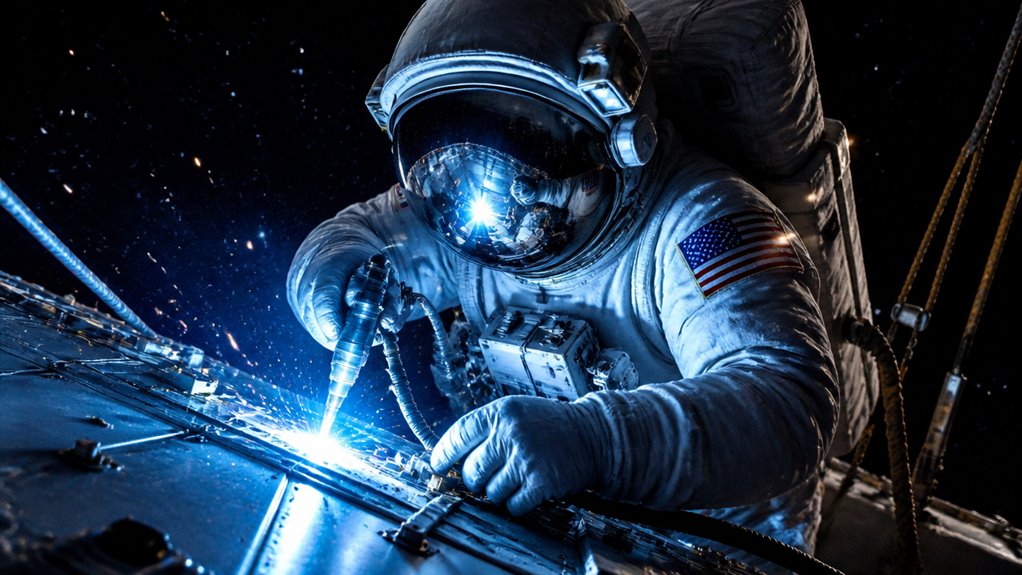
Yes, you can weld in space, but it requires specialized methods to handle vacuum and microgravity conditions that affect heat flow and molten metal stability.
Techniques like electron beam, laser, and friction stir welding are adapted for precise control and minimal contamination.
Autonomous robotic systems with real-time sensors now optimize weld quality despite thermal and environmental challenges.
Understanding space welding is essential for future on-demand repairs and large-scale construction beyond Earth, with proven technologies paving the way.

Although welding in space shares the fundamental goal of joining materials, it differs markedly from terrestrial welding due to the unique environment of vacuum and microgravity.
Welding in space challenges traditional methods due to vacuum conditions and microgravity’s effects on materials.
You’ll find that traditional arc welding faces significant challenges in space. Vacuum conditions eliminate atmospheric shielding, and microgravity disrupts molten metal behavior, complicating weld pool control and heat dissipation.
Instead, space welding often relies on beam-based methods like electron or laser beam welding. These methods function effectively in vacuum and enable precise energy delivery.
You must also consider thermal extremes and contamination risks that can degrade weld quality. Additionally, space welding demands high reliability because repair opportunities are limited, requiring autonomous and remotely controlled processes.
Ultimately, you adapt welding techniques to address altered material behaviors and environmental constraints absent on Earth. The use of an electron beam welding vacuum environment is critical to maintaining beam focus and weld integrity in space applications.
Did you know that the first space welding experiments actually took place in 1969? That’s right! Soviet cosmonauts on Soyuz-6 conducted these initial trials, which really served as a proof of concept for welding in orbit.
From that point on, the field of space welding began to evolve. Researchers started focusing on developing autonomous welding technologies. This included innovative methods like electron and laser beam welding, which are particularly effective in vacuum conditions.
Understanding how this progression unfolded is pretty fascinating. It really highlights the journey from those early manual trials to the automated processes we now consider essential for future missions. It’s exciting to think about where this technology could take us next!
For space applications, selecting welding processes that offer portability and minimal equipment is crucial due to the challenging environment.
When Soviet cosmonauts performed the first welds in orbit aboard Soyuz-6 in October 1969, they set a foundational milestone for space manufacturing and repair technologies.
These initial experiments proved that welding in microgravity and vacuum was feasible, despite challenges like molten metal behavior and thermal control.
Later, Skylab in 1973 and Salyut-7 in 1984 expanded on these tests, demonstrating arc and electron beam welding methods under space conditions.
These early trials exposed critical issues such as weld pool stability and contamination control, informing future equipment design.
These proof-of-concept welds established essential parameters for weld quality, strength, and process reliability, laying groundwork for more advanced, autonomous welding technologies in orbit and beyond.
Similar to underwater welding, maintaining precise control of heat and shielding gases is vital to ensure weld integrity in the challenging vacuum environment of space.
Building on the foundational in-orbit welds conducted during the early space missions, the focus has shifted toward developing welding systems that operate with minimal human intervention.
You’ll find that autonomous welding leverages electron and laser beam technologies well-suited to vacuum conditions. This enables precise energy delivery without atmospheric interference.
NASA and ESA have progressed from manual experiments to robotic systems incorporating advanced sensors and digital twins. This enhances weld quality and consistency under microgravity.
This shift addresses key challenges such as molten metal control and thermal fluctuations. It also improves reliability for critical repairs and construction.
As you explore autonomous welders, note their potential for lunar habitats and orbital manufacturing. This marks a pivotal evolution from proof-of-concept trials to operational in-space fabrication and maintenance essential for long-duration missions.
Additionally, plasma welding’s precise heat input control offers promising adaptability for future space applications requiring minimal distortion and high-quality joints.
Space welding faces unique hurdles because vacuum and microgravity drastically alter the behavior of molten metal and heat transfer.
In vacuum, the absence of atmospheric pressure changes the cooling rate and eliminates gas shielding, increasing oxidation risks and contamination.
Vacuum removes atmospheric pressure, altering cooling rates and eliminating gas shielding, which raises oxidation and contamination risks.
You’ll notice molten metal forms unstable pools without gravity to contain it, complicating control and leading to irregular weld bead shapes.
Microgravity also disrupts convection currents that normally help dissipate heat, causing localized overheating or insufficient fusion.
Thermal gradients become unpredictable, impacting weld integrity and repeatability.
Moreover, cold welding risks arise as clean metal surfaces in vacuum can bond without melting, presenting challenges for joint design.
These conditions demand precise energy input control and innovative process adaptations to achieve reliable, structurally sound welds in space environments.
Laser welding’s ability to deliver precise heat input with minimal heat-affected zones is critical to overcoming these challenges in space.
Understanding how vacuum and microgravity impact molten metal behavior and heat transfer sets the stage for evaluating which welding methods can perform reliably outside Earth’s atmosphere.
Electron beam welding has proven effective due to its compatibility with vacuum, offering deep penetration and precise heat control.
Laser beam welding, still under development, shows promise for autonomous in-space manufacturing with its focused energy delivery.
Friction stir welding stands out as a solid-state process, reducing molten pool instability under microgravity.
Gas tungsten arc welding, plasma arc welding, and gas metal arc welding have also been demonstrated but face challenges with plasma control and shielding gas retention.
Each method requires adaptation to manage altered heat dissipation and molten metal flow, ensuring weld integrity in space environments where traditional atmospheric conditions are absent.
Regulated Metal Deposition (RMD) offers precise microsecond control of voltage and current, which could potentially improve weld stability and reduce spatter in space welding applications.
Although cold welding might sound like an inevitable hazard when clean metal surfaces contact each other in a vacuum, it actually occurs less frequently than many assume.
Cold welding, often feared in space, happens less often than commonly believed.
Cold welding requires ultra-clean, oxide-free surfaces under sufficient pressure, conditions rarely met unintentionally in spacecraft assemblies.
In the vacuum of space, metal atoms on contacting surfaces can bond directly due to the absence of atmospheric contaminants. However, surface roughness and microscopic debris typically prevent spontaneous cold welding.
Understanding this phenomenon helps you predict material behavior during docking, mechanism operation, and structural joining.
NASA’s research emphasizes how microgravity and vacuum alter surface interactions, solidification, and mechanical properties. This knowledge informs design choices that minimize cold welding risks while optimizing weld integrity for long-duration missions and maintenance in orbit.
Unlike traditional fusion welding, friction welding achieves strong bonds without melting base materials by generating heat through mechanical friction, making it a promising technique for space applications.
NASA is pushing the boundaries of autonomous welding by integrating advanced robotics, sensor technologies, and digital modeling to guarantee reliability and precision in orbit.
You’ll find that NASA employs digital-twin simulations to predict weld outcomes under microgravity and vacuum, enabling preemptive adjustments to welding parameters.
Autonomous robotic systems execute laser and electron beam welding with real-time sensor feedback to control weld pool dynamics and thermal profiles.
This closed-loop control mitigates risks from unpredictable molten metal behavior and extreme thermal variations.
Additionally, NASA’s parabolic flight experiments validate autonomous weld sequences, confirming consistent weld quality.
By combining precision sensors, adaptive algorithms, and robotics, NASA ensures welding processes maintain structural integrity without human intervention.
This is a critical step toward sustainable spacecraft assembly and repair in challenging space environments.
Effective plasma suppression and inert gas shielding are employed to enhance beam efficiency and maintain weld quality in vacuum conditions.
Space welding opens up critical possibilities that you won’t achieve by relying solely on Earth-based manufacturing and maintenance.
For future missions, in-space welding enables on-demand repairs and reduces launch mass by allowing modular assembly. It supports the construction of habitats and infrastructure beyond Earth.
This flexibility enhances mission resilience and sustainability during long-duration lunar or Mars expeditions.
| Mission Aspect | Benefit of Space Welding |
|---|---|
| Repair & Maintenance | Immediate fixes, minimizing downtime |
| Structural Assembly | Enabling large-scale in-orbit builds |
| Resource Utilization | Leveraging local materials for manufacturing |
You rely on specialized protective gear like welding helmets with filtered visors to guard against intense light and UV radiation.
Your suit and gloves shield you from extreme heat and molten metal splatter.
You work within controlled environments or use robotic systems to minimize exposure. Additionally, you follow strict protocols to manage fumes, prevent contamination, and guarantee electrical safety.
You maintain communication with ground control for real-time support and emergency response.
You power welding equipment in space primarily through spacecraft electrical systems, which convert solar energy collected by panels into usable electrical power.
Battery systems also store and supply energy during welding operations.
Electron beam and laser welding methods rely on high-voltage, stable power sources integrated into the spacecraft.
You must guarantee power delivery is reliable and insulated against electromagnetic interference to maintain consistent weld quality in the challenging space environment.
Yes, welding in space can repair micrometeoroid damage, but it’s far from simple.
You face microgravity and vacuum challenges that alter molten metal flow and heat control.
Electron beam or laser welding methods work best, offering strong, reliable joints comparable to Earth welds.
With precise control and autonomous systems, you can restore structural integrity in spacecraft.
This is vital for long missions where in-situ repair outperforms risky replacements or patching.
You’ll receive specialized training focused on welding techniques suited for space conditions, including electron beam and laser welding.
Your program emphasizes handling microgravity effects, vacuum challenges, and thermal control.
You’ll practice using simulators and mockups to master remote or autonomous welding tools.
Safety protocols and contamination prevention are critical components.
This technical preparation guarantees you can perform precise, reliable welds during spacecraft assembly or repair missions.
In a vacuum environment, welding fumes don’t disperse as they do on Earth because there’s no atmosphere to carry them away.
Instead, the fumes form tiny particles that can float near the weld site, potentially contaminating equipment or surfaces.
You need specialized containment and filtration to manage this.
Without proper control, these particles may interfere with weld quality or pose hazards in confined spacecraft environments.
Thus, precise fume extraction is critical.
You might think welding in space is just like on Earth, but the vacuum and microgravity create unique challenges that demand innovative solutions.
While terrestrial welding relies on gravity and atmosphere, space welding pushes materials to behave differently. This requires advanced methods and autonomous technology.
Understanding these contrasts is vital because mastering space welding isn’t just a technical feat. It’s essential for building the future of off-world exploration and long-term missions beyond our planet.