Phone:
(701)814-6992
Physical address:
6296 Donnelly Plaza
Ratkeville, Bahamas.

Phone:
(701)814-6992
Physical address:
6296 Donnelly Plaza
Ratkeville, Bahamas.

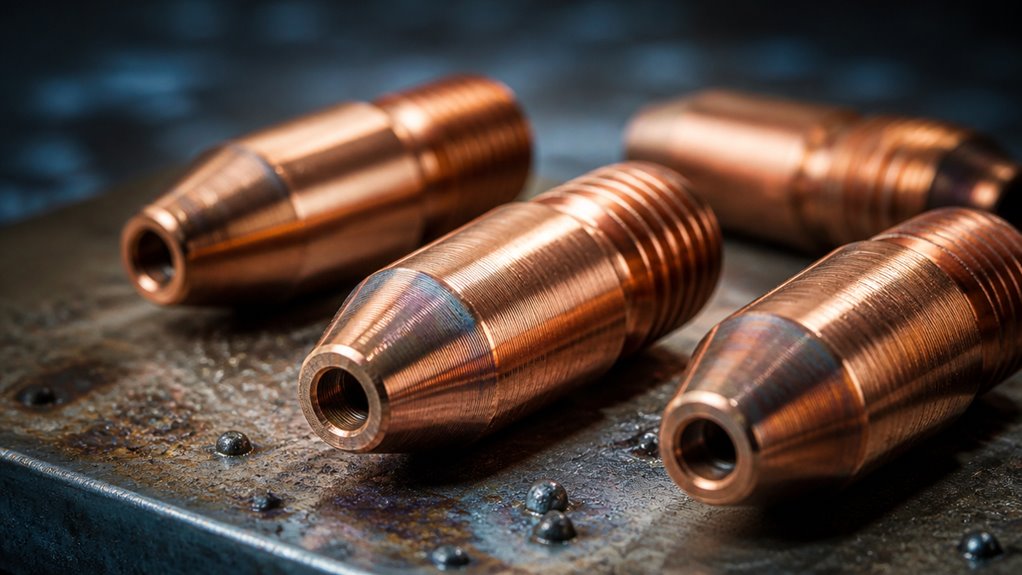
You rely on MIG welder contact tips to guarantee stable electrical current and precise wire guidance. These factors directly affect arc stability and weld quality.
Matching your tip’s bore size to your wire diameter and welder brand prevents burnbacks, erratic feeding, and premature wear.
Regularly inspect for deformation, spatter buildup, or inconsistent wire feed to avoid weld defects.
Proper tip maintenance and exact sizing keep your welds consistent. Exploring these factors further will boost your welding performance.
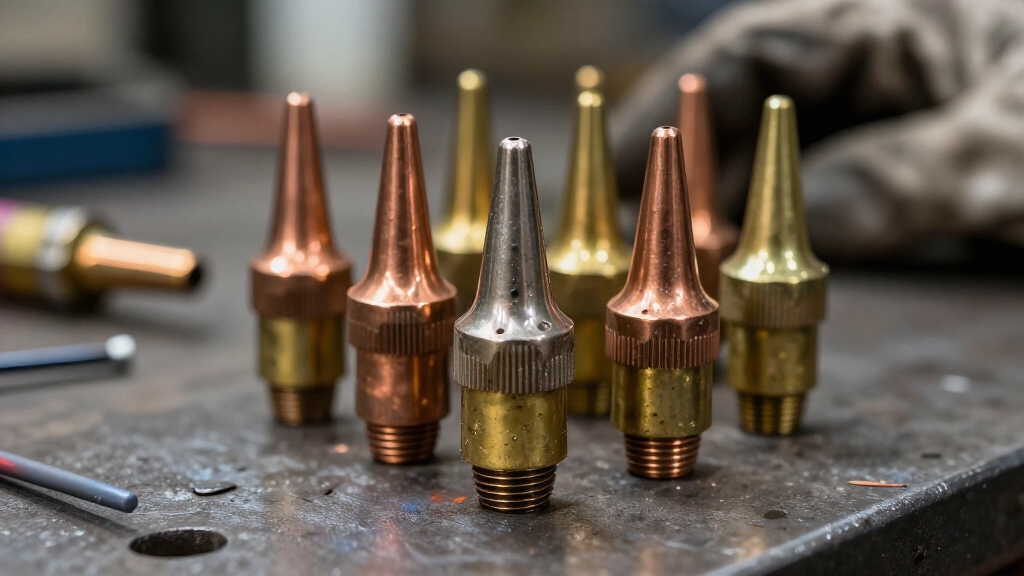
Although often overlooked, MIG welder contact tips play a critical role in ensuring stable electrical current transfer to the welding wire. This directly impacts arc stability and weld quality.
You rely on contact tips to guide the wire precisely through their bore, maintaining consistent electrical contact. If the tip’s bore deforms or wears unevenly, wire feeding becomes erratic, causing arc fluctuations and compromised weld integrity.
Proper current transfer minimizes micro-arcing and supports a stable arc, essential for uniform penetration and bead appearance. Neglecting tip condition leads to frequent burnbacks and inconsistent wire feed speed, directly affecting your weld’s mechanical properties.
Understanding this critical interface helps you maintain efficient welding performance and reduces downtime caused by poor arc behavior or tip failure. Regular inspection and cleaning of contact tips to remove spatter buildup is essential to prevent welding defects and ensure arc stability.
When selecting contact tips, you must match both the wire diameter and your welder brand to guarantee peak performance. Using a tip sized incorrectly or incompatible with your torch can cause unstable arcs, erratic wire feeding, and premature wear.
Each welder brand, such as Miller, Lincoln, and Tweco, has specific thread types and seat designs requiring brand-specific tips. Equally critical is matching the tip’s bore diameter exactly to the wire size to maintain consistent current transfer and smooth wire travel.
| Welder Brand | Wire Size (inches) |
|---|---|
| Miller | 0.023, 0.030, 0.035 |
| Lincoln | 0.030, 0.035, 0.045 |
| Tweco | 0.023, 0.030 |
| Binzel | 0.035, 0.045 |
| Generic | 0.023 – 0.045 |
Proper matching optimizes weld quality and tip longevity. Ensuring a correct tip sizing prevents common performance problems like micro-arcing and wire jams, contributing to consistent arc stability.
How do you determine the correct contact tip size for your welding wire? The key is matching the tip bore diameter precisely to your wire size for peak electrical contact and smooth feeding. Follow these steps:
Regularly inspecting tips for wear and spatter buildup helps maintain arc quality and consistent welding performance.
Matching your contact tip size to your wire guarantees smooth feeding and stable arc performance. However, even correctly sized tips wear over time and affect weld quality.
Watch for signs like an oval or egg-shaped bore instead of a perfect round. This deformation disrupts wire guidance and current transfer.
You might notice inconsistent wire feeding, increased burnback, or micro-arcing. These all indicate electrical instability caused by tip degradation.
Exterior melting or spatter buildup signals advanced wear that compromises arc consistency. If you detect loose fitment when tightening the tip or experience sudden arc fluctuations, inspect the tip immediately.
Addressing these issues promptly prevents poor welds and equipment damage. Regularly monitoring bore shape, wire fit, and feeding behavior helps you identify when maintenance or replacement is essential for peak welding performance.
Frequent light cleaning with the proper tip cleaner size is crucial to extend the life of your contact tips and maintain consistent weld quality.
Regularly maintaining your contact tips markedly prolongs their lifespan and guarantees consistent weld quality. To optimize tip performance and reduce wear, focus on these key practices:
Consistent maintenance of contact tips extends their life and ensures reliable, high-quality welds.
Additionally, maintaining the proper stickout length helps avoid excessive heat and arc instability that can accelerate contact tip wear.
Yes, you can customize contact tips for non-standard wire diameters, but it requires precision.
You’ll need tips with bores sized exactly to your wire diameter to guarantee smooth feeding and stable current transfer.
Keep in mind that oversized or undersized tips can cause feeding issues or arc instability.
Custom tips must also match your gun’s thread, length, and seat specifications.
Proper fit and finish are critical to maintain weld quality and prevent premature wear.
Humidity can accelerate corrosion and oxidation on the contact tip’s surface, degrading electrical conductivity and causing unstable arc performance.
You’ll notice increased resistance, leading to inconsistent current transfer and potential micro-arcing.
Moisture can also promote contamination buildup inside the bore, disrupting smooth wire feeding.
To maintain peak performance, you should store tips in a dry environment and inspect them regularly for signs of corrosion or wear caused by humidity exposure.
Yes, you can find environmentally friendly contact tips made from recycled copper or copper alloys, reducing raw material extraction.
Some manufacturers use lead-free, RoHS-compliant materials to minimize toxic elements.
While these eco-conscious tips maintain electrical conductivity and wear resistance, you should verify their compatibility with your welding setup.
Opting for longer-lasting, recyclable tips also helps reduce waste, supporting sustainability without sacrificing performance or durability in demanding welding applications.
Like the hum of a finely tuned engine, your welding noise level can be subtly influenced by contact tips. If a tip wears down or mismatches wire size, it can cause irregular arc stability and micro-arcing, which increase noise.
You’ll notice smoother, quieter operation with a properly sized, well-maintained tip. This guarantees stable current transfer and consistent wire feeding, minimizing the harsh sounds that disrupt your welding rhythm.
When changing contact tips, you should first disconnect power to avoid electric shock.
Let the gun cool down to prevent burns, and wear heat-resistant gloves and safety glasses.
Use proper tools to remove and tighten tips, guaranteeing they’re fully seated to maintain electrical contact.
Inspect the tip and wire feed for damage or wear before reinstalling.
Always follow your welding equipment’s manufacturer guidelines to guarantee safe, reliable operation.
Now that you understand how vital the right contact tip is for your MIG welder, ask yourself: are you truly optimizing your welding performance?
Using mismatched or worn tips can silently sabotage your work quality and efficiency.
Don’t wait until inconsistent arcs or excessive spatter force you to fix avoidable problems.
Stay ahead by choosing the precise size, matching your wire, and maintaining your tips regularly.
The difference might be subtle, but it’s absolutely transformative.
[…] maintenance and precise size selection help prevent micro-arcing and ensure consistent welding […]