Phone:
(701)814-6992
Physical address:
6296 Donnelly Plaza
Ratkeville, Bahamas.

Phone:
(701)814-6992
Physical address:
6296 Donnelly Plaza
Ratkeville, Bahamas.

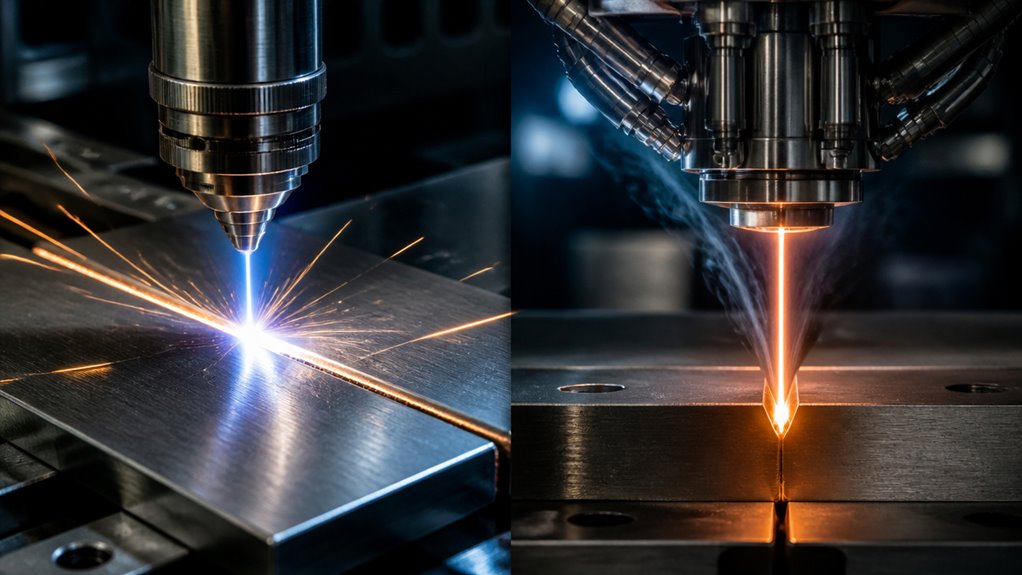
You’ll find Laser Beam Welding (LBW) uses a focused light beam in atmospheric or inert gas environments. This allows quick setup and versatility with various materials.
Electron Beam Welding (EBW) directs an electron stream in vacuum. It offers deeper penetration, superior weld integrity, and excellent control for reactive metals but requires complex, costly vacuum infrastructure.
LBW excels in precision on thinner parts, while EBW suits heavy sections needing deep, narrow welds. Understanding these trade-offs sharpens your selection for specific applications and materials.
| Feature | Laser Beam Welding (LBW) | Electron Beam Welding (EBW) |
|---|---|---|
| Energy Source | Focused laser light beam | High-velocity electron stream |
| Operating Environment | Atmosphere or inert gas | High vacuum |
| Setup Complexity | Lower | Higher |
| Vacuum Requirement | Not required | Required |
| Part Size Flexibility | Suitable for larger parts | Limited by vacuum chamber |
| Penetration Depth | Shallow to moderate | Very deep |
| Weld Profile | Narrow, precise welds | Narrow, deep welds |
| Heat-Affected Zone | Small | Minimal |
| Thermal Distortion | Low | Very low |
| Weld Quality | Excellent precision and control | Superior weld integrity |
| Material Compatibility | Versatile; suitable for various materials | Excellent for weldable and reactive metals |
| Reactive Metals | Requires careful shielding | Excellent due to vacuum environment |
| Dissimilar Metals | Can handle some combinations | Effective due to narrow heat-affected zone |
| Production Speed | Faster setup and cycle times | Longer due to vacuum pump-down |
| Cost | Generally lower | Higher upfront and operating costs |
| Equipment | Laser, optics/fiber delivery, shielding systems | Vacuum chamber, electron gun, pumps, focusing system |
| Operator Skill | Lower complexity | Higher specialized skill required |
| Best Applications | Thin to moderate materials, large parts, precision production | Thick sections, reactive metals, deep-penetration applications |
| Main Advantage | Flexible, fast, precise welding without vacuum | Exceptional penetration, weld integrity, and contamination control |
| Main Drawback | Generally less penetration than EBW | Expensive, complex, and size-limited by vacuum equipment |
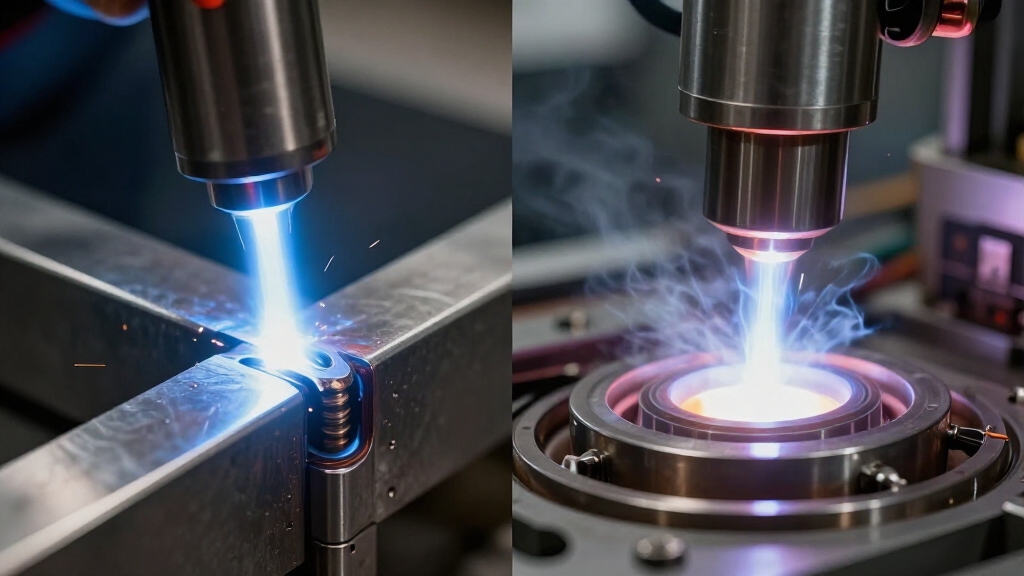
Both laser beam welding (LBW) and electron beam welding (EBW) use concentrated energy sources to join metals, but they operate on fundamentally different principles.
LBW directs a focused coherent light beam, delivered via lenses or fiber optics. This enables flexible beam positioning and adaptability to various part sizes.
In contrast, EBW generates a high-velocity electron stream, focused magnetically within a vacuum chamber. It converts electron kinetic energy into localized heat upon impact.
Both methods achieve high energy density, producing narrow, deep welds with minimal heat-affected zones. This reduces distortion.
You’ll find LBW’s optical delivery ideal for varied setups. EBW’s vacuum environment and electron kinetic heating enable deeper penetration and contamination control.
Understanding these core distinctions helps you select the appropriate welding process based on material and design needs.
Effective plasma suppression and shielding in LBW are essential to maintain beam efficiency and weld quality.
Choosing between laser beam welding (LBW) and electron beam welding (EBW) involves considering their distinct operating environments and setup requirements.
LBW operates in open atmosphere with optional inert gas shielding, offering flexible integration and faster setup.
EBW requires a vacuum chamber, which restricts workpiece size and extends cycle time due to pump-down.
This vacuum environment benefits contamination-sensitive applications but demands complex infrastructure.
Your choice depends on part size, contamination control, and production speed.
The concept of a shielding environment plays a critical role in both methods, influencing weld quality and process stability.
| Aspect | LBW | EBW |
|---|---|---|
| Operating Environment | Atmosphere or inert gas | High vacuum chamber |
| Setup Complexity | Low, no vacuum needed | High, vacuum pump-down required |
| Part Size Limit | Large, flexible | Limited by chamber dimensions |
| Contamination Risk | Moderate, controlled via gas | Minimal, vacuum protects weld |
| Cycle Time | Faster setup and welding | Longer due to evacuation time |
When selecting a welding method, you need to take into account material compatibility carefully. Laser beam welding (LBW) and electron beam welding (EBW) each excel with different metals and conditions.
LBW is versatile, welding many metals and some dissimilar combinations. It can also handle magnetic and non-metallic materials where EBW falls short.
EBW, on the other hand, handles all weldable metals and excels with reactive metals due to its vacuum environment, which minimizes oxidation.
Key points on material compatibility:
Additionally, EBW achieves deep penetration with minimal distortion by creating a narrow deep keyhole, enabling strong, precise welds in challenging materials.
Understanding these distinctions helps you choose the most suitable welding process for your materials.
Although laser beam welding (LBW) and electron beam welding (EBW) both deliver high-energy-density heat sources, they differ markedly in penetration depth and weld quality.
EBW typically achieves significantly deeper welds, often exceeding 1/2 inch in thick materials, due to the focused kinetic energy of electrons impacting the workpiece.
This results in narrow, deep welds with minimal heat-affected zones and low distortion, ideal for heavy-section applications.
In contrast, LBW excels in precision, producing strong, narrow welds on thin to moderate thicknesses with excellent control over weld geometry.
While LBW’s welds maintain good quality and reduced thermal distortion, they generally offer shallower penetration than EBW.
Laser welding’s low heat input reduces thermal distortion and preserves base metal properties, making it ideal for thin to medium materials.
Your choice depends on the thickness and complexity of the material.
EBW guarantees superior depth and weld integrity, whereas LBW provides versatility and fine weld control.
Because electron beam welding (EBW) requires a vacuum chamber and specialized equipment, it typically incurs higher upfront and operational costs compared to laser beam welding (LBW). LBW operates in atmospheric conditions and allows for faster setup.
EBW offers superior power efficiency and deeper penetration but at the expense of longer cycle times due to vacuum pump-down. LBW suits larger parts and faster production environments with lower capital complexity.
When selecting between EBW and LBW, consider these key criteria:
Evaluate these factors against your application’s cost constraints and performance needs to choose the best welding process. Additionally, understanding the heat-affected zone differences between these methods can help optimize joint quality and preserve base material properties.
You’ll need stricter containment with EBW due to the vacuum chamber and high-energy electron stream. This requires radiation shielding and careful vacuum integrity checks.
With LBW, protect against intense laser radiation by using proper eyewear and barriers, but you won’t deal with vacuum hazards.
Both require ventilation for fumes, but LBW’s open atmosphere setup demands more attention to airborne particles.
You’ll need to regularly clean and align LBW optics, check fiber optic cables for damage, and make sure cooling systems function properly.
For EBW, maintain vacuum pumps and seals, inspect electron guns, and monitor magnetic focusing coils.
Both require periodic calibration of power supplies and safety interlocks. Neglecting these tasks can reduce weld quality and equipment lifespan.
Schedule preventative maintenance based on usage intensity and manufacturer guidelines to avoid costly downtime.
Imagine harnessing lightning and fire in tandem; that’s what hybrid welding does by combining LBW and EBW.
You can integrate these processes to exploit LBW’s flexibility and EBW’s deep penetration, achieving welds impossible individually.
However, you must carefully synchronize beam delivery, vacuum conditions, and power settings to avoid interference.
While technically complex, hybrid welding can enhance precision and strength, especially in challenging materials or geometries.
You’ll find key defects unique to LBW include porosity from improper shielding gas or contamination and keyhole instability causing spatter or undercut.
For EBW, vacuum-related issues like beam deflection or electron scattering can create uneven penetration or porosity.
Also, EBW may suffer from cracking due to rapid cooling in thick sections.
Recognizing these defects helps you optimize parameters and maintain weld integrity specific to each process’s constraints.
You’ll find EBW demands higher operator skill due to vacuum system management, precise beam alignment, and strict process control.
LBW operators face less complexity, focusing on optics and shielding gas control, making setup and adjustments quicker.
While both require metallurgical understanding, EBW’s chamber and electron beam parameters add layers of technical challenge.
You’ll need more specialized training to maintain consistent quality and troubleshoot effectively in EBW compared to LBW.
When choosing between laser beam welding and electron beam welding, you’ll find both excel in precision and penetration but differ in environment and cost.
Coincidentally, your material and application needs often dictate the ideal method. Vacuum conditions favor EBW, while LBW thrives in open settings.
By analyzing your project’s speed, efficiency, and quality demands, you can confidently select the technique that optimizes performance without compromise.