Phone:
(701)814-6992
Physical address:
6296 Donnelly Plaza
Ratkeville, Bahamas.

Phone:
(701)814-6992
Physical address:
6296 Donnelly Plaza
Ratkeville, Bahamas.

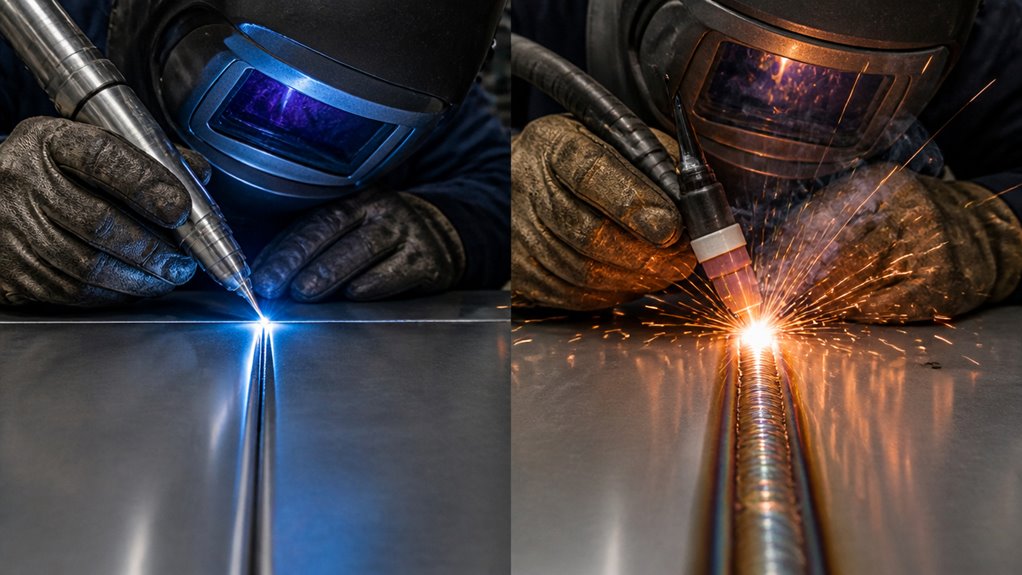
If you need fast, precise welds with minimal heat distortion on thin to medium metals, laser welding is your best bet. It operates up to ten times faster than TIG.
It excels in automated, high-volume settings but demands tight fit-up and safety controls. TIG welding offers superior manual control and better gap tolerance.
It works well on thicker, complex joints with wider heat zones. Understanding each method’s trade-offs helps you optimize weld quality and efficiency for your projects.
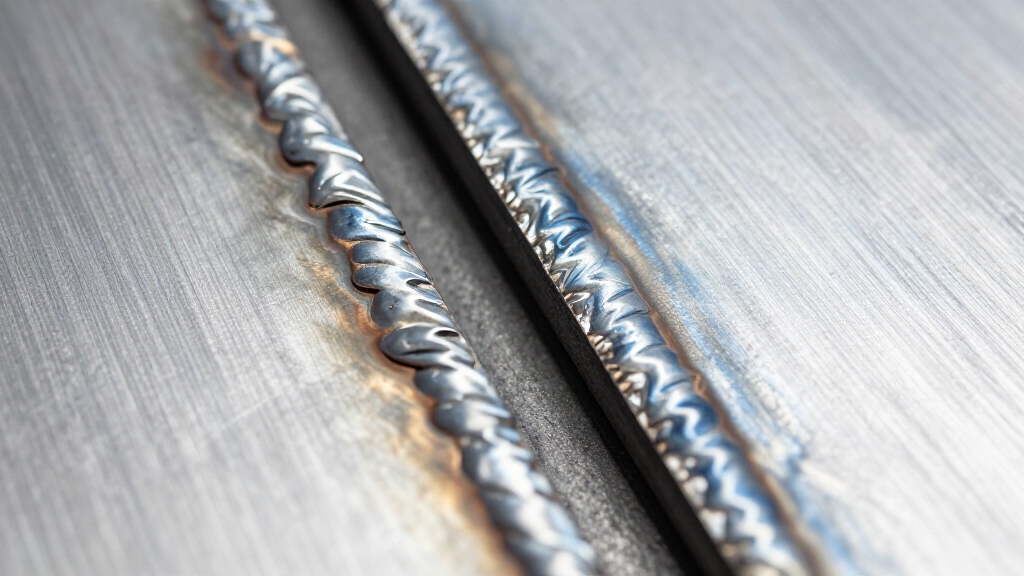
While both laser and TIG welding generate heat to join metals, laser welding delivers markedly lower heat input. This reduces the heat-affected zone and minimizes distortion, especially on thin parts.
You’ll find laser welding introduces roughly half the heat into 18-gauge carbon steel compared to TIG. This lower heat input translates into less thermal expansion and contraction, preserving dimensional accuracy and reducing warping risks.
Laser welding delivers about half the heat of TIG, reducing thermal distortion and preserving accuracy in 18-gauge steel.
Conversely, TIG welding’s wider heat-affected zone creates greater thermal stress, increasing the chance of distortion on thin sheet metal. However, TIG’s higher heat input allows for larger molten pools and better gap tolerance, which can be advantageous in some applications.
When precision and minimal distortion are priorities, laser welding’s controlled heat input gives you tighter dimensional control in precision assemblies. Additionally, the narrow HAZ of laser welding preserves the mechanical properties of the base metal, further enhancing weld quality and durability.
You’ll find that laser welding operates significantly faster than TIG welding—often achieving speeds that are 3 to 10 times higher! The exact speed can depend on factors like material thickness and geometry, but the difference is pretty striking.
This speed advantage really shines in high-volume production environments where cycle time can make a huge impact on overall throughput.
Plus, laser welding works seamlessly with automated systems. This compatibility not only enhances consistency but also boosts productivity in precision manufacturing.
Additionally, laser welding benefits from precise beam focus that enables deep penetration with minimal distortion, ensuring high-quality welds even at high speeds.
Because laser welding operates at markedly higher speeds than TIG welding, it offers substantial productivity advantages in sheet-metal applications.
You’ll find laser welding typically runs three to ten times faster, depending on material thickness and joint geometry.
For example, welding a 1mm stainless steel tube with a 200mm seam can take TIG 4–5 minutes, while laser finishes under 1 minute.
This speed gain results from laser’s concentrated energy and higher travel velocities, enabling rapid fusion with minimal heat input.
Consequently, you can increase throughput dramatically without compromising weld quality.
However, to capitalize on these speeds, you must maintain tight fit-up tolerances and consistent part alignment.
In contrast, TIG’s slower pace limits productivity but allows greater gap tolerance and manual control, making it less suitable when speed is critical.
Effective beam oscillation patterns and sensor feedback also help maintain weld consistency at these high speeds.
Maximizing throughput in high-volume production demands welding methods that combine speed with consistent quality. Laser welding fits this profile exceptionally well.
You’ll find laser welding offers significant speed advantages, enabling rapid cycle times without sacrificing precision. This efficiency translates directly into higher output and reduced labor costs.
Consider these key productivity benefits:
Additionally, plasma welding provides deeper penetration and higher welding speeds compared to conventional TIG, offering another advanced option for production where precision and efficiency are critical.
When integrating automation into welding processes, laser welding delivers unmatched speed and consistency that directly enhance productivity.
You’ll benefit from welding speeds typically 3 to 10 times faster than TIG, drastically reducing cycle times in high-volume production.
The laser’s precise energy delivery and narrow heat-affected zone minimize distortion, supporting dimensional accuracy without compromising throughput.
Automated laser systems maintain repeatable weld quality with minimal operator intervention, increasing uptime and reducing rework.
Although laser welding demands tight fit-up tolerance, its rapid travel speed and compatibility with robotic handling make it ideal for streamlined workflows.
Compared to TIG, which requires slower, manual operation, laser welding’s automation integration leads to significant gains in efficiency.
This enables you to meet stringent production targets while maintaining superior weld integrity.
Proper shielding gas use during laser welding further enhances weld quality by preventing oxidation and porosity, which is critical for automated, high-speed processes requiring consistent results and minimal defects in industrial applications.
Achieving high precision and consistent weld quality demands a clear understanding of the strengths each welding method offers.
Laser welding excels with its high energy density and precise beam focus, delivering narrow, consistent welds ideal for automated, aesthetic parts.
TIG welding, by contrast, provides superior manual control, valuable for intricate or custom work where operator skill impacts quality directly.
Consider these key points:
Additionally, laser welding’s use of pulsed laser modes can minimize thermal distortion and improve weld quality for thin or delicate parts.
You’ll choose based on precision needs and production context.
Understanding fit-up tolerance is key to selecting the right welding method for your project.
Laser welding demands tight fit-up and precise alignment because its focused beam requires minimal joint variation to maintain weld integrity and consistency.
If gaps or misalignments exceed tolerance, laser welds risk incomplete fusion or defects.
In contrast, TIG welding tolerates wider gaps and less accurate fit-up due to its ability to manually control the arc and add filler metal, bridging irregular joints effectively.
This makes TIG more forgiving during fabrication variances or repair work.
Consequently, when your project involves high-volume, precision parts with consistent geometry, laser welding’s strict fit-up tolerance guarantees repeatable quality.
For less exact assemblies or field repairs, TIG’s broader fit-up acceptance offers practical flexibility without compromising strength.
Proper control of heat input is essential in both methods to ensure optimal weld pool formation and minimize defects.
Although both laser and TIG welding serve distinct roles across various thicknesses, your choice depends heavily on the material gauge and joint complexity. Laser welding excels on thin to medium-thickness materials, typically up to 8 mm (5/16 inch), providing low heat input and minimal distortion.
TIG welding suits thicker sections and multipass joints, offering better gap bridging and repair versatility.
Consider these factors:
Choose based on thickness and joint demands for optimal outcomes. Additionally, TIG welding can benefit from AC/DC welding versatility to optimize penetration and arc stability across different metals and positions.
When comparing laser and TIG welding, you’ll find distinct differences in upfront costs, required skill levels, and safety protocols.
Laser welding demands markedly higher initial investment due to complex equipment and controlled environments. TIG machines are more affordable and accessible for small shops.
Skill acquisition differs: TIG welding requires extensive manual dexterity and experience for critical tasks. Laser welding’s handheld systems are quicker to learn but involve strict laser safety training.
Safety also diverges. Laser welding operates as a Class 4 hazard, necessitating specialized eyewear and controlled areas to mitigate exposure risks. In contrast, TIG welding uses conventional arc-welding PPE with simpler safety measures.
Understanding these factors helps you assess operational budgets, workforce training, and workplace safety when selecting the most suitable welding method. Additionally, unlike fusion welding, friction welding is a solid-state joining process that requires no filler metal, flux, or shielding gas, highlighting alternative welding technologies.
You’ll find that laser welding’s lower heat input results in a narrower heat-affected zone and less thermal distortion, preserving finer microstructural features.
This rapid cooling often leads to a finer grain size and reduced segregation compared to TIG welding.
In contrast, TIG’s higher heat input produces a wider heat-affected zone and coarser grains, potentially altering mechanical properties.
Yes, you can combine laser welding with TIG welding in hybrid processes to leverage their strengths.
The laser provides precise, high-speed fusion with low heat input. TIG adds filler material and gap-bridging capability.
This approach enhances joint quality and dimensional control, especially on challenging geometries or thicker sections.
However, integrating both requires careful synchronization of parameters and equipment to maintain weld consistency and ensure proper microstructure development.
Wondering which welding method leaves a smaller environmental footprint?
Laser welding uses markedly less heat, cutting energy consumption and reducing waste from distortion and rework.
Its higher speed means less electricity per part, lowering emissions.
TIG welding, with higher heat input and slower speed, consumes more energy and produces more fumes.
You’ll find laser welding produces markedly less noise and fewer fumes than TIG welding. Its focused, high-energy beam minimizes spatter and vaporized material, resulting in a cleaner process.
TIG welding, relying on an electric arc and filler metals, generates more audible noise and visible fumes, requiring stronger ventilation.
If you prioritize a quieter workspace with reduced fume exposure, laser welding offers clear advantages, especially in automated or high-volume environments.
Precision parts production prefers laser welding, prized for its speed and consistent seams, especially in automotive and aerospace sectors.
You’ll find TIG welding thriving in traditional trades like pipefitting, shipbuilding, and repair shops, where its forgiving nature handles thicker metals and irregular joints.
When you demand fast, flawless fabrication, laser leads; for flexible, fine-tuned finishing, TIG takes the trophy.
Your industry choice hinges on material, volume, and dimensional demands.
When comparing laser and TIG welding, you’ll find laser welding offers faster speed and lower distortion, enhancing productivity and precision, especially on thinner materials.
However, TIG welding’s broader fit-up tolerance and versatility make it reliable for thicker sections and complex joints.
Understanding these trade-offs helps you choose the right method, debunking the myth that one technique universally outperforms the other.
Your selection depends on specific project needs, balancing cost, skill, and material considerations.