Phone:
(701)814-6992
Physical address:
6296 Donnelly Plaza
Ratkeville, Bahamas.

Phone:
(701)814-6992
Physical address:
6296 Donnelly Plaza
Ratkeville, Bahamas.

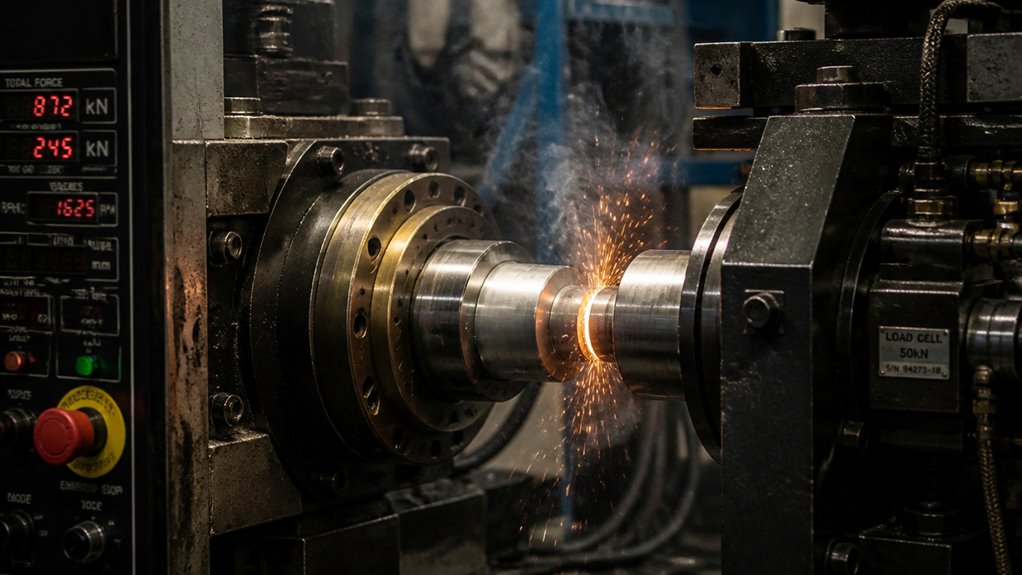
You’ll find friction welding machines excel at joining axisymmetric parts without melting. However, they face limits in material compatibility; brittle or coated metals resist proper bonding.
Geometry constraints require uniform circular sections and rigid fixturing to avoid misalignment and defects. Machine capacity restricts maximum part size and cycle speed, while operational precision governs plastic deformation quality.
Speed boosts productivity but risks overheating. Understanding these trade-offs clarifies friction welding’s capabilities and where challenges emerge in scaling and quality control.
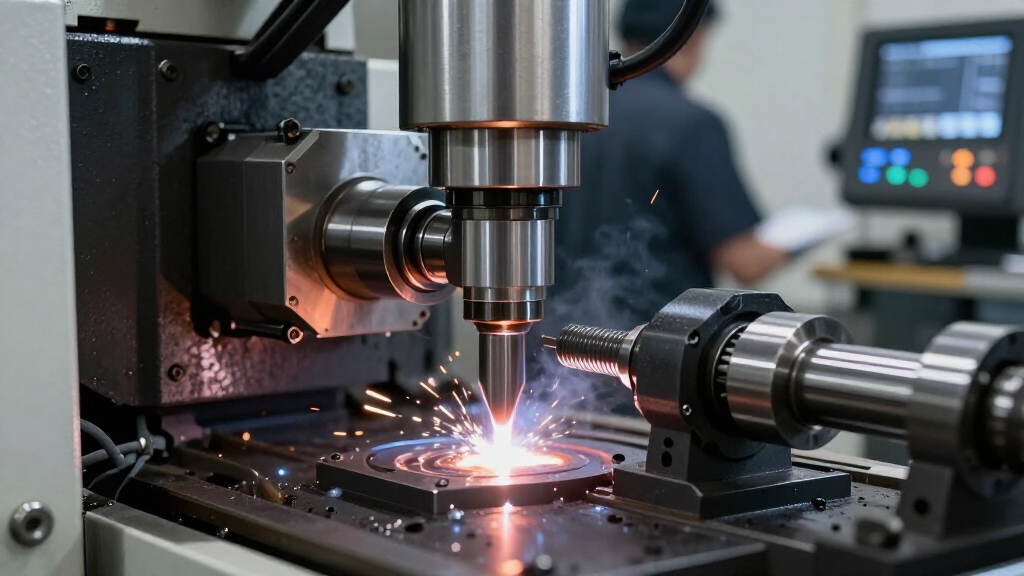
Friction welding machines deliver solid-state joining by generating heat through mechanical friction. This allows you to bond metals without bulk melting.
You achieve high-strength, defect-resistant joints by avoiding fusion’s liquid phase, which reduces common welding weaknesses. The process excels at joining dissimilar metals, expanding your application range in automotive and industrial components.
Rotary friction welding is ideal for axisymmetric parts like shafts and pipes, where one workpiece rotates relative to the other. Modern machines integrate programmable controls, sensors, and fixtures, enabling automation and repeatability.
You can select from compact units for light tasks to heavy-duty systems offering forge forces up to 400 tons. This accommodates various part sizes and production volumes.
This versatility lets you optimize your welding operations for speed, precision, and reliability across diverse manufacturing needs. Precise control of friction speed, pressure, and duration ensures plastic deformation without melting, which is critical for consistent joint quality.
Although you can join many metal combinations using friction welding, certain material and joint constraints limit its universal application.
Friction welding suits many metals, but specific material and joint limits affect its universal use.
You’ll find that dry-bearing and nonforgeable materials resist standard friction welding due to inadequate plastic deformation. Brittle metals and coated surfaces also pose challenges, risking cracking or poor bonding.
When working with thick or heavy sections, slower heating and extended cycle times reduce process efficiency. Additionally, the maximum weldable cross-section often hinges on spindle motor power, commonly capped around 20,000 mm², restricting very large parts.
These factors demand careful assessment of material properties and joint configuration before selecting friction welding. Ignoring these limitations can lead to suboptimal weld quality, increased defects, or outright failure in production environments.
Furthermore, unlike fusion welding which relies on melting base metals to form a metallurgical bond, friction welding depends on plastic deformation without melting, which influences its applicability and joint characteristics.
When designing parts for rotary friction welding, it’s crucial to stick to axisymmetric geometries. Why? Well, one of the components needs to rotate around a central axis for the process to work effectively. If you start introducing complex joint shapes—like non-circular or non-linear weld paths—you can run into some serious challenges. Often, these shapes can push the limits of what the machine can handle.
Understanding these geometry constraints is key. It helps you avoid potential hiccups with clamping, alignment, and overall weld quality during production. By keeping it simple and sticking to the guidelines, you can ensure a smoother welding process and better results. Best results are achieved on forgeable, cylindrical geometries that maintain uniform pressure and heat generation essential for strong welds.
One critical geometric constraint you’ll encounter in friction welding is the axisymmetric part requirement.
Friction welding, especially rotary friction welding, depends on rotating at least one workpiece around a central axis to generate frictional heat. This restricts you to parts with circular cross-sections, like shafts, tubes, or discs.
Non-axisymmetric components or irregular shapes can’t be reliably welded since uniform heat and pressure distribution become impossible. You’ll also find it challenging to weld flat or angular joints outside this symmetry requirement, limiting design flexibility.
Additionally, clamping thin-walled or disc-shaped parts demands precise fixturing to prevent deformation during rotation. Understanding this constraint is essential because it directly influences which geometries you can process.
This affects setup complexity, cycle time, and ultimately the weld quality in friction welding applications. Proper preparation and securing the workspace are as important in friction welding as in other metalworking processes to ensure safety and quality workspace organization.
When designing joints for friction welding, the complexity of joint geometry directly impacts the feasibility and quality of the weld.
You’ll find that rotary friction welding demands at least one workpiece to rotate around a central axis, limiting you primarily to axisymmetric parts like shafts or pipes.
Non-circular cross sections, thin-walled components, and non-linear weld paths challenge machine capabilities, often causing clamping or alignment issues.
Complex joint shapes increase the difficulty of maintaining uniform heat generation and pressure distribution, risking weld defects or inconsistent bonding.
Additionally, varying thicknesses or angular joints require careful process control since standard fixtures may not accommodate irregular geometries.
To optimize weld integrity, you must design joints within these geometric constraints, balancing part complexity with machine capabilities to avoid costly setup and quality problems.
Unlike friction welding, resistance welding excels in joining overlapping thin sheets quickly, but both processes require precise control of force and heat.
Investing in friction welding machines can really set you back with high capital equipment costs, especially if you’re looking at industrial-grade systems. It’s not just the machine itself; you also need to consider the setup and specialized tooling. These require precise alignment and rigid fixtures, which can really add to those initial expenses.
Now, if you’re thinking about automation, it can definitely help with scalability. But keep in mind, it comes with its own challenges. You’ll need sophisticated controls, and that can limit your flexibility, especially if you’re working with low-volume production. So, it’s a bit of a balancing act!
Additionally, ensuring the proper welding techniques such as alignment and fit-up is crucial for achieving leak-proof, durable joints in friction welding applications.
Finding your way through capital equipment costs for friction welding machines requires careful analysis of the significant upfront investment involved. You must weigh machine capacity, automation level, and intended production volume to justify costs.
Industrial-grade systems with high forge capacity and advanced controls can cost substantially more but improve throughput and consistency in high-volume runs. Additionally, considering the automation and repeatability features can enhance productivity and reduce human error.
| Machine Type | Approximate Cost Range | Suitable Production Volume |
|---|---|---|
| Compact/Entry-level | $50,000 – $150,000 | Low to medium |
| Modular Industrial | $250,000 – $800,000 | Medium to high |
| Heavy-duty Systems | $800,000+ | High volume, large parts |
You should consider these factors to balance performance needs against financial constraints efficiently.
After budgeting for capital equipment costs, allocating resources for setup and tooling becomes a critical consideration in friction welding operations.
You must invest in specialized fixtures and rigid clamping systems to guarantee precise alignment and uniform heat generation. Setup complexity often drives costs, especially for components with non-standard geometries or longer lengths.
This makes friction welding most cost-effective in high-volume production runs, where setup expenses amortize over many parts.
Key factors to contemplate include:
A detailed, analytical approach to setup and tooling optimizes production efficiency and weld quality. Incorporating rigid clamping techniques can minimize distortion and maintain joint integrity during welding.
Because friction welding relies heavily on precise control and repeatability, automation plays a crucial role in scaling production efficiently.
Automated systems integrate programmable controls, sensors, and rigid fixtures, minimizing variability and setup time. This lets you maintain high throughput while ensuring consistent joint quality.
However, capital costs and tooling complexity limit scalability for low-volume jobs. You’ll find modular heavy-duty machines excel for large parts, but they require significant investment and space.
Ultrasonic welding machines, for example, use high-frequency vibrations combined with pressure to create strong bonds without melting base materials, illustrating the importance of precise control in advanced welding processes.
| Factor | Impact |
|---|---|
| Automation Level | Increases consistency, reduces labor cost |
| Machine Capacity | Defines maximum part size and cycle speed |
| Setup Complexity | Affects flexibility and changeover time |
| Capital Investment | Determines scalability feasibility |
You must balance these to optimize production cost and scalability.
While friction welding offers many advantages, you must carefully manage operational risks to guarantee consistent joint quality.
Improper pressure or misalignment can cause stress concentrations, leading to joint failure. Tool wear, especially in friction stir welding, raises operating costs and affects productivity.
Exit holes may persist if process parameters aren’t optimized, compromising integrity. Additionally, skilled setup and rigid clamping are essential for uniform heating and alignment.
Key operational risks and quality challenges include:
Addressing these challenges demands precise control, regular maintenance, and operator expertise to maintain repeatability and weld integrity. Laser welding, by contrast, benefits from precise heat input control that minimizes defects and enhances joint quality.
Though friction welding inherently offers rapid joint formation, overall productivity hinges markedly on achievable welding speed and the level of automation integrated into the system.
Faster spindle speeds reduce cycle times but require precise control to avoid defects.
Automation enhances consistency by managing parameters like pressure, rotation speed, and timing, minimizing human error and setup time.
However, integrating automation demands higher initial investment and maintenance expertise.
| Factor | Effect on Productivity | Consideration |
|---|---|---|
| Welding Speed | Reduces cycle time | Risk of overheating or defects |
| Automation Level | Increases repeatability, speed | Requires upfront capital |
| Setup Efficiency | Decreases downtime | Needs skilled programming |
Optimizing these factors directly elevates output without compromising joint quality.
Friction welding enhances environmental sustainability by using less energy than fusion welding since it avoids full melting.
You won’t need filler metals, flux, or shielding gases, reducing chemical waste and emissions.
The process also produces minimal distortion, lowering scrap rates and material waste.
Its fast joining times cut energy consumption further.
However, high capital costs and tooling complexity might limit widespread adoption, so you must weigh environmental benefits against economic feasibility.
Operating friction welding machines is like walking a tightrope; you must balance precision and safety. You’ll need to wear heat-resistant gloves and eye protection against sparks.
Guarantee rigid clamping to prevent sudden part ejection. Since friction welding involves high rotational speeds, keep clear of moving components and verify all guards are in place.
Additionally, monitor machine pressure carefully to avoid stress-related failures. Maintain strict alignment for consistent, safe operation.
Yes, you can adapt friction welding machines for aerospace manufacturing, but you’ll need systems capable of joining high-strength, often dissimilar alloys with tight tolerances.
Make sure the machines handle complex geometries and thin-walled components common in aerospace.
Automation and precise control are vital to maintain consistent quality.
However, be mindful of limitations like equipment cost, fixture requirements, and material compatibility, which could affect scalability and joint performance in aerospace applications.
Your operator’s skill level directly affects friction welding machine maintenance.
Skilled operators ensure precise alignment and ideal pressure, reducing wear on components and preventing joint failures.
They can detect early signs of tool degradation or misalignment, enabling timely adjustments.
Conversely, less experienced operators may cause uneven stress or improper setup, accelerating machine wear and increasing downtime.
Investing in operator training minimizes maintenance costs and prolongs machine lifespan through consistent, accurate operation.
When you face unexpected vibrations during friction welding, first check for misalignment or imbalance in rotating components.
Inspect the spindle, tooling, and clamping fixtures for wear or damage.
Verify that the workpieces are properly secured and balanced.
Examine the machine’s bearings and lubrication status.
Finally, assess operating parameters like pressure, speed, and cycle time to confirm they match recommended settings.
Addressing these factors helps you minimize vibrations and maintain weld quality.
Friction welding machines act like precision instruments, balancing capabilities and constraints to forge strong, reliable joints.
You’ll find they excel with compatible materials and simple geometries but face limits with complex shapes or dissimilar metals.
Production speed and automation boost efficiency, yet operational risks demand careful quality control.
Understanding these trade-offs helps you optimize performance, ensuring your welding process is both cost-effective and technically sound in demanding industrial applications.