Phone:
(701)814-6992
Physical address:
6296 Donnelly Plaza
Ratkeville, Bahamas.

Phone:
(701)814-6992
Physical address:
6296 Donnelly Plaza
Ratkeville, Bahamas.

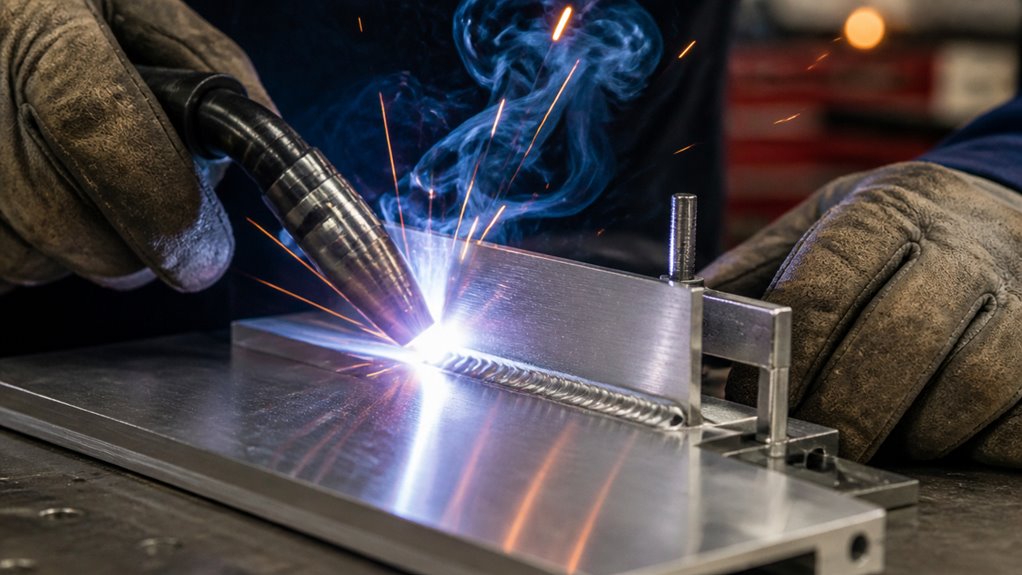
To weld aluminum effectively, choose TIG for thin sections under 6 mm to guarantee precision and minimal heat distortion. Use MIG for thicker materials up to 50 mm, utilizing preheating for heavier parts.
Prepare surfaces by removing oxides and contaminants with a dedicated stainless-steel wire brush. Use filler metals that match your alloy, and shield with 100% argon or argon-helium blends.
Control heat input and machine settings carefully. Mastering these fundamentals sets the stage for strong, clean welds and deeper insights ahead.
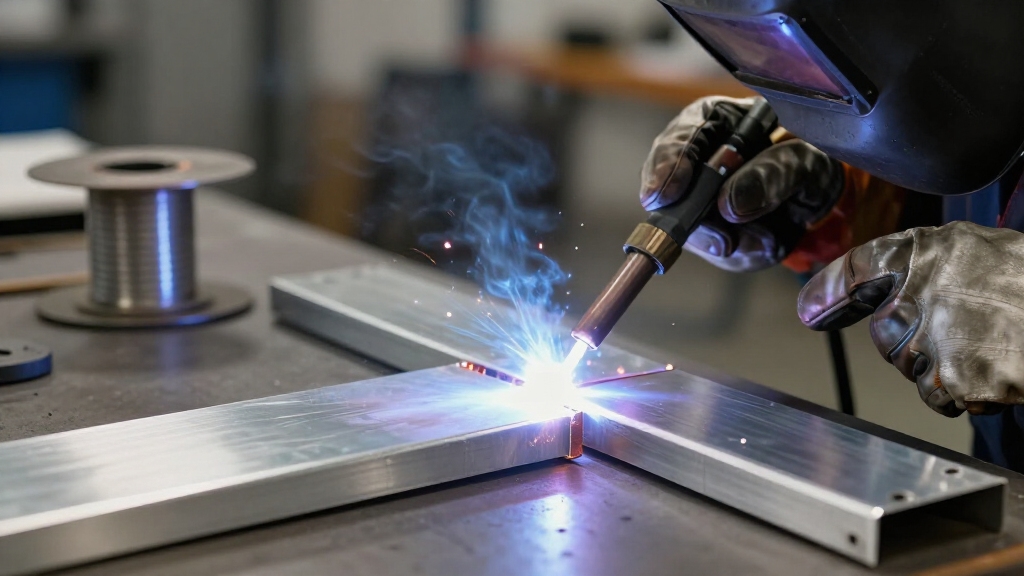
When deciding between TIG and MIG welding for aluminum, you need to take into account factors such as material thickness, weld precision, and production volume.
TIG welding, using a non-consumable tungsten electrode, offers superior control over the weld puddle. This makes it ideal for thin aluminum and precision applications.
Conversely, MIG welding is the most common industrial process. It excels with thicker materials and longer welds, providing faster throughput suitable for production environments.
Your choice also depends on cost constraints, desired weld quality, geometry complexity, and repeatability.
TIG demands slower travel speeds and tighter arcs for accuracy, while MIG allows quicker welding with efficient deposition rates.
Evaluating these parameters methodically guarantees you select the appropriate process tailored to your project’s technical requirements and operational efficiency.
Additionally, understanding the importance of selecting the correct flame type can be critical when using oxy-acetylene welding methods for aluminum to ensure optimal weld quality.
When you’re working with aluminum, choosing the right welding method really depends on the thickness of the material. For aluminum that’s under 6 mm thick, TIG welding is usually your best bet. It gives you that precision and control that’s so important for those finer details.
But if you’re dealing with thicker sections—let’s say anything from 6 mm up to 50 mm—MIG welding usually shines. It’s faster and provides better penetration, which is crucial for those thicker pieces.
Using a spool gun with 100% argon is essential for smooth feeding and clean welds when MIG welding thicker aluminum.
Although aluminum welding methods vary widely, selecting the best process hinges largely on matching the material thickness to the appropriate technique. For thin aluminum (under 6 mm), TIG welding offers precise control and superior weld quality.
MIG welding suits thicker sections, especially beyond 6 mm, enabling faster deposition and better productivity. When welding very thick aluminum (>20 mm), preheating may be necessary to guarantee proper fusion and reduce cracking risks.
Proper surface preparation and oxide removal are essential before welding to ensure strong, defect-free joints.
| Thickness Range (mm) | Recommended Method | Key Considerations |
|---|---|---|
| 1 – 3 | TIG | Precision, minimal heat input |
| 3 – 6 | TIG | Control, cosmetic welds |
| 6 – 20 | MIG | Production speed, penetration |
| 20 – 50 | MIG + Preheating | Fusion, reduced cracking |
| >50 | Specialized Methods | Multi-pass, heavy preheat |
Match thickness precisely to optimize weld integrity and efficiency.
Since aluminum’s thermal conductivity and oxide layer present unique challenges, selecting the appropriate welding method based on material thickness and application is critical.
You’ll want to match the process to the aluminum gauge and job requirements for best results.
Consider these guidelines:
Use TIG for aluminum under 6 mm or when precision and appearance matter.
Opt for MIG on thicker aluminum, up to 50 mm, especially for long or production welds.
Preheat thick sections to enhance fusion and reduce cracking.
Prioritize TIG for narrow, cosmetic welds; choose MIG for large fabrication projects.
Factor in cost, speed, repeatability, and safety when deciding the method.
Ensure proper surface preparation and cleaning to prevent contamination and porosity for optimal weld quality.
Removing aluminum oxide and contaminants from the surface is critical to achieving a clean, defect-free weld.
Start by degreasing the aluminum with a suitable solvent to eliminate oils and dirt.
Then, use a stainless-steel wire brush dedicated solely to aluminum to mechanically remove the oxide layer.
Avoid cross-contamination by never using the same brush on other metals.
Make certain the surface is dry and free from moisture before welding.
Proper fit-up and clamping are essential to minimize gaps and distortion, which can compromise weld quality.
Thorough cleaning improves fusion and reduces porosity risks.
For best results, clean and weld the aluminum promptly to prevent rapid re-oxidation that can undermine weld integrity.
When it comes to selecting filler metals for aluminum welding, it’s really important to pick ones that match your base aluminum alloy. This ensures that you get proper fusion and the mechanical strength you’re aiming for.
Now, let’s talk about shielding gases. For thin sections, 100% argon is usually the go-to choice. But if you’re working with thicker materials, you might want to consider argon-helium blends. The type of gas you choose can really make a difference in weld penetration and the overall quality of the bead. Using pure argon shielding gas at appropriate flow rates also helps maintain arc stability and reduces spatter during welding.
Selecting the right filler metal and shielding gas is critical to achieving strong, defect-free aluminum welds. You must make sure the filler metal matches the base aluminum alloy’s composition and mechanical requirements to avoid cracking and porosity.
Incompatible filler metals can cause weak joints or excessive weld defects. Consider these key points:
Match filler alloy series (e.g., 4xxx, 5xxx) to base metal to maintain corrosion resistance and strength. Use filler metals with compatible melting points for consistent fusion.
Avoid mixing incompatible alloys that promote hot cracking or brittleness. Choose filler wire diameter appropriate for material thickness and welding process.
Confirm chemical compatibility with the service environment to prevent weld degradation. Additionally, using the appropriate shielding gas ensures arc stability and prevents oxidation during welding.
Shielding gas choices play a critical role in protecting the molten aluminum weld pool from atmospheric contamination. This contamination can cause porosity and weaken the joint.
You’ll typically use 100% argon for thin aluminum, as it provides stable arc characteristics and effective oxide removal. When welding thicker sections, consider argon-helium blends. Adding helium increases heat input, improving penetration and bead fluidity.
Keep your shielding gas flow rate between 10–20 L/min to guarantee adequate coverage. This prevents turbulence that can introduce contaminants. Avoid mixing gases that might destabilize the arc or cause oxidation. For aluminum thicker than 4 mm, helium blends become essential to achieve necessary penetration and weld strength by increasing arc energy and heat transfer.
Choosing the right filler metal is just as important as picking the correct shielding gas to guarantee weld integrity and performance. You must select filler metals that match the base aluminum alloy closely to avoid defects and assure mechanical compatibility.
Shielding gases should complement the filler to optimize arc stability and penetration. Consider these factors when matching base material:
Use filler wire alloy compatible with the base metal’s composition. Select 100% argon for thin aluminum and argon-helium mixes for thicker sections.
Match strength and corrosion resistance requirements of the service environment. Assure filler metal supports desired finishing and mechanical properties.
Maintain shielding gas flow rates between 10–20 L/min for consistent protection. This methodical approach secures sound, defect-free welds with reliable performance.
Additionally, choosing between ER4043 and ER5356 filler metals depends on the aluminum alloy and whether you prioritize fluidity or structural strength in your weld.
Managing heat input and machine settings is essential when welding aluminum due to its high thermal conductivity.
You must carefully control amperage, voltage, and travel speed to prevent burn-through and guarantee proper fusion.
For TIG welding, maintain a tight arc and slow, steady travel to achieve consistent penetration.
With MIG, use the push technique instead of pull, keeping a stable torch angle and consistent speed to control bead shape.
Adjust wire feed speed and shielding gas flow, typically 10–20 L/min of argon or argon-helium mixes, to optimize weld pool fluidity and penetration.
Fine-tuning AC frequency and balance settings also improves arc stability in TIG welding.
Precise heat management and consistent machine parameters directly influence weld quality and reduce defects like porosity and distortion.
Additionally, maintaining a short arc length about equal to the tungsten diameter is critical for arc stability and preventing contamination during TIG welding.
Start by thoroughly cleaning the aluminum surface to remove oxide layers, oils, and contaminants. These can cause porosity and weak fusion. Proper surface prep is essential for high-quality welds.
You should also select the right welding process based on material thickness and application requirements. Control heat input carefully to prevent burn-through and maintain fusion integrity.
Maintain a stable torch angle and consistent travel speed to ensure a uniform bead shape. Use compatible filler metals and appropriate shielding gas to enhance weld strength and appearance.
Use a dedicated stainless-steel brush for oxide removal. Choose TIG for thin aluminum and precision welds, MIG for thicker sections.
Apply 100% argon for thin materials and argon-helium mixes for thicker work. Avoid weaving; prefer stringer beads for consistent penetration.
Inspect welds post-process for defects like porosity and lack of fusion.
Because aluminum welding generates intense UV radiation and hazardous fumes, you need to wear a UV-resistant welding mask and heat-resistant gloves to protect your skin and eyes.
Aluminum welding produces intense UV rays and fumes, so always wear a UV-resistant mask and heat-proof gloves.
Always make sure your welding helmet meets appropriate safety standards for UV and infrared protection.
Maintain strong ventilation or use fume extraction systems to minimize inhalation of aluminum oxide and other toxic fumes.
Wear flame-resistant clothing to guard against sparks and spatter.
Keep your workspace clear of flammable materials and ensure a stable, non-slip surface to prevent accidents.
Inspect your equipment regularly, confirming that cables, torches, and gas connections are intact and leak-free.
Finally, stay aware of your surroundings and avoid distractions to maintain focus, guaranteeing safe and effective aluminum welding at all times.
You generally can’t weld aluminum effectively without specialized equipment. Aluminum’s high thermal conductivity and oxide layer require precise heat control and specific shielding gases.
Ordinary steel welding gear won’t provide the necessary AC TIG or MIG settings, proper argon shielding, or filler compatibility. Attempting it with basic tools risks poor fusion, porosity, and weak joints.
To achieve reliable, high-quality aluminum welds, you’ll need dedicated aluminum-capable machines and proper surface preparation.
You’ll commonly encounter aluminum weld cracking due to rapid cooling, improper heat control, or contamination like oxides and dirt.
Inadequate cleaning leaves oxide layers that cause porosity and weak fusion, increasing cracking risk.
Using incorrect filler metal or mismatched alloys stresses the weld.
Also, excessive weld bead width or poor joint fit-up can cause residual stress.
Managing heat input, thorough cleaning, and proper filler selection are essential to prevent cracking.
Humidity is the silent saboteur in aluminum welding. It introduces moisture that leads to hydrogen porosity in your welds.
When humidity is high, water vapor can contaminate the weld pool, causing bubbles and weak spots.
To maintain quality, you must control the environment by welding in low-humidity conditions or using proper shielding gas flow.
Always dry your materials and equipment thoroughly to prevent moisture-induced defects and guarantee strong, reliable welds.
Yes, you should perform post-weld treatments on aluminum to improve performance and longevity.
Typically, you’ll remove any weld spatter and clean the surface to eliminate oxides and contaminants.
Stress relieving through controlled heat treatment can reduce residual stresses and distortion.
In some cases, anodizing or applying protective coatings will enhance corrosion resistance.
Always inspect welds for defects and maintain dimensional accuracy before final assembly or service.
You can automate aluminum welding in small workshops, but it demands careful process selection and setup.
Automation suits MIG welding better due to its speed and ease with thicker materials.
You’ll need precise control over parameters like wire feed, shielding gas flow, and heat input to avoid defects.
While initial costs and programming complexity can be hurdles, automation improves repeatability and efficiency.
This is especially true for consistent, longer welds on production runs in compact shop environments.
When welding aluminum, mastering your technique is like tuning a fine instrument. Precision and control make all the difference.
Choose TIG or MIG based on thickness. Prepare surfaces meticulously and select the right filler metals and shielding gases.
Control heat and machine settings carefully to avoid defects. Follow these steps methodically, and you’ll consistently produce strong, clean welds.
Remember, safety isn’t optional; it’s the foundation of every successful aluminum welding project.