Phone:
(701)814-6992
Physical address:
6296 Donnelly Plaza
Ratkeville, Bahamas.

Phone:
(701)814-6992
Physical address:
6296 Donnelly Plaza
Ratkeville, Bahamas.

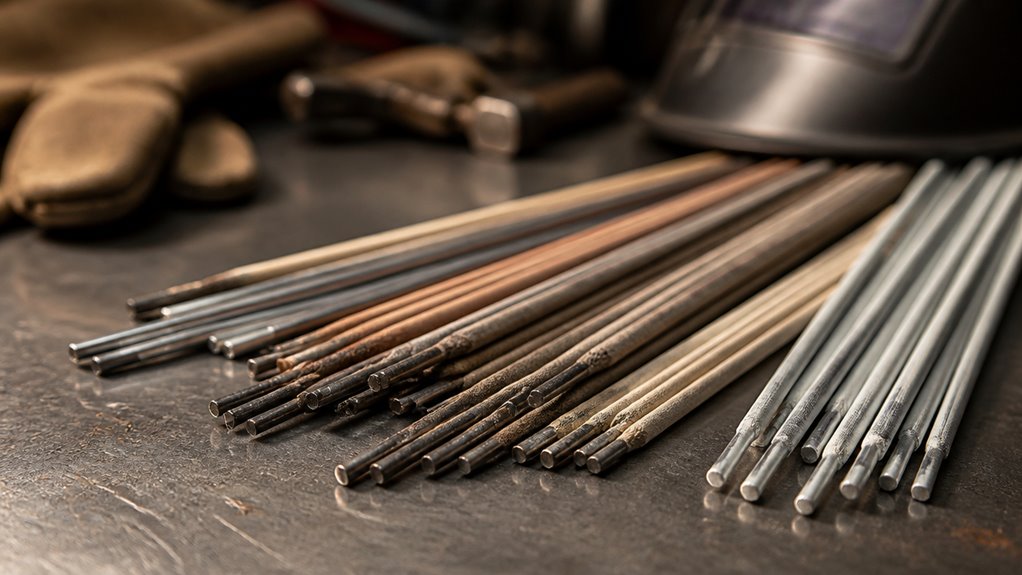
You’ll find welding rods classified by tensile strength, position, and coating, like the E6010’s deep-penetration fast-freeze or the smoother, general-purpose E6013.
Low-hydrogen E7018 rods offer high strength and crack resistance for structural work.
E7024 excels in heavy fabrication with rapid deposition but limited positions.
Specialty rods cater to stainless steel, aluminum, and repairs, designed for specific metals and conditions.
Understanding these differences helps you match rods precisely to your welding needs.
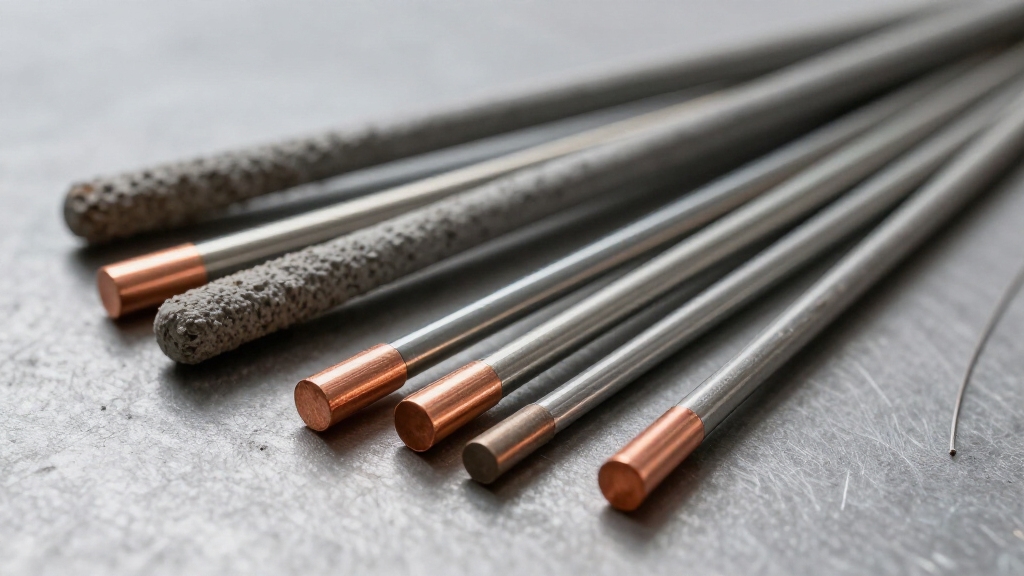
Although welding rods come in various types and specifications, understanding their classifications is essential to selecting the right electrode for your project.
Selecting the right electrode starts with understanding welding rod classifications and their specific types.
Welding rods are commonly identified by AWS-style numbers like E6010 or E7018, which indicate tensile strength, welding position suitability, and coating type.
The first two digits reveal the minimum tensile strength in thousands of psi. The third digit specifies the welding position—whether flat, horizontal, vertical, or all-position.
The final digit describes the electrode’s coating and current compatibility, essential for arc stability and slag formation.
You’ll find that flux coatings generate shielding gas and slag to protect the weld pool from atmospheric contamination.
By analyzing these classifications, you can precisely match electrodes to materials, joint configurations, and welding power sources.
This optimizes both performance and weld integrity.
The AWS system standardizes these numbers to ensure proper selection based on tensile strength, position capability, and flux type.
When you need deep penetration and strong welds on challenging surfaces, fast-freeze rods like E6010 and E6011 deliver aggressive arc characteristics. They excel in all-position welding and dirty or rusty conditions.
These rods produce a digging arc with superior slag removal, making them ideal for root passes and pipe welding where weld integrity is critical.
In contrast, general-purpose rods such as E6013 offer smoother arcs and easier handling, suited for thin materials and light fabrication.
While E6013 provides cleaner, more cosmetic weld beads, it sacrifices penetration depth and slag control. When choosing between them, consider the welding environment and joint requirements. Fast-freeze rods prioritize strength and penetration under adverse conditions, whereas general-purpose rods favor ease of use and appearance on cleaner, thinner metals.
Notably, 6011 rods feature a fast-freezing slag that stabilizes the weld puddle and reduces slag inclusion on poorly prepared surfaces.
Because structural welds demand high strength and durability, using low-hydrogen E7018 rods is essential for critical applications. These electrodes deliver a tensile strength of approximately 70,000 psi, meeting rigorous industry standards for heavy equipment and code welding.
Their low-hydrogen flux coating minimizes hydrogen-induced cracking, enhancing weld toughness and long-term integrity. When you operate E7018 rods, you’ll benefit from a stable arc and smooth bead appearance, which also improves resistance to slag inclusions.
Their all-position capability allows you to weld vertically, horizontally, or overhead without compromising quality. Additionally, proper storage and handling of these rods are vital to maintain their low-hydrogen properties. Maintaining storage temperatures between 225–300°F helps preserve the low-hydrogen coating and prevents moisture absorption, ensuring optimal weld quality.
While E7018 rods provide excellent strength and durability for structural work, you’ll find that E7024 electrodes focus on maximizing welding speed and material deposition.
These rods are engineered for heavy fabrication where productivity is critical. Their high iron powder content allows you to deposit more weld metal per pass, drastically reducing welding time on thick steel sections.
However, E7024 rods are limited to flat and horizontal positions due to their fast-freeze characteristics. You’ll appreciate their smooth, stable arc and minimal spatter, which contribute to cleaner welds.
Additionally, their coating composition helps maintain arc stability and protects the weld pool from atmospheric contamination.
Although general-purpose rods cover many welding needs, specialty welding rods are essential when working with stainless steel, aluminum, or performing repair welding on challenging materials.
When welding stainless steel, rods formulated to resist corrosion and maintain strength at high temperatures guarantee durability and joint integrity.
Aluminum rods require specific alloys to accommodate aluminum’s high thermal conductivity and oxide layer, providing clean, strong welds without contamination.
For repair welding, rods designed for cast iron, bronze, or nickel base metals enable effective restoration of parts that general rods can’t handle.
Using these specialty rods prevents common issues such as cracking, contamination, and weak bonds.
Selecting the correct rod type based on base metal properties and application specifics is critical to achieving peak weld performance and longevity.
Proper preheating and controlled cooling are often necessary when working with metals like cast iron to minimize thermal shock and prevent weld fractures.
You adjust your welding machine settings based on the rod’s specifications to optimize arc stability and weld quality.
Different rods require specific amperage ranges, polarity, and current types like DCEN, DCEP, or AC.
Using a rod needing higher amperage without adjustment causes poor penetration or burn-through.
Conversely, low amperage results in unstable arcs and weak welds.
Matching your settings to the rod guarantees proper melting, arc control, and defect-free welds.
You need to wear proper personal protective equipment, including gloves and safety glasses, to prevent burns and eye injury.
Store welding rods in dry conditions to avoid moisture absorption, which can cause weld defects and safety hazards.
Handle rods carefully to prevent damage to their flux coating.
Always ensure adequate ventilation to avoid inhaling harmful fumes.
Follow manufacturer guidelines and inspect rods before use to maintain safe, effective welding operations.
You might think simply keeping rods in their original packaging is enough, but to prevent moisture absorption, you need more.
Store welding rods in a dry, airtight container or rod oven at recommended temperatures, typically between 100°F and 250°F. This prevents hydrogen contamination and cracking.
Use desiccants if necessary and reseal packaging promptly. Controlled storage guarantees consistent weld quality and avoids costly re-drying or weld defects caused by moisture exposure.
You generally shouldn’t reuse welding rods after breaking or partial use. Exposure to moisture and contamination compromises their flux coating and performance.
Once broken, the protective flux coating can crack or degrade, reducing shielding effectiveness. This increases the risk of weld defects like porosity or cracking.
If you must reuse, make sure the rods are thoroughly dried in a rod oven to restore low-hydrogen properties and maintain weld integrity.
You might think flux cracking or flaking is just bad luck, but it’s actually caused by moisture absorption or overheating.
When flux absorbs moisture, it releases steam during welding, causing cracks or flakes. Overheating breaks down the flux coating’s integrity too, leading to spalling.
To avoid this, you need to store rods properly in dry conditions and control your welding amperage precisely. This ensures consistent, strong welds without flux defects.
Now that you’ve explored the various welding rods, from fast-freeze to low-hydrogen E7018 and high-deposition E7024, aren’t you better equipped to choose the right one for your project?
Understanding each rod’s unique properties guarantees peak weld strength and durability, especially in structural and heavy fabrication tasks.
Specialty rods for stainless steel and aluminum add versatility. With this knowledge, you can confidently tackle welding challenges with precision and efficiency every time.