Phone:
(701)814-6992
Physical address:
6296 Donnelly Plaza
Ratkeville, Bahamas.

Phone:
(701)814-6992
Physical address:
6296 Donnelly Plaza
Ratkeville, Bahamas.

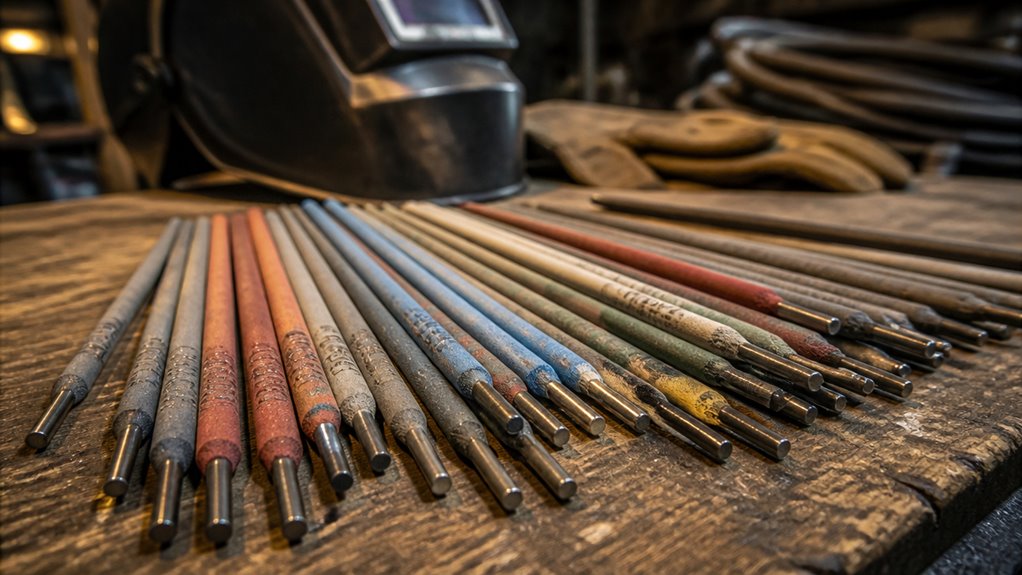
When you see numbers on welding rods, they tell you key details: the first digits indicate the minimum tensile strength of the weld metal, ensuring it meets the required strength standards.
The third digit shows which welding positions the rod supports, like all-position or flat-only.
The last digit reveals the flux coating type and compatible current, essential for arc stability and weld quality.
Decoding these numbers helps you select the right rod for strength, position, and performance. Explore further to match electrodes perfectly to your job.
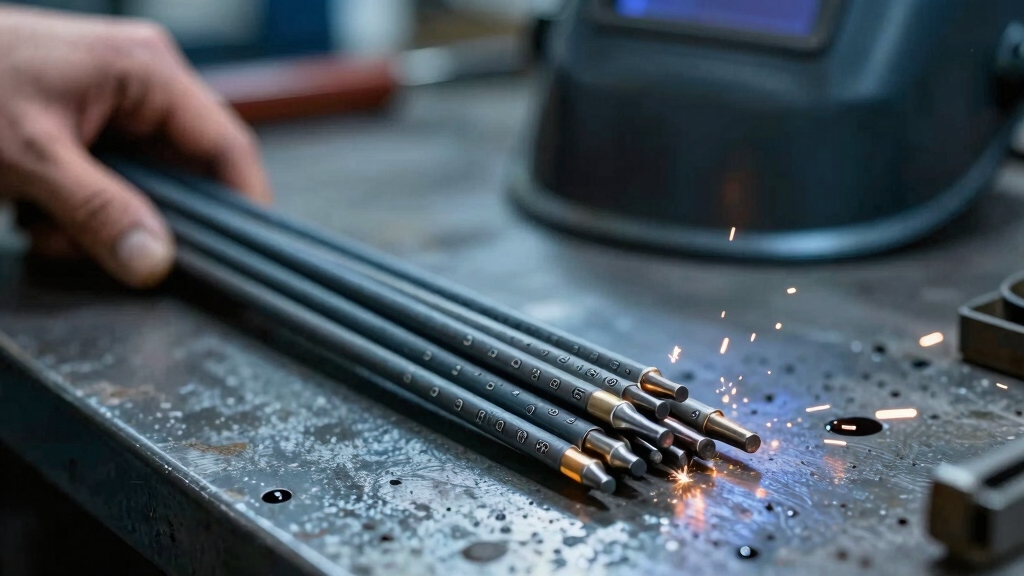
When you read the numbers on a welding rod, you’re looking at a standardized code that conveys critical information about the electrode’s mechanical properties and welding capabilities.
The American Welding Society (AWS) sets this system, where the prefix E means electrode for arc welding. The digits following E classify key characteristics: the first two or three digits indicate minimum tensile strength in thousands of psi.
The next digit specifies welding position (1 for all positions, 2 for flat/horizontal only, 4 for several positions). The final digit(s) identify the flux coating and compatible current type.
This code isn’t about size; it’s a performance classification that helps you select the right rod for strength, position, and power requirements. This ensures optimal weld quality and operational effectiveness.
Proper welding performance also depends on selecting the correct breaker size to match the welder’s rated input current and duty cycle.
Understanding tensile strength is essential for selecting the appropriate welding rod, as it directly indicates the rod’s mechanical performance under stress.
The first digits in an AWS electrode code reveal this critical property, expressed in thousands of psi. Here’s how to read it:
When selecting welding rods for automotive repairs, it is important to consider the thickness of sheet metal to match the rod’s tensile strength with the panel’s structural requirements.
You know, when you’re looking at an electrode number, the third digit is pretty important. It tells you which welding positions the rod can handle.
For instance, a code of 1 means the rod is versatile and works in all positions.
On the other hand, if you see a 2, that limits you to flat and horizontal positions only. And if you come across a 4, it opens up vertical down and overhead options as well.
Low-hydrogen electrodes like E7018 provide excellent all-position versatility and toughness for structural welding.
In AWS electrode numbers, the third digit specifically indicates the welding positions the rod is designed to support. This guides you in selecting the right electrode for your joint orientation.
This digit helps you quickly determine if a rod is suitable for all positions or limited to specific ones. Here’s what the third digit tells you:
Understanding these codes ensures you pick a rod that matches your welding angles and joint configurations precisely. This optimizes weld quality and efficiency. Proper selection also helps achieve optimal weld penetration and mechanical properties for your project.
When selecting a welding rod, the third digit in the AWS electrode number tells you exactly which positions the rod supports. This ensures you choose the right tool for your joint orientation.
A third digit of 1 means the rod works in all positions: flat, horizontal, vertical, and overhead. This offers maximum versatility. A 2 indicates the rod is limited to flat and horizontal positions, suitable for simpler welds.
A 4 means the rod supports flat, horizontal, vertical down, and overhead positions but excludes vertical up. By interpreting this digit accurately, you match the electrode to the welding task.
This optimizes weld quality and efficiency.
This classification prevents position mismatch, reducing defects and rework. It makes your welding operation more reliable and productive.
Electrodes like the 7018 with a third digit of 1 are especially valued for their all-position welding capability, which enhances their usability across diverse applications.
Hey there! Let’s talk about how the last digit in the rod number can really help you out. This digit isn’t just a random number; it actually tells you what type of flux coating is on the rod. Why is that important? Well, it directly impacts things like arc stability and the overall characteristics of your weld.
But that’s not all! This digit also indicates the required welding current and polarity. This means you’ll want to set up your machine just right to get the best performance possible. When you choose the right combination of coating and current, you’re setting yourself up for consistent weld quality, which is key for meeting whatever application demands you might have. So, keep an eye on that last digit—it’s a small detail that makes a big difference! Proper handling and storage are essential to maintain this performance and avoid issues like arc destabilization.
Understanding the flux coating and current type indicated by the last digit of a welding rod number is essential for selecting the correct electrode. This digit defines the electrode’s flux composition and compatible current type, directly affecting arc stability, slag formation, and weld quality.
Here’s what you need to know:
Recognizing these codes lets you match electrodes precisely to your welding application. Additionally, electrodes with low-hydrogen coatings offer enhanced arc stability that reduces spatter and improves overall weld quality.
Although flux coating types primarily determine the welding rod’s performance, the associated current requirements play an equally critical role in achieving ideal arc stability and weld quality.
The last digit in the AWS rod number indicates the best current type: AC, DC electrode positive (DCEP), or DC electrode negative (DCEN) matched to the flux composition.
For example, E6010 rods with high cellulose sodium coatings require DCEN for a stable arc.
In contrast, E7018 low-hydrogen potassium rods perform best on DCEP or AC.
Using the correct current type prevents welding defects like porosity or lack of fusion.
Additionally, some rods tolerate AC, such as titania-coated electrodes, offering versatility.
Understanding this numeric code lets you configure your welder accurately, optimizing penetration, bead profile, and overall weld integrity.
For instance, 6011 rods are best used with AC for optimal arc stability and penetration, while 6013 rods are compatible with both AC and DC for easier arc control.
Many welding defects trace back to mismatches between flux coating types and current settings, which directly influence arc stability and weld quality.
When you choose an electrode, the last digit in its number tells you the coating type and compatible current, critical for performance.
Consider these impacts:
Understanding rod numbers guarantees correct flux-current pairing. This optimizes weld integrity and minimizes defects.
Additionally, rods like the 6013 offer all-position capability, providing flexibility for various joint angles and orientations.
Select welding rods by carefully analyzing their AWS electrode numbers, which encode critical performance factors such as tensile strength, welding position suitability, and flux coating type.
Choose welding rods by decoding AWS numbers to ensure proper strength, position, and flux compatibility for quality welds.
You begin by identifying the tensile strength—depicted by the first two or three digits—guaranteeing the rod matches the mechanical requirements of your material.
Next, check the third digit to confirm the welding positions supported, matching it to your joint orientation.
Finally, decode the last digit(s) to determine flux composition and compatible welding current polarity, which directly influence arc stability and weld quality.
By interpreting these numbers, you accurately align rod selection with your application’s strength demands, positional constraints, and power settings.
This prevents weld defects and maximizes performance.
This methodical approach guarantees your electrode choice optimizes both efficiency and structural integrity in your welding project.
For critical, load-bearing applications, selecting rods like 7018 with superior ductility and impact resistance is essential to ensure weld integrity under stress.
Understanding how to read welding rod numbers sets the foundation for choosing the right electrode.
Knowing the common AWS welding rod classifications and their typical applications sharpens your ability to match rods to specific welding tasks. Here are three common AWS rods and when to use them:
When choosing welding rods for different jobs, you need to take into account the material type, joint configuration, and welding position to guarantee peak weld quality and strength.
First, identify the base metal’s tensile strength and select a rod with equal or higher minimum tensile strength, as indicated by the first digits in the electrode number.
Next, consider the welding position. Electrodes labeled with a third digit of “1” work for all positions, while “2” suits flat and horizontal only.
Finally, match the flux coating and current type to your power source and desired weld characteristics. For example, low-hydrogen rods like E7018 reduce cracking in structural steel.
Welding rod numbers are standardized internationally mainly through the American Welding Society (AWS) system, which many countries adopt or align with for consistency.
You’ll find that the AWS classification sets clear codes for tensile strength, welding position, and flux type.
While some regions use additional standards like ISO, you’ll often see AWS numbers referenced globally. They provide a precise, universally understood classification for electrode performance and application.
Yes, welding rod numbers can change with new AWS updates.
The American Welding Society periodically revises classification standards to reflect advances in metallurgy, welding technology, and industry needs.
When updates occur, you might see modifications in tensile strength requirements, allowable positions, flux compositions, or current specifications within electrode codes.
Staying current guarantees you select electrodes that meet the latest performance criteria and comply with updated safety and quality standards.
No, electrode numbers don’t indicate rod diameter or length. Instead, they classify tensile strength, welding position capability, and flux coating with current type.
Diameter and length are specified separately on packaging or product specs. You’ll find rod dimensions clearly listed but not embedded in the AWS classification number.
Imagine welding rods like keys unfastening specific protections. While the numbers primarily reveal tensile strength, position, and flux type, they indirectly hint at corrosion resistance through the flux coating classification.
Certain coatings, like low-hydrogen potassium in E7018, offer better slag coverage and moisture resistance, enhancing corrosion protection.
Yes, you’ll find specific AWS classifications for specialty or exotic metal electrodes, usually outside standard E60xx or E70xx series.
These rods often have unique codes reflecting their alloy composition and mechanical properties tailored for metals like stainless steel, nickel alloys, or aluminum.
You should reference manufacturer datasheets or AWS A5.XX specifications to identify exact numbers.
They provide precise guidance on tensile strength, welding position, and flux tailored for those exotic metals.
Understanding the numbers on welding rods is like reading a blueprint for strength and precision. Each digit symbolizes key details: tensile strength, welding position, and flux type that guide you to the perfect match for your project.
By decoding these numbers, you hold the power to weld with confidence. This ensures every joint is as strong and reliable as the rod itself.
Choose wisely, weld precisely, and let the numbers lead your craft.