Phone:
(701)814-6992
Physical address:
6296 Donnelly Plaza
Ratkeville, Bahamas.

Phone:
(701)814-6992
Physical address:
6296 Donnelly Plaza
Ratkeville, Bahamas.

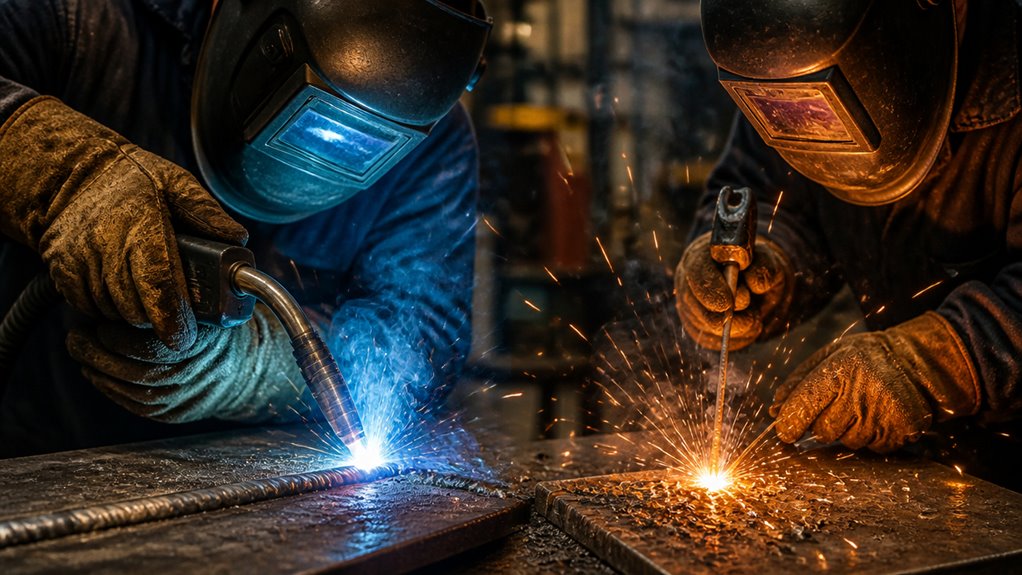
When choosing between GMAW and SMAW welding, you’ll find GMAW excels in productivity. It produces cleaner, smoother welds with continuous wire feed and external shielding gas, making it ideal for controlled indoor settings and thin metals.
SMAW offers more rugged versatility with flux-coated electrodes generating self-shielding gas. This makes it reliable outdoors, in wind, or on thick structural steel. Your choice depends on environment, material, and workflow demands.
Keep exploring to uncover detailed performance comparisons and application tips.
| Feature | GMAW (MIG Welding) | SMAW (Stick Welding) |
|---|---|---|
| Welding Process | Continuous wire-fed electrode | Flux-coated consumable electrode |
| Shielding Method | External shielding gas (Argon/CO₂) | Flux-generated self-shielding gas |
| Power Source | Constant Voltage (CV) | Constant Current (CC) |
| Deposition Rate | 5–12 lbs/hr | 1–5 lbs/hr |
| Welding Speed | Faster | Slower |
| Weld Appearance | Smooth and clean | Strong but rougher with slag |
| Slag Production | Minimal | High |
| Cleanup Required | Low | Higher |
| Best Material Thickness | Thin to medium metals | Medium to thick metals |
| Outdoor Performance | Poor in windy conditions | Excellent |
| Equipment Complexity | Higher | Lower |
| Equipment Cost | Higher | More affordable |
| Portability | Moderate | Excellent |
| Skill Level | Easier to learn | Requires greater manual skill |
| Best Applications | Automotive, sheet metal, manufacturing | Construction, pipelines, structural steel, field repairs |
| Main Advantage | High productivity, cleaner welds, and continuous operation | Rugged, portable, and performs well in outdoor conditions |
| Main Drawback | Requires shielding gas and controlled environments | Slower process with more slag cleanup and electrode changes |
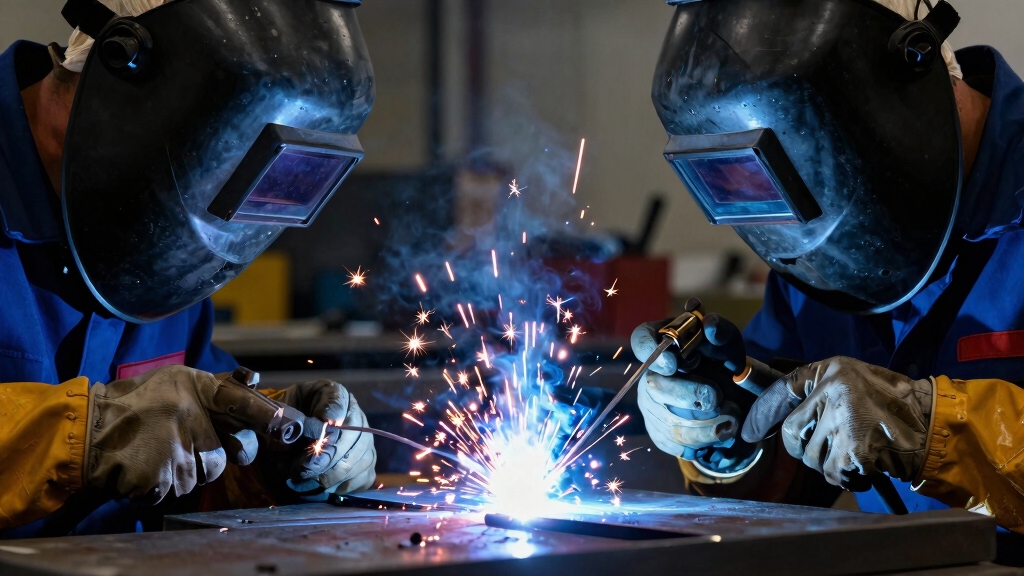
Although both SMAW (Shielded Metal Arc Welding) and GMAW (Gas Metal Arc Welding) join metals through arc welding processes, they differ fundamentally in electrode design, shielding methods, and operational mechanics.
SMAW uses a short, flux-coated consumable rod that generates its own shielding gas and slag during welding.
In contrast, GMAW feeds a continuous bare wire electrode automatically through a gun, relying entirely on externally supplied shielding gas like Argon or CO₂.
SMAW requires frequent electrode changes due to rod length, interrupting workflow, whereas GMAW supports continuous operation.
These distinctions affect how you manage welding tasks:
SMAW offers adaptability and simplicity with manual control, while GMAW delivers steady wire feed and cleaner shielding but demands precise gas handling and equipment complexity.
Understanding these core differences helps you select the ideal process for your application.
Additionally, unlike SMAW, GMAW typically requires an external shielding gas to protect the weld pool from contamination during welding.
You’ll notice that SMAW, or Shielded Metal Arc Welding, uses a constant current power source. This means it keeps the amperage steady while the voltage changes based on the arc length. This flexibility is great for adapting to different conditions you might encounter while welding.
On the other hand, GMAW, or Gas Metal Arc Welding, operates with a constant voltage system. In this case, the voltage stays fixed, and the current is adjusted through the wire feed speed. This setup helps ensure a consistent heat input, which is crucial for achieving quality welds.
The choice between these two methods ultimately depends on the desired level of arc control and automation needs.
When you compare SMAW and GMAW power sources, the key difference lies in their electrical control modes: SMAW uses a constant current (CC) power supply, while GMAW operates with a constant voltage (CV) power source.
In SMAW, the amperage remains stable, and voltage varies based on arc length, allowing the arc to adapt dynamically to electrode manipulation and material thickness.
Conversely, GMAW maintains a fixed voltage, with current adjusting according to wire feed speed, ensuring consistent heat input and penetration.
This fundamental distinction means SMAW tolerates variable arc lengths, suitable for rugged, thicker materials.
GMAW demands steady wire feeding and voltage stability, optimizing precision on thinner metals.
Understanding these electrical nuances informs your choice between flexibility and control in welding applications.
For optimal performance, it is important to secure work clamp close to the weld area to maintain good electrical contact and minimize arc instability.
Because SMAW uses a constant current power source, it allows you to maintain arc stability even with varying arc lengths. This gives you greater manual control during welding. This adaptability is ideal for fieldwork and thicker materials.
In contrast, GMAW employs a constant voltage power source. This stabilizes voltage but varies current with wire feed speed. As a result, it produces a steadier arc suitable for thinner materials and automated processes.
The wire feeding mechanism in GMAW supplies the consumable electrode wire continuously, controlled by the machine, which helps maintain consistent arc length and steady deposition rate.
| Aspect | SMAW (CC Power Source) | GMAW (CV Power Source) |
|---|---|---|
| Arc Stability | Maintains current despite voltage fluctuations | Maintains voltage, current varies with feed speed |
| Control | Greater manual control over arc length | Automated wire feed controls arc |
| Application Flexibility | Suitable for inconsistent arc lengths | Best for steady, continuous arcs |
Understanding these differences helps you optimize arc stability and control based on welding conditions.
You’ll notice that GMAW really stands out when it comes to deposition rates. It typically delivers between 5 to 12 pounds per hour, while SMAW lags behind at just 1 to 5 pounds per hour. This difference isn’t just a number; it significantly affects production efficiency.
With GMAW’s continuous wire feed, you spend less time dealing with downtime. No more frequent electrode replacements or dealing with slag removal—it all adds up. So, when you understand these operational factors, it becomes much easier to optimize your welding processes for better throughput and cost-effectiveness.
Additionally, GMAW’s continuous wire-fed arc process helps maintain consistent weld quality and speeds up joint filling on thinner materials.
Typically, GMAW delivers markedly higher deposition rates compared to SMAW, ranging from 5 to 12 lbs per hour versus SMAW’s 1 to 5 lbs per hour.
This difference stems primarily from GMAW’s continuous wire feed system, which eliminates frequent stoppages for electrode replacement inherent in SMAW’s short consumable rods.
By maintaining a steady wire feed, GMAW achieves consistent filler metal deposition, enhancing production speed.
In contrast, SMAW requires periodic pauses not only for electrode changes but also for slag removal, reducing effective weld time.
Consequently, when analyzing productivity, you’ll find GMAW markedly outperforms SMAW in applications demanding higher throughput.
Understanding these deposition rate disparities helps you select the appropriate process based on project scale, balancing speed against operational constraints without conflating with factors influencing overall operational efficiency.
Additionally, GMAW typically produces minimal spatter, reducing cleanup time compared to SMAW’s slag-producing process.
When comparing operational efficiency between GMAW and SMAW, it’s crucial to factor in both deposition rates and production workflow.
GMAW achieves deposition rates from 5 to 12 lbs/hr, markedly surpassing SMAW’s 1 to 5 lbs/hr. This higher deposition rate directly translates into greater production efficiency.
GMAW allows continuous welding without frequent interruptions. In contrast, SMAW requires periodic stops for electrode replacement and slag removal, reducing overall productivity.
Additionally, GMAW’s automated wire feeding supports steady, high-speed operation, minimizing downtime and operator fatigue.
You’ll find GMAW better suited for high-volume or precision work. SMAW’s manual process limits throughput but excels in rugged, variable conditions.
Consequently, when optimizing for operational efficiency, GMAW offers clear advantages in deposition and workflow continuity.
Its use of a continuous consumable wire electrode ensures a stable arc and consistent heat input, further enhancing welding speed and quality.
How does weld quality differ between SMAW and GMAW processes? When you rely on SMAW, you get strong welds with excellent penetration, particularly suited for structural steel and heavy-duty applications.
However, the surface finish tends to be rougher due to slag inclusion and manual slag removal.
GMAW, in contrast, produces cleaner, smoother welds with superior appearance.
This is due to continuous wire feed and external shielding gas that reduce contamination.
You’ll also notice GMAW deposits inherently low hydrogen levels and demands less preheat, improving weld integrity under strict standards like D1.1.
If your priority is high-quality aesthetics and minimal post-weld cleanup, GMAW excels.
But if you need rugged, all-position welds and robust penetration in demanding environments, SMAW remains a reliable choice despite a comparatively lower surface finish.
It is important to consider that process sensitivity to parameter deviations can significantly affect weld quality and defect formation.
Although both SMAW and GMAW are effective welding methods, their performance varies markedly under environmental conditions.
SMAW excels outdoors because its flux coating generates a self-contained shielding gas and slag, protecting the weld from wind, rain, and heat. This makes SMAW reliable in unstable environments where gas shielding could be compromised.
Conversely, GMAW depends on external shielding gas, which disperses easily in winds above 5 mph. This requires windbreaks or indoor settings for consistent weld quality.
Additionally, GMAW is limited to specific welding positions to maintain gas coverage, whereas SMAW supports all-position welding, enhancing flexibility on-site.
Thus, when environmental challenges like wind or moisture are present, SMAW usually offers superior operational stability and weld integrity compared to GMAW.
For vertical SMAW, selecting the correct electrode type and controlling heat input are crucial to achieving precision and avoiding defects.
Because SMAW equipment consists mainly of a power source and an electrode holder, it remains simpler, more portable, and less expensive than GMAW systems.
GMAW requires additional components like wire feeders, gas cylinders, and a welding gun, increasing both initial investment and maintenance complexity.
GMAW involves extra gear—wire feeders, gas cylinders, and welding guns—raising costs and maintenance needs.
When it comes to skill, you’ll find SMAW demands greater manual dexterity and arc control, as you must manage electrode manipulation and slag removal continuously.
Conversely, GMAW’s automation through constant wire feeding and shielding gas delivery reduces operator error and the learning curve.
This automation improves consistency and lowers the skill threshold needed for quality welds.
Consequently, you’ll weigh SMAW’s low-cost simplicity against GMAW’s higher expense but easier operability, depending on your project’s technical and budgetary constraints.
Additionally, laser welding offers narrow heat-affected zones that minimize distortion and preserve base material integrity, providing a modern alternative to traditional welding methods.
When selecting between SMAW and GMAW welding, you must consider the specific demands of your project’s environment, material type, and positional requirements.
Choose SMAW when working outdoors or in windy, unpredictable conditions since its self-generated shielding gas maintains arc stability. It excels with thick structural steels and pipeline welding where ruggedness and all-position capability are essential.
Conversely, GMAW suits controlled environments demanding high productivity and cleaner welds, such as automotive manufacturing and thin sheet metal fabrication. Its steady heat input and continuous wire feed enable precise, smooth welds, especially in flat or horizontal positions.
Ultimately, your application’s environmental tolerance, material thickness, and desired weld quality will dictate which process maximizes efficiency and meets technical specifications.
Deciding which welding process to choose hinges on analyzing your project’s specific requirements, including environmental conditions, material characteristics, and production goals.
If you work outdoors or in windy conditions, SMAW offers superior reliability due to its self-shielding flux and all-position capability.
For projects demanding high productivity and cleaner welds on thinner metals, GMAW’s continuous wire feed and external gas shielding provide consistent quality and speed.
Consider equipment complexity and cost: SMAW gear is simpler and portable but requires more skill.
GMAW demands higher upfront investment yet benefits from automation, reducing operator error.
Assess your material thickness and desired weld appearance.
SMAW excels in heavy structural work, while GMAW suits precision applications.
Ultimately, weigh environmental tolerance, production efficiency, and skill level to select the best process.
Electrode storage critically impacts SMAW welding quality because moisture absorption from improper storage causes hydrogen-induced cracking and porosity.
You need to keep electrodes dry and sealed in airtight containers or ovens at recommended temperatures to maintain flux integrity.
If electrodes absorb humidity, their flux coating degrades, leading to unstable arcs and inconsistent slag formation.
This compromises weld strength and appearance.
Proper storage guarantees consistent arc stability and weld reliability during your work.
Can you imagine trying to maintain a stable external shielding gas environment underwater?
No, GMAW welding can’t be performed underwater because it relies entirely on external shielding gas, which disperses instantly in water.
This disrupts arc stability and weld quality. Underwater welding typically uses specialized methods like SMAW or FCAW with flux coatings that generate protective gas and slag, ensuring effective shielding despite the aquatic conditions.
You need to manage shielding gas exposure in GMAW carefully. Protect yourself from gas leaks and guarantee proper ventilation since external gases can displace oxygen.
With SMAW, focus more on handling hot slag and frequent electrode changes safely. Slag can cause burns and spatter.
Both require eye and respiratory protection. SMAW demands higher vigilance against unstable arcs and slag, while GMAW emphasizes shielding gas containment and equipment grounding.
Welding codes impact your process selection by specifying required weld quality, material compatibility, and environmental conditions.
They guide you to choose processes that meet strength, penetration, and inspection standards. For example, codes may mandate low hydrogen levels or particular joint designs, influencing your choice.
You’ll need to align your process with code requirements to assure safety, durability, and certification.
This requires balancing productivity with compliance for the intended application.
Imagine a wire feed system as a steady river; any blockage disrupts flow.
To troubleshoot wire feed issues, first check for spool tension. Too tight or loose causes feeding problems.
Inspect the liner for clogs or wear and clean the drive rolls to remove debris. Make sure the wire diameter matches the drive roll groove.
Finally, verify the wire speed and voltage settings align with material requirements to maintain consistent welding performance.
When deciding between SMAW and GMAW, you’re not just choosing a welding method. You’re picking the ultimate game-changer for your project’s success.
SMAW offers rugged simplicity and versatility, while GMAW delivers unmatched speed and precision. Ignoring these differences could turn your welding job into a nightmare of inefficiency or poor quality.
So, choose wisely: your weld’s strength, appearance, and overall outcome depend on mastering these technical nuances perfectly.