Phone:
(701)814-6992
Physical address:
6296 Donnelly Plaza
Ratkeville, Bahamas.

Phone:
(701)814-6992
Physical address:
6296 Donnelly Plaza
Ratkeville, Bahamas.

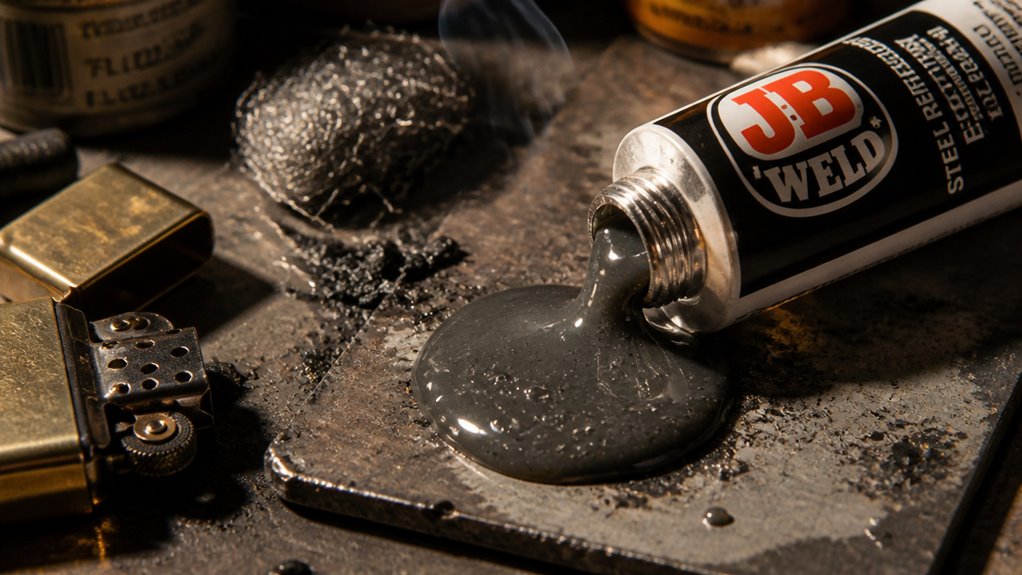
You shouldn’t consider J-B Weld highly flammable, but it is combustible and can ignite under certain conditions. Most formulations have flash points above 140°F, categorizing them as combustible rather than flammable.
Vapors may accumulate in low areas and flash back if ignited by sparks, open flames, or static. Proper ventilation and handling reduce risk.
While cured epoxy resists combustion, uncured materials can release hazardous gases. Explore its ignition thresholds, handling precautions, and safety measures for full insight.
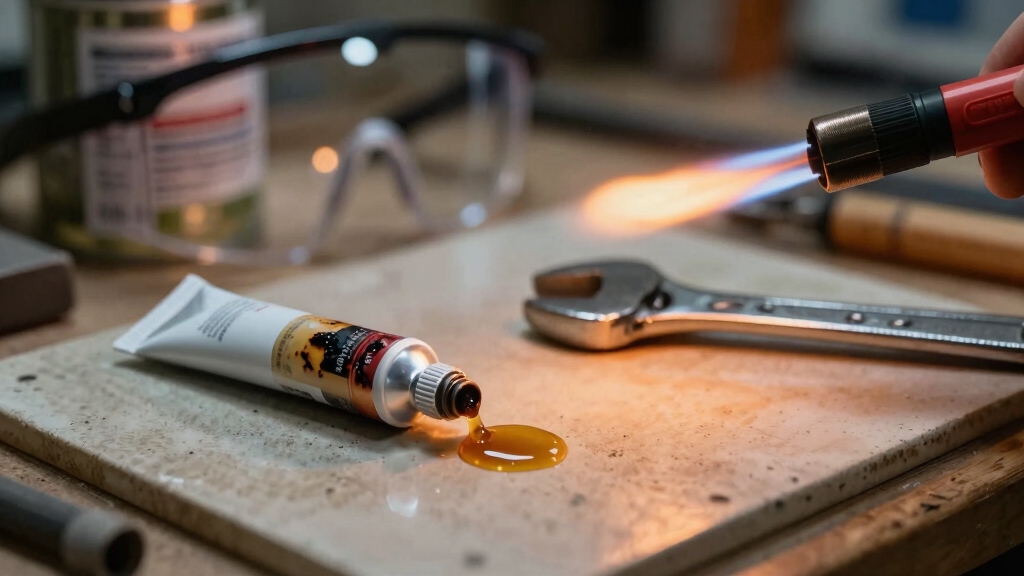
Although J-B Weld products are generally considered low-risk with respect to flammability, you should understand their specific ignition thresholds and hazard conditions before use.
J-B Weld products are low-risk for flammability but require awareness of ignition thresholds before use.
Most standard formulations have flash points between 140°F and 200°F, classifying them as combustible rather than highly flammable.
The absence of established autoignition temperatures and flammable limits in safety data sheets means you can’t precisely predict ignition under all conditions.
Exposure to open flames, sparks, or static discharge poses the primary ignition risk.
Heat, mechanical shock, and moisture don’t trigger combustion.
Vapors can accumulate and flash back if confined in low areas.
You must handle and store J-B Weld away from ignition sources, maintain ventilation to prevent vapor buildup, and adhere strictly to temperature controls to mitigate flammability hazards effectively.
Additionally, J-B Weld cures best within an optimal temperature range of 70°F–85°F, which also helps reduce any flammability risks associated with improper heat exposure.
Understanding the flammability risks of J-B Weld products helps clarify which formulations present minimal fire hazards.
Importantly, J-B Weld ExtremeHeat is water-based, non-flammable, and free from solvents or volatile organic compounds (VOCs). This makes it the safest option concerning fire risk.
Most standard J-B Weld epoxies have flash points above 140°F, classifying them as combustible liquids rather than flammable. This reduces ignition likelihood under typical use.
However, certain products like J-B Weld Australia’s SuperWeld and some multi-purpose putties fall under Flammable Liquids Category 3 due to lower flash points and potential aspiration hazards.
When selecting a J-B Weld product, focus on those with water-based or high flash point formulations to minimize exposure to flammability risks during application and storage.
Proper surface preparation and curing are essential to ensure the epoxy achieves its maximum heat resistance and safety.
When evaluating J-B Weld’s safety profile, you’ll find that its flash points typically exceed 140°F (60°C). This places most formulations in the combustible rather than flammable category.
For instance, Setaflash closed cup testing records flash points above 199.9°F (93.3°C), underscoring reduced ignition risk under normal conditions. Importantly, autoignition temperatures and flammable limits remain unspecified, signaling limited data but a low propensity for spontaneous combustion.
Combustion thresholds reveal that while J-B Weld epoxies won’t ignite readily, exposure to open flames or sparks can initiate burning. The product’s combustion yields hazardous gases like carbon monoxide and nitrogen oxides, demanding caution.
Therefore, while not highly flammable, you must manage J-B Weld near ignition sources prudently to mitigate fire hazards effectively. Additionally, temperature fluctuations and heat can trigger premature curing, which may alter the material’s thermal stability and safety profile.
J-B Weld resists rapid ignition because its chemical composition and physical properties limit vapor release and flammability under typical conditions.
Its epoxy matrix contains minimal volatile organic compounds, resulting in a flash point well above 140°F, which categorizes it as combustible rather than highly flammable.
You won’t find significant vapor pressure or low ignition thresholds, so the risk of spontaneous ignition is low.
The absence of solvents and low volatility reduce the formation of flammable vapor-air mixtures, which are essential for rapid flame propagation.
Although combustible at elevated temperatures or near open flames, J-B Weld’s thermal stability and chemical inertness under normal use prevent it from sustaining combustion.
This controlled combustibility guarantees safer handling and storage, distinguishing it from highly flammable substances with low flash points and rapid vaporization.
Proper curing and surface preparation are critical to maintaining thermal stability and preventing bond failure when exposed to heat or flame.
Although J-B Weld is generally resistant to ignition under normal conditions, certain sources like open flames, sparks, and static discharge can ignite it.
You should recognize that while mechanical impacts, heat, moisture, and chemical contacts don’t trigger ignition, direct exposure to flames or electrical sparks creates sufficient energy to overcome its flash point, typically above 140°F.
Static discharge, especially in poorly ventilated areas where vapors accumulate, poses a significant ignition risk due to potential flashbacks.
You must also be aware that vapors can travel distances to ignition sources, intensifying hazard potential.
Understanding these ignition triggers is essential, as J-B Weld doesn’t sustain combustion readily but can combust under specific energy inputs.
This necessitates vigilance around open flames and electrical sparks during application or curing.
For safe use, it is important to follow proper surface preparation and curing guidelines to minimize any hazards.
To guarantee safe handling and storage of J-B Weld, you must maintain product temperatures below 100°F (38°C) to prevent thermal degradation and potential container rupture.
Store J-B Weld in tightly sealed containers, keeping them dry and protected from freezing or physical damage. Always use the product in well-ventilated areas to avoid vapor buildup, as vapors can accumulate and pose ignition risks.
Avoid exposure to open flames, sparks, or other ignition sources during handling and storage. Don’t breathe in vapors, dust, or mist; use appropriate respiratory protection if necessary.
Properly segregate J-B Weld from incompatible substances, although it isn’t reactive with oxidizers or acids. Consistent adherence to these parameters minimizes hazards, ensuring product integrity and user safety in your workspace.
Additionally, maintaining ambient temperatures above 50°F and ideally near 70°F for curing can help ensure safe and effective use.
When you’re faced with a J-B Weld fire, it’s important to know how to put it out effectively. You can use carbon dioxide, dry chemical extinguishers, foam, or even water fog.
Just a heads up, though—steer clear of applying water directly! Doing so might spread the flames or even cause the container to rupture, which is definitely not what you want.
If firefighters are on the scene, they should be wearing self-contained breathing apparatuses that are approved by OSHA/NIOSH. This gear is crucial because it helps protect against toxic combustion byproducts that can be released during the fire. Safety first, right?
Because J-B Weld’s cured epoxy is formulated to resist chemical degradation, it typically does not contribute to flame spread, making its chemical resistance a key safety feature in fire scenarios.
In handling a fire involving J-B Weld products, you should rely on carbon dioxide, dry chemical, foam, or water fog as effective extinguishing agents.
These media interrupt the combustion process without introducing reactive elements that might exacerbate the fire.
Avoid applying water directly to the flames; instead, use water fog to cool adjacent containers, minimizing the risk of rupture due to heat exposure.
Treat the fire similarly to a fuel oil fire, emphasizing containment and cooling.
Since J-B Weld vapors can travel and flash back, apply extinguishing agents cautiously to prevent reignition.
Employing these methods guarantees controlled suppression while managing hazards like toxic combustion gases.
Using the correct extinguishing media optimizes fire control and safeguards property during emergency response.
Proper safety gear such as respiratory protection should be used when dealing with toxic combustion gases to ensure personal safety.
Wearing OSHA/NIOSH-approved self-contained breathing apparatus is essential for firefighters tackling J-B Weld fires due to the release of toxic combustion gases like carbon monoxide and nitrogen oxides.
You must approach these incidents with caution, considering the product’s combustible nature and potential for container rupture under fire exposure.
Key safety precautions include:
Use carbon dioxide, dry chemical, foam, or water fog to extinguish flames; avoid direct water streams on fires.
Cool fire-exposed containers with water spray to prevent explosions.
Monitor for vapor accumulation in low areas to avoid flashbacks.
Maintain situational awareness for sudden ignition near open flames or sparks.
Don protective gear, including gloves and eye protection, to prevent chemical exposure.
Following these protocols guarantees effective fire suppression and minimizes health risks in J-B Weld emergencies.
Note that the temperature limits of J-B Weld affect its behavior in fire, as elevated heat can reduce its mechanical properties and cause bond weakening.
Although J-B Weld products are generally considered low in toxicity, prolonged or repeated skin contact can trigger allergic reactions or irritation.
J-B Weld is low in toxicity but may cause irritation or allergies with prolonged skin contact.
This is especially true if you handle the uncured material without proper protective measures.
You should avoid direct exposure to uncured epoxy resins, as they contain reactive chemicals that may sensitize your skin or cause dermatitis.
Inhalation of vapors or dust during mixing and sanding can also pose respiratory discomfort.
While fully cured J-B Weld is non-toxic, the uncured components may release minimal volatile organic compounds (VOCs), warranting adequate ventilation.
You should always use gloves and eye protection to prevent contact and minimize inhalation risks.
Awareness of these health risks enables you to apply J-B Weld safely, preventing adverse effects associated with improper handling or exposure.
Proper surface preparation and curing also reduce the risk of exposure to uncured chemicals.
Sure! Here’s a more conversational version of your text:
—
Hey there! So, let’s talk about J-B Weld and its safety ratings. First off, it has an NFPA fire rating of 0. That’s great news because it means there’s minimal fire hazard when you use it normally.
Now, when it comes to health, it has a rating of 1. This suggests that it’s generally low in toxicity, but there’s still a possibility of irritation.
It’s good to know that the product itself isn’t classified as carcinogenic. However, keep in mind that some components, like fiberglass powder, can pose inhalation risks.
When evaluating J-B Weld‘s safety profile, the NFPA fire rating of 0 indicates it poses minimal fire hazards under normal conditions. This is reassuring for handling and storage.
The NFPA health rating of 1 signals slight health risks, mainly mild irritation, but no acute toxicity. These ratings help you gauge safe practices and necessary precautions.
Key NFPA insights include:
Understanding these ratings helps you manage J-B Weld safely in your projects.
Since regulatory ratings provide critical insights into product safety, understanding J-B Weld’s carcinogenicity and toxicity profile is essential for safe handling.
The product holds an NFPA health rating of 1, indicating low toxicity with minimal health risks during normal use.
However, fiberglass powder in some formulations can be carcinogenic if inhaled in dust form, so avoid generating airborne particles.
J-B Weld itself isn’t classified as a carcinogen.
Prolonged skin contact may cause irritation or allergic reactions, so wearing gloves is advisable.
Fully cured J-B Weld is non-toxic but isn’t rated for food contact, emphasizing that ingestion or prolonged exposure to uncured material should be avoided.
Following manufacturer guidelines and using adequate ventilation will mitigate toxicity risks effectively.
You shouldn’t use J-B Weld near food preparation surfaces if direct contact is possible.
While fully cured J-B Weld is non-toxic, it’s not rated food-safe.
Prolonged exposure or incomplete curing may risk contamination.
To guarantee safety, apply it only on non-food-contact areas or use food-grade epoxy alternatives specifically designed for such applications.
Always follow manufacturer guidelines to prevent health hazards related to chemical exposure.
J-B Weld typically takes about 4 to 6 hours to set enough for handling.
However, it requires 15 to 24 hours to fully cure and reach maximum strength.
Temperature and humidity affect curing time; warmer, drier conditions accelerate it.
To guarantee peak bonding, you should let the epoxy cure undisturbed for at least 24 hours.
Avoid applying stress or load before full curing to maintain structural integrity.
Using J-B Weld on plastic is a bit like fitting puzzle pieces; you need the right type.
Standard J-B Weld can bond some rigid plastics but struggles with flexible or polyethylene-based ones.
For best results, choose J-B Weld PlasticWeld or an epoxy formulated for plastics.
Always roughen the surface first to improve adhesion.
While it’s safe and effective on many plastics, confirm compatibility with your specific material to ensure a durable, lasting bond.
You can expect unopened J-B Weld products to maintain peak performance for about two to three years when stored properly.
Keep them sealed tightly, stored below 100°F (38°C), and away from moisture or freezing conditions.
Proper storage prevents thermal degradation and maintains the chemical integrity.
After this period, curing effectiveness may diminish, so always check the product before use to confirm reliable bonding and strength.
You can paint over J-B Weld after curing once it’s fully set, typically after 15–24 hours.
To make sure proper adhesion, lightly sand the cured surface to create a mechanical bond for the paint. Use oil-based or epoxy-compatible paints for best results, as they chemically match the epoxy’s properties.
Avoid painting too early; uncured epoxy may repel paint, causing poor finish and adhesion failure.
Proper surface prep guarantees durability and aesthetics.
You should know that while J-B Weld isn’t highly flammable, it can ignite at temperatures above 500°F, roughly the heat of a hot grill.
This means you need to handle it carefully around ignition sources. Store it in a cool, dry place and avoid open flames.
Understanding its combustion threshold helps you minimize fire risks and guarantees safer use, especially when working on high-heat repairs or in confined spaces where fumes might accumulate.