Phone:
(701)814-6992
Physical address:
6296 Donnelly Plaza
Ratkeville, Bahamas.

Phone:
(701)814-6992
Physical address:
6296 Donnelly Plaza
Ratkeville, Bahamas.

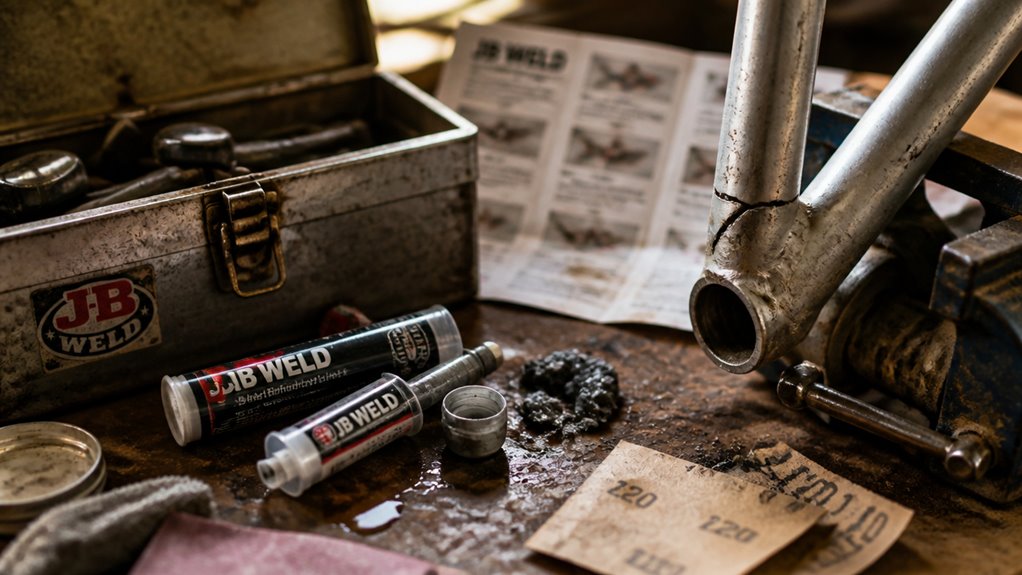
You’ll find J-B Weld creates a strong, steel-reinforced bond ideal for durable metal repairs with tensile strength up to 5,000 psi.
To get the best results, thoroughly clean and roughen surfaces before mixing equal parts resin and hardener.
Then clamp parts firm during a 15–24 hour cure. It excels under static loads but isn’t suited for flexible or high-vibration joints.
Different variants tackle moisture or uneven repairs. Keep going to explore detailed tips and product options.
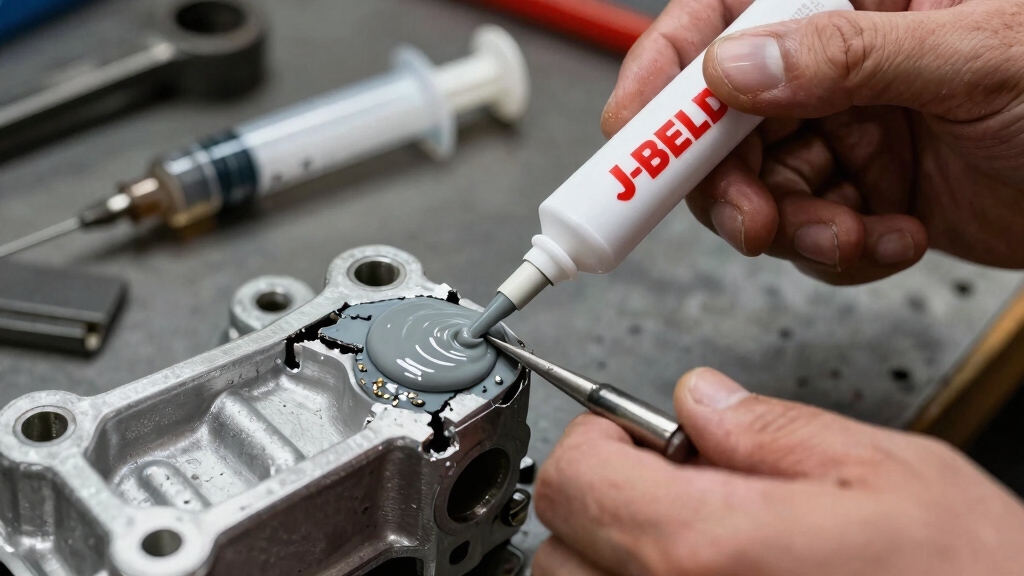
J-B Weld combines a two-part epoxy resin and hardener to create a cold-weld adhesive specifically designed for metal repairs and general bonding tasks.
When you mix these components, a chemical reaction begins, forming a rigid, steel-reinforced bond that withstands tensile strengths around 5,000 psi.
It’s engineered to deliver durable, static repairs rather than flexible joints, making it ideal for metal-to-metal applications.
The epoxy’s steel particles boost mechanical strength, allowing it to substitute welding in low-stress, non-structural fixes.
You should note that its effectiveness relies on the adhesive’s ability to bond tightly to clean, prepared surfaces.
Various product lines cater to specific environments, like MarineWeld for aquatic exposure or SteelStik for putty-style repairs.
All operate on the same epoxy-hardener principle.
To ensure maximum bond strength, it is crucial to prepare surfaces properly by cleaning, roughening, and removing oils before application.
Although the epoxy begins curing once mixed, you need to prepare your surfaces properly and apply the adhesive precisely to guarantee maximum bond strength.
Start by mixing equal parts of resin and hardener thoroughly until uniform. Then, spread the mixture evenly over one surface to ensure full coverage and intimate contact.
Press the parts together firmly, using clamps if possible, to maintain alignment and prevent gaps. Keep the bonded assembly undisturbed during curing to avoid weakening the joint.
Key steps include:
Mixing resin and hardener thoroughly for a uniform catalyst reaction.
Applying an even layer to maximize contact area and adhesion.
Clamping or securing parts to maintain pressure throughout curing.
Allow at least 15–24 hours for full cure before handling or stressing the joint. It is important to apply the adhesive on dry, prepped surfaces to ensure the strongest bond and durability.
To get the strongest J-B Weld bond, you really need to start with surfaces that are squeaky clean.
That means no oil, rust, paint, or moisture should be hanging around.
A good way to tackle this is by using abrasive methods like sanding or wire brushing.
It’s all about roughening up the substrate, which helps increase the surface area for a better mechanical grip.
Now, why is this so important?
Well, proper surface prep ensures you get peak chemical contact, which is key to enhancing the durability of your bond.
Taking the time to prep your surfaces right will pay off in the long run!
Also, ensuring the product is fully cured according to the recommended cure times is essential for maximum bond strength and longevity.
Preparing surfaces thoroughly is essential for achieving the strongest possible bond with J-B Weld. You need to remove all contaminants that could interfere with adhesion.
Start by degreasing the area with a solvent like acetone or isopropyl alcohol to eliminate oils and residues.
Next, mechanically abrade the surface with sandpaper or a wire brush to expose fresh material and increase surface area.
Finally, wipe down the surface to remove dust and particles before applying the epoxy.
Key cleaning steps include:
These techniques guarantee peak chemical bonding and mechanical grip for the strongest J-B Weld bond. Proper surface preparation is critical because oxidation and moisture can cause adhesion failure, especially in plumbing environments where ensuring a dry surface can be challenging surface preparation.
When you increase the surface roughness before applying J-B Weld, you markedly boost the mechanical interlocking between the adhesive and the substrate. Use abrasive methods like sanding or grinding to create micro-textures, which significantly expand the bonding area.
Make certain you remove all contaminants—oil, rust, paint, and moisture—since even minor residues can weaken adhesion. After roughening, thoroughly clean the surface with a solvent like acetone to eliminate dust and oils.
Precision in this preparation phase directly influences bond strength, as J-B Weld relies on both chemical bonding and mechanical grip. Avoid over-smoothing or leaving contaminants, as these reduce effective contact.
Proper surface prep sets the foundation for a durable, high-strength bond capable of matching or exceeding the base material’s performance under static loads. For metal bonding applications, selecting the appropriate welding technique can further enhance joint strength and durability.
Evaluate J-B Weld’s strength by comparing it directly with the metal it bonds.
While J-B Weld’s tensile strength can reach around 5000 psi, it rarely surpasses the yield strength of common metals like steel or aluminum under heavy loads.
You should understand that the epoxy forms a rigid, steel-reinforced bond, but it behaves differently than metal under stress.
In practical terms, consider:
This makes J-B Weld a powerful adhesive, yet not equivalent to the inherent strength of the metal itself.
Applying moderate heat during curing can significantly improve the bond strength and reduce drying time, making heat curing methods an important consideration for optimal results.
Although J-B Weld offers impressive bonding strength, you should reserve its use for non-structural repairs and static load applications where flexibility and extreme stress resistance aren’t critical.
It excels at metal-to-metal bonding, filling cracks, gaps, and damaged threads, making it ideal for automotive, marine, and household fixes.
You’ll get the best results on clean, roughened surfaces with proper mixing and curing.
However, avoid relying on it for heavy vibration, high heat, or load-bearing structural components, as its rigid epoxy can crack or fail under those conditions.
Additionally, repeated thermal cycling and dynamic stress reduce durability.
For maximum longevity, ensure proper surface preparation and curing before use.
Since different repair scenarios demand specific properties, choosing the right J-B Weld variant is essential for achieving ideal results. You want to match the epoxy’s characteristics to your project’s environment and load requirements.
For instance, Original J-B Weld excels at rigid, high-strength metal bonding, making it ideal for automotive and household repairs. MarineWeld offers enhanced water resistance and faster curing, perfect for marine applications. SteelStik, a putty form, suits quick, moldable fixes on wet or uneven surfaces.
Use Original for durable, static metal repairs requiring high tensile strength. Select MarineWeld when moisture exposure and corrosion resistance are critical. Apply SteelStik for on-the-spot, wet-environment repairs needing shape retention. Proper surface preparation and curing conditions are critical for maximizing pressure capacity and bond strength.
Yes, you can paint over J-B Weld after it fully cures. To guarantee proper adhesion, lightly sand the cured surface to create a better mechanical bond for the paint.
Cleaning the area of any dust or grease before painting is essential. Use paint compatible with epoxy surfaces, typically oil-based or acrylic paints.
Keep in mind that painting won’t affect the epoxy’s strength but improves aesthetics and surface protection.
You wouldn’t want to use J-B Weld where your food touches, like a cutting board or utensils.
Though it’s tough and durable, it’s not FDA-approved for food contact and can leach chemicals.
It excels in metal repairs, but its curing agents and resins don’t meet strict food safety standards.
If you need a safe bond for kitchenware, opt for food-grade adhesives specifically designed for that purpose.
Once opened, you should use J-B Weld within six months for best performance.
Exposure to air can start the curing process inside the tubes, reducing effectiveness over time.
Store it tightly sealed in a cool, dry place to slow degradation.
If the epoxy or hardener thickens or hardens prematurely, it’s likely past its prime and won’t bond as strongly or cure properly.
Discard and replace as needed.
When it comes to bonding plastic or rubber, J-B Weld isn’t your ace in the hole. It’s primarily designed for metal and rigid repairs, so it doesn’t adhere well to flexible or non-porous surfaces like most plastics and rubbers.
For these materials, you’ll want a specialized adhesive formulated for flexibility and chemical compatibility. J-B Weld’s steel-reinforced epoxy can crack or peel under stress or movement on plastics and rubber.
You can expect unopened J-B Weld to have a shelf life of about two to three years when stored properly.
Keep it in a cool, dry place away from direct sunlight and extreme temperatures to maintain its effectiveness.
Once opened, the chemical reaction starts, so the usable life shortens markedly.
Always check for separation or hardening before use, as degraded epoxy won’t cure or bond correctly.
When you need a metal repair that sticks like steel itself, J-B Weld often coincides with your expectations perfectly.
You’ll find that by preparing surfaces properly and following curing steps, this epoxy forms a bond rivaling metal strength.
Whether you’re fixing a cracked pipe or reinforcing a broken tool, understanding its variants helps you pick the right formula.
Trust in J-B Weld’s precise chemistry. It’s engineered for durability when metal meets epoxy.