Phone:
(701)814-6992
Physical address:
6296 Donnelly Plaza
Ratkeville, Bahamas.

Phone:
(701)814-6992
Physical address:
6296 Donnelly Plaza
Ratkeville, Bahamas.

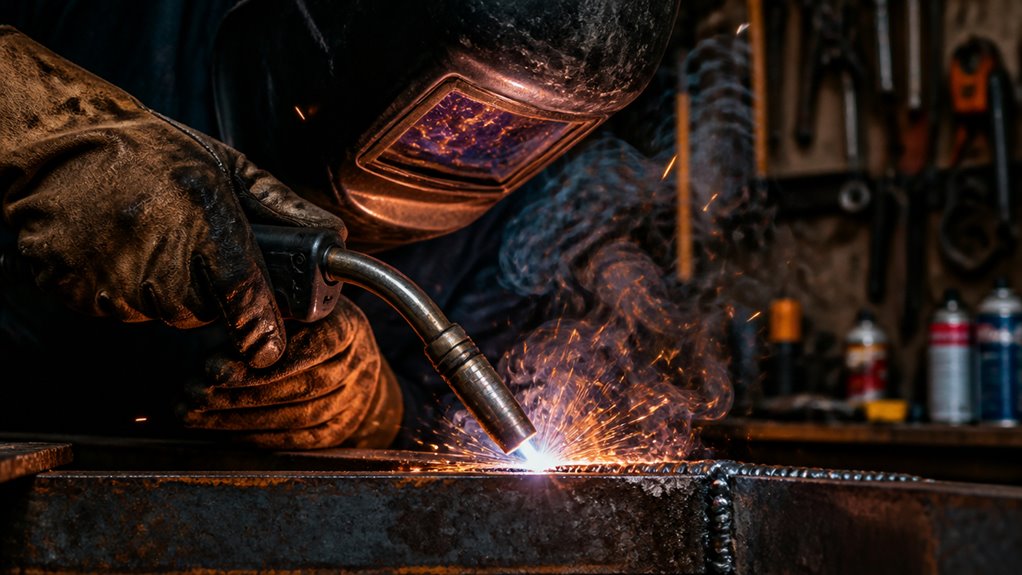
You can MIG weld without gas by using self-shielded flux-cored wire, which contains flux that produces protective gases and slag during welding.
Start by switching your welder to DC electrode negative polarity. Install the correct drive rollers and contact tips for your wire diameter, and fine-tune voltage and wire-feed speed.
This method works well outdoors and on contaminated surfaces but requires good ventilation and slag cleanup.
Keep your settings precise to avoid spatter and weak welds. You’ll find more detailed guidance on wire selection, setup, and troubleshooting ahead.
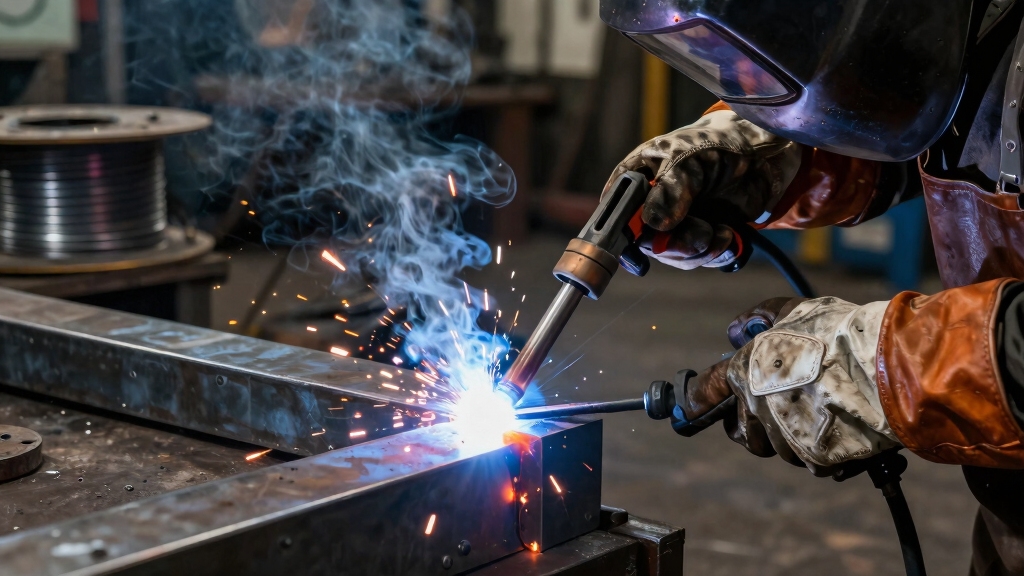
When you hear the term “gasless MIG welding,” it usually refers to flux-cored arc welding using self-shielded flux-cored wire.
Gasless MIG welding typically means using self-shielded flux-cored wire for effective welding without external gas.
This wire has a tubular core filled with flux, which melts as you weld, producing protective gases that shield the molten weld pool from atmospheric contamination.
A slag layer forms on top, protecting the cooling bead and stabilizing the weld.
Unlike standard MIG welding with solid wire, gasless MIG doesn’t require an external shielding gas, making it ideal for outdoor or windy conditions.
If you try to weld with solid wire without gas, oxygen and nitrogen contaminate the weld, causing porosity and weak joints.
Gasless MIG uses specific wire and polarity settings to maintain weld quality without relying on external shielding gas.
The self-shielded process offers consistent welds even on contaminated surfaces, reducing cleanup time and improving efficiency.
When you’re picking flux-cored wire for gasless MIG, the first thing to consider is going for a self-shielded wire type. These are specifically designed for FCAW-S applications, which makes them a great choice.
Next up, you’ll want to match the wire diameter to both your welding equipment and the material thickness you’re working with. This is key for achieving the best feed and penetration.
Oh, and don’t forget about your machine’s polarity settings! It’s super important to ensure they’re compatible with the wire you’re using. This helps keep that arc performance stable, which is exactly what you want while welding.
Self-shielded wires generate their own protective gas shield internally, meaning external gas is not necessary for outdoor or windy conditions.
Selecting the right flux-cored wire is essential for achieving strong, clean welds without shielding gas.
You’ll mainly encounter two types: self-shielded (FCAW-S) and gas-shielded (FCAW-G).
For gasless MIG welding, focus on self-shielded wires, which contain flux that generates protective gases and slag during welding.
This eliminates the need for external gas. These wires work well outdoors and in windy conditions.
Gas-shielded flux-cored wires, by contrast, require external shielding gas and aren’t suitable for gasless setups.
Within self-shielded wires, choose based on your base metal. Mild steel wires are common, but stainless or low-alloy options exist for specialized applications.
Also, check the wire’s classification and recommended polarity to ensure compatibility with your welder and welding technique.
Understanding the flux composition helps control slag formation and weld metal chemistry for better results.
After choosing the appropriate type of self-shielded flux-cored wire, the next step is to pick the right wire diameter for your gasless MIG welding project.
Generally, 0.030-inch and 0.035-inch diameters are the most common choices. Use 0.030-inch wire for thinner metals, typically under 1/8 inch, where better control and less heat input help prevent burn-through.
Opt for 0.035-inch wire on thicker materials, above 1/8 inch, to guarantee deeper penetration and faster deposition rates. Keep in mind that larger diameters require higher amperage settings and may produce more spatter.
Also, check your welder’s drive rolls and contact tips compatibility with the selected diameter to avoid feeding issues. Selecting the right diameter guarantees stable arc performance, consistent weld quality, and efficient gasless MIG welding.
Proper voltage and wire speed tuning are also essential to optimize arc stability and control spatter when using different wire diameters in gasless MIG welding.
Because flux-cored wires require specific polarity settings to function correctly, you’ll need to match your wire type with your welder’s polarity capabilities to guarantee stable arc performance.
Most self-shielded flux-cored wires require a DC electrode negative (DCEN) setup, where the wire is connected to the negative terminal. This polarity guarantees proper melting of the flux core and consistent gas shielding from the flux vapors.
Using the wrong polarity leads to poor arc stability, excessive spatter, and weak welds.
When choosing flux-cored wire, consider:
Matching polarity and wire guarantees reliable, high-quality gasless MIG welding. Maintaining DCEN polarity is essential to optimize arc stability and penetration when using flux-core wires.
Using standard MIG wire without shielding gas exposes your weld pool to oxygen and nitrogen from the atmosphere. This leads to oxidation and contamination, which causes porosity in the weld.
Standard MIG wire without shielding gas allows atmospheric gases to cause oxidation and weld porosity.
Porosity compromises structural integrity, resulting in weak joints that are prone to failure under stress. Without gas, you’ll also experience excessive spatter, making cleanup more difficult and slowing your workflow.
The weld bead’s appearance deteriorates, showing irregularities and roughness due to unstable arcs and lack of protection. Additionally, the absence of shielding gas disrupts arc stability, increasing the risk of incomplete fusion and cracking.
To maintain weld quality and strength, avoid using solid MIG wire without proper shielding gas. Instead, switch to self-shielded flux-cored wire designed for gasless welding applications. However, be aware that flux-cored wires still produce inconsistent weld quality and are not a substitute for 100% argon shielding in critical applications.
To weld without gas, you’ll want to switch to a self-shielded flux-cored wire that’s made specifically for gasless operation. It’s pretty straightforward!
Just remember to adjust your welder settings by disconnecting the gas supply. If your machine requires it, you’ll need to change the polarity to electrode negative.
Also, don’t forget to install the right drive roller and contact tip that match your wire diameter. This step is crucial for ensuring smooth feeding and consistent arc performance.
With everything set up correctly, you’ll be ready to tackle your welding projects!
Be sure to choose the correct wire diameter to match your metal thickness and amperage for optimal performance when welding without gas.
Selecting the right flux-cored wire is essential for successful gasless MIG welding. You need a self-shielded wire specifically designed for gasless operation, as it contains flux that generates protective gases and slag during welding.
Avoid using solid MIG wire without gas, or you’ll face porosity and weak welds. Choose the correct diameter for your welder and project thickness to maintain stable arc performance.
Consider these key points when choosing flux-cored wire:
Self-shielding capability eliminates the need for external gas.
Ensure compatibility with your machine’s polarity and drive rollers.
Select a flux composition suited to your base metal type.
Choose a wire diameter that matches your application’s penetration and bead size.
Minimize excessive spatter and slag for easier cleanup.
Flux core’s continuous wire feed allows faster material deposition and higher productivity compared to stick welding.
Picking the right wire sets the foundation for strong, reliable gasless welds.
Adjust your welder settings carefully to optimize performance for gasless MIG welding with flux-cored wire. Start by switching polarity to electrode negative (DCEN), essential for self-shielded flux-cored wires.
Remove the shielding gas and install the correct drive rollers and contact tips matching your wire diameter. Fine-tune voltage and wire feed speed through test welds, aiming for a stable arc and minimal spatter. Keep your base metal clean to prevent contamination.
Make sure to use the drag torch technique to manage slag coverage and ensure proper penetration during flux core welding.
| Parameter | Recommended Setting | Notes |
|---|---|---|
| Polarity | Electrode Negative (DCEN) | Required for flux-cored wire |
| Wire Diameter | 0.030″ or 0.035″ | Match drive rollers/tips |
| Voltage Range | 18-22 V | Adjust for bead shape |
| Wire Feed Speed | 300-400 inches/min | Controls penetration and spatter |
Mastering gasless MIG welding requires adopting specific techniques that compensate for the lack of shielding gas.
You’ll rely on flux-cored wire’s self-shielding properties, but you must adjust your approach to control slag, spatter, and heat input effectively.
Use a pull or drag technique to maintain a stable arc and prevent slag inclusion.
Short, controlled passes help manage bead shape and cooling rates, minimizing defects.
Always clean your base metal thoroughly to assure strong welds.
Practice on scrap metal to fine-tune your voltage and wire-feed settings.
Tack welds might need slag removal before continuing.
Embrace patience; slag and smoke obscure the arc but protect your weld.
Focus on steady, deliberate movement to control bead quality.
Prepare surfaces meticulously for solid fusion.
Adjust parameters based on scrap trials for confidence.
Accept slag cleanup as part of the process to assure durability.
Ensure thorough surface preparation to improve strength and durability before welding.
Now that you’ve honed your technique for gasless MIG welding, it’s important to understand what makes this method stand out and where it falls short.
You’ll appreciate that gasless MIG welding eliminates the need for external shielding gas, making your setup simpler and more portable. This is especially beneficial in windy or remote environments.
The self-shielded flux-cored wire provides reliable protection against atmospheric contamination, ensuring strong joints without complex equipment.
However, expect increased spatter and slag, which means you’ll spend more time cleaning the weld bead afterward.
Also, fumes and smoke levels are higher than with gas-shielded MIG, requiring good ventilation.
Finally, the weld’s appearance tends to be rougher, so gasless MIG isn’t ideal for high-cosmetic or precision work.
Understanding these trade-offs helps you choose the right approach for your project.
Frequently, welders encounter specific challenges when working with gasless MIG welding that can affect the quality and strength of their joints. Recognizing and addressing these issues quickly guarantees durable, clean welds.
Common problems include excessive spatter, poor arc stability, slag inclusion, porosity, and weak penetration. Here’s how to fix them:
Adjust voltage and wire feed speed to reduce spatter and improve arc stability.
Clean the base metal thoroughly to prevent slag and porosity.
Use the correct polarity (electrode negative) and proper drive rollers for the wire.
Employ a pull technique with steady, controlled passes to manage heat and bead shape.
Remove slag between passes to avoid inclusions and guarantee strong fusion.
Yes, you can switch between gas-shielded and gasless MIG during the same project, but you must change your setup accordingly.
Switch wire types from solid wire for gas-shielded to flux-cored for gasless and adjust polarity if needed.
Remove or reconnect your shielding gas system as appropriate.
Also, swap drive rollers and contact tips to match wire diameter.
Keep base metals clean and expect differences in weld appearance and cleanup requirements between methods.
Picture thick smoke swirling around your face as sparks fly. Wear a welding helmet with a proper shade lens to protect your eyes and skin.
Use flame-resistant gloves and a long-sleeve jacket to shield your arms from spatter and slag. Respiratory protection is essential since gasless MIG produces more fumes; a respirator or welding fume extractor keeps your lungs safe.
Don’t forget sturdy boots and ear protection to complete your gear setup.
Weather conditions impact gasless MIG welding less than gas-shielded MIG since flux-cored wire creates its own shielding gas.
You can weld outdoors even in windy conditions without worrying about gas blow-off.
However, heavy rain or moisture can cause porosity and weaken the weld, so you should avoid welding in wet environments.
Cold temperatures can affect wire feed and weld penetration, so adjust settings accordingly to maintain consistent quality.
You can use gasless MIG welding on certain stainless steel types with self-shielded flux-cored wire designed specifically for stainless.
However, it’s not suitable for aluminum, since flux-cored wires for aluminum don’t exist.
Shielding gas is essential to prevent oxidation.
For stainless, make sure you select the right wire and adjust polarity accordingly.
Expect more cleanup due to slag, and remember that weld quality may not match gas-shielded processes.
After gasless MIG welding, you’ll want to treat your equipment like a well-oiled machine.
Clean the contact tip and drive rollers to prevent wire feeding hiccups. Remove slag and spatter buildup from the nozzle to ensure consistent arc stability.
Inspect the wire feeder for dust and debris, lubricate moving parts as needed, and check electrical connections for tightness.
Regular maintenance keeps your gear firing smoothly and extends its lifespan.
Now that you know the ins and outs of gasless MIG welding, you might think it’s a simple swap from gas-shielded methods. But beware. Choosing the wrong wire or ignoring settings can lead to costly defects.
Yet, when you master flux-cored wire and adjust your welder precisely, you release a versatile, portable welding option.
Ready to tackle your next project without gas? The challenge is real, but so is the payoff.