Phone:
(701)814-6992
Physical address:
6296 Donnelly Plaza
Ratkeville, Bahamas.

Phone:
(701)814-6992
Physical address:
6296 Donnelly Plaza
Ratkeville, Bahamas.

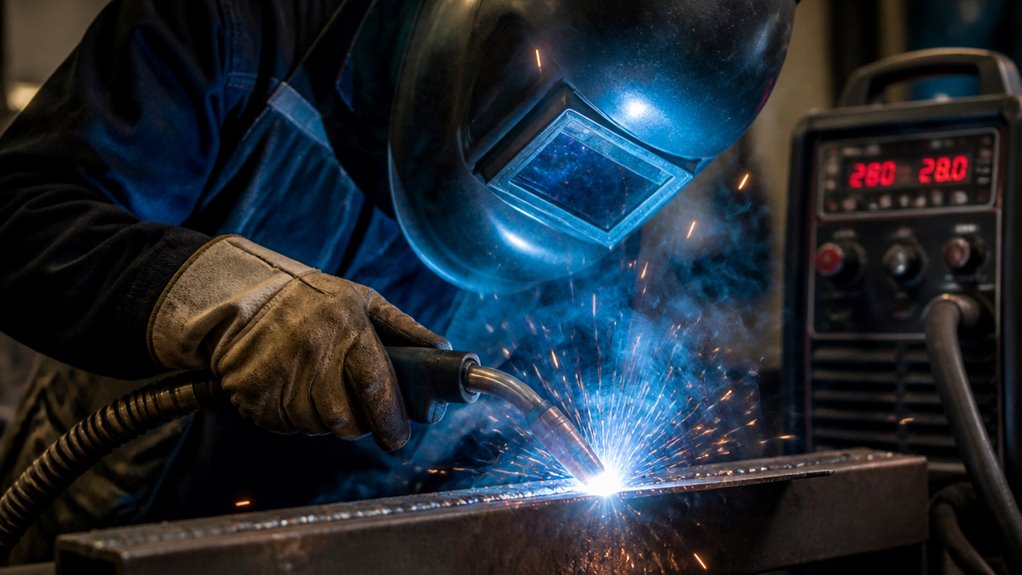
You’ll find welders typically draw between 1,000 and 8,000 watts, depending on the type and settings.
MIG welders often use 2,000–8,000W, TIG around 1,000–3,000W, and stick welders 1,500–6,000W.
Startup wattage can surge 30–50% above running watts due to motor and arc initiation.
Duty cycle further affects average power use by limiting continuous operation.
Understanding these details helps you accurately size circuits or generators for your welding setup and optimize efficiency.
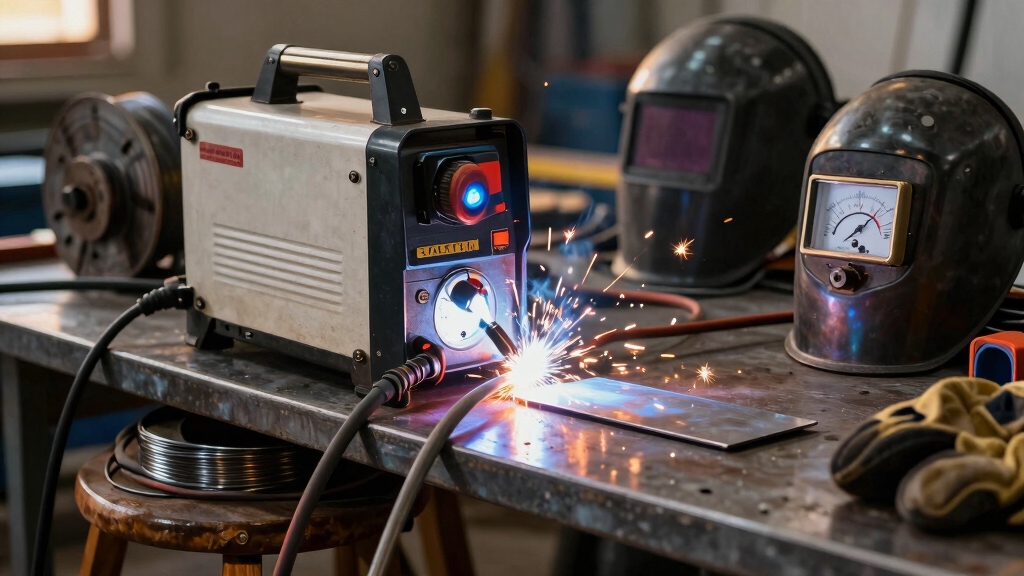
Understanding the power requirements for common welding applications helps you select the right equipment and power source.
Knowing welding power needs ensures you choose the proper gear and power supply effectively.
MIG welders typically demand 2,000 to 8,000 watts depending on output current and wire feed speed.
TIG welders range between 1,000 and 3,000 watts under typical conditions.
Stick welders often require 1,500 to 6,000 watts for 100-amp models.
Flux-cored welders show distinct running (about 2,800W) and starting (around 4,500W) power needs, critical for generator sizing.
Specialty welders like plasma arc or laser can exceed 50,000 watts based on process and machine class.
Duty cycle impacts actual energy consumption, so you must consider both peak wattage and operating time.
Selecting the appropriate power source, whether direct current or alternating current, is essential to optimize arc stability and welding performance.
Matching your welder’s power needs with the correct supply starts by calculating its wattage based on available voltage and current.
Use the formula Watts = Volts × Amps to estimate power draw. For example, if your welder operates at 240V drawing 30A, it demands about 7,200W.
Check your machine’s label or manual to find these ratings precisely. Remember, input current can differ markedly from output welding current, especially in high-amperage units.
Also, account for startup power surges by adding roughly 30% above the running wattage to size your power source safely.
This calculation provides a baseline for evaluating your electrical needs, ensuring compatibility with your power supply and avoiding under- or over-sizing.
Accurate wattage calculation is critical for efficient, safe welding operation.
For safe and reliable use, always match your welder’s power requirements with the correct wire gauge and circuit breaker ratings.
Although wattage requirements vary widely, you can generally expect MIG welders to draw between 2,000 and 8,000 watts depending on their output current and wire feed speed.
TIG welders typically consume less power, around 1,000 to 3,000 watts. Stick welders range from 1,500 to 6,000 watts. Flux-cored welders commonly operate near 2,800 watts.
Specialized welders like plasma arc or laser welders may demand from 5,000 up to 50,000 watts.
| Welder Type | Typical Wattage Range (W) |
|---|---|
| MIG | 2,000 – 8,000 |
| TIG | 1,000 – 3,000 |
| Stick | 1,500 – 6,000 |
| Flux-cored | ~2,800 |
| Plasma/Laser | 5,000 – 50,000 |
Inverter welding machines improve energy efficiency and reduce power consumption through high-frequency operation, making them a smart choice for managing electrical load.
Understanding these ranges helps you select appropriate power sources and plan for electrical capacity.
You might’ve noticed that starting watts are higher than running watts. This happens because the welder’s motor and the arc need a quick burst of power right at the start. It’s kind of like when you start a car; it takes a bit more energy to get everything moving.
This initial surge is crucial. It helps overcome electrical and thermal inertia, which means it kicks in to handle the sudden load increase when the arc strikes and all the components start working. So, understanding these temporary conditions is really important if you want to size power sources accurately for your welding equipment. Welding transformers use high current at low voltage to generate and maintain the arc, which contributes to the initial power surge.
Because welders rely on electric motors and arc initiation processes, their power draw spikes markedly at startup compared to steady operation.
When you start a welder, the motor that drives wire feed or cooling systems demands an initial surge of current to overcome inertia. This inrush current is higher than the motor’s running current, causing a noticeable wattage peak.
Simultaneously, the arc initiation requires a transient high-voltage pulse to strike the arc, which also contributes to the surge.
Once the motor reaches operational speed and the arc stabilizes, current draw decreases to a steady state.
Understanding this motor and arc surge explains why starting watts exceed running watts. This impacts generator sizing and circuit protection to guarantee reliable, uninterrupted welding performance.
Proper setup and maintenance of the wire feed mechanism and power source connections are essential to minimize electrical resistance and ensure efficient operation during both startup and steady welding conditions.
Initial power demand reflects the transient surge in electrical load that welders experience at startup.
When you switch on a welder, the inrush current spikes beyond the steady-state running current due to the sudden energizing of internal components like transformers and motors.
This surge causes starting watts to exceed running watts by approximately 30% to 50%, depending on machine type and design.
The initial demand accounts for magnetizing the transformer core and overcoming mechanical inertia before normal operation stabilizes current draw.
You’ll see this reflected in generator sizing, where startup wattage ratings markedly exceed running wattage to prevent voltage drops or protective trips.
Understanding this transient behavior helps you select appropriate power sources that handle peak loads without compromising welder performance or equipment longevity.
Proper tap selection on the welding transformer can also help manage these initial power surges by optimizing voltage and current output during startup, ensuring arc stability and reducing stress on electrical components.
Understanding why starting watts exceed running watts involves examining both thermal and electrical inertia within the welder’s components.
When you power up the machine, electrical inertia causes a surge as capacitors charge and transformers magnetize, demanding higher initial current.
Simultaneously, thermal inertia requires extra energy to heat internal elements like coils and circuit boards from ambient temperature to operational levels.
This combined effect results in a transient spike in power consumption exceeding steady-state running watts.
Once components reach stable temperatures and magnetic fields saturate, power draw stabilizes at a lower level reflecting welding output and duty cycle.
Consequently, starting watts incorporate these inertia-driven surges, explaining why generator sizing and power supply planning must factor in a 30-50% wattage margin above continuous running watts to ensure reliable operation.
Additionally, applying the NEC 200% rule helps accommodate these initial current surges safely within electrical systems.
While voltage and amperage set the baseline for a welder’s power draw, the duty cycle plays a critical role in determining actual energy consumption during operation.
The duty cycle, expressed as a percentage, indicates how long the welder can operate at a given output within a 10-minute period without overheating.
If your machine has a 60% duty cycle at 200 amps, it means it draws full power for 6 minutes and then must cool for 4 minutes.
This cyclical operation reduces average power consumption compared to continuous running.
To estimate real energy use, multiply volts, amps, and duty cycle (as a decimal), then convert to kilowatt-hours.
Consequently, a higher duty cycle directly increases total electrical load, demanding a more robust power supply and impacting operational costs.
Keep in mind that 120V MIG welders typically max out around 140–160 amps, which limits their duty cycle and overall power consumption.
You know, it’s really important to grasp the difference between input and output power when it comes to welding machines.
Input power, which you calculate by multiplying volts and amps, essentially shows how much electricity your welder is pulling from the supply.
On the flip side, output power is what actually makes it to the arc. This value is often lower because of efficiency losses; not all the power a welder uses goes into creating that arc.
So, when you compare these two figures, you can really get a better sense of how your machine performs and what its power needs are.
It’s a practical way to ensure you’re getting the most out of your equipment!
Understanding whether your welder operates in constant current or constant voltage mode can also impact how efficiently that power is delivered to the arc.
Because welding machines convert electrical energy into heat and light to join metals, the input power they draw from the source often differs markedly from their welding output power.
You need to understand that input power reflects the actual electrical demand on your supply, not just the welding current it produces.
Factors influencing input power include:
This input power is vital for sizing circuits and generators properly.
It ensures stable operation without overloads.
It’s a more all-encompassing metric than output power alone, as it accounts for conversion losses and operational dynamics.
Adjusting welding parameters such as voltage and amperage based on material thickness and welding position can also impact the input power requirements.
Understanding input power lays the foundation for distinguishing between a welder’s input and output power. Input power is what the machine draws from the electrical source (Volts × Amps), while output power is the energy actually delivered to the welding arc, often measured in amperage and voltage at the weld.
Due to inefficiencies, input power always exceeds output power. You need to take into account this difference to accurately size power supplies and manage energy consumption.
| Parameter | Input Power (Watts) | Output Power (Watts) |
|---|---|---|
| 120V, 15A Welder | 1,800 | ~1,200 |
| 240V, 30A Welder | 7,200 | ~5,000 |
| 200A MIG Welder | 44,000 | ~30,000 |
This table highlights typical input-output disparities in welders.
Calculate the total power requirements before selecting a generator for welding applications to guarantee reliable operation.
Start by determining the welder’s running watts using the formula: Watts = Volts × Amps.
Then, factor in startup surge by adding 30-50% more watts to cover initial power spikes.
Consider the duty cycle, as continuous load impacts generator sizing.
Focus on these key elements:
Identify welder type and typical wattage range (e.g., MIG: 3,000-8,000W).
Calculate running watts and add surge margin for startup.
Account for duty cycle to estimate sustained power demand.
This method ensures you choose a generator with enough capacity to handle peak welding loads without overloading or causing interruptions.
Although welding equipment demands significant power, you can optimize its energy use by adjusting settings and operational practices.
First, select the lowest amperage that achieves weld quality to reduce current draw.
Second, minimize idle time since welders consume power even when not welding.
Third, use appropriate duty cycles to avoid unnecessary energy spikes.
Fourth, ensure proper maintenance to prevent energy losses.
Finally, consider using inverter-based welders, which are more energy-efficient than transformer types.
| Tip | Benefit |
|---|---|
| Optimize amperage settings | Reduces current and wattage |
| Minimize idle time | Lowers overall energy usage |
| Control duty cycle | Prevents excessive draw |
| Maintain equipment | Improves efficiency |
| Use inverter welders | Enhances energy conversion |
You should always wear proper personal protective equipment, including a welding helmet with the correct shade, flame-resistant gloves, and clothing.
Make certain your work area has adequate ventilation to avoid harmful fumes.
Use properly rated extension cords and circuits to handle the high wattage, preventing overloads or electrical fires.
Keep a fire extinguisher nearby and maintain clear access to emergency shutoffs.
Regularly inspect your equipment for damage or wear before use.
Before the dawn of electric welding, ambient temperature wasn’t a concern. However, it now affects power consumption.
When it’s cold, your welder works harder to maintain stable arcs and consistent heat, drawing more watts.
In hotter environments, cooling demands rise, increasing power use for fans or cooling systems.
You should expect fluctuations in energy draw based on temperature, affecting efficiency and possibly duty cycle performance.
Yes, solar power systems can support welding equipment if they’re sized correctly.
You’ll need a system capable of handling the welder’s startup surge wattage plus continuous running watts, often between 3,000W and 10,000W or more.
Battery storage and inverter capacity must match these demands, especially for heavy-duty welders.
Proper load management and sufficient solar input guarantee stable operation, but smaller or intermittent systems may struggle with high power spikes.
Regularly inspect and clean your welder’s electrical connections and cables to reduce resistance and prevent voltage spikes.
Tighten loose terminals and replace damaged wires to maintain stable current flow.
Keep cooling systems functional to avoid overheating, which can cause sudden power surges.
Calibrate control circuits and check for worn components like capacitors or contactors; faulty parts often trigger surges.
Proper maintenance guarantees consistent power delivery and prolongs your welder’s lifespan.
Yes, you’ll find specific welders designed for low-energy usage, especially inverter welders.
These machines optimize power efficiency by converting AC to DC more effectively, reducing energy waste.
You’ll see lower running watts, often around 1,000 to 3,000W for TIG or MIG models.
They also typically have adjustable duty cycles and smart controls to minimize power draw during idle periods.
This helps you save electricity without sacrificing performance.
To power your welder proficiently, prioritize precise power planning. Understanding wattage from voltage and amps to duty cycles prevents performance pitfalls and protects your equipment.
Starting watts spike, so sizing your generator smartly safeguards seamless operation. Streamlining energy use not only saves costs but sustains system strength.
By balancing input with output and respecting your welder’s specific specifications, you’ll wield welding wattage wisely. Win with well-informed, watt-efficient work every time.