Phone:
(701)814-6992
Physical address:
6296 Donnelly Plaza
Ratkeville, Bahamas.

Phone:
(701)814-6992
Physical address:
6296 Donnelly Plaza
Ratkeville, Bahamas.

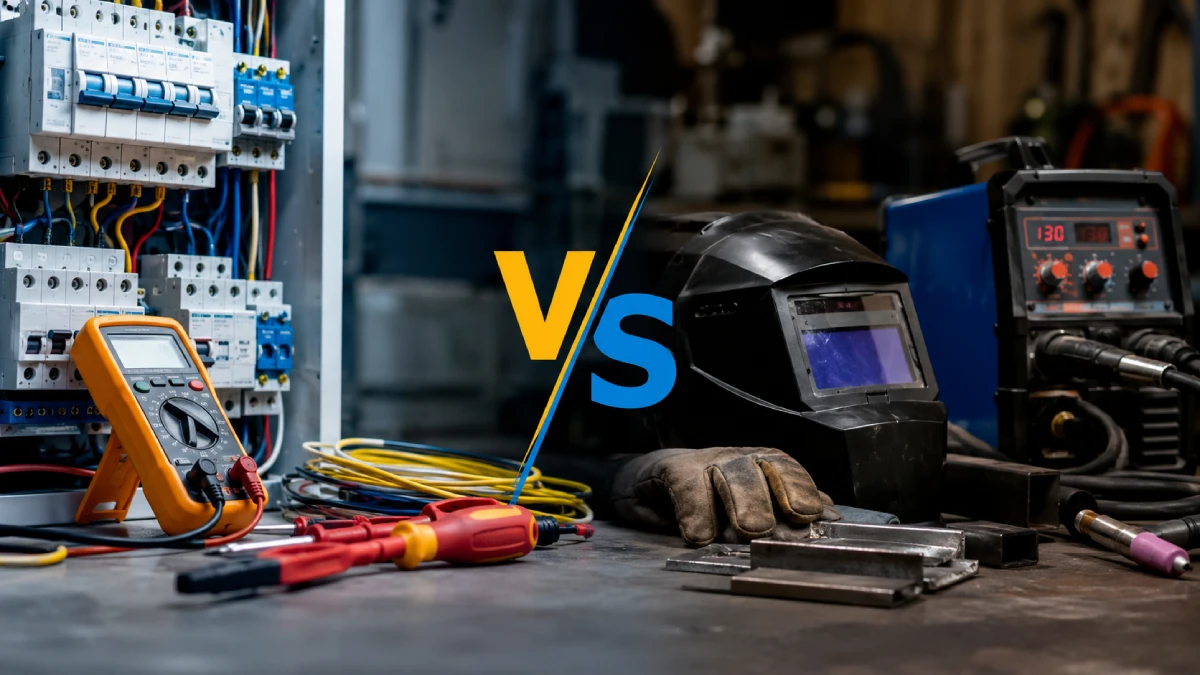
If you’re deciding between electrician and welder, consider that electricians install and maintain complex electrical systems, requiring formal apprenticeships and licensing.
Welders fuse metal parts using heat, with hands-on training and optional certification.
Electricians earn a median of $62,350, higher than welders‘ $51,000, but welders can specialize for bigger pay.
Both trades demand physical stamina and focus on safety, yet operate in distinct environments with unique tools.
Understanding their roles, training, and outlook will clarify which fits your goals best.
| Feature | Electrician | Welder |
|---|---|---|
| Primary Job | Install, maintain, and repair electrical systems | Join, fabricate, and repair metal components |
| Main Work | Electrical wiring, panels, circuits, troubleshooting | Metal fabrication, cutting, and welding |
| Training Duration | About 4-year apprenticeship | 2–4 years of hands-on training |
| Licensing | Usually required | Often optional (depends on employer/location) |
| Certifications | State license, Journeyman, Master Electrician | AWS and specialty welding certifications |
| Median Annual Salary | Around $62,350 | Around $51,000 |
| Top Earning Potential | Over $106,000 | Up to $200,000 in specialized welding fields |
| Job Growth | Around 10% | Around 3% |
| Work Environment | Homes, commercial buildings, industrial facilities | Construction sites, fabrication shops, factories, outdoors |
| Physical Demands | Moderate to high | High |
| Primary Hazards | Electrical shock, arc flash, falls | Heat, sparks, UV radiation, fumes |
| Essential Tools | Multimeter, wire strippers, voltage tester | Welding machine, torch, helmet, grinder |
| Best Specializations | Industrial, renewable energy, automation | Underwater, pipeline, aerospace, nuclear welding |
| Career Stability | Excellent | Good |
| Best For | Those who enjoy electrical systems and troubleshooting | Those who enjoy metal fabrication and hands-on work |
| Main Advantage | Higher salary, stronger job growth, licensing-based career path | Faster entry into the workforce and high earning potential in specialized fields |
| Main Drawback | Longer training and licensing requirements | More physically demanding with greater exposure to heat and fumes |
Although both electricians and welders work with essential infrastructure components, their core tasks differ markedly.
You’ll find electricians installing, maintaining, and repairing electrical wiring and systems across residential, commercial, and industrial sites.
They troubleshoot electrical faults, guarantee compliance with safety codes, and design wiring systems for new constructions. Welders, on the other hand, fuse metal parts using heat, pressure, or electricity, often working on structures like buildings, pipelines, or vehicles.
You’ll interpret blueprints to select materials and maintain welding equipment, while repairing metal imperfections. Specializations vary: electricians focus on construction or maintenance, whereas welders specialize in techniques such as gas metal arc welding or shielded metal arc welding.
Your daily tasks reflect these technical distinctions, requiring different skill sets and operational tools. Following qualified Welding Procedure Specifications ensures welders maintain consistency and code compliance in their work.
Because electricians handle complex and potentially hazardous electrical systems, they must complete formal education followed by a multi-year apprenticeship before working independently.
You’ll typically undergo a 4-year apprenticeship combining classroom instruction and on-the-job training to obtain your journeyman license, which is mandatory in most states.
In contrast, welders focus on skill competency through shorter training programs, usually 2–4 years, and certification remains optional depending on your work location.
Here’s a clear comparison:
Understanding these distinctions helps you choose the right career path based on required credentials and training intensity.
Welders often enhance their career prospects by obtaining performance-based certifications that validate their skills and may require renewal.
You’ll find that electrician roles are projected to grow about 10% over the next decade! This growth is largely driven by the expanding construction and alternative energy sectors.
Pretty exciting, right?
On the other hand, welder employment is expected to grow around 3%. This aligns more with average occupational trends, so it’s a bit slower compared to electricians.
Understanding these growth rates really helps you evaluate future career opportunities and see where the industry demand is headed.
It’s all about making informed decisions for your career!
For those interested in aerospace welding, gaining certifications like AWS D17.1 can significantly enhance job prospects in this specialized field.
When examining employment growth rates, electricians are projected to experience markedly higher demand than welders over the next decade. Updated projections indicate an approximate 10% growth for electricians from 2020 to 2030, compared to just 3% for welders. This disparity reflects evolving technology and regulatory requirements that intensify the need for skilled electrical labor.
Key growth rate distinctions include:
Understanding these growth metrics helps you assess long-term career stability and opportunities within each trade. Additionally, welders often require extended training and certification for advanced skills, which can affect job readiness and career advancement in the field of advanced welding techniques.
Although both electricians and welders play critical roles in construction and manufacturing, the demand drivers for each trade differ markedly due to industry-specific factors.
Electricians benefit from robust growth fueled by expanding construction projects and the rise of alternative energy installations, which require complex electrical systems and ongoing maintenance.
Regulatory changes emphasizing electrical safety and energy efficiency further increase demand for skilled electricians.
In contrast, welding demand aligns closely with manufacturing output, infrastructure repair, and heavy industry, which are more susceptible to economic fluctuations.
Welders’ growth remains steady but slower, at about 3%, reflecting mature markets and automation impacts.
You’ll find electrician employment projections at roughly 10% growth, driven by technological advancements and new builds.
Welders experience more modest increases, highlighting divergent industry dynamics shaping job outlooks in each field.
Both trades require adherence to strict safety standards and certifications to maximize career advancement and job security.
As technological advancements and regulatory requirements evolve, electricians will see stronger job growth compared to welders. Projections indicate a 10% increase in employment through 2030.
You’ll find electrician demand driven by expanding construction and alternative energy sectors. Welders, meanwhile, face a modest 3% growth rate, reflecting steady but slower industry changes.
Consider these key career outlook points:
Welding remains a critical skill within fabrication processes due to its role in creating permanent metal bonds that ensure structural integrity.
Several key salary differences distinguish electricians from welders, reflecting variations in training, skill demand, and specialization.
As an electrician, you can expect a median annual wage of about $62,350, roughly $11,350 higher than the $51,000 median for welders.
Top-tier electricians earn over $106,030 annually, while welders in the top 10% make around $75,850.
However, specialized welders such as underwater, pipeline, or nuclear welders can surpass typical electrician salaries, earning between $80,000 and $200,000.
Additionally, electricians benefit from significant overtime pay, averaging over $8,000 yearly, which boosts total income.
The higher median salary for electricians reflects their longer apprenticeship and licensing requirements, as well as growing demand in construction and alternative energy sectors.
This positions you for stronger earnings potential compared to most welding roles.
Maintaining welding certification continuity is crucial for welders to retain their qualifications and maximize earning opportunities.
You’ll find electricians working in all sorts of places—homes, commercial buildings, and industrial sites. They often have to navigate confined spaces and climb ladders while managing electrical systems. It can be quite a juggling act!
Welders, on the other hand, usually work in factories, construction zones, or even outdoors. They deal with intense heat, flying sparks, and heavy materials, which can be pretty demanding.
Both of these roles require a lot of physical labor and come with their own set of safety hazards. Electricians face electrical risks, while welders have to watch out for thermal and fume dangers. It’s important to stay aware in both jobs! Proper use of personal protective equipment is essential to prevent injuries and ensure safety on the job.
Within industrial, commercial, and residential environments, electricians navigate confined spaces, climb ladders, and handle exposed wiring to install and maintain electrical systems.
Welders, on the other hand, often work in factories, construction sites, or outdoor locations, dealing with metal fabrication and joining processes under variable conditions.
Consider these typical work setting distinctions:
Welders must also maintain physical stamina essential for challenging and varied locations worldwide.
Your choice depends on which environment suits your technical skills and comfort with physical conditions.
Understanding the physical labor challenges faced by electricians and welders reveals how each trade demands distinct endurance and safety considerations.
As an electrician, you frequently navigate confined spaces, climb ladders, and manipulate wiring using hand tools. This requires sustained flexibility and fine motor skills.
Your work environment varies from residential to industrial, demanding adaptability to awkward postures and precise coordination.
Conversely, as a welder, you regularly endure intense heat, handle heavy metal components, and operate high-temperature equipment. This demands significant upper body strength, stamina, and tolerance for prolonged static positions amid sparks and fumes.
Both roles require robust physical conditioning, but welders face greater thermal strain while electricians manage more spatial constraints.
Recognizing these differences is essential for preparing your body and optimizing performance in either profession. Additionally, welders must consistently use personal protective equipment to safeguard against burns, radiation, and toxic fumes inherent in their work environment.
Although both electricians and welders work in physically demanding environments, each faces distinct safety hazards that require specialized precautions.
When you work as an electrician, you confront risks like electric shock, arc flash, and falls from heights while maneuvering confined spaces or exposed wiring.
Welders, by contrast, contend with intense heat, metal fumes, and radiation exposure from welding arcs.
To manage these hazards effectively, consider the following:
Because both electricians and welders face distinct hazards, recognizing their specific safety risks is crucial to maintaining a secure work environment. As an electrician, you confront electrical shocks and falls, requiring insulated gloves and voltage testers.
Welders handle extreme heat and metal fumes, necessitating welding helmets and respirators. Using proper tools not only boosts efficiency but also minimizes injury.
| Profession | Primary Safety Risks | Essential Tools |
|---|---|---|
| Electrician | Electrical shock, falls | Insulated gloves, voltage tester |
| Welder | Burns, fumes, eye damage | Welding helmet, respirator |
| Both | Physical injury, fatigue | Protective clothing, safety boots |
You must adhere strictly to protective gear protocols to mitigate these risks effectively.
Both electricians and welders build expertise in specialized areas that shape their career trajectories and earning potential.
Electricians and welders develop specialized skills that influence their career paths and earning opportunities.
As an electrician, you can focus on residential wiring, telecommunications, or outside line work. Each area demands distinct technical skills and certifications.
Welders, on the other hand, often specialize in processes like gas metal arc welding or advanced fields such as underwater or pipeline welding, which command higher pay.
Consider these specialization pathways:
Understanding these specializations helps you strategically plan your career growth and maximize earnings.
When deciding between becoming an electrician or a welder, you’ll want to weigh factors like training duration, work environment, physical demands, and long-term earning potential.
Electricians require a longer apprenticeship, typically four years, and must obtain state licenses. They benefit from higher median salaries and stronger job growth projections.
Welders complete training faster, focusing on practical skills, and may enter specialized fields like underwater or pipeline welding for elevated pay. However, overall growth is slower.
Consider your tolerance for physical risks. Welders face heat and fume exposure, while electricians encounter electrical hazards.
Additionally, electricians often work indoors or in confined spaces, while welders operate in varied environments, including outdoors.
Analyze these elements relative to your career goals, risk tolerance, and desired income to identify the trade that aligns best with your professional aspirations.
You’ll excel as an electrician if you’re detail-oriented, analytical, and comfortable troubleshooting complex electrical systems under safety constraints.
Precision and patience help you navigate intricate wiring and codes.
As a welder, you’ll thrive with strong hand-eye coordination, physical stamina, and spatial awareness for fusing metals accurately.
You must handle heat and maintain focus during repetitive, high-risk tasks.
Both roles demand discipline, but your preferences for problem-solving or manual dexterity guide your fit.
You’ll find electricians often work overtime, adding an average of $8,109 annually to their income. This can challenge work-life balance but boost earnings.
Welders’ schedules may be more variable, especially in specialized fields like underwater welding, demanding long, irregular hours.
Both trades require managing physical strain and safety risks, so you must prioritize rest and recovery. Effective time management and setting boundaries are key to sustaining your well-being in either role.
You’ll face distinct injury risks in these trades. As an electrician, you’re prone to electrical shocks, burns, and falls from ladders or scaffolding. You must strictly follow safety protocols to avoid these hazards.
As a welder, you’ll encounter burns, eye damage from UV light, inhalation of toxic fumes, and heat exhaustion. Using proper protective gear and ventilation systems is critical for minimizing injury risks in welding environments.
You generally can’t work internationally as an electrician or welder without additional certification.
Electrical licensing is often region-specific, requiring you to meet local codes and standards before working abroad.
Welders face fewer mandatory certifications, but employers typically require proof of skill competency or industry-recognized certifications for international jobs.
To legally and safely work overseas, you’ll need to research destination requirements and obtain any necessary licenses or certifications.
Weather conditions markedly impact your daily tasks. If you’re working outdoors, electricians must be cautious of rain or moisture, which increase electrical hazards and often delay work.
Welders contend with wind that can disrupt shielding gases, compromising weld quality, and extreme temperatures that affect metal properties and worker safety.
Both trades require adapting methods and safety protocols to maintain precision and protect yourself from environmental risks during adverse weather.
Choosing between electrician and welder hinges on your skills, interests, and career goals.
Both trades demand precision, safety awareness, and technical expertise.
However, they diverge in environments, tools, and growth opportunities.
You’ll either wire the future or weld it together.
So, ask yourself: do you light up systems or fuse metals?
Your answer will spark the right path, shaping a career built on mastery and steady demand.
Choose wisely, choose well.