Phone:
(701)814-6992
Physical address:
6296 Donnelly Plaza
Ratkeville, Bahamas.

Phone:
(701)814-6992
Physical address:
6296 Donnelly Plaza
Ratkeville, Bahamas.

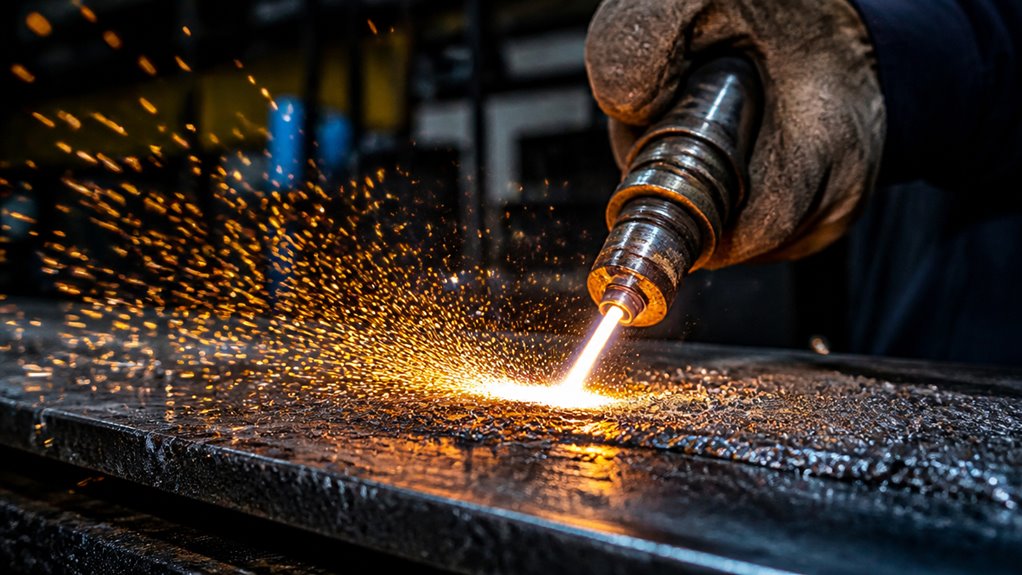
Spray welding lets you deposit molten or semi-molten metal onto a substrate to repair or coat without fully melting the base material, preserving its structure.
You’ll use specialized equipment like arc, flame, or plasma spray systems, controlling heat input and spray angle to avoid distortion.
This method achieves strong metallurgical bonds quickly with high deposition rates, especially on thicker parts.
Keep in mind surface prep and equipment settings are essential for quality. Explore how these factors optimize your outcome.
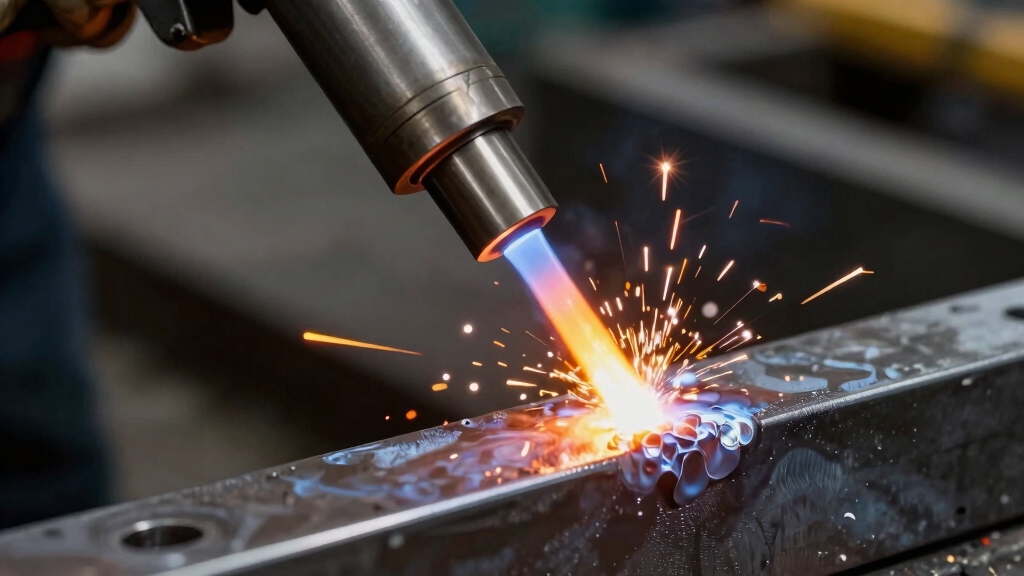
Although spray welding encompasses various thermal spraying techniques, its core principle involves propelling molten or semi-molten material onto a substrate to coat or repair it.
Spray welding uses molten material propelled onto surfaces for precise coating and repair.
You accelerate and direct molten powder, wire, or rod toward the surface using gas jets or atomization.
Unlike traditional welding, you avoid fully melting the substrate, preserving delicate structures.
Energy sources such as plasma, flame, or electric arcs melt the feedstock, which solidifies rapidly upon contact.
This process enables precise coating and repair without compromising the base material’s integrity.
By controlling parameters like particle velocity and temperature, you achieve effective adhesion and thickness.
Understanding this fundamental mechanism helps you optimize spray welding for diverse industrial applications while maintaining substrate stability and coating performance.
Additionally, precise heat input control in spray welding minimizes damage to the substrate, similar to laser welding techniques.
Before initiating spray welding, you must thoroughly prepare the substrate to guarantee peak adhesion and coating integrity.
Begin by removing all contaminants: oil, grease, rust, and scale. Use chemical cleaning or abrasive blasting to expose a clean, roughened surface that enhances mechanical bonding.
Preheating the substrate to the recommended temperature, typically 250-300°C for steel, reduces thermal stresses and improves fusion without risking oxidation.
Make sure the surface geometry avoids sharp edges or narrow holes, which can cause coating defects.
Maintain proper substrate thickness, as thin plates risk burn-through due to the high heat input.
Confirm that the surface is dry and free of oxide films, especially on alloys susceptible to oxidation. This ensures a consistent metallurgical bond and peak coating performance during spray welding.
Proper current control during the spray welding process is essential to achieve a stable arc and optimal coating quality.
When it comes to spray welding, there are a few different methods to consider. Each one uses a unique energy source, like plasma, flame, or electric arc. It’s important to know how these methods work because they each generate heat and accelerate particles in different ways. Effective plasma suppression techniques are essential to maintain energy efficiency and weld quality in plasma-based spray welding.
Explore the common spray welding methods by examining the various types of equipment that enable precise thermal spraying. You’ll encounter three primary techniques:
Each method offers distinct advantages depending on application requirements, material compatibility, and coating thickness. This allows you to select the most suitable process for repair or protective coating tasks. Plasma-based methods, such as PTA, benefit from the high temperature and energy density produced by a constricted plasma arc, enabling precise and high-quality coatings.
Understanding the energy sources driving spray welding equipment is essential for selecting the right method and achieving ideal coating quality. These sources directly affect melting efficiency, coating adhesion, and deposition rates.
You’ll encounter flame, arc, plasma, detonation, and cold spray techniques, each powered differently to fulfill specific industrial needs.
| Energy Source | Heat Generation | Common Applications |
|---|---|---|
| Flame | Combustion of fuel gases | General coating, repair |
| Arc | Electric arc between wires | High deposition rate tasks |
| Plasma | Ionized gas discharge | Precision coatings |
| Detonation | Gas-oxygen explosive mix | Dense, wear-resistant layers |
| Cold Spray | Supersonic gas jet | Heat-sensitive substrates |
Choosing the correct energy source optimizes coating integrity and process efficiency tailored to your project. The electric arc used in arc spray welding provides a stable and controllable heat source, enabling high deposition rates and clean coatings.
Different types of spray welding equipment operate under distinct principles and parameters that directly influence their application scope and performance.
You’ll notice operational differences mainly hinge on heat source, particle acceleration, and material feed mechanisms.
Here’s a breakdown:
Understanding these distinctions helps you select the appropriate equipment for your repair or coating needs.
This optimizes efficiency and quality.
For applications requiring deep penetration, such as thick materials, using pure CO2 shielding gas can significantly enhance weld fusion and strength.
In industries where component longevity and surface restoration are critical, spray welding plays a pivotal role by enabling precise repair and protective coating applications.
You’ll find it widely used in automotive manufacturing to restore worn castings like shafts and cylinder bores, ensuring components meet exact dimensional specifications for machining.
Heavy industry sectors rely on spray welding for its high metal deposition rates, particularly on thick steel parts, to rebuild surfaces without melting the substrate.
The process efficiently restores dimensions such as shaft outside diameters, extending component life and reducing downtime.
Additionally, spray welding protects surfaces against corrosion and wear, making it indispensable for maintenance in demanding environments where both durability and dimensional accuracy must be maintained.
Its versatility and efficiency align well with Eastwood welders’ multi-process capability, supporting a range of welding tasks across industries.
Although spray welding requires specialized equipment and skill, it offers distinct advantages for repairing worn or damaged components.
You’ll find it especially effective when restoring parts without fully melting the substrate, preserving structural integrity.
Consider these key benefits:
Additionally, the process benefits from thermal retention which helps reduce heat loss and improves fusion quality during repairs.
These advantages make spray welding a reliable, cost-effective choice for extending component life and maintaining performance in demanding industrial environments.
When it comes to spray welding, it’s really important to think about the thickness of the materials you’re working with. If the plates are too thin, the excessive heat can cause some serious damage. So, definitely keep that in mind!
Then, there are the equipment limitations to consider. A lot of machines have specific voltage constraints that can really limit your options for this process. It’s essential to know what your equipment can handle before diving in.
And let’s not forget about managing the heat. The intense heat generated during spray welding is no joke! Keeping everything under control is crucial to ensure both your safety and the quality of the coating throughout the procedure. Effective heat management often requires acclimatization protocols and cooling strategies to reduce heat stress risks.
Spray welding demands careful consideration of material thickness. Applying high heat to thin plates often results in burn-through or warping.
You need to understand these constraints to ensure weld quality and structural integrity. Here are the key points to weigh:
Additionally, controlling the thermal input by adjusting parameters such as current and gas flow is essential to prevent material distortion and ensure weld integrity, as these factors directly influence heat density during the process.
Managing material thickness effectively is only one part of ensuring successful spray welding. Understanding voltage and equipment limitations is equally important.
Most spray welding machines face voltage constraints that restrict their ability to maintain stable arcs necessary for melting and propelling wire or powder. You’ll find that voltage, not just amperage, directly influences metal transfer quality and deposition rates.
Equipment incapable of delivering adequate voltage will produce inconsistent coatings, increased porosity, and potential weld defects. Additionally, the torch design must accommodate high voltage operation without electrical breakdown or overheating.
Since spray welding demands elevated arc voltages to liquefy the feedstock efficiently, you must select machines rated for these parameters. Ignoring these limits compromises weld integrity and reduces process reliability, especially when working with thicker materials that require sustained high-voltage arcs for effective fusion.
Controlling heat input during spray welding is critical to prevent damage and guarantee weld quality. Excessive heat can burn through thin materials or cause distortion, compromising the weld’s integrity. You must monitor temperature closely and adapt your technique accordingly.
When managing heat and ensuring safety, consider these key points:
Optimize your welding setup by ensuring the spraying torch remains perpendicular to the surface. Deviations increase porosity and compromise coating integrity.
Maintain a consistent standoff distance to control particle velocity and heat input. These factors directly affect bond strength and coating uniformity.
Preheat the substrate within recommended temperature ranges of 250-300°C for steel. This reduces thermal shock and improves metallurgical bonding.
Use appropriate alloy powders heated between 1000-1300°C for optimal melting and slag flotation.
Monitor voltage and amperage closely to sustain the spray arc mode. This maximizes metal deposition rates without burning the substrate.
Avoid spraying thin plates and sharp edges to prevent defects.
Finally, implement controlled, overlapping passes to guarantee uniform thickness and minimize coating discontinuities. This will achieve robust, high-quality welds.
Spray welding differs from thermal spraying mainly in fusion and heat input.
Spray welding melts the coating material to fuse it metallurgically with the substrate, ensuring deep penetration and strong bonding.
Thermal spraying, however, typically deposits particles without melting the base metal, relying on mechanical adhesion.
If you need thicker, more durable coatings with metallurgical bonds, spray welding is superior.
Thermal spraying suits lighter, less heat-intensive applications.
Yes, you can automate spray welding for large-scale production.
Automation enhances consistency, accuracy, and deposition rates, especially on heavy materials requiring thick coatings.
You’ll need specialized equipment like robotic arms integrated with spray welding torches, ensuring perpendicular torch alignment to minimize defects.
However, consider voltage and heat input limits to avoid substrate damage.
Proper programming and maintenance are vital to maximize efficiency and maintain coating quality in high-volume industrial environments.
You’ll find spray welding generates particulate emissions and fumes from molten materials, posing air quality concerns.
It also consumes significant energy, often from non-renewable sources, impacting your carbon footprint.
Waste from overspray and slag disposal requires careful handling to prevent soil and water contamination.
Implementing proper ventilation, filtration, and recycling systems can mitigate these impacts.
This helps you maintain compliance with environmental regulations while optimizing operational efficiency.
A typical spray welding coating can last several years, depending on your operating conditions and maintenance. Its durability hinges on factors like substrate preparation, coating thickness, and environmental exposure.
If you make certain proper surface prep and apply the coating at recommended parameters, you’ll achieve a robust layer resistant to wear and corrosion.
However, high-stress or abrasive environments may shorten its lifespan. Regular inspections help you maintain performance and plan timely repairs.
You shouldn’t use spray welding in industries handling thin plate materials because the intense heat risks burning holes.
Also, sectors requiring coatings on sharp edges or narrow holes might find spray welding unsuitable due to coating integrity issues.
Aluminum, copper, titanium, and manganese alloy applications are limited since preheating can cause oxide films.
If your operations involve voltage-limited machines, spray welding may not be feasible either.
Now that you’ve explored spray welding, you know it’s not just a quick fix. It’s a precise science demanding careful prep, the right equipment, and strict safety.
Like a skilled artist with a brush, your technique shapes the repair’s success. Remember, mastering spray welding means balancing its advantages with its limits.
So, don’t just weld; engineer your approach to guarantee every spray counts with accuracy and safety.