Phone:
(701)814-6992
Physical address:
6296 Donnelly Plaza
Ratkeville, Bahamas.

Phone:
(701)814-6992
Physical address:
6296 Donnelly Plaza
Ratkeville, Bahamas.

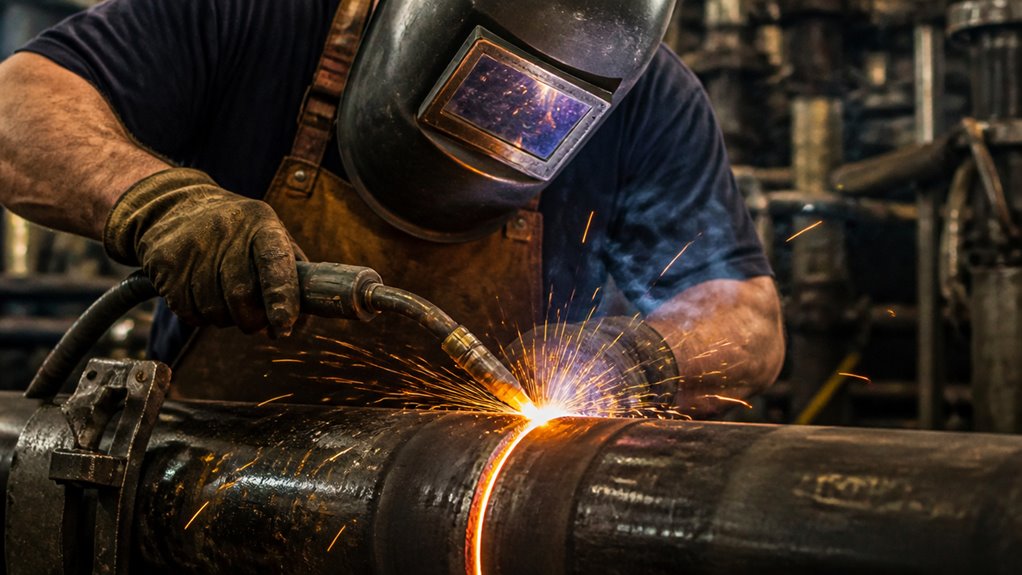
Yes, as a pipefitter, you weld regularly to join pipes and fittings. This ensures strong, leak-proof joints that withstand pressure and environmental conditions.
You use methods like TIG, MIG, Stick, and flux-cored arc welding, with tack welding for alignment. Welding is essential for permanent, pressure-tight connections in complex piping systems, especially in industrial settings.
You also handle pipe preparation and fitting tasks, so your welding integrates with broader assembly work. Understanding these details reveals why your welding role is specialized and indispensable.
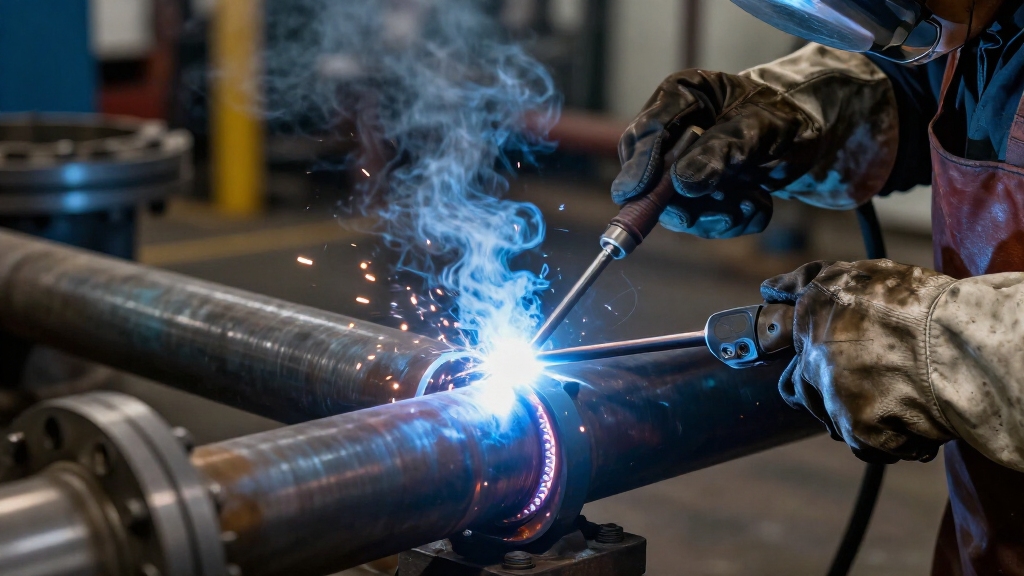
When you work as a pipefitter, welding often becomes a critical task for assembling and securing pipe sections. You’ll perform welding to join pipes, fittings, and components in various positions: flat, vertical, or overhead.
Welding is essential for pipefitters to securely join pipe sections in multiple positions.
Your welding methods may include TIG, MIG, Stick, or flux-cored arc welding, depending on the pipe material and job requirements. You might also tack-weld parts to hold them temporarily before final welding.
However, welding is only part of your role. You’ll also prepare pipe surfaces by cleaning and aligning sections precisely before welding. Your welding work guarantees leak-proof, durable joints that withstand pressure and environmental factors.
Mastering welding techniques enhances your ability to build reliable piping systems in industrial and commercial settings. Proper heat input control during tack welding is essential to minimize distortion and ensure quality joints.
You perform welding on job sites whenever pipe sections require permanent, pressure-tight joints that mechanical fittings can’t provide.
Welding guarantees structural integrity and leak prevention in high-pressure, high-temperature, or corrosive environments.
You also weld when pipe systems must meet strict code or safety standards, such as in chemical plants or power stations.
Additionally, welding is essential for joining complex or custom-fabricated components that can’t be connected mechanically.
You typically weld after fitting and aligning pipe sections, often performing tack welds to hold parts before final welding.
Your welding methods vary by pipe material, position, and application, ranging from TIG to flux-cored arc welding.
Ultimately, you weld when durability, safety, and compliance demand a permanent metallurgical bond rather than a mechanical connection.
Proper surface preparation and joint fit-up are critical to ensure weld quality and prevent defects on the job site.
Although welding secures pipe joints permanently, pipefitting involves a range of other critical tasks that guarantee the entire piping system functions correctly and safely.
You’ll need to measure, cut, thread, and bend pipes precisely to fit system layouts accurately.
Preparing pipe surfaces by removing rust, grease, and scale is essential for proper joining or welding.
You also install pipe supports, branches, and tracing systems to maintain stability and functionality.
Testing piping systems for leaks and pressure integrity with gauges and hydrostatic tests confirms reliability.
Additionally, reading blueprints and marking pipe runs accurately allows you to align and assemble components efficiently.
These tasks require technical skill and attention to detail, making your role crucial beyond just welding.
Understanding the importance of fixed-position welding techniques is also vital to ensure secure and code-compliant pipe joints in the field.
Since pipefitters handle a broader scope of tasks beyond welding, their welding work focuses primarily on joining pipes within complex piping systems rather than on general metal fabrication.
Pipefitters specialize in welding pipes within intricate systems, not general metal fabrication.
When you weld as a pipefitter, you concentrate on creating strong, leak-proof joints that maintain system integrity under pressure and temperature variations.
Unlike welders who may fuse diverse metal components in various industries, you must consider pipe alignment, fit-up, and material compatibility specific to piping.
Your welding techniques, such as TIG, MIG, or stick welding, are applied strategically to guarantee system functionality and safety.
You often tack weld to hold parts before final welding, integrating welding as one step in the pipe installation and maintenance process.
Welders focus chiefly on metal joining without broader system assembly responsibilities.
Mastery of precise positioning and fit-up is essential for pipefitters to prevent defects that could compromise sealing and joint integrity.
Across different industries and job sites, the extent and nature of pipefitter welding vary considerably. In industrial settings, you’ll often weld steam, chemical, or fuel piping, requiring advanced skills and certifications.
In commercial HVAC or utility work, welding may be limited or handled by specialized welders. Your welding tasks depend on employer expectations, project complexity, and piping system requirements.
Proper control of heat input and use of appropriate techniques is essential to ensure weld quality and avoid defects.
| Industry | Welding Role |
|---|---|
| Industrial | Frequent welding; certified |
| Commercial HVAC | Limited welding; mostly fitting |
| Utility | Occasional welding; mixed roles |
Understanding this helps you prepare for job-specific demands. Whether you weld daily or focus on layout and fitting, tailoring your skills to the industry secures efficiency and compliance with safety and quality standards.
You’ll typically need welding certifications like AWS (American Welding Society) qualifications, such as the Certified Welder (CW) or specific process certifications (TIG, MIG, Stick).
Employers might require pipefitters to hold certifications aligned with ASME standards, especially for pressure piping.
Additionally, you’ll often need to pass practical tests demonstrating proficiency in welding pipe joints in various positions.
Staying updated with safety and industry-specific certifications is also essential for your welding role.
Training for pipefitter welding usually takes between six months and two years, depending on your program and intensity.
Think of it as forging a sword; each skill you master sharpens your ability. You’ll learn welding techniques, blueprint reading, and safety protocols through hands-on practice and classroom instruction.
Apprenticeships typically last four years but include welding training segments.
Keep in mind, specialized certifications can add extra time to hone your expertise.
Yes, you’ll typically earn more as a pipefitter welder compared to a non-welding pipefitter.
Welding skills add specialized value, increasing your versatility and marketability.
Employers often pay premiums or higher rates for certified welding capabilities since welding demands additional training and certification.
However, your exact pay depends on factors like location, industry, certification level, and experience.
Mastering welding can boost your earning potential within the pipefitting trade.
You absolutely must suit up like a welding superhero.
Wear a welding helmet with a proper shade lens to shield your eyes from intense UV and IR rays.
Don flame-resistant gloves, a leather jacket or welding apron, and long sleeves to protect against sparks and molten metal.
Don’t forget ear protection, steel-toe boots, and respiratory gear if fumes are present.
Safety isn’t optional; it’s essential for every pipefitter welder on site.
Yes, you can weld different types of metals as a pipefitter, including carbon steel, stainless steel, and sometimes aluminum or copper alloys.
Your ability depends on your training, certifications, and the welding processes you know, like TIG, MIG, or Stick welding.
You’ll choose techniques and filler materials suited to each metal’s properties, ensuring strong, durable joints.
Always follow the specifications for the piping system you’re working on.
When you work as a pipefitter, welding is just one tool in your skilled toolbox. It’s like a wrench that fits specific bolts. You’ll weld when the job demands secure, leak-proof joints.
But you’ll also handle measuring, cutting, and assembling pipes with precision. Your welding differs from specialized welders’ work, shaped by varied industries and job requirements. Mastering these tasks guarantees your versatility and reliability on any site.