Phone:
(701)814-6992
Physical address:
6296 Donnelly Plaza
Ratkeville, Bahamas.

Phone:
(701)814-6992
Physical address:
6296 Donnelly Plaza
Ratkeville, Bahamas.

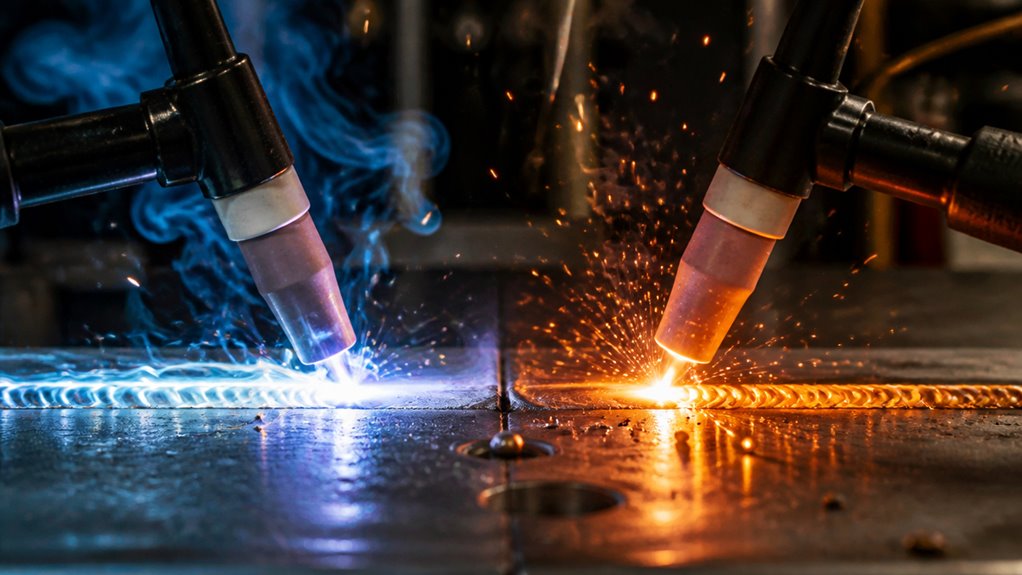
You’ll choose AC TIG welding when working with aluminum or magnesium since its alternating polarity cleans oxides for stronger welds.
However, it causes arc fluctuations needing high-frequency stabilization.
DC TIG offers steadier, focused arcs with deeper penetration, ideal for steel, stainless, and titanium.
This enhances weld precision and electrode life.
Understanding how each affects metal compatibility, arc stability, and heat control will help you optimize quality and troubleshoot effectively as you explore further differences.

| Feature | AC TIG | DC TIG |
|---|---|---|
| Current Type | Alternating current with polarity switching | Direct current with constant polarity |
| Arc Stability | Less stable due to polarity reversal | Stable, focused, and predictable |
| Arc Characteristics | Fluctuating but provides cleaning action | Steady and quieter |
| Heat Distribution | More balanced between cleaning and penetration | Concentrated on the workpiece |
| Penetration | Shallower and more uniform | Deeper and sharper |
| Oxide Cleaning | Built-in oxide cleaning during the positive cycle | No oxide-cleaning action |
| Best Metals | Aluminum and magnesium | Steel, stainless steel, titanium, copper, and brass |
| Aluminum Welding | Excellent due to oxide removal | Less suitable because it lacks oxide cleaning |
| Magnesium Welding | Excellent for stubborn oxide layers | Not ideal |
| Steel Welding | Less effective for thin steel due to arc fluctuation | Excellent for precise steel welding |
| Stainless Steel | Not the preferred option | Excellent |
| Titanium | Not highlighted as the preferred option | Excellent due to precise control |
| Heat Control | Balances cleaning and penetration | Precise and concentrated |
| Electrode Wear | More tungsten erosion can occur | Reduced tungsten wear |
| Electrode Options | Pure or zirconiated tungsten recommended | Thoriated or ceriated tungsten recommended |
| Main Advantage | Removes stubborn oxides while welding | Provides stable arc and deeper penetration |
| Main Limitation | More arc fluctuation and shallower penetration | Cannot provide oxide cleaning |
| Power Consumption | Slightly higher because polarity continuously reverses | Generally slightly lower |
| Equipment Cost | AC/DC machines tend to cost more | DC equipment generally costs less |
| Maintenance Cost | Generally higher | Generally lower |
| Ideal Applications | Aluminum, magnesium, and reactive non-ferrous metals | Steel, stainless, titanium, precision and thin-material welding |
| Best Choice for Mixed Metals | AC/DC machine provides greater versatility | DC-only is limited mainly to compatible metals |
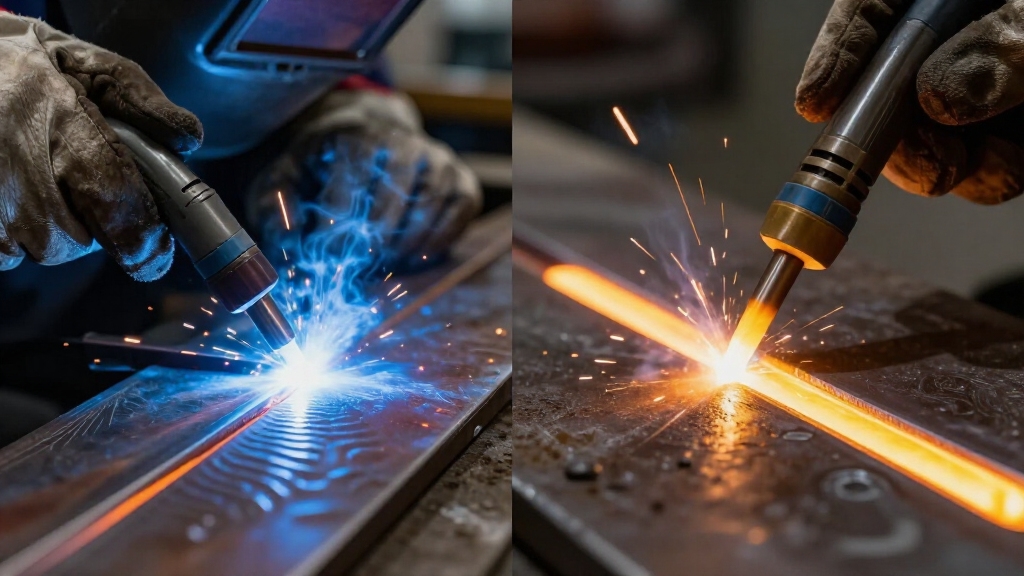
Although both AC and DC TIG welding employ tungsten electrodes to create the arc, their fundamental difference lies in the type of current used.
AC TIG alternates current polarity continuously, while DC TIG maintains a steady, unidirectional current.
AC TIG switches polarity constantly, whereas DC TIG uses a stable, one-way current for welding.
This alternating current in AC TIG reverses polarity multiple times per second, causing periodic shifts between positive and negative cycles.
In contrast, DC TIG produces a constant polarity arc, resulting in a more focused and stable welding process.
You’ll notice DC TIG delivers a steady, quieter arc with precise control, ideal for fine, detailed work.
Meanwhile, AC TIG’s polarity reversal introduces fluctuations, affecting arc stability but enabling unique surface effects.
Understanding this electrical distinction helps you select the appropriate TIG mode based on your welding requirements and desired arc characteristics.
DCEN, or Direct Current Electrode Negative, is the default polarity in most TIG applications due to its energy efficiency and deeper penetration.
When it comes to TIG welding, you’ll notice that DC TIG really shines when working with mild steel, stainless steel, and other ferrous metals. Why is that? Well, it’s all about the stable and focused arc it creates. It makes the whole process smoother and more efficient.
On the flip side, if you’re diving into aluminum or magnesium, AC TIG is the way to go. This is because the alternating current is fantastic at tackling those stubborn oxide layers that can be a real pain. So, understanding how this oxide-cleaning action works is super important when you’re deciding on the right current for your welding project. It can make all the difference! The choice between AC and DC also impacts arc stability and heat control, which are crucial for achieving clean and precise welds.
Metals like mild steel, stainless steel, titanium, copper, and brass respond best to DC TIG welding due to the steady, focused arc and consistent polarity this current provides.
When you choose DC TIG, you get precise heat control and deeper penetration, essential for these metals’ weld integrity. Here’s why DC TIG suits these materials:
This makes DC TIG your go-to for metals requiring precise, high-quality welds without the oxide cleaning action of AC TIG. Proper torch angle and technique are key to maintaining gas coverage and preventing weld defects during DC TIG welding.
While DC TIG excels with steels and many metals requiring steady, focused heat, some materials demand a different approach to welding current.
AC TIG is essential when working with aluminum and magnesium, as it alternates polarity to provide a cleaning effect that breaks down stubborn oxide layers.
This oxide removal is critical for achieving proper fusion and preventing weld defects on these reactive metals.
Non-ferrous metals with tenacious surface oxides also benefit from AC TIG’s alternating cycle, which balances penetration with surface cleaning.
If you’re welding aluminum or magnesium, relying on AC TIG guarantees better weld integrity and quality.
In contrast, DC TIG’s constant polarity lacks this cleaning ability, making it unsuitable for these metals despite its stability and focused arc advantages.
Using an AC-capable TIG welder is necessary for effective oxide cleaning and stable fusion when welding aluminum and similar metals.
Understanding the role of oxide cleaning is essential when choosing between AC and DC TIG welding for different metals.
AC TIG welding offers a built-in cleaning mechanism during its positive half-cycle, which scrubs away stubborn oxides like aluminum oxide.
This cleaning action is critical for ensuring proper fusion and weld quality on reactive metals. In contrast, DC TIG lacks this scrubbing effect, making it less suitable for metals with resilient oxide layers.
Consider these key points:
Additionally, maintaining a consistent torch angle and arc length during welding helps produce uniform puddles and secure alignment, which is vital for quality welds.
Because aluminum forms a tough oxide layer that hinders proper fusion, AC TIG’s built-in cleaning action becomes essential for effective welding. The alternating current cycles between positive and negative polarity, with the positive half-cycle actively breaking down the aluminum oxide on the surface.
This oxide disruption exposes clean metal, enabling stronger metallurgical bonding during the negative half-cycle. Without this cleaning phase, oxide contamination persists, causing weak welds and porosity. DC TIG lacks this scrubbing effect since current flows unidirectionally, making it less suitable for aluminum.
Using a sharp, ball-shaped pure or ceriated tungsten with AC current enhances this cleaning effect by providing a stable arc and optimal cleaning action during welding.
Have you ever noticed how DC TIG welding works? It really focuses the heat directly into the workpiece. This means you get deeper penetration and a more concentrated arc. It’s pretty impressive!
Now, let’s talk about AC TIG. It takes a different approach by balancing the heat between cleaning and penetration. This results in a more even heat distribution, but the arc isn’t as focused.
Understanding these differences is key. It can really help you choose the right current for whatever welding project you have in mind. What do you think?
Additionally, the electrode tip shape plays a significant role in controlling arc concentration and penetration during both AC and DC TIG welding.
Heat concentration plays a pivotal role in TIG welding performance, directly impacting penetration depth and weld quality.
When choosing between AC and DC TIG, understanding their heat focus differences is essential.
DC TIG, particularly with electrode negative (DCEN), concentrates heat sharply on the workpiece, yielding a stable, focused arc.
AC TIG divides its cycle between cleaning and penetration, resulting in a more balanced heat distribution but less arc focus.
Consider these key points:
You’ll find DC TIG better for precision, while AC TIG excels when cleaning action is essential.
Penetration depth critically influences weld strength and integrity. Understanding how AC and DC TIG affect this factor is essential for best results.
DC TIG concentrates heat in the workpiece with electrode negative polarity. This gives you deeper penetration and a focused arc ideal for steel and stainless.
AC TIG balances heat between cleaning and penetration cycles. This reduces depth but improves surface oxide removal on aluminum.
However, the alternating polarity in AC TIG can cause arc fluctuation, which affects arc stability and heat input consistency.
| Aspect | DC TIG | AC TIG |
|---|---|---|
| Current Type | Direct current, constant polarity | Alternating current, polarity switches |
| Heat Distribution | Concentrated on workpiece | Balanced between electrode and workpiece |
| Arc Stability | Stable, focused arc | Less stable, cleaning cycle included |
| Penetration Depth | Deeper, sharper | Shallower, more uniform |
| Best Use | Steel, stainless | Aluminum, magnesium |
Choose based on material and penetration needs.
When welding steel with DC TIG, you benefit from a consistently stable arc that enhances control and precision.
This stability arises because DC TIG uses a direct current flowing in a single direction, unlike AC TIG’s constantly reversing polarity.
Here’s why DC TIG offers better arc stability on steel:
This combination makes DC TIG the superior choice for precision steel welding. Additionally, maintaining proper cleaning and preparation prevents surface defects that can compromise weld quality and integrity.
When you’re trying to decide between AC/DC and DC-only TIG welders, it’s all about finding the right balance between versatility and your specific material needs.
AC/DC machines are pretty cool because they can tackle both aluminum—thanks to their oxide cleaning feature—and steel with great arc stability. This means you can switch between materials without a hitch.
On the other hand, DC-only units really shine when it comes to welding steel and other ferrous metals. They’re built for that!
Although DC-only TIG machines excel at welding steel and similar metals, they lack the versatility needed for aluminum work. Aluminum requires AC output for effective oxide cleaning.
When choosing between AC/DC and DC-only TIG welders, consider your application needs carefully. Here’s why:
Selecting a welder depends on your metal types and welding demands. Versatility favors AC/DC machines, but DC-only suits specialized steel tasks.
Because different metals respond uniquely to TIG welding currents, understanding material compatibility is vital when choosing between AC/DC and DC-only TIG welders.
DC TIG excels with steel, stainless, and titanium due to its steady arc and deeper penetration. AC TIG is essential for aluminum and magnesium, offering built-in oxide cleaning.
| Material | Recommended Current Type | Key Benefit |
|---|---|---|
| Aluminum | AC | Oxide cleaning action |
| Steel/Stainless | DC | Stable arc, deep penetration |
| Titanium | DC | Precise control, clean weld |
Selecting the correct current guarantees optimal weld quality by matching electrical characteristics to metal behavior and oxide presence.
Choosing between AC/DC and DC-only TIG welders hinges on the specific welding applications and materials you intend to work with. Your choice affects arc stability, heat distribution, and surface cleaning, critical for weld quality.
Selecting the right welder means aligning its electrical characteristics with your material demands and weld quality requirements.
Identify the right TIG welding current type by matching it to your material and application needs.
Use AC TIG primarily for welding aluminum and magnesium, where the alternating current’s built-in oxide cleaning action guarantees proper fusion on these reactive metals.
This makes AC TIG essential for fabrication and repair work involving non-ferrous alloys with stubborn oxide layers.
On the other hand, DC TIG excels with mild steel, stainless steel, titanium, and copper.
Its steady, focused arc provides deeper penetration and finer control, ideal for precision tasks, thin materials, or out-of-position welding.
When your projects involve both aluminum and steel, an AC/DC TIG machine offers the necessary versatility.
Selecting the correct current optimizes weld quality by aligning heat distribution, arc stability, and surface cleaning with your specific metal and job requirements.
Troubleshooting weld quality issues in AC and DC TIG welding requires a systematic approach focused on understanding the distinct characteristics of each current type.
Apply these targeted checks to isolate and correct weld defects efficiently.
When welding aluminum with AC TIG, optimize your machine’s AC balance control to maximize the cleaning action during the positive half-cycle. This breaks up the stubborn aluminum oxide layer.
Adjusting the balance toward more positive current enhances oxide removal but reduces penetration. Find a balance that maintains fusion without excessive tungsten erosion.
Use a high-frequency start to stabilize the arc, as AC arcs can feel less steady due to polarity switching. Set your amperage considering the alloy thickness; aluminum demands higher heat input than steel.
Maintain a tight tungsten angle, around 15 degrees, to focus heat and improve arc control. Finally, ensure your shielding gas—pure argon or argon-helium mix—is clean and consistent to prevent contamination and achieve peak weld quality.
Although steel and stainless steel respond well to DC TIG welding, optimizing your setup is crucial for achieving clean, strong welds.
Steel and stainless steel weld best with DC TIG when setup is carefully optimized for strength and cleanliness.
You’ll want to focus on three key areas:
You can use AC TIG for thin steel sheets, but it’s not the most effective choice.
AC’s alternating polarity causes less arc stability and more heat fluctuation, making it harder to control on thin steel.
You’ll struggle with arc wobble and inconsistent penetration.
DC TIG offers a steadier, more focused arc and better heat control, which suits thin steel welding much better.
Save AC TIG for aluminum or metals needing oxide cleaning.
Think of your electrode like a musician’s instrument. Its type shapes the performance.
In DC TIG, you’ll want a thoriated or ceriated tungsten for a stable, focused arc.
This enhances penetration on steel.
For AC TIG, pure or zirconiated tungsten handles polarity switching better.
This improves cleaning and arc stability on aluminum.
Choosing the right electrode guarantees you get consistent arc control, heat distribution, and weld quality.
It’s tailored to your metal and current type.
You need to be aware that AC TIG welding produces a rapidly alternating current, increasing the risk of electric shock compared to DC TIG.
Insulated gloves and dry clothing are essential. DC TIG offers a steadier arc with less shock hazard, but you still must prevent contact with live parts.
Both require proper ventilation to avoid harmful fumes and eye protection against ultraviolet radiation.
AC’s arc instability might demand extra caution against arc flash exposure.
Power consumption between AC and DC TIG welding doesn’t differ wildly, but AC can be a bit like juggling.
Switching polarities demands more energy to maintain the arc’s stability.
You’ll find AC TIG tends to use slightly more power because it continuously reverses current direction.
This creates additional electrical stress.
However, this increase is generally marginal, so in practical terms, your energy bills won’t spike dramatically when using AC over DC TIG welding.
You’ll find DC TIG welding generally costs less industrially due to simpler equipment and lower maintenance.
AC TIG machines, especially those with AC/DC capabilities, tend to be pricier upfront and consume more power for oxide cleaning cycles, increasing operational costs.
However, if you weld aluminum frequently, AC TIG’s cleaning efficiency can reduce rework expenses, balancing overall costs.
Your choice depends on materials and production volume to optimize cost-effectiveness.
Think of AC and DC TIG as two sides of a coin, each tailored for specific metals and welding needs.
Just as a musician chooses instruments for different melodies, you select AC for aluminum’s oxide cleaning and DC for steel’s arc stability.
Remember, mastering both lets you adapt seamlessly, ensuring precise heat control and penetration every time.
Like a seasoned craftsman, your welding quality hinges on understanding these fundamental differences and applying them strategically.
Last update on 2026-10-10 / Affiliate links / Images from Amazon Product Advertising API