Phone:
(701)814-6992
Physical address:
6296 Donnelly Plaza
Ratkeville, Bahamas.

Phone:
(701)814-6992
Physical address:
6296 Donnelly Plaza
Ratkeville, Bahamas.

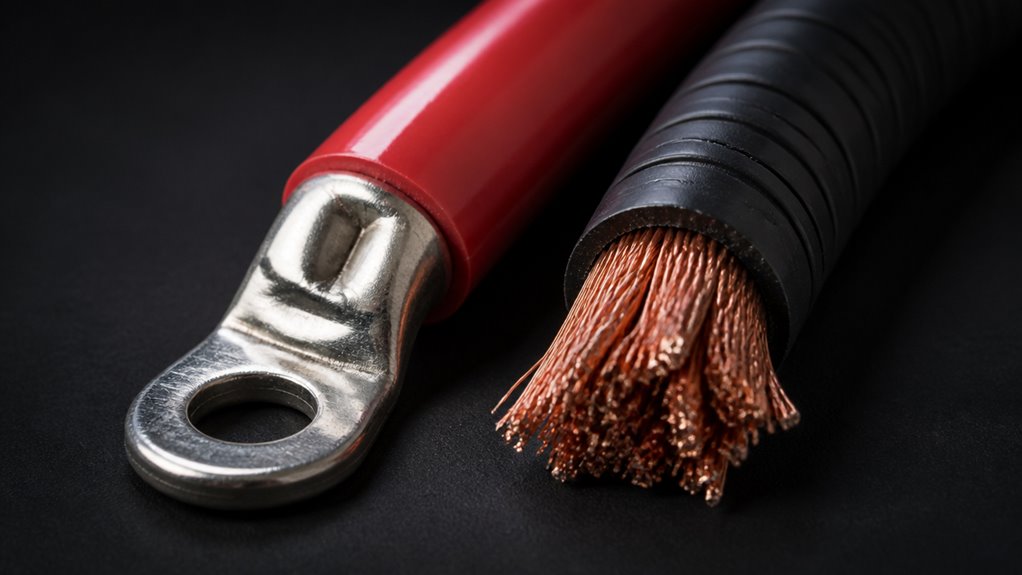
When choosing between battery and welding cables, you’ll find battery cables use fewer, thicker copper strands. This makes them stiffer and suited for static, low-voltage applications around 60 volts.
Welding cables feature many fine strands, enhancing flexibility and durability. They support higher voltages up to 600 volts with superior insulation.
This makes welding cables ideal for dynamic, high-flex environments requiring frequent bending and vibration resistance. Understanding these differences helps you match cable performance to your project’s electrical and mechanical demands.
| Feature | Battery Cable | Welding Cable |
|---|---|---|
| Primary Design | Static, high-current connections | Dynamic, high-flex electrical applications |
| Conductor Construction | Fewer, thicker copper strands | Many fine copper strands |
| Flexibility | Relatively stiff | Highly flexible |
| Bending Resistance | Limited repeated bending | Excellent resistance to repeated bending |
| Typical Voltage Rating | Around 60V | Up to 600V |
| Common System Voltage | 12V–24V | Higher-voltage welding and industrial systems |
| Insulation | PVC or XLPE | EPDM or neoprene |
| Heat Resistance | Moderate | Superior |
| Abrasion Resistance | Moderate | High |
| Oil & Grease Resistance | Excellent | Good |
| Vibration Resistance | Moderate | Excellent |
| Routing | Best for short, fixed runs | Ideal for tight spaces and complex bends |
| Typical Applications | Automotive and marine battery/starter circuits | Welding equipment and high-flex installations |
| Current Capacity | High when properly gauged | High when properly gauged |
| Durability Under Movement | Lower | Higher |
| Cost | Generally less expensive | Higher upfront cost |
| Best Advantage | Cost-effective for static battery connections | Flexibility and durability in demanding environments |
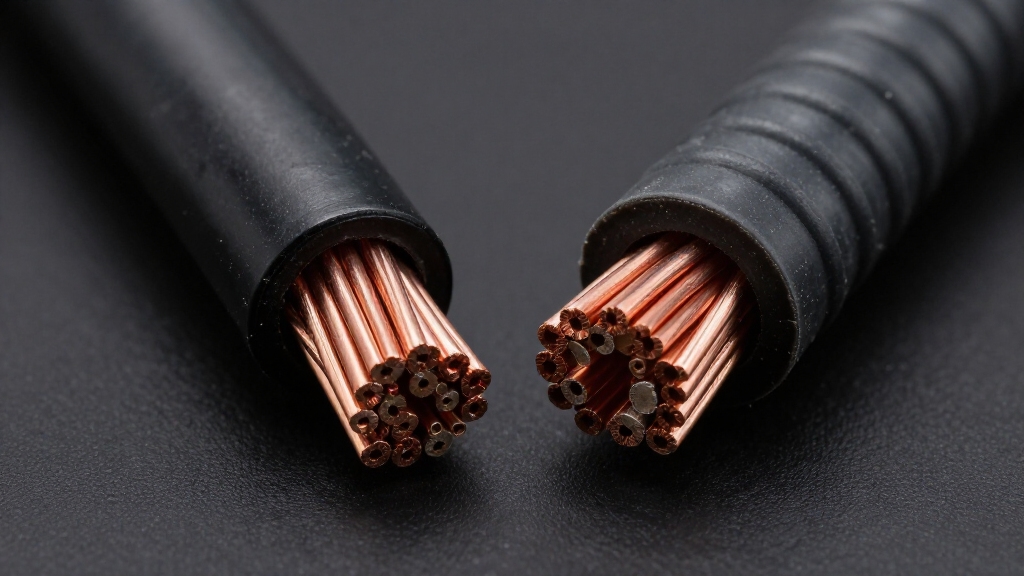
Although both battery and welding cables use stranded copper conductors, their core construction differs markedly to meet distinct performance needs.
Battery and welding cables share stranded copper cores but differ significantly to suit unique performance requirements.
Battery cables consist of fewer, thicker copper strands, resulting in a stiffer core suitable for static installations.
Welding cables, in contrast, employ many more, finer strands, enhancing flexibility and durability under movement.
This strand configuration influences electrical performance and handling characteristics. Even cables with identical gauge ratings can vary markedly in strand count and core behavior.
Understanding these distinctions helps you select the right cable for your application, avoiding assumptions based solely on gauge.
The finer strands in welding cables not only improve flexibility but also often increase copper content per foot. This can potentially benefit conductivity in dynamic environments where consistent bending occurs.
Additionally, the conductor strand count directly impacts both electrical resistance and flexibility, which are critical factors in cable performance and longevity.
You’ll notice that welding cable offers superior flexibility, thanks to its fine-strand construction.
This makes it perfect for applications where there’s a lot of movement or tight routing involved.
On the other hand, battery cable has thicker strands, which gives it a stiffer profile.
That’s why it’s better suited for fixed, static runs, like in automotive starter circuits.
Additionally, ensuring proper cable tension during installation helps maintain consistent electrical conductivity and prevents damage over time.
When you need cables that bend, twist, or coil repeatedly, welding cable offers superior flexibility compared to battery cable due to its fine-strand copper construction.
Welding cable contains many more, finer copper strands, enabling it to flex without fatigue or damage, which is essential in dynamic environments.
In contrast, battery cable uses fewer, thicker strands, resulting in stiffer behavior that limits repeated bending.
This structural difference affects routing: welding cable navigates tight spaces and complex bends with ease, while battery cable resists flexing and is better suited to fixed, short runs.
Although both cables can carry similar current at equivalent gauge, welding cable’s strand arrangement enhances mechanical durability under flexing stress.
Understanding these distinctions helps you select the best cable for applications demanding frequent movement or vibration.
Additionally, welding cables often feature copper coatings that improve electrical conductivity and protect against oxidation, contributing to their durability and performance in demanding conditions.
Since flexibility and environmental demands vary widely between applications, selecting the right cable type depends on evaluating movement frequency, vibration exposure, and routing complexity.
You’ll find battery cable ideal for static, short runs in automotive or marine settings, where stiffness isn’t a problem and cost-efficiency matters.
Conversely, welding cable’s fine-strand construction and robust EPDM or neoprene insulation excel in high-flex, high-vibration environments requiring tight bends and repeated movement.
Its superior voltage rating up to 600V also makes it suitable for demanding power applications beyond typical battery circuits.
When routing complexity and mechanical stress increase, welding cable maintains integrity and conductivity.
Battery cable may struggle due to lower flexibility.
Assess your application’s physical and electrical requirements carefully to guarantee peak cable performance and longevity.
Additionally, using thick, low-resistance cables is essential to minimize voltage drop and ensure stable current flow in high-demand applications.
You know, if you take a look at battery cables, you’ll find they’re usually rated around 60 volts. They’re specifically designed for low-voltage battery and starter circuits. It makes sense, right? These cables are all about getting the job done for those specific applications.
Now, on the flip side, we’ve got welding cables. These bad boys can handle up to 600 volts! That makes them perfect for higher-voltage applications. Plus, they offer a lot more flexibility for those demanding environments. Understanding these differences in voltage capacity is super important. It helps you match the right cable to your application’s electrical needs. Additionally, welding cables must be compatible with regulated metal deposition equipment to ensure optimal performance and safety.
Although both battery and welding cables serve electrical conduction purposes, their voltage capacities differ markedly due to design intent and insulation standards.
Battery cables typically carry a voltage rating around 60 volts, optimized for low-voltage battery and starter circuits. Their insulation, usually PVC or XLPE, suits under-hood environments but limits voltage endurance.
Conversely, welding cables are engineered for up to 600 volts, with EPDM or neoprene insulation designed to withstand higher voltages, heat, and mechanical stress.
This higher voltage capacity stems from both the insulation robustness and compliance with stricter standards.
When you choose between them, consider that welding cable’s elevated voltage rating offers broader application versatility, though it may be unnecessary for typical battery circuits.
Understanding these voltage capacity differences helps you select the appropriate cable without over- or under-specifying your system.
Additionally, proper preheating and cooling control are critical factors in welding applications that require cables capable of handling extreme thermal conditions.
When selecting cables for your electrical system, understanding the voltage requirements is essential to guarantee safety and performance.
Battery cables typically carry low-voltage loads around 12 to 24 volts and are commonly rated for about 60 volts. This is sufficient for automotive battery and starter circuits.
Welding cables, however, are rated up to 600 volts and are designed for higher-voltage applications such as welding equipment.
This significant difference means welding cable exceeds the voltage demands of battery circuits. It becomes a versatile option when higher voltage tolerance or added safety margin is needed.
If your system involves standard battery voltages, battery cable’s lower rating is adequate and more cost-effective.
But for applications where voltage spikes or higher electrical stress may occur, welding cable’s superior voltage rating offers enhanced reliability and safety.
Additionally, proper circuit sizing and adherence to safety requirements are crucial when using cables in high-current welding environments to prevent overheating and ensure operational stability.
Because insulation directly impacts cable longevity and performance, understanding the differences between battery cable and welding cable coatings is essential.
Insulation plays a crucial role in cable durability and function, making coating differences vital to understand.
Battery cables typically use PVC or XLPE insulation, engineered to resist oil, grease, acids, and under-hood conditions. Welding cables employ EPDM or neoprene insulation, optimized for heat resistance, abrasion, and frequent flexing.
Consider these distinctions:
You’ll want to match insulation type to environmental demands for optimal cable robustness and lifespan. The enhanced heat resistance and flexibility of welding cable insulation are crucial for maintaining stable arcs and ensuring consistent welding performance in demanding conditions.
Since copper strand construction substantially influences electrical performance, understanding the differences between battery and welding cables helps you select the right cable for your application.
Battery cables use fewer, thicker copper strands. This results in a stiffer conductor with adequate current capacity for low-voltage, static applications.
Welding cables, however, feature many finer strands, enhancing flexibility and often increasing copper content per foot at the same gauge. This fine-strand structure improves conductivity under conditions involving frequent movement or vibration.
It reduces strain and potential breakage. While both cable types can carry similar amperage in automotive contexts if gauges match, welding cable’s strand design offers superior handling of dynamic electrical loads.
Ultimately, you must weigh strand construction’s impact on flexibility and conductivity. This will help optimize performance and durability in your specific use case.
Additionally, matching the cable’s construction to the required amperage capacity is essential for maintaining strong, reliable electrical connections.
Choosing between battery cable and welding cable boils down to understanding your application’s specific demands for flexibility, voltage rating, and environmental conditions.
You’ll want battery cable for fixed, high-current automotive or marine battery and starter connections where stiffness isn’t a problem.
Welding cable excels in environments requiring frequent flexing, vibration resistance, and complex routing.
Consider these use cases:
Match your cable choice to these demands for peak performance and longevity.
For welding applications, it is critical to use ground clamps and cables that match or exceed the welder’s amperage rating to ensure safe current flow and prevent overheating.
Evaluating cost and budget factors is a key step after determining the appropriate cable type for your application.
Battery cables typically cost less due to their simpler construction and insulation materials like PVC or XLPE. This makes them a cost-effective choice for fixed, low-flex installations.
Battery cables offer an affordable solution for fixed applications with minimal bending or movement.
Welding cables, with their fine-strand copper conductors and durable EPDM or neoprene insulation, carry a higher upfront cost. This reflects enhanced flexibility, voltage rating, and durability.
If your project demands frequent movement or exposure to harsh environments, the increased expense of welding cable is justified by its longevity and performance.
Conversely, using welding cable where battery cable suffices may inflate your budget unnecessarily.
Carefully weigh the trade-off between initial cost and long-term reliability to optimize your expenditure without compromising functionality.
When selecting the appropriate cable for your project, consider factors like flexibility requirements, voltage rating, environmental conditions, and budget constraints.
Battery cables excel in static, high-current applications with limited movement. Welding cables offer superior flexibility and durability for dynamic or tight installations.
Consider these key points:
Match your cable choice to these parameters for peak performance and longevity.
Yes, welding cable can handle automotive starter motor cranking without damage. Its fine-strand copper conductors provide excellent flexibility and conductivity, accommodating high current loads typical of starter motors.
Plus, its insulation withstands heat and vibration well. However, make certain the gauge matches the starter’s current requirements.
While welding cable often exceeds voltage and durability needs for automotive use, selecting the correct gauge and proper installation is essential for reliable performance.
Ever wonder how heat impacts cable longevity? High temperatures degrade both battery and welding cables’ insulation over time, causing stiffness and cracking.
Welding cable insulation, like EPDM, withstands heat better than battery cable’s PVC or XLPE, preserving flexibility longer.
Excessive heat accelerates copper conductor oxidation in both, reducing conductivity.
To maintain performance, avoid prolonged exposure to elevated temperatures and ensure proper ventilation or heat shielding in your installations.
You should avoid mixing battery and welding cables in one system without careful consideration.
Differences in insulation, voltage ratings, and flexibility can create risks. Using a cable with a lower voltage rating or incompatible insulation might cause overheating or insulation failure.
Make certain all cables meet the system’s electrical and environmental demands. Always match cables to their intended application and verify compatibility to maintain safety and prevent potential short circuits or fire hazards.
When cutting thick cables, you’ll want heavy-duty cable cutters or hydraulic cutters that handle tough copper strands without fraying.
For battery cable, standard cable cutters with sharp blades work well since strands are thicker and fewer.
Welding cable demands more precision; use fine-toothed cable scissors or specialized wire strippers designed for fine strands to avoid damage.
For terminations, crimping tools with dies matched to cable gauge guarantee secure, low-resistance connections on both types.
You need to follow strict environmental regulations when disposing of battery and welding cables due to heavy metals and insulation chemicals.
Both cables often contain copper and PVC or specialized rubbers, which require recycling to prevent soil and water contamination.
You must use certified recycling facilities to handle hazardous materials properly.
Improper disposal can lead to regulatory fines and environmental damage, so prioritize responsible recycling and adhere to local and federal waste management laws.
Choosing between battery and welding cables is like picking the right tool for a precise task. Using welding cable for your battery setup is like driving a sports car on rough terrain: it’s overbuilt and less flexible.
Data shows battery cables have finer strands, optimizing flexibility and conductivity for power delivery. By matching cable specs to your project’s demands, you guarantee efficiency, safety, and durability. These are key factors that save time and cash in the long run.