Phone:
(701)814-6992
Physical address:
6296 Donnelly Plaza
Ratkeville, Bahamas.

Phone:
(701)814-6992
Physical address:
6296 Donnelly Plaza
Ratkeville, Bahamas.

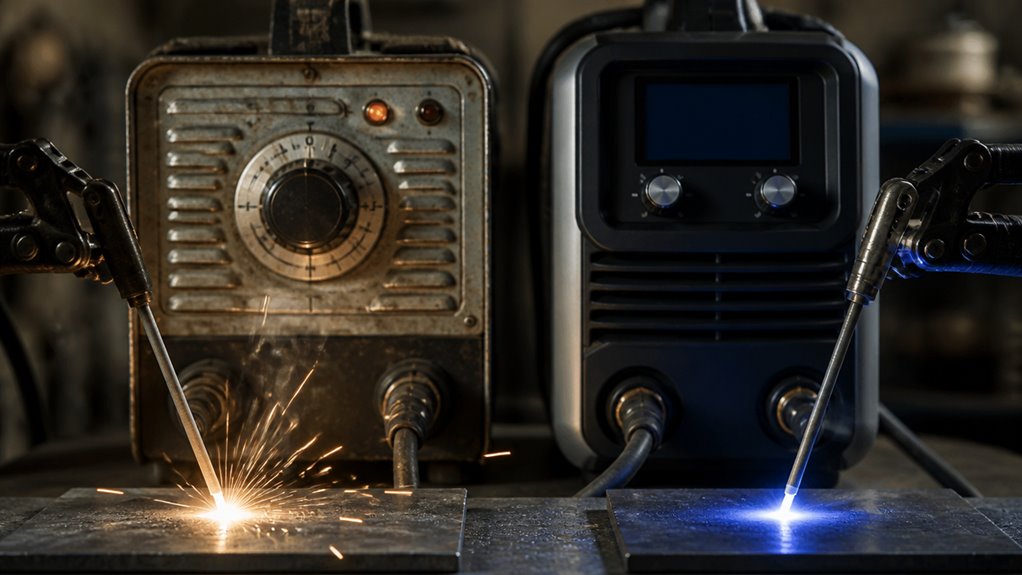
You’ll find AC welders use alternating current that reverses polarity, helping clean oxides and reduce arc blow. This makes them ideal for aluminum and non-ferrous metals.
DC welders deliver steady, direct current with consistent polarity. They offer smoother arcs, deeper penetration, and superior weld quality, making them perfect for steel and stainless steel.
While AC can produce a less stable arc, its cleaning action is essential for certain metals. Exploring these fundamentals reveals how current choice impacts weld control and results.
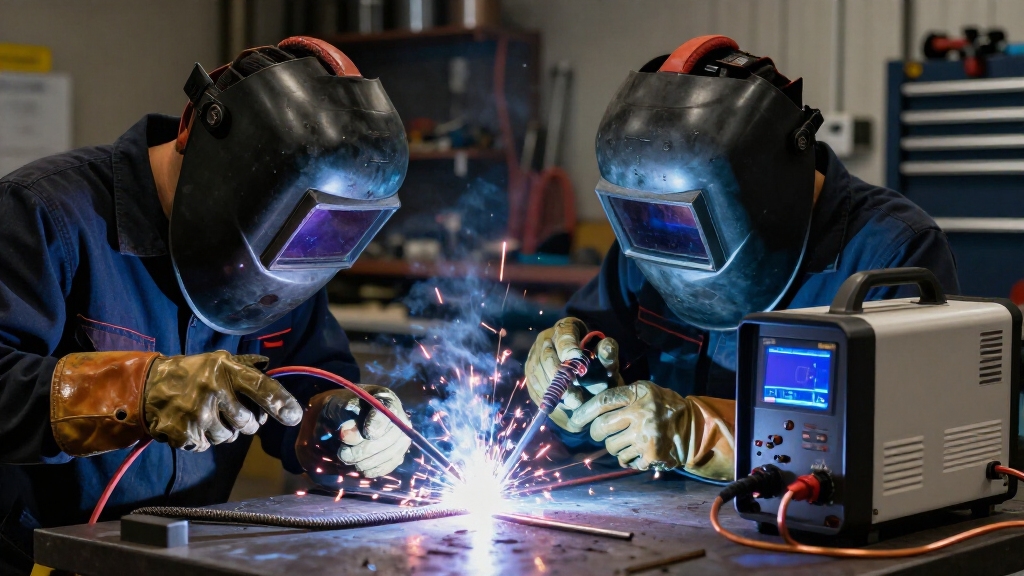
Although both AC and DC welders serve the fundamental purpose of joining metals, they differ markedly in current type, arc stability, penetration, and application suitability.
AC and DC welders both join metals but vary significantly in current type, arc stability, and usage.
You’ll notice AC welders use alternating current, which reverses direction about 120 times per second. This causes polarity to switch continuously, leading to a less stable, more erratic arc.
In contrast, DC welders deliver direct current in a single direction. This provides a smoother, more stable arc and easier control.
DC welding typically offers deeper penetration and cleaner welds with less spatter.
However, AC welders excel in reducing arc blow on magnetized workpieces and are often preferred for aluminum due to their oxide-cleaning effect.
Modern standards and technical evidence overwhelmingly endorse DC for arc stability and heat control, especially in vertical and overhead welding positions.
When you work with AC welding, the current reverses direction continuously, causing the polarity to switch back and forth about 120 times per second on a standard 60-hertz supply.
This rapid alternation means the electrode alternates between positive and negative polarity, blending the effects of both in a single weld cycle.
Conversely, DC welding maintains a constant polarity, either DC electrode negative (DCEN) or DC electrode positive (DCEP), which directly influences heat distribution and weld penetration.
With DC, you can control whether the heat concentrates more on the electrode or the workpiece, optimizing bead shape and penetration depth.
In contrast, AC’s polarity shifts continuously, producing a composite effect that balances cleaning action and penetration but reduces your ability to fine-tune heat placement compared to DC.
This continuous polarity change in AC welding also facilitates oxide layer cleaning on reactive metals like aluminum and magnesium, which is critical for weld quality.
Because DC welding maintains a constant current direction, it produces a steadier arc that’s easier for you to control. This continuous polarity eliminates the zero-crossing points found in AC, where the current momentarily drops to zero and restarts, causing the arc to fluctuate.
With DC, the arc remains consistently energized, resulting in less spatter and smoother bead formation. You’ll notice better arc initiation and reduced interruptions, allowing for precise manipulation of the weld pool.
Additionally, DC’s stable current flow minimizes arc wandering, enhancing your ability to maintain a uniform weld path. This stability is essential in applications demanding high-quality, clean welds, as it improves both operator control and overall welding efficiency compared to the pulsating nature of AC arcs.
DC TIG also reduces heat on the tungsten electrode, enhancing electrode longevity and arc precision.
Since weld penetration directly affects strength and durability, understanding the differences between AC and DC welding in this area is essential.
You’ll find DC welding generally delivers stronger penetration due to its constant polarity, promoting deeper fusion and cleaner welds. This results in higher weld quality with less spatter and smoother surfaces.
In contrast, AC welding’s alternating polarity causes shallower penetration and increased spatter, producing less uniform welds. The frequent polarity shifts in AC create less consistent heat input, impacting bead stability and fusion depth.
When precision and structural integrity matter, DC welding often outperforms AC by providing more controlled, deeper penetration and superior weld finish.
Consequently, selecting DC or AC depends on your specific application priorities regarding weld strength and surface quality.
Additionally, choosing the appropriate polarity and heat distribution in DC welding can further optimize penetration and cleaning action for different materials and techniques.
When you weld magnetized metals using AC, something interesting happens. The rapid polarity reversal actually helps to neutralize the influence of the magnetic field on the arc. Pretty cool, right? This continuous switching of polarity is key because it stops arc blow in its tracks. Using AC welding helps reduce the magnetic forces that cause erratic arc deflection, improving weld stability and quality by minimizing magnetic arc blow.
Although arc blow poses a significant challenge during welding on magnetized metals, AC welding effectively mitigates this issue through continuous polarity reversal.
By switching polarity approximately 120 times per second on a 60 Hz supply, AC welding prevents the magnetic field from concentrating in one direction, which otherwise deflects the arc.
This rapid alternation neutralizes localized magnetic forces, maintaining arc stability and consistent weld penetration.
You’ll notice that this dynamic polarity shift minimizes arc wandering and allows better control over the weld pool on magnetized workpieces.
Unlike DC welding, where constant polarity can cause arc deflection and poor bead quality, AC’s polarity reversal inherently counters magnetic interference.
Consequently, this feature is vital when welding ferromagnetic materials prone to magnetization, ensuring a more reliable, controlled welding process.
Additionally, AC welding’s ability to balance oxide cleaning and penetration enhances weld quality on metals like aluminum and magnesium.
By continuously reversing polarity, AC welding neutralizes the magnetic fields that cause arc blow in magnetized metals. This rapid alternation occurs 120 times per second on a 60 Hz supply. It prevents the arc from being deflected by static magnetic forces.
As a result, you maintain better arc control and a consistent weld path on magnetized or ferromagnetic materials.
This alternating polarity also balances heat distribution between the electrode and workpiece, enhancing arc stability.
| Factor | AC Welding Effect |
|---|---|
| Polarity Reversal | Neutralizes magnetic fields |
| Arc Deflection | Substantially reduced |
| Weld Path Control | Enhanced on magnetized metals |
| Suitability | Ideal for magnetized or contaminated workpieces |
Using AC, you avoid arc blow-related disruptions common in DC welding. This improves weld quality on challenging surfaces.
The rapid polarity reversals in AC welding don’t just neutralize magnetic fields. They also actively stabilize the welding arc on magnetized metals.
Because the current switches direction about 120 times per second, the arc experiences continuous resets that counteract the deflecting forces caused by magnetic flux concentration.
This frequent polarity alternation prevents the arc from drifting or blowing away from the intended weld path, which is common with steady DC polarity under magnetic influence.
By minimizing arc blow, AC welding maintains a more consistent arc length and heat distribution, improving weld control on magnetized workpieces.
Although AC arcs typically feel less smooth than DC, their inherent ability to stabilize the arc under challenging magnetic conditions makes AC welding indispensable for certain metals and applications sensitive to magnetic distortion.
This stabilization is enhanced by the drooping voltage characteristic of DC power supplies, which helps maintain arc length consistency despite minor fluctuations.
Choose your welding current based on the metal you’re working with to optimize weld quality and efficiency.
Select welding current suited to your metal for optimal weld quality and efficiency.
For ferrous metals like steel, stainless steel, and chromoly, DC welding is typically your best choice. It provides stable arc control, deeper penetration, and cleaner welds.
You can select DCEP or DCEN polarity to tailor heat distribution, improving weld integrity.
On the other hand, for non-ferrous metals, especially aluminum and other alloys with oxide layers, AC welding excels by offering effective oxide cleaning through polarity reversal.
Although AC may produce a less stable arc and shallower penetration, its cleaning action is vital for weld quality on these metals.
Understanding your metal’s properties guarantees you match the welding current to achieve peak fusion and mechanical strength.
For example, AC TIG welding is preferred for aluminum due to its ability to provide precise heat control and break down surface oxides for superior welds.
Welding aluminum becomes markedly more manageable when using AC current because it effectively tackles the persistent oxide layer on the metal’s surface.
The alternating current reverses polarity rapidly, disrupting and cleaning this tough oxide barrier, which inhibits proper fusion. This cleaning action is essential for achieving high-quality aluminum welds.
When you use AC welding for aluminum, you benefit from:
Oxide layer disruption: Polarity switching breaks down aluminum oxide, promoting better weld penetration.
Arc cleaning effect: AC’s positive polarity phase removes impurities, improving bead appearance.
Reduced arc blow: AC’s alternating nature counters magnetic arc disturbances common in aluminum welding.
This combination facilitates stronger, cleaner welds, making AC the preferred current type for aluminum despite its less stable arc compared to DC. Additionally, maintaining a 70% electrode negative / 30% electrode positive AC balance helps optimize penetration and cleaning during the weld.
When you’re welding steel and stainless steel, opting for DC is a smart choice. Why? Well, it offers fantastic arc stability, which means you get consistent control throughout the entire welding process.
Plus, DC provides enhanced penetration. This results in stronger, more reliable welds with cleaner fusion. You definitely want that kind of strength in your welds!
And here’s another bonus: DC produces less spatter. That means you’ll spend less time on cleanup, which is always a win.
Arc stability plays a crucial role in achieving consistent, high-quality welds on steel and stainless steel. When you opt for DC welding, you benefit from a steady, uninterrupted current flow, which materially reduces arc fluctuations compared to AC.
This stability lets you maintain better control over the weld puddle, leading to smoother bead appearance and fewer defects. Here’s why DC welding’s arc stability matters for steel and stainless steel:
Provides a consistent arc without polarity switching, enabling precise heat control. It reduces arc interruptions, which minimizes spatter and improves bead uniformity.
It also facilitates easier arc starting and smoother operation for enhanced weld quality. Choosing DC welding guarantees you achieve reliable, repeatable welds essential for critical steel fabrication tasks.
Building on the improved control and stability DC welding offers, you’ll find it also markedly enhances penetration quality on steel and stainless steel.
Because DC current flows in a constant direction, you can select polarity, typically DCEP (direct current electrode positive), to concentrate heat more effectively at the weld pool’s leading edge.
This focused heat input drives deeper fusion into the base metal, producing stronger, more durable joints.
In contrast, AC welding’s alternating polarity dilutes heat concentration, often resulting in shallower penetration.
When working with steel and stainless steel, you’ll appreciate how DC welding minimizes defects related to insufficient fusion and guarantees consistent weld bead geometry.
Consequently, for critical structural applications requiring robust penetration, DC welding is the preferred choice to achieve superior metallurgical integrity and mechanical performance.
You’ll frequently find that DC welding markedly reduces spatter compared to AC. This makes it the preferred choice for steel and stainless steel applications where cleanliness and weld appearance matter.
The steady polarity in DC stabilizes the arc, minimizing erratic metal ejection and resulting in a smoother weld bead with less cleanup. This reduction in spatter enhances weld quality and efficiency.
When choosing DC welding for steel and stainless steel, consider these advantages:
Consistent arc stability reduces metal spatter and weld defects.
Improved heat control enables precise penetration with clean edges.
Lower spatter output decreases post-weld cleaning time and material waste.
This makes DC welding ideal for critical structural and aesthetic welds where surface quality and minimal rework are priorities.
Although both AC and DC welding machines serve essential roles, their cost structures differ markedly due to design complexity and internal components.
AC welders tend to be less expensive because their circuitry is simpler and lacks rectifiers or inverters needed to produce steady direct current.
You’ll find AC machines generally have fewer parts, which can translate into lower manufacturing and maintenance costs.
In contrast, DC welders require more intricate electronics to convert and regulate current flow, raising their price.
However, DC machines often deliver smoother arcs and higher productivity, potentially offsetting initial expenses over time.
When budgeting, consider that the upfront investment for DC welders is higher, but their performance benefits might justify the cost depending on your welding applications and frequency of use.
AC/DC welders really shine when it comes to tackling a variety of metals. They let you switch between alternating and direct current with ease, which is great for optimizing weld quality and penetration. This means you can tailor the polarity and arc characteristics to match the specific needs of the material you’re working with.
Plus, this flexibility enhances your control over the welding process and helps reduce defects. It’s all about getting the best results for your projects.
In the end, using a dual-current welder can really boost your efficiency. You’ll spend less time changing equipment and setting things up, especially when you’re handling mixed welding tasks. It’s a win-win!
Many welding projects demand working with multiple metals, making versatile equipment essential. An AC/DC welder allows you to handle diverse materials efficiently by switching current types to match specific metal requirements. This flexibility lets you optimize weld quality and penetration for each metal involved.
Consider these key advantages:
AC current excels with aluminum and non-ferrous alloys by breaking down surface oxides, improving weld cleanliness.
DC current offers stable arcs and deep penetration, ideal for steel, stainless steel, and ferrous metals.
Using a single machine for both currents eliminates the need for multiple welders, saving space and cost.
Switching between AC and DC currents in a single welding machine gives you precise control over the welding process, adapting to the unique demands of each metal and joint type.
You can exploit AC’s polarity reversal to minimize arc blow on magnetized workpieces or enhance oxide removal on aluminum.
Conversely, DC offers a steady arc, smoother bead, and deeper penetration, ideal for ferrous metals and critical weld quality.
This flexibility lets you optimize heat input, arc stability, and weld profile without changing equipment, saving time and effort.
By selecting the appropriate current mode on demand, you accommodate diverse materials and welding positions within mixed jobs efficiently.
AC/DC welders consequently combine the strengths of both currents, providing technical versatility that single-current machines can’t match.
Maximize your workflow by leveraging AC/DC welders, which seamlessly adapt to varied welding tasks without interrupting your process.
These machines let you switch between AC and DC currents to match metal types and welding conditions instantly, enhancing job flexibility and reducing downtime.
You won’t need multiple welders for different alloys or oxide layers, simplifying logistics and cutting costs.
Key efficiency benefits include:
Versatility: Handle aluminum with AC for oxide removal and steel with DC for stable arcs.
Reduced setup time: Quickly toggle current types to suit changing workpieces.
Improved weld quality: Optimize penetration and arc stability by selecting the appropriate current.
You’ll generally weld faster with a DC welder because it produces a smoother, more stable arc and stronger penetration. This stability lets you maintain a consistent speed without sacrificing weld quality.
With AC, the arc fluctuates as polarity reverses, which can slow you down to control spatter and maintain bead appearance.
Ever wonder why your electrode fades faster sometimes? Yes, welding current affects electrode lifespan.
DC welding provides a steadier arc, reducing electrode wear and spatter, so your electrode lasts longer.
AC’s constantly reversing polarity causes more spatter and uneven heating, which can wear electrodes quicker.
If you want efficiency and durability, DC is your best bet, especially for extended projects requiring consistent performance and less frequent electrode changes.
Yes, safety differences exist between AC and DC welders.
AC welders pose a higher risk of electric shock due to the current’s alternating nature causing muscle contractions.
DC welders provide steadier current, reducing shock risk but can cause arc blow, affecting control.
You must consider grounding, insulation, and protective gear regardless of type.
Proper equipment maintenance and operator training remain critical to minimizing hazards in both cases.
Think of your weld like a candle flame in a breeze: AC’s arc flickers more, struggling against the wind’s interruptions, while DC’s steady flame resists gusts with smoother control.
In outdoor or windy conditions, you’ll find DC welders perform better, maintaining arc stability and consistent penetration.
AC welders, prone to erratic arc behavior, can falter more easily.
You’ll need to inspect AC welders for wear on components managing the alternating current, especially transformers and rectifiers.
Ensure insulation integrity against frequent polarity shifts.
DC welders require regular checks on rectifier diodes and cooling systems, as their constant polarity can cause more heat buildup.
Both need electrode holders, cables, and connections cleaned and tightened.
However, DC machines often demand more frequent diode replacement to maintain arc stability and prevent failure from overheating.
Choosing between AC and DC welders is like selecting the right current to forge your path.
AC pulses like a river, smoothing aluminum’s flow and easing magnetized metals.
DC cuts with the steady precision of a laser, delivering deep, stable penetration in steel.
Understanding these currents lets you wield control over your welds, optimizing quality and efficiency.
Ultimately, your choice shapes the arc’s dance, defining the strength and clarity of your metal’s final bond.