Phone:
(701)814-6992
Physical address:
6296 Donnelly Plaza
Ratkeville, Bahamas.

Phone:
(701)814-6992
Physical address:
6296 Donnelly Plaza
Ratkeville, Bahamas.

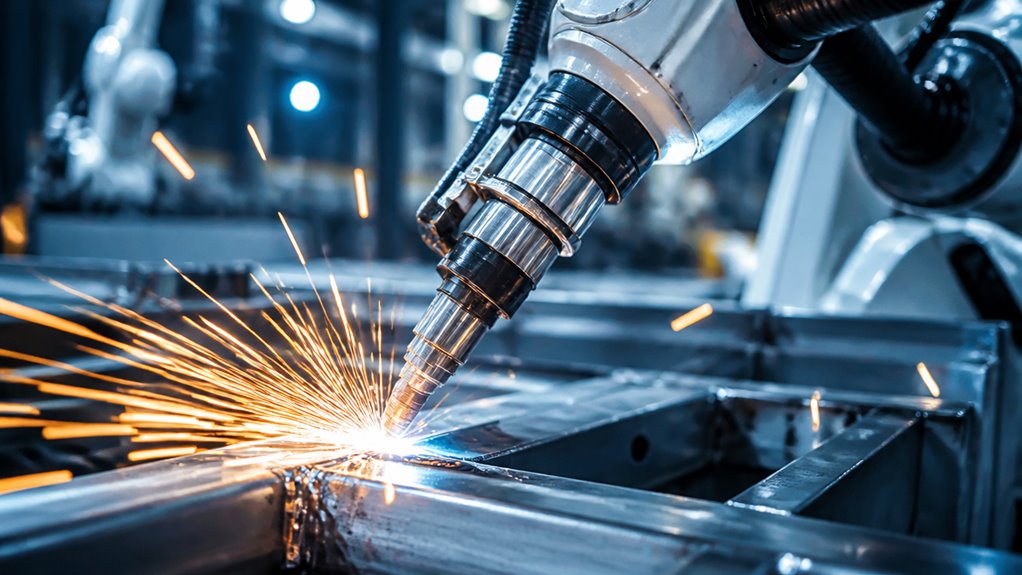
Robotic welding lets you achieve precise control over torch angle, speed, and wire feed, ensuring uniform, high-quality welds with defect rates below 1%.
You’ll boost productivity by up to 30%, matching multiple human welders’ output and maintaining 60–80% arc-on time for consistent throughput.
Automation reduces costly scrap, improves safety by removing workers from hazardous conditions, and shortens ROI periods to 12–24 months.
Discover how these advantages transform your manufacturing efficiency and reliability.
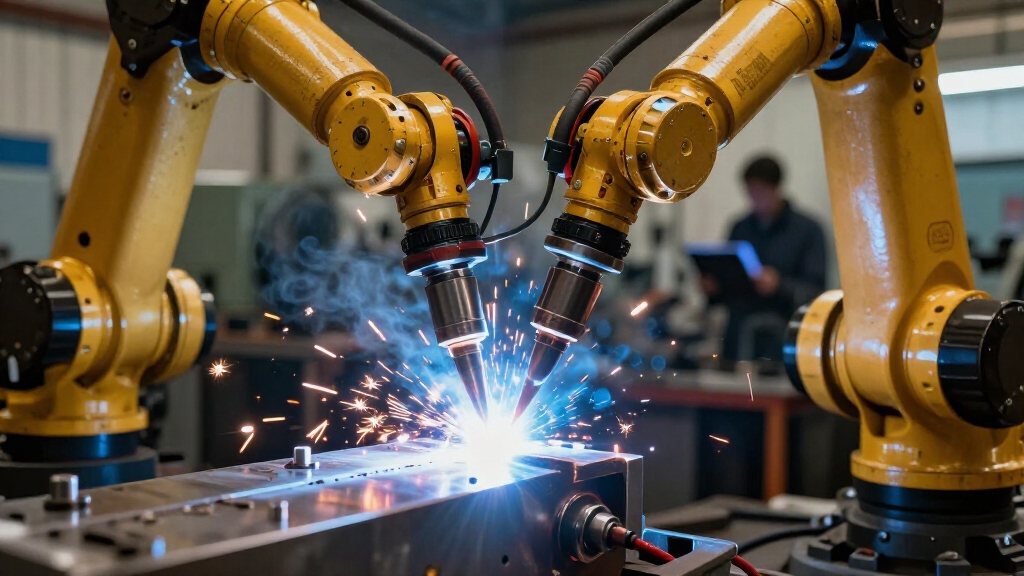
Robotic welding takes over the repetitive and precise task of joining metal components by using automated machines programmed to execute specific welding operations.
Robotic welding automates precise, repetitive metal joining with programmed machines for consistent, high-quality results.
You’ll find these systems critical because they guarantee uniform weld quality through precise control of parameters like torch angle, speed, and feed rate.
This precision minimizes variability between parts and reduces defects, which is essential for applications demanding high reliability.
By automating welding, you eliminate the inconsistencies introduced by human fatigue and skill variation, achieving repeatable, consistent results.
Additionally, robotic welding integrates seamlessly with manufacturing workflows, enabling you to maintain tight tolerances and complex weld patterns that manual processes struggle to replicate.
Understanding this technology fundamentally shifts how you approach metal fabrication, emphasizing accuracy, efficiency, and process control as key drivers of production quality.
Its ability to deliver up to 30% faster welds compared to manual methods is a significant advantage in optimizing production speed and throughput.
When you integrate automated welding systems into your production line, you markedly increase throughput by eliminating downtime associated with breaks and fatigue.
Robotic welders operate continuously across long shifts, achieving cycle times notably faster than manual welding.
In arc-on time, a single robot matches the productivity of approximately 2.5 human welders, delivering up to a 3:1 output improvement when optimized.
This acceleration enables you to maintain stringent production schedules and reduce bottlenecks effectively.
Moreover, robotic systems streamline labor allocation by automating repetitive welding tasks, allowing skilled operators to focus on programming and inspection.
Robotic welding systems typically achieve 60–80% arc-on time, significantly boosting overall efficiency compared to manual processes.
Consistently achieving high-quality welds requires precise control and repeatability that automated systems deliver reliably.
When you use robotic welding, you get uniform bead placement and reduced variation from part to part. This precision lowers defect rates and minimizes the need for rework, ensuring every joint meets stringent quality standards.
With accurate metal deposition, you avoid filler waste and enhance final product reliability.
The integration of a well-maintained wire feed mechanism ensures consistent wire delivery, which is critical for maintaining stable arc conditions and uniform weld quality in robotic welding.
| Quality Metric | Manual Welding | Robotic Welding |
|---|---|---|
| Defect Rate | Up to 5% | Below 1% |
| Rework Frequency | High | Low |
| Bead Consistency | Variable | Uniform |
| Filler Metal Waste | Higher | Reduced |
Robotic control maintains these advantages consistently across large production runs.
Minimizing worker exposure to hazardous welding environments markedly enhances safety and operational efficiency. By deploying robotic welding automation, you eliminate direct contact with intense heat, toxic fumes, and flying sparks. This considerably reduces injury risks.
Robots perform repetitive torch work without fatigue, preventing strain-related injuries. This allows skilled workers to focus on supervision and quality control. This approach also benefits confined or poorly ventilated spaces where human operation poses higher hazards.
Key safety advantages include:
Removing workers from exposure to extreme heat and harmful gases.
Reducing repetitive motion injuries by automating torch handling.
Enhancing safety in confined or hazardous spaces.
Allowing personnel to prioritize setup, inspection, and control tasks.
Lowering overall workplace accident rates through consistent automation.
Robotic welding therefore creates a safer, more controlled production environment. Additionally, automation helps mitigate risks related to electric shock by minimizing direct human interaction with energized equipment.
Lowering operating costs and accelerating return on investment (ROI) are critical goals for any welding operation. Robotic welding systems deliver measurable advantages in these areas.
By reducing defects, scrap, and rework, you directly decrease material waste and labor hours. This cuts production costs per part.
Robots work continuously with faster cycle times, boosting throughput without proportional labor increases. This enhances production efficiency.
Consistent weld quality improves process reliability, enabling better production planning and fewer bottlenecks. These factors combine to shorten typical robotic system payback periods to 12–24 months.
Additionally, optimizing filler metal use and minimizing manual intervention lowers overhead expenses. Embracing robotic welding enhances your cost structure and maximizes ROI through improved productivity, waste reduction, and streamlined workflows.
The integration of automation trends such as AI-driven monitoring and adaptive welding parameters further elevates efficiency and quality in robotic welding systems.
Programming robotic welding systems can be moderately challenging, but you’ll find it manageable with proper training.
You’ll need to understand robot kinematics, welding parameters, and path programming.
Modern systems offer user-friendly interfaces and offline programming tools, reducing complexity.
While initial setup requires precision to guarantee accuracy and efficiency, once programmed, robots maintain consistent weld quality.
Your expertise in both welding and automation directly impacts programming ease and system performance.
You’ll find robotic welding works best with metals like carbon steel, stainless steel, and aluminum due to their consistent weldability and common industrial use.
These metals respond well to precise heat control and automated filler deposition.
Robotic systems handle mild variations in alloy composition but excel with metals that require repetitive, high-quality welds.
For exotic metals or highly variable materials, you may need specialized programming or equipment adjustments to maintain weld integrity.
Yes, you can integrate robotic welding systems with existing production lines.
These systems offer flexible automation solutions that adapt to current workflows, minimizing downtime during installation.
You’ll benefit from seamless communication between robots and line controls via standardized interfaces and protocols.
This integration enhances throughput and consistency without disrupting your process.
It allows you to optimize productivity, reduce bottlenecks, and maintain precise coordination across the entire manufacturing operation.
You need to perform regular maintenance on robotic welding equipment, including cleaning weld spatter from torch tips and nozzles to ensure consistent performance.
Inspect and replace consumables like contact tips and liners frequently.
Calibrate sensors and check electrical connections to avoid faults.
Lubricate mechanical joints per manufacturer guidelines to prevent wear.
Also, update software and monitor system diagnostics to detect issues early, maintaining accuracy and uptime in your automated welding processes.
You’ll find robotic welders handle complex or custom welds by leveraging advanced programming and sensor feedback.
Robots can execute precise, repeatable motions with accuracy levels improving output by up to 3:1 compared to manual welding.
They adapt through CAD-based path planning and real-time adjustments, ensuring consistent bead placement even on intricate geometries.
By embracing robotic welding, you’re not just keeping pace; you’re setting the gold standard in efficiency and precision.
This technology consistently delivers top-tier welds and boosts your output while safeguarding your team and trimming costs.
Think of robotic welding as the backbone of a streamlined operation, where automation turns complex tasks into smooth, reliable processes.
In a competitive landscape, it’s the sharp edge that transforms potential into performance.