Phone:
(701)814-6992
Physical address:
6296 Donnelly Plaza
Ratkeville, Bahamas.

Phone:
(701)814-6992
Physical address:
6296 Donnelly Plaza
Ratkeville, Bahamas.

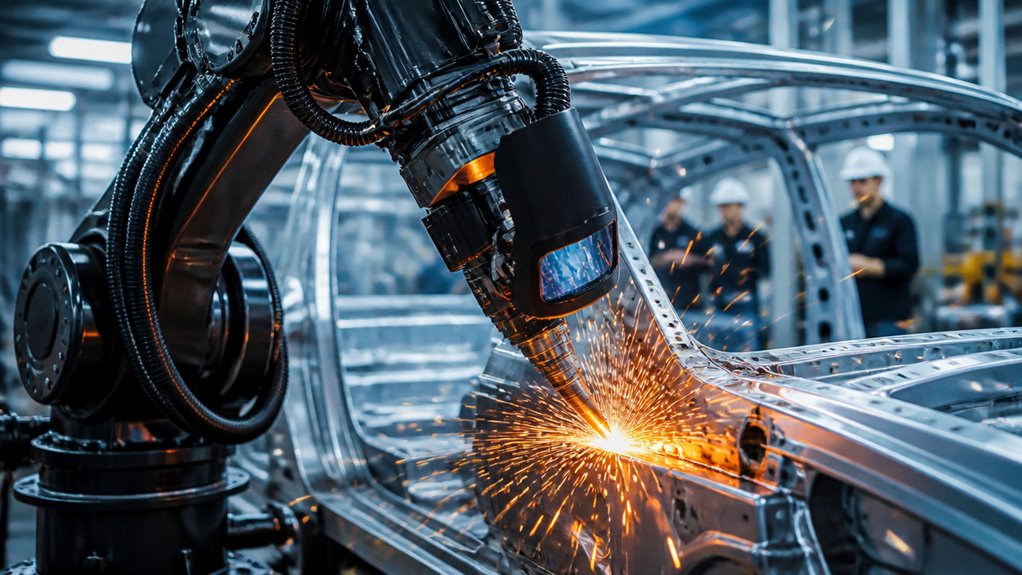
You use robotic welding to automate precise, consistent welds by programming industrial robots to control torch movement, welding parameters, and part handling.
This system replaces manual torch manipulation, reducing human error and variability. It supports various welding methods like arc and laser.
The robot arm follows exact paths, with sensors providing real-time feedback to maintain quality.
Benefits include increased speed, lower scrap, and reduced labor costs. Understanding its components and safety measures reveals how it boosts manufacturing efficiency.
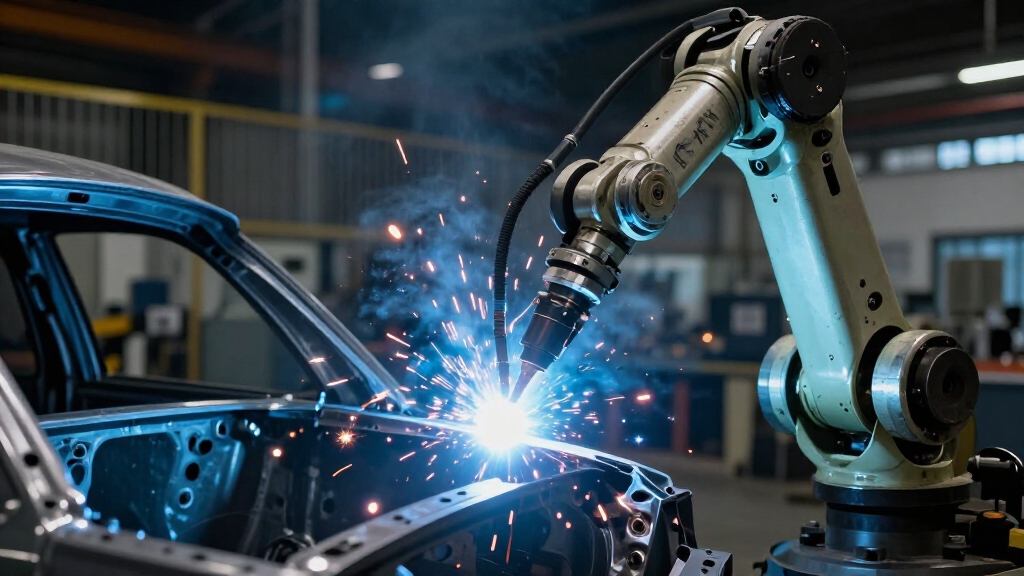
Robotic welding automates the welding process by using programmable industrial robots to control torch movement, welding parameters, and part handling with high precision.
Robotic welding leverages programmable robots for precise control of torch movement and welding parameters.
You rely on these robots to replace manual intervention by executing pre-programmed paths along weld joints, ensuring consistent and repeatable results.
The system typically integrates a robot arm, welding torch, power source, controller, sensors, and workholding devices.
You can reprogram the robot for various parts and production runs, adapting to different welding techniques like arc, spot, or laser welding depending on your application.
This automation minimizes human error and variability, enhancing weld quality and efficiency.
The welding torch in robotic systems often includes an integrated wire feed mechanism to ensure consistent wire delivery and stable arc conditions.
When you program the welding system, the robot arm precisely moves the torch or workpiece along a predefined path. This ensures exact positioning and consistent motion throughout the welding cycle.
The controller orchestrates the sequence, speed, and torch orientation. The power source regulates current, voltage, and wire feed rate.
Sensors provide real-time feedback, maintaining weld quality and repeatability. This integrated process minimizes deviations and optimizes efficiency.
Key operational elements include:
Full automation eliminates manual torch manipulation, reducing operator fatigue and improving process control for enhanced weld consistency.
Typically, a welding automation system comprises several critical components that work in unison to achieve precise and repeatable welds. You’ll find the robot arm, welding torch, power source, controller, sensors, and workholding equipment as integral. Each part plays a specific role that you must understand to optimize system performance.
| Component | Function | Key Considerations |
|---|---|---|
| Robot Arm | Positions torch/workpiece precisely | Degrees of freedom, payload |
| Welding Torch | Delivers weld energy | Compatibility, cooling |
| Power Source | Controls welding parameters | Current, voltage, waveform |
| Controller | Manages motion and process parameters | Programming flexibility |
Mastering these elements allows you to configure and maintain a reliable robotic welding system tailored to your production demands. Advanced systems may incorporate regulated metal deposition technology to enhance weld quality and reduce defects.
Many manufacturers realize significant gains in accuracy and consistency by integrating automated welding systems into their production lines.
When you implement robotic welding, you reduce variability inherent in manual processes, ensuring repeatable, high-quality welds. This leads to less scrap and rework, optimizing material use and lowering costs.
Additionally, robotic systems enhance throughput by enabling continuous operation without fatigue-related slowdowns.
Key benefits you gain include:
Robotic welding typically achieves 60–80% arc-on time, significantly boosting productivity compared to manual methods.
Although robotic welding cells offer significant productivity advantages, you must implement stringent safety measures to mitigate inherent risks.
Begin with a comprehensive risk assessment to identify hazards such as robot motion, arc radiation, fumes, and fire.
Install physical barriers like guarding, light curtains, and scanners to prevent unauthorized access during operation.
Integrate emergency-stop systems and interlocks directly into the control architecture to halt the robot instantly if a hazard is detected.
Make certain all safety components comply with relevant standards and regulations.
Program the robot and layout the cell to minimize operator exposure without compromising efficiency.
Additionally, maintain proper ventilation to control fumes and heat.
Regularly inspect and test safety systems to confirm functionality, preserving a safe environment while maximizing robotic welding performance.
It is also critical to ensure operators wear appropriate personal protective equipment to guard against burns, radiation, and electric shock hazards.
Implementing robotic welding systems typically costs between $50,000 and $400,000, depending on complexity, robot type, and integration level.
You’ll pay for the robot arm, welding equipment, controllers, sensors, and safety features. Custom programming and tooling add expenses.
Higher automation and specialized welding methods increase costs. You should also factor in training, maintenance, and facility modifications.
Careful cost-benefit analysis helps justify investment by improving efficiency and weld consistency.
Think of your robotic welding equipment as a finely tuned orchestra. It needs regular tuning to perform flawlessly.
You’ll need to routinely inspect and clean the robot arm, welding torch, and sensors to prevent buildup and wear.
Calibrate controllers and check electrical connections to guarantee precision.
Replace consumables like nozzles and liners on schedule.
Regular software updates and preventive maintenance keep your system running smoothly, minimizing downtime and maximizing weld quality.
Yes, you can integrate robotic welding systems with your existing production lines.
These systems are designed for flexibility and can be programmed to match your current workflows.
You’ll coordinate the robot’s controller with line automation and synchronize torch movements with conveyor speeds.
Additionally, sensors and communication protocols enable seamless data exchange, ensuring consistent production flow while enhancing precision and throughput.
This can be achieved without significant downtime or reconfiguration challenges.
It typically takes you a few hours to several days to program a new welding path, depending on complexity and part geometry.
If the design is straightforward, you might finish in hours using teach pendants or offline programming.
However, intricate joints or multi-robot coordination extend this time.
You’ll analyze the joint, define parameters precisely, and test the path iteratively.
This ensures accuracy and repeatability before full production.
You need specialized training to operate robotic welding cells effectively. This includes learning robot programming, system calibration, safety protocols, and troubleshooting techniques.
You’ll master controller interfaces, sensor integration, and welding parameter adjustments to maintain quality and productivity. Hands-on practice with simulation and real equipment is essential.
Additionally, understanding risk assessment and emergency procedures guarantees safe operation. Continuous education keeps you updated on software upgrades and evolving industry standards.
Think of robotic welding like a skilled pianist playing a complex piece flawlessly every time.
Just as the pianist’s precision creates harmony, robotic welding delivers consistent, high-quality welds at incredible speed, up to 30% faster than manual methods.
By integrating these systems, you not only boost efficiency but also reduce errors and enhance safety.
Embracing robotic welding means harnessing technology’s precision to transform your manufacturing process into a well-orchestrated performance.