Phone:
(701)814-6992
Physical address:
6296 Donnelly Plaza
Ratkeville, Bahamas.

Phone:
(701)814-6992
Physical address:
6296 Donnelly Plaza
Ratkeville, Bahamas.

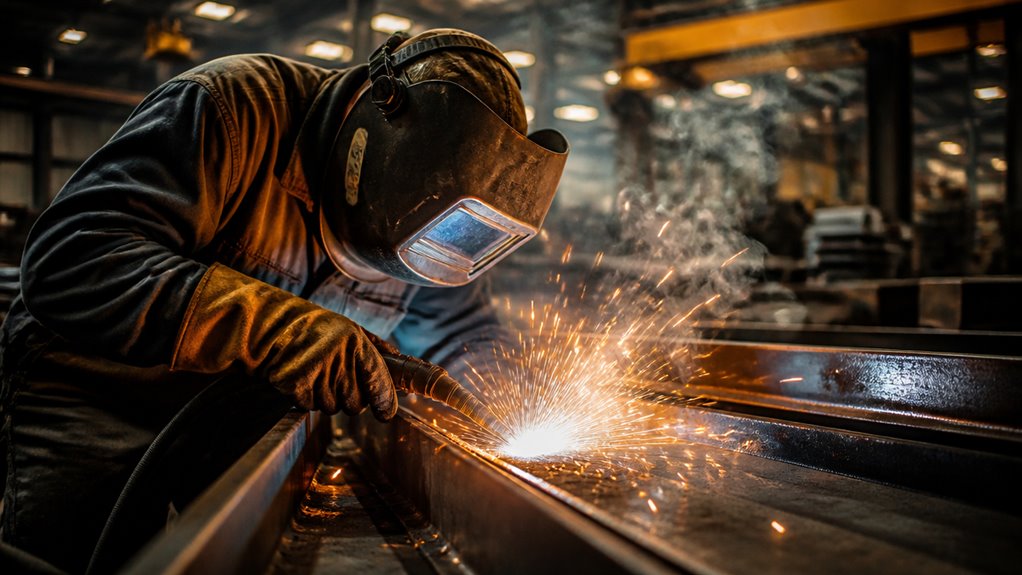
A welding plant is your integrated system for joining metals using controlled heat, pressure, or both, ensuring consistent energy and optimized weld quality.
It combines power sources, cables, torches, and gas supply to support diverse welding processes like arc and gas welding.
Welding plants also include cutting and assembly tools, synchronizing workflows for structural integrity and precision.
You’ll find they’re essential in fabrication and repair across industries, and understanding their components and operation reveals how they boost productivity and safety.
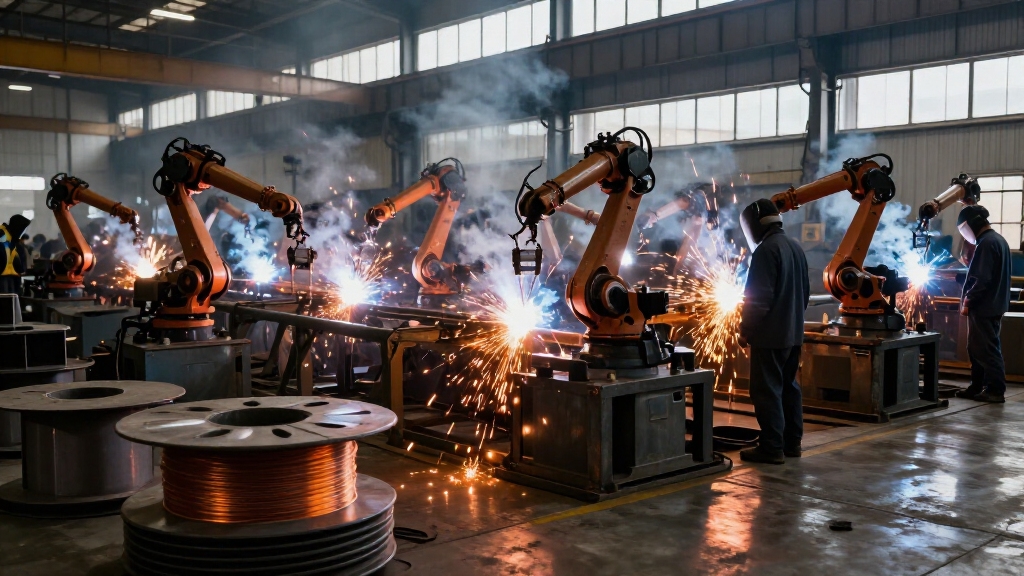
When you set up a welding plant, you’re creating an all-encompassing system designed to join metals efficiently through heat, pressure, or both. This system integrates specialized equipment and processes to guarantee strong, reliable metal bonds essential for fabrication, repair, and construction.
You rely on the plant’s ability to deliver consistent energy and controlled conditions, optimizing weld quality and productivity. Understanding the welding plant’s scope helps you address operational needs, safety requirements, and application contexts, ranging from stationary workshop setups to portable engine-driven units for remote work.
Its significance lies in supporting diverse industrial sectors by enabling permanent metal joining, which is fundamental to structural integrity and manufacturing efficiency. Recognizing this, you can better plan, operate, and maintain a welding plant tailored to your project’s demands. Selecting the appropriate welding process based on materials, environment, and skill level is key to maximizing efficiency and quality in your welding plant.
The core components of a welding plant really revolve around some essential equipment that’s all about delivering precise metal joining. You know, it’s fascinating how each piece plays its part in the bigger picture.
Take the power source, for instance. It’s super critical because it supplies the necessary electrical current, ensuring everything runs smoothly with consistent control and stability. When you think about it, understanding how these elements work together really lays the groundwork for analyzing the plant’s overall performance. It’s like a well-oiled machine! Modern welding plants often use constant voltage mode to maintain stable arc conditions in most semiautomatic applications.
Understanding the essential equipment in a welding plant is crucial for efficient and safe metal joining operations. You’ll rely on a power source to deliver the precise current needed for various welding techniques.
Cables serve as critical conductors, connecting the power source to the welding tool and workpiece, ensuring stable electrical flow. The torch or electrode holder directs the energy and filler material, allowing accurate control of the weld pool.
When applicable, a gas supply system provides shielding or fuel gases, protecting the weld from oxidation and contamination. In mobile units, internal combustion engines enable autonomous operation without external power.
Each component must be selected and maintained to match the welding process, material type, and operational environment. This ensures consistent weld quality and workplace safety. Proper control of heat input and welding parameters is essential to achieve strong metallurgical bonds and avoid defects.
A power source delivers the electrical current essential for initiating and sustaining the welding arc. You rely on it to convert input energy, either electrical or mechanical, into a controlled output current tailored for specific welding processes.
It regulates voltage and current to maintain arc stability, ensuring consistent heat generation and metal fusion. You’ll find transformer, inverter, and engine-driven types, each designed for distinct power requirements and mobility needs.
The power source’s duty cycle and output range directly affect weld quality and productivity. When selecting one, you must consider compatibility with welding methods, material thickness, and operational environment.
Proper function of the power source is critical. It safeguards against fluctuations, prevents equipment damage, and supports precise control over welding parameters throughout the fabrication process.
Modern welding plants often utilize inverter technology for enhanced efficiency, compactness, and precise arc control.
In a welding plant, you’ll come across a variety of key welding processes, each tailored to meet different needs.
For instance, arc welding techniques are quite popular because they create strong and versatile joints using electrical current. It’s fascinating how effective they are!
Then we’ve gas welding methods and semi-automatic options. These are great for providing controlled heat input and efficiency.
They work well with different types of metals and various thicknesses. It’s pretty impressive how these techniques can adapt to so many applications, don’t you think?
One commonly used method in welding plants is GMAW welding, known for its high deposition rates and minimal post-weld cleanup.
Mastering arc welding techniques is essential for optimizing the performance and quality of welding plants. Arc welding relies on an electric arc between an electrode and the base metal to create fusion.
You’ll find several key processes, each suited for specific applications and materials. Understanding their differences helps you select the right method for efficiency and weld integrity.
Shielded Metal Arc Welding (SMAW): Uses a consumable electrode coated with flux, ideal for outdoor and maintenance work.
Gas Metal Arc Welding (GMAW/MIG): Employs a continuous wire electrode with shielding gas, suited for high-speed production.
Flux-Cored Arc Welding (FCAW): Similar to GMAW but uses flux-filled wire, effective on thicker materials and outdoors.
Submerged Arc Welding (SAW): Utilizes a granular flux to cover the arc, providing deep penetration and high deposition rates.
Both GMAW and FCAW are classified as semiautomatic welding processes, where wire feeding is controlled by a machine while the operator manually guides the torch.
While arc welding techniques dominate many fabrication settings, gas welding methods remain integral for specific applications requiring precise control of heat and material flow.
You’ll use fuel gases, typically acetylene, combined with oxygen to generate a flame capable of melting and joining metals.
This process, often called oxy-fuel welding, provides you with excellent control over the flame temperature and size.
It’s suitable for delicate or thin materials where overheating is a concern.
Gas welding also allows for efficient preheating and post-weld heating, vital in stress relief during complex assemblies.
However, it demands careful gas mixing and flame adjustment to maintain weld quality and avoid oxidation.
Understanding these parameters helps you optimize the process in your welding plant for specialized repair or fabrication tasks.
Selecting the correct flame type is crucial to achieve optimal weld quality and compatibility with different metals.
Semi-automatic welding processes stand out by integrating manual control with mechanized wire feeding. This combination allows you to maintain steady weld quality while improving efficiency.
These methods offer better consistency than fully manual welding. They reduce operator fatigue and error without losing flexibility. By automating wire feed, you can optimize deposition rates and control weld bead shape precisely.
Key semi-automatic welding options include:
Selecting the right process depends on material type, joint design, and production volume. This ensures you balance quality, cost, and productivity effectively. The wire feed mechanism, featuring motorized drive rolls and tensioners, is essential for maintaining consistent wire feed and stable arc conditions in semiautomatic welding.
Welding plant configurations vary markedly depending on their intended application, power source, and mobility.
You’ll encounter stationary plants designed for workshop environments, utilizing electric power sources for consistent, high-quality output.
Alternatively, engine-driven welding plants offer mobility, integrating internal combustion engines, ideal for remote locations without grid access.
Gas welding plants rely on fuel gas and oxygen cylinders, suited for specialized processes requiring flame control.
Manual electric arc setups remain common for general-purpose metal joining, allowing flexibility across diverse tasks.
Industrial welding plants often form part of larger fabrication systems, incorporating cutting, drilling, and pressing equipment.
This enables automated or semi-automated workflows.
When analyzing types, consider power delivery methods, process specificity, and site conditions to understand how each plant fulfills distinct operational demands in metal fabrication and repair.
Modern plants often utilize multi process welders to enhance versatility and reduce equipment footprint across various welding tasks.
Choose a welding plant by carefully evaluating your project’s specific requirements, including material type, thickness, and environmental conditions. You need a system that matches your welding process, be it arc, gas, or engine-driven, to guarantee peak performance and efficiency.
Consider these critical factors:
Additionally, ensure the welding plant is securely mounted and balanced using factory mounting holes or welded tabs to prevent movement and vibration during transport.
When setting up a welding plant, you’ll want to have a variety of welding machines on hand. Think about everything from inverter units to semi-automatic systems. These tools are essential for ensuring you get that precise metal joining you’re aiming for.
And let’s not forget about cutting and preparation tools! Bevel cutters and laser machines play a huge role in achieving accurate fit-up and ensuring the quality of your joints. They’re really critical for getting everything just right.
Lastly, efficient material handling equipment is a must. Cranes and forklifts can make a world of difference in supporting your workflow. They help move those heavy components safely around the workshop, making the whole process smoother and safer.
Mastering metal joining starts with understanding the various machines that power the welding process in a plant setup.
Welding machines convert electrical energy into the heat necessary to fuse metals. Selecting the right type directly impacts weld quality and efficiency.
You’ll encounter diverse machines tailored for specific applications, each with unique power sources, control features, and operational modes.
Key welding machines include:
Transformer-based welders: Robust and reliable for manual arc welding.
Inverter welders: Compact, energy-efficient units with precise current control.
MIG (Metal Inert Gas) welders: Semi-automatic, suited for high-speed welding with shielding gas.
SAW (Submerged Arc Welding) machines: High deposition rate systems ideal for thick materials.
Understanding these machines lets you optimize performance and maintain consistent weld integrity.
Cutting and preparation tools form the backbone of a welding plant’s workflow, ensuring metal pieces meet exact specifications before joining.
You rely on precision cutting equipment like laser cutters, plasma torches, and beveling machines to achieve clean, accurate edges and angles essential for strong welds.
Proper surface preparation demands grinding, drilling, and deburring tools that remove contaminants, rust, and irregularities, promoting ideal fusion.
You must calibrate these tools carefully, as dimensional accuracy directly affects weld integrity and fit-up.
Additionally, controlled beveling techniques prepare joint geometries suited to welding processes and material thickness.
Utilizing technologically advanced cutting and preparation tools minimizes rework, reduces material waste, and enhances workflow efficiency, making these tools indispensable in any welding plant setup.
Material-handling systems play a critical role in welding plants by facilitating the efficient movement, storage, and positioning of heavy metal components throughout the workshop.
Without proper equipment, you’d waste time and risk injury handling bulky materials manually.
To optimize workflow and safety, you should integrate reliable material handling tools designed for heavy loads and precise placement.
Key equipment includes:
Although welding plants are essential for metal fabrication, they pose significant safety risks that you must address to protect operators and facilities.
Welding plants are crucial for fabrication but present serious safety challenges requiring vigilant protection measures.
Key hazards include electric shock from high currents, exposure to toxic welding fumes, fire and explosion from sparks near combustible materials, and injury from confined space or height work.
To control these risks, implement rigorous ventilation systems to disperse fumes, enforce strict isolation of flammable substances, and maintain clear fire-watch protocols.
Make sure operators wear appropriate personal protective equipment, such as welding helmets, gloves, and flame-resistant clothing. Use insulated tools to prevent shocks.
Regularly inspect cables and equipment for damage. Additionally, train personnel on emergency response and safe operating procedures.
Welding plants form the backbone of industrial fabrication workflows by integrating multiple processes that transform raw metal into finished components.
When you operate a welding plant, you engage in a tightly coordinated system combining cutting, welding, and assembly to guarantee structural integrity and dimensional accuracy.
The workflow efficiency hinges on your ability to synchronize power sources, material handling, and precision welding techniques.
Key aspects to take into account include:
Maintaining and troubleshooting welding plant equipment demands systematic inspection and prompt intervention to prevent downtime and guarantee operational safety.
You must regularly check connections, cables, and the power source for wear or damage. Faulty components reduce performance and increase safety risks.
Use diagnostic tools to identify electrical faults, overheating, or gas leaks swiftly.
Keep a maintenance log to track repairs and replacements, assuring consistent reliability.
| Issue | Emotional Impact |
|---|---|
| Equipment failure | Frustration, urgency |
| Safety hazards | Anxiety, caution |
| Downtime | Stress, financial loss |
| Unplanned repairs | Disruption, inconvenience |
| Efficient operation | Confidence, satisfaction |
Staying proactive minimizes hazards and assures your welding plant operates at peak efficiency.
Engine-driven welding plants frequently provide the most practical solution for remote work sites where access to electrical power is limited or nonexistent.
Engine-driven welding plants are ideal for remote sites lacking reliable electrical power access.
You rely on their integrated internal combustion engine to generate electricity and supply welding current independently.
This autonomy enables you to perform critical welding operations without infrastructure constraints.
Key advantages include:
Portability: Easily transportable to off-grid locations.
Dual functionality: Provides auxiliary power for tools and lighting.
Versatility: Supports various welding processes including arc and gas welding.
Reliability: Engine design optimized for continuous, heavy-duty operation.
A typical welding plant’s cost varies widely, usually ranging from $10,000 to over $100,000, depending on size, complexity, and features.
If you need a basic stationary setup, expect lower costs. Mobile, engine-driven plants or those integrated with advanced cutting and handling equipment will push the price higher.
You should factor in additional expenses like safety gear, ventilation, and installation. Always analyze your specific operational needs to select the right investment.
You need formal welding training, including certifications such as AWS or ISO standards, to operate a welding plant safely and effectively.
You’ll learn equipment setup, welding techniques, safety protocols, and maintenance procedures.
Hands-on experience with power sources, torches, and gas supplies is critical.
Additionally, understanding hazard controls, ventilation, and protective gear usage guarantees compliance with industrial safety standards.
This minimizes risks like electric shock, fumes, and fire during operations.
Yes, you can rent welding plants for short-term projects.
Rental options often include engine-driven units or stationary systems, allowing you to match equipment to your specific job needs without long-term investment.
This flexibility supports field repairs, remote work, or temporary fabrication tasks.
Just make sure you understand the rental terms, required training, and safety protocols to operate the equipment effectively and comply with industry standards during your project.
You’ll find welding plants impact the environment mainly through emissions of fumes, gases, and particulate matter.
The processes generate hazardous metal oxides and ozone, which can degrade air quality.
Noise pollution and energy consumption also contribute to environmental strain.
Managing waste, such as slag and used electrodes, is essential to prevent soil and water contamination.
You must implement ventilation and filtration systems, along with proper disposal methods, to minimize these effects effectively.
Setting up a welding plant typically takes from several hours to a few days, depending on complexity and scale.
You’ll need to install power sources, connect cables, position torches, and make certain gas supplies if used.
Mobile units with engine drives take less time, while full workshop setups with auxiliary equipment require detailed planning and safety checks.
Efficient layout and compliance with safety protocols speed up your setup process.
Now that you understand the ins and outs of welding plants, you’re equipped to choose and operate the right system like a skilled conductor leading an orchestra.
Each component and process must harmonize for peak performance and safety.
Remember, selecting the appropriate welding plant isn’t just about power; it’s about precision, efficiency, and control.
Master these elements, and your projects will weld together seamlessly, driving your industrial success forward.