Phone:
(701)814-6992
Physical address:
6296 Donnelly Plaza
Ratkeville, Bahamas.

Phone:
(701)814-6992
Physical address:
6296 Donnelly Plaza
Ratkeville, Bahamas.

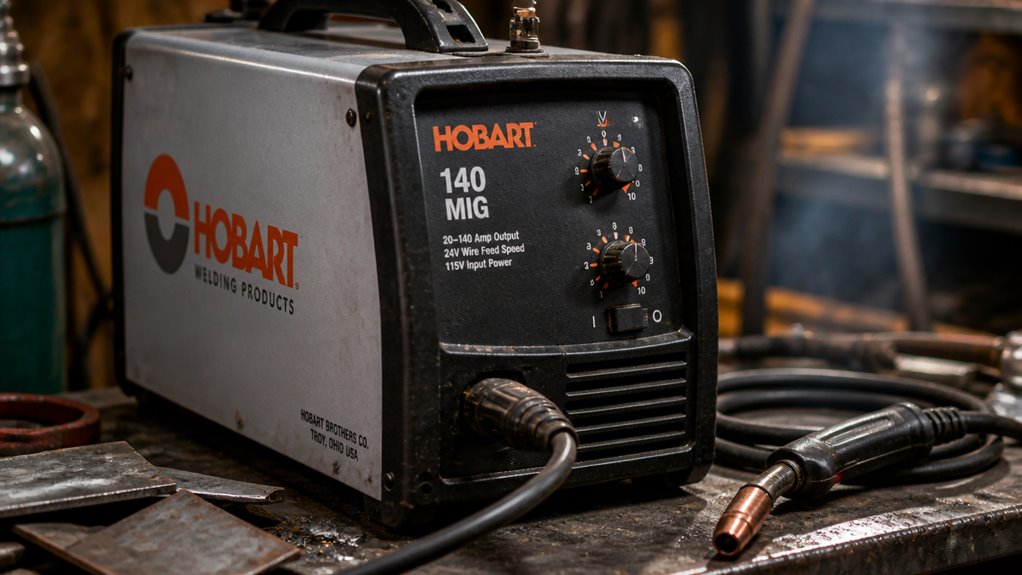
You’ll find the Hobart 140 MIG Welder runs on standard 115V household power, making setup simple for home shops without costly rewiring.
It delivers 25–140 amps, ideal for welding mild steel up to 1/4 inch, but a 20% duty cycle limits continuous use.
Its adjustable voltage and reliable wire feed support solid and flux-cored wires from .023 to .035 inches, balancing portability and performance.
Exploring its specs further reveals how it suits light fabrications and occasional repairs.
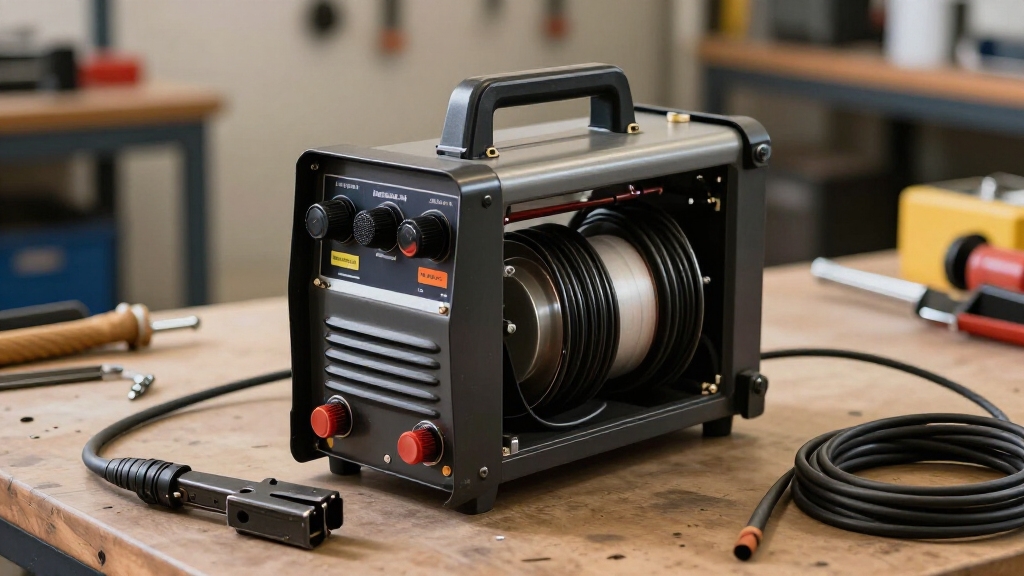
While the Hobart Handler 140 operates on standard 115V household power, it delivers a versatile welding experience that suits most home projects.
You get an amperage range from 25A up to 140A, allowing you to weld mild steel from 24 gauge to ¼ inch in a single pass.
Amperage from 25A to 140A lets you weld mild steel from 24 gauge to ¼ inch in one pass.
Its 20% duty cycle at 90A means you’ll manage short, intermittent welds without overheating.
The tapped voltage control lets you fine-tune the arc for different thicknesses and wire types, enhancing precision.
With wire feed speeds up to approximately 700 IPM, you control deposition rates effectively.
The 10-foot gun and work cable improve reach around your workspace, while the included regulator and gas hose simplify setup.
Together, these features optimize the Hobart 140 for home and light fabrication tasks.
It also features a durable industrial-grade cast aluminum drive system for smooth wire feeding and long-lasting performance.
Because the Hobart 140 runs on standard 115V household power, you can easily plug it into typical home shop outlets without requiring specialized electrical upgrades.
This compatibility eliminates the need for costly rewiring or dedicated circuits, making setup straightforward and cost-effective.
Operating on single-phase 60 Hz power, the welder delivers a maximum output of 140 amps, sufficient for welding mild steel up to 1/4 inch thick in single passes.
The 115V input, while limiting maximum power compared to 220V machines, aligns well with the demands of light fabrication and repair tasks common in home shops.
Its power draw remains manageable for residential circuits, reducing trip risks and ensuring consistent arc stability during typical welding intervals you’ll encounter in hobby or maintenance projects.
Unlike some welders, the Hobart 140 offers multi-process welding capabilities, adding versatility beyond basic AC stick welding units.
To optimize your welding projects with the Hobart 140, you need to understand its welding range and duty cycle limitations.
The unit operates from 25 to 140 amps, allowing you to weld mild steel from 24 gauge up to ¼ inch in a single pass. This range covers most light to medium fabrication tasks.
However, at its rated output of 90 amps, the welder has a 20% duty cycle, meaning you can weld for 2 minutes within a 10-minute period before it needs to cool. Exceeding this risks overheating and potential damage.
This duty cycle suits intermittent work but limits continuous welding on thicker materials.
Knowing these parameters helps you plan weld duration and amperage settings to maintain performance and protect the machine. Proper surface preparation and cooling periods are essential to ensure the longevity and safety of welding equipment under heat stress, as detailed in thermal performance studies.
Which wire types and diameters deliver peak performance with the Hobart 140? To optimize your welding results, focus on these key wire specifications:
1. Solid Steel Wire (.023″ to .035″)
Best for mild steel applications, offering clean, spatter-free welds with shielding gas. The .030″ and .035″ diameters provide balance between penetration and control.
2. Flux-Cored Wire (.030″ to .035″)
Ideal when gas shielding isn’t feasible. Provides deeper penetration but increases spatter, suitable for outdoor or rusted surfaces.
3. Stainless Steel Wire (.023″ to .035″)
Compatible but requires precise amperage settings to avoid burn-through, especially at thinner gauges.
Stick within these diameter ranges to maintain consistent wire feed and arc stability. This is crucial given the Hobart 140’s wire feed motor and voltage output limits.
It guarantees efficient, reliable welds across typical light to medium-duty projects. Additionally, understanding the duty cycle and amperage output is essential to ensure the Hobart 140 performs optimally without overheating during extended use.
The Hobart 140 really shines when it comes to welding thin steel. It can easily handle gauges as light as 24, delivering clean and controlled passes every time. So, if you’re working on something light, this machine is definitely a great choice.
When it comes to medium thicknesses, it holds its own up to 1/4 inch. That makes it suitable for most light fabrication tasks you might encounter.
However, it’s worth noting that its 115V input and 20% duty cycle can limit how effectively it performs on thicker metals. For those tougher jobs, you might need to consider making multiple passes or even looking at higher-powered machines to get the results you want.
For heavier duty work and thicker materials, a welder with a higher amperage range and dual-voltage capabilities may be more appropriate.
How effectively does the Hobart Handler 140 handle thin steel welding tasks? It performs well on steel as thin as 24 gauge, providing clean, controlled welds without excessive burn-through. Its voltage control lets you fine-tune the arc, vital for delicate thin materials. Key aspects include:
While it’s not specialized for ultra-thin sheet metals, the Handler 140 balances ease of use and control effectively. This makes it suitable for hobbyists and light repair work involving thin steel. Its performance can also be enhanced by using pulse MIG mode, which reduces spatter and improves weld quality on thin materials.
Although the Hobart Handler 140 is primarily designed for light to medium-duty welding, it handles medium thickness metals up to 1/4 inch steel in a single pass with reliable consistency.
You’ll find that its 25A to 140A amperage range allows precise control over penetration and bead profile, essential for maintaining weld integrity on thicker stock.
The tapped voltage settings facilitate arc stability, minimizing spatter and ensuring uniform fusion across the joint.
Wire feed speeds from roughly 40 to 700 IPM support smooth material deposition, optimizing heat input for 1/4 inch thickness.
While the 20% duty cycle at 90A limits prolonged weld times, it’s sufficient for typical medium-thickness repair and fabrication tasks.
For optimal welding results on steel up to 3/16 inch thickness, proper surface preparation is essential to improve weld strength and durability.
When welding metals thicker than 1/4 inch, the Hobart Handler 140’s performance diminishes noticeably due to its 115V input and 20% duty cycle at 90A. You’ll find these key limitations:
If your work demands frequent welding on thick metals, you’ll likely need a higher voltage machine with a stronger duty cycle. This will guarantee consistent weld quality and efficiency. Proper use of equipment also involves attention to pressure ratings to ensure safety and optimal performance.
The Hobart 140’s design prioritizes portability and user convenience, making it well-suited for home shops and fieldwork.
Weighing approximately 57 pounds, it strikes a balance between sturdiness and manageable transport, allowing you to carry it comfortably between job sites.
Its compact dimensions (about 19.5 x 10.625 x 12.375 inches) facilitate storage and use in confined spaces.
You’ll appreciate the integrated handle, which enhances grip and maneuverability.
The 10-foot gun and work cable extend your reach without relying on additional extensions, improving workflow efficiency.
Operating on standard 115V household power lets you plug in virtually anywhere without specialized outlets.
These features collectively reduce setup time and physical strain, making the Hobart 140 a practical choice for users needing reliable mobility and ease of use.
Its compact size and lightweight design also align with industry trends favoring portable welders for on-site convenience and quick setup.
Beyond its portability and user-friendly design, the Hobart 140 stands out due to its highly reliable wire drive system. This system guarantees consistent wire feeding, critical for maintaining a stable arc and quality welds.
The Hobart 140’s reliable wire drive ensures consistent feeding for a stable arc and superior weld quality.
You’ll notice:
This precise wire delivery enhances your ability to produce clean, reliable welds across a range of light to medium-duty applications. Regular inspection and cleaning of the drive system’s components, including liners and tips, further ensure stable arc performance and reduce feeding interruptions.
Although the Hobart 140 delivers reliable performance for light to medium welding tasks, its 20% duty cycle at 90 amps imposes significant constraints on continuous use. This means you can weld for only 2 minutes within a 10-minute period before the unit requires cooling.
Exceeding this threshold risks overheating the transformer or power components, triggering thermal shutdowns. For projects demanding longer weld times or higher amperage, frequent pauses to prevent damage can disrupt workflow and reduce efficiency.
While this duty cycle suits intermittent repairs or small fabrications, it limits productivity in sustained heavy-duty applications. Understanding this constraint is essential to avoid premature wear and optimize the welder’s lifespan within its intended operational envelope.
Understanding the 20% duty cycle limitation helps set realistic expectations when comparing the Hobart 140 to other 115V welders. It holds its own in the entry-level MIG market but has distinct trade-offs.
You’ll find it robust for home or light-duty use. However, its 115V input and duty cycle restrict heavy or continuous welding compared to higher-voltage models.
Consider the Hobart 140 welder if you need a reliable, portable machine for light to medium steel fabrication using standard household power.
It’s ideal for home shops, hobbyists, automotive repair, and small farm tasks where 115V power is the norm. You’ll appreciate its capability to weld mild steel up to 1/4 inch and its smooth arc performance, which enhances weld quality on thinner materials.
However, if your work demands extended continuous welding or thicker metals beyond 1/4 inch, this model may limit productivity due to its 20% duty cycle at 90A and 115V input.
It suits users who prioritize portability and ease of use over heavy industrial capacity. Overall, it fits well for those needing a dependable, straightforward MIG welder for standard repair and fabrication projects.
You get a regulator and gas hose included with the Hobart 140 welder, ensuring you’re ready for shielding gas setup right out of the box.
The package also features a 10-foot gun and work cable, giving you solid reach for various projects.
These accessories contribute to ease of use and convenience, supporting smooth wire feeding and effective gas flow.
This is essential for consistent MIG and flux-cored welding performance.
You can weld aluminum with the Hobart 140, but it’s not ideally suited for it. The welder supports flux-cored and MIG processes, and some retailers list aluminum compatibility.
However, it lacks a spool gun, which is essential for clean aluminum welding. You’d need to rely on push-pull setups or external spool guns for better results.
For thin to moderate aluminum work, consider specialized equipment to avoid feed issues and guarantee weld quality.
The warranty period for the Hobart 140 is your safety net, lasting five years.
This limited warranty covers defects in materials and workmanship, giving you peace of mind as you tackle your projects.
It reflects Hobart’s confidence in the welder’s durability and reliability.
You shouldn’t use the Hobart 140 outdoors in wet or damp conditions because it lacks weatherproofing and proper enclosure for moisture resistance.
Exposure to rain or high humidity can damage internal components and create safety hazards.
However, you can operate it outdoors if you provide adequate shelter, like a canopy or enclosed workspace, to protect it from weather.
Always ensure proper ventilation and dry conditions for safe, reliable welding performance.
To keep your Hobart 140 operating well, regularly clean the wire feed mechanism and drive rolls to prevent buildup.
Inspect and replace contact tips and nozzles as they wear.
Check gas hoses and connections for leaks.
Maintain proper tension on the wire spool and ensure the wire is free of rust or contaminants.
Periodically clean dust from vents and internal components.
These steps guarantee stable arc performance and extend the welder’s service life.
If you’re looking for a reliable 115V welder that balances power and portability, the Hobart 140 fits perfectly. It matches the typical home shop’s electrical limits.
Its precise wire drive system and versatile welding range offer solid performance on various metals, even with a 20% duty cycle.
While it’s not for heavy industrial use, you’ll find it technically adept for DIY projects and light fabrication.
This makes it a smart, efficient choice for home welders.