Phone:
(701)814-6992
Physical address:
6296 Donnelly Plaza
Ratkeville, Bahamas.

Phone:
(701)814-6992
Physical address:
6296 Donnelly Plaza
Ratkeville, Bahamas.

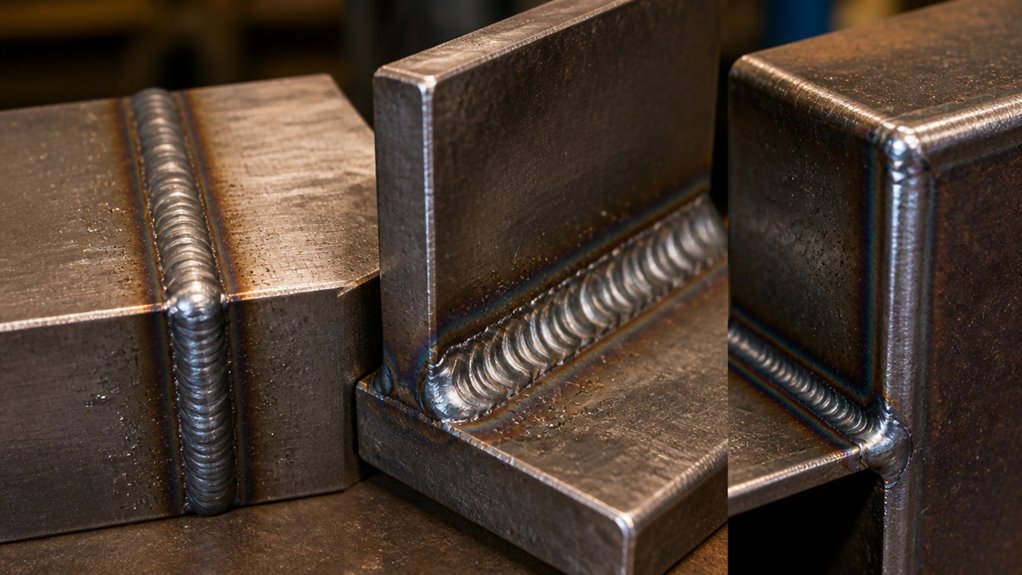
You’ll encounter five main welding joints: butt, where edges align end-to-end for full penetration; T-joints, joining perpendicular pieces typically with fillet welds; corner joints forming L-shapes for frames or enclosures; lap joints overlapping materials of differing thicknesses for shear strength; and edge joints aligning thin edges side-by-side for light-duty use.
Choosing joint types affects weld technique, strength, and load handling. This guides your process from groove to fillet welds to optimize durability and fabrication efficiency. Exploring their details reveals how to match joint design with application demands.
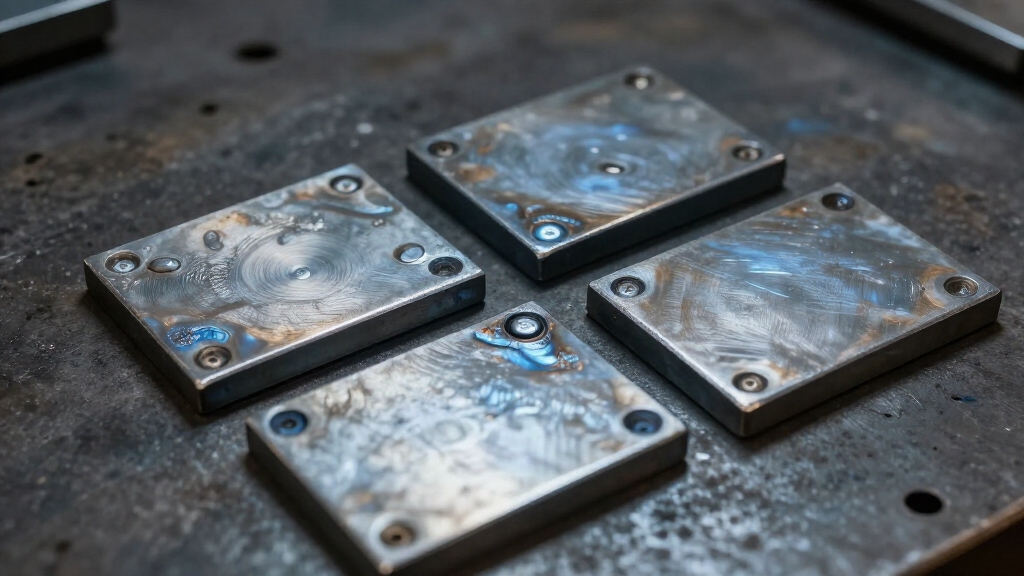
Welding joints are the critical points where two or more metal or plastic pieces come together through welding. Understanding their types and configurations is essential for ensuring structural integrity and peak performance.
When you prepare welding joints, you arrange the workpieces in specific geometries that dictate the weld’s strength, fit-up precision, and fabrication method. The American Welding Society identifies five basic joint types: butt, corner, edge, lap, and T-joint.
Each joint type influences the choice of weld, such as groove or fillet, and impacts load distribution and stress resistance. Knowing these joint types lets you select the appropriate welding technique to optimize durability and functionality in your project. This knowledge helps prevent failures and ensures long-term reliability. Proper groove geometry and joint preparation are especially critical for achieving complete joint penetration and strong, defect-free welds.
When joining two workpieces in the same plane, a butt joint provides a clean and efficient connection by aligning their edges end to end or with a controlled root opening.
You’ll often use butt joints in piping, fabrication, and construction where strength and alignment are critical. They accommodate groove welds and come in square, bevel, J, or U-groove configurations. This allows precise control over penetration and weld profile.
Selecting the appropriate groove design ensures full penetration and maximizes joint strength and durability.
| Butt Joint Type | Typical Application |
|---|---|
| Square Groove | Thin materials, quick welds |
| Bevel Groove | Thick sections, deep welds |
| J-Groove | Limited access, curved edges |
| U-Groove | Heavy plates, high strength |
Choosing the right groove type optimizes weld strength and efficiency for your project.
A T-joint forms where two metal pieces intersect at roughly a 90-degree angle, creating a shape that resembles the letter T.
You typically use fillet welds along the joint’s intersection to secure the vertical member to the horizontal base.
This weld type provides good strength and is straightforward to execute.
Besides fillet welds, you can apply plug, slot, or bevel groove welds depending on load requirements and material thickness.
T-joints are prevalent in structural fabrication, where perpendicular connections are crucial for frameworks, supports, and equipment assemblies.
When preparing a T-joint, make certain proper fit-up to avoid gaps that could weaken the weld.
Correct joint preparation and welding technique help you achieve peak penetration and strength in your welds.
This makes T-joints reliable in many industrial applications.
Ensure to measure the fillet weld size accurately using a fillet weld gauge to confirm compliance with design and code requirements.
T-joints connect metal pieces at right angles, but corner joints also join components at approximately 90 degrees. This forms an L-shape that you’ll find in both inside and outside corners.
You’ll rely on corner joints when fabricating frames or enclosures, as they provide robust structural integrity. These joints often use fillet welds, though groove welds can enhance strength. Proper fit-up and weld size are vital to avoid stress concentration.
The quality of the weld bead in these joints is crucial for distributing mechanical loads evenly and ensuring long-term durability.
| Feature | Inside Corner | Outside Corner |
|---|---|---|
| Joint Shape | L-shape, concave angle | L-shape, convex angle |
| Common Weld Type | Fillet weld | Fillet or groove weld |
| Application | Sheet metal, enclosures | Frames, brackets |
Corner joints offer strong, reliable connections when executed with precision.
When you’re dealing with materials that have different thicknesses, lap joints really shine. They do a great job of spreading out stress over the overlap area, which is a big plus. Plus, you get the added strength from being able to apply fillet welds on both sides. This really boosts the integrity of the joint.
Now, when it comes to welding, it’s all about adapting your techniques. You might need to tweak the heat input and the size of your welds to get the best fusion. Doing this not only helps ensure a solid connection but also keeps distortion in check when you’re working with those varying thicknesses. Maintaining arc stability through proper torch cleaning is essential to achieving consistent weld quality in these situations.
Utilizing lap joints for joining metals of varying thicknesses offers significant advantages in maintaining structural integrity and weld quality.
When you overlap a thicker metal piece with a thinner one, lap joints provide excellent fit-up flexibility. This reduces the likelihood of warping or distortion caused by uneven heat distribution.
This design also allows you to control weld penetration effectively. It ensures adequate fusion on the thinner section without excessive burn-through.
Additionally, the overlapping configuration distributes stress more evenly across the joint, minimizing localized weaknesses.
You can apply fillet welds along the edges, optimizing bead size to accommodate thickness differences. This method simplifies welding preparation and reduces machining costs.
Lap joints are ideal for assemblies where thickness variation is unavoidable or intentional for design purposes.
Proper heat input control during welding is essential to minimize distortion and ensure a strong, defect-free joint.
The overlapping configuration of lap joints accommodates thickness differences and enhances the overall strength of the welded assembly.
When you weld thicker and thinner materials together, the lap joint distributes stress across the overlapping area, reducing localized strain. This makes it ideal for applications where load-bearing capacity varies due to material thickness.
Fillet welds applied along the edges of the overlap provide excellent resistance to shear forces and bending moments.
Additionally, the lap joint’s geometry allows deeper penetration on the thinner material without compromising the thicker piece’s integrity.
Although lap joints excel at joining materials of differing thicknesses, adapting welding techniques is vital to guarantee peak strength and durability.
When working with lap joints, you must adjust heat input to accommodate thickness variance. Higher heat for thicker plates prevents lack of fusion, while careful control on thinner materials avoids burn-through.
You’ll typically use fillet welds on both edges of the overlap to evenly distribute stress. Weld size should correspond to the thinner material’s thickness to prevent distortion.
Additionally, securing proper fit-up and cleaning between layers removes contaminants that could weaken the joint. You might also consider using backing strips or stitch welds for thicker sections to minimize residual stress.
Proper technique adjustment confirms the lap joint performs reliably under load. Utilizing continuous wire feed and appropriate shielding gas helps maintain weld integrity and reduces contamination during the process.
Edge joints serve as a practical choice when working with thin or sheet materials, aligning the edges side by side or nearly parallel. You’ll find edge joints ideal for light-duty applications where minimizing distortion is critical.
Edge joints are perfect for thin materials, offering a distortion-minimizing solution for light-duty tasks.
Since these joints handle less stress, they’re best suited for cosmetic or non-structural purposes. When welding edge joints, controlling heat input is essential to avoid burn-through on thin metals. You can employ fillet, groove, or bevel welds depending on fit-up and accessibility.
Key considerations for edge joints with thin materials include:
Advanced welding techniques like electron beam welding offer precise heat control and minimal distortion, making them suitable for delicate edge joint applications.
Understanding the distinct characteristics of fillet and groove welds helps you select the best weld type for your joint design and load requirements.
Fillet welds, typically used in T, lap, and corner joints, join surfaces at right angles without groove preparation. They provide moderate strength and are easier to apply, ideal for structural applications where joint accessibility is limited.
Groove welds involve preparing the edges with specific groove types: square, bevel, J, or U, to guarantee full penetration and maximum strength. These welds are common in butt joints and are critical when joining thick materials or where high load-bearing capacity is necessary.
Choosing the right welding joint directly influences the techniques you’ll apply and the resulting strength of the assembly. Each joint type dictates the welding process, preparation, and positioning necessary for optimal penetration and fusion.
For example, butt joints require careful groove preparation to guarantee deep welds. Lap joints rely on fillet welds for load distribution. Your choice also affects residual stress patterns and potential distortion, impacting structural integrity.
Butt joints enable strong, full-penetration groove welds suited for high-stress applications. T-joints favor fillet welds, balancing ease of access with load-bearing capacity. Corner joints provide robust welds for frame-like structures, often combining groove and fillet techniques.
Lap joints suit dissimilar thicknesses, enhancing strength via overlapping. Edge joints, being weaker, demand precise control for thin materials or light-duty tasks. Fillet welds, commonly used in lap, T-, and corner joints, are valued for their minimal joint preparation and triangular cross-section that influences weld strength and size.
When you’re picking a welding joint, the first thing to think about is the material thickness. You want to make sure everything fits together nicely and that the weld penetrates properly. It’s a crucial step!
Next up, consider the strength you need from the joint. Different types of joints can handle different loads and distribute stress in various ways. So, it’s important to choose one that matches your requirements.
And don’t forget to check that the joint you select works well with your welding process. This alignment can really help improve the quality and efficiency of your welds. Trust me, it makes a difference!
Additionally, controlling heat input and penetration is essential to ensure the joint’s structural integrity and prevent defects.
Evaluating the thickness of your materials plays a vital role in selecting the appropriate welding joint to guarantee strength and integrity.
Thicker materials often require groove welds with butt joints to ensure full penetration and avoid defects. Conversely, thinner materials benefit from fillet welds in lap or T-joints to prevent burn-through.
Matching joint type to thickness optimizes load distribution and reduces distortion. Consider these points when assessing material thickness:
Use butt joints for thick plates needing deep weld penetration. Employ lap joints when joining dissimilar thicknesses. Choose edge joints for thin sheets with minimal load demands. Opt for fillet welds in T or corner joints for moderate thickness. Adjust groove preparation (square, bevel, J, U) based on thickness to control weld size and heat input.
Properly aligning joint type and thickness secures durability and weld quality.
Although multiple welding joint types are available, selecting the right joint hinges on the required strength of the final assembly. You need to evaluate the load conditions: tensile, shear, or bending forces that the joint will endure.
Butt joints offer high strength for axial loads due to full penetration groove welds. They’re ideal for piping and structural components.
T-joints and lap joints provide superior resistance to shear forces with fillet welds, making them suitable for structural frames and overlapping materials.
Corner joints balance strength and accessibility and are often chosen where combined loads act.
Edge joints, while easier to fabricate, generally exhibit lower strength and should be reserved for light-duty applications.
Always match joint configuration to mechanical demands to ensure structural integrity and longevity without overengineering.
Since each welding process has unique characteristics and limitations, you must select a joint type that aligns with the specific welding method you plan to use.
Consider the compatibility of the joint with the welding process to guarantee optimal penetration, strength, and quality. For example, butt joints suit groove welds common in TIG or MIG welding, while T-joints work well with fillet welds in SMAW.
You also need to evaluate heat input, accessibility, and required weld size.
Key considerations include:
Choosing the right joint guarantees efficiency and structural integrity.
You need to adjust your safety gear based on joint type complexity.
For butt and groove welds, make certain proper ventilation to handle deeper weld fumes.
T-joints and lap joints demand stable positioning to prevent slippage. Use clamps and supports.
Corner and edge joints often involve thinner materials. Protect yourself from sharp edges and spatter by wearing gloves and sleeves.
Always use eye protection suited for the welding arc intensity specific to each joint type.
Think of joint preparation as tuning an engine before a race; if you fine-tune it well, you speed through.
When you properly prepare a welding joint—clean edges, precise bevels, correct root openings—you reduce defects and improve weld penetration.
This streamlined setup lets you weld faster with fewer passes and less rework.
In contrast, poor preparation slows you down, increasing corrections and compromising efficiency and quality.
You’ll encounter unique defects with each welding joint: butt joints often face incomplete penetration or root cracking due to improper edge prep.
T-joints commonly show lack of fusion at the fillet weld.
Corner joints can develop undercut along the edges.
Lap joints are prone to lack of fusion between overlapped layers.
Edge joints may suffer from burn-through or insufficient weld size.
Identifying these helps guarantee effective inspection and repair strategies.
When you choose a welding joint, you’re setting the stage for how heat treatment unfolds.
Complex joints like T-joints may demand more careful thermal management to avoid stress concentration.
Simpler butt joints often allow more uniform heat distribution.
You’ll find that thicker overlaps need tailored cooling rates to prevent distortion.
So, your joint type guides the heat treatment’s temperature, duration, and cooling method.
This ensures strength and integrity without unwelcome surprises.
Yes, you can repair welding joints differently depending on their type.
For instance, butt joints often require groove weld rework, while lap joints might need fillet weld reinforcement.
T-joints and corner joints may need specific edge preparation or weld bead reshaping to restore strength.
Edge joints, being weaker, usually demand delicate repair techniques to avoid distortion.
Tailoring your repair approach guarantees peak structural integrity and longevity.
Choosing the right welding joint is like selecting the perfect key to liberate structural integrity. Each joint, whether butt, T, corner, lap, or edge, shapes your project’s strength and durability.
Understanding their unique characteristics empowers you to craft connections that withstand stress and time. Master these joints, and you hold the blueprint for precision and resilience.
This ensures your welds don’t just join metal; they forge lasting bonds built to endure.