Phone:
(701)814-6992
Physical address:
6296 Donnelly Plaza
Ratkeville, Bahamas.

Phone:
(701)814-6992
Physical address:
6296 Donnelly Plaza
Ratkeville, Bahamas.

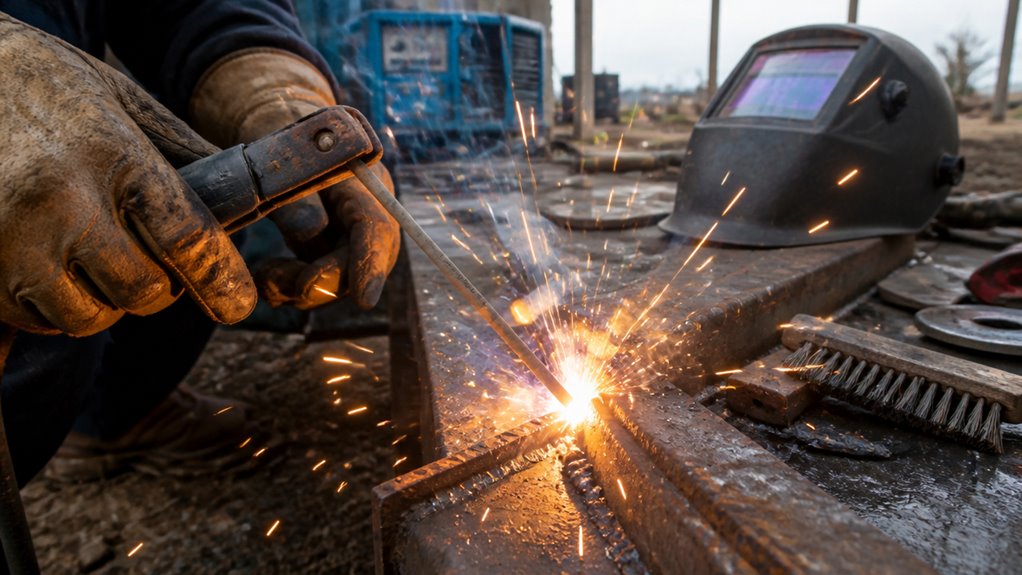
You should choose stick welding when working outdoors or in windy conditions where gas shielding won’t hold.
It’s ideal for thick steel and heavy sections, providing strong, durable welds with deep penetration.
Stick welding handles rusty, dirty, or painted surfaces better than other methods and requires minimal, portable equipment, making it perfect for field repairs or rough jobs.
However, avoid it for thin metal or aluminum.
Keep exploring to understand electrode choices, applications, and operational tips.
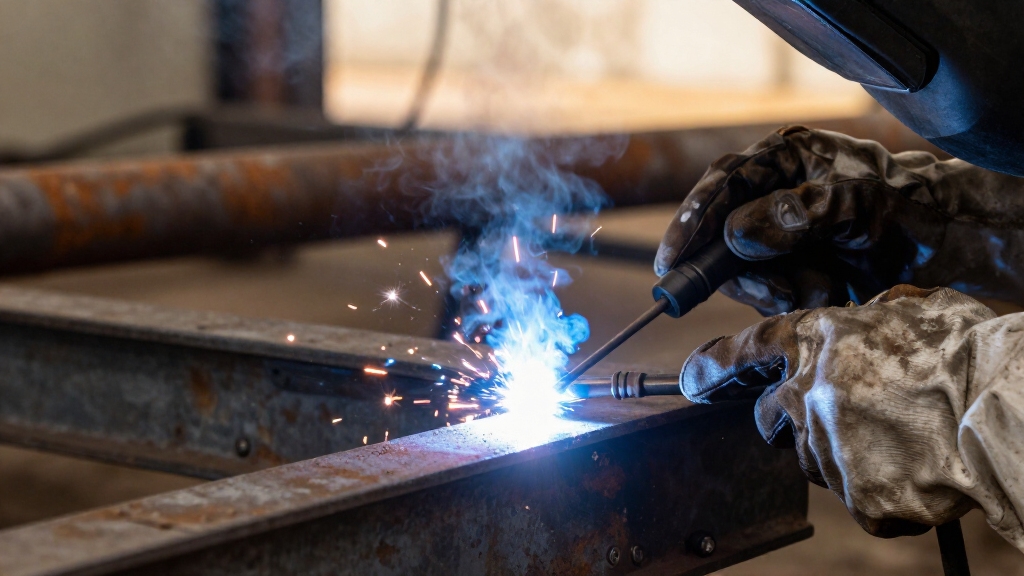
Stick welding, also known as Shielded Metal Arc Welding (SMAW), uses a flux-coated electrode to create a weld by melting both the electrode and the base metal.
Stick welding, or SMAW, melts a flux-coated electrode and base metal to form strong, reliable welds.
You’ll choose stick welding when you need a straightforward, versatile method that provides strong penetration and reliable welds.
It excels outdoors or in windy conditions since the flux coating generates its own shielding gas, eliminating reliance on external gas cylinders.
This makes it ideal for field repairs, construction sites, and marine environments.
Additionally, you’ll find stick welding valuable when working with thicker steel or when portability is essential, as the equipment is compact and easy to transport.
Its tolerance for dirty or rusty surfaces also makes it a practical choice for maintenance and repair tasks where pristine metal isn’t guaranteed.
Stick welding is also favored for its deep penetration and ability to produce durable, high-strength welds in heavy-duty applications.
When working with thin metal or aluminum, you’ll find that stick welding often falls short due to excessive heat input and poor control.
Thin materials, typically below 2 mm, are highly susceptible to burn-through and warping when exposed to the high amperage and slower cooling rates characteristic of stick welding.
This makes it difficult to maintain weld integrity and dimensional accuracy.
Additionally, aluminum’s high thermal conductivity and oxide layer require specialized processes like TIG or MIG.
These methods offer better heat control and cleaning action.
Stick welding’s flux-coated electrodes can’t adequately address aluminum’s welding challenges, resulting in weak, porous welds.
For thin steel and aluminum, you’ll achieve superior results with low-amp TIG or MIG welding, which provide precise heat input and cleaner, more reliable welds.
Proper preheating techniques can improve weld quality but do not fully compensate for stick welding limitations on thin aluminum.
In outdoor and windy environments, you’ll find that welding methods relying on external shielding gas often struggle to maintain consistent arc protection.
Stick welding, however, uses a flux-coated electrode that creates its own shielding gas and slag. This eliminates dependence on external gas, making it highly effective in wind since the shielding isn’t blown away.
You can confidently perform field repairs on farms, fences, and construction sites where portability and wind resistance are critical.
Marine and harbor jobs also benefit from stick welding’s robustness in open-air conditions. Unlike MIG or TIG welding, stick welding maintains weld integrity despite atmospheric contamination or gusty conditions.
This makes it the preferred choice when environmental factors would otherwise disrupt the welding process.
Its cellulose-based flux produces a forceful spray-type arc that enhances penetration and cleaning action in challenging environments.
Although clean surfaces are ideal for most welding processes, you’ll find stick welding excels when working with rusty, dirty, or painted metal.
The flux coating on stick electrodes generates a protective slag and shielding gas that tolerates surface contamination. This makes it more forgiving than MIG or TIG.
Specifically, E6011 electrodes are designed to penetrate oxidized or painted layers effectively. This ensures sound fusion despite imperfect conditions.
This capability makes stick welding indispensable for field repairs on equipment, gates, and structural components where cleanliness is impractical.
You don’t have to spend time extensively cleaning the metal, which improves efficiency without sacrificing weld quality.
In maintenance or repair scenarios involving less-than-pristine surfaces, stick welding offers reliable performance and strong weld integrity that other processes struggle to achieve under similar conditions.
However, it is important to note that stick welding is best suited for light surface rust, as heavy rust requires proper grinding and cleaning to avoid defects like porosity and weak fusion, ensuring a strong, reliable weld.
Stick welding really shines when it comes to working with thick steel. It’s all about that strong penetration, which ensures deep fusion and creates robust welds. You’ll often see it in structural steel applications, like beams and columns, where durability and strength are absolutely essential.
And let’s not forget about heavy fabrication projects! They really reap the benefits of stick welding’s reliability and code-quality performance. Using electrodes like E7018 makes a big difference, too. So, whether you’re tackling a big structural job or something equally demanding, stick welding is a go-to choice for getting the job done right. Additionally, rods like 6011 provide deep penetration and aggressive arc action, making them ideal for welding on dirty or rusty surfaces often found in field conditions.
Choose stick welding when you need strong penetration for thick steel and structural fabrication. This process delivers deep fusion between base metals, ensuring robust, load-bearing welds essential for structural integrity.
Its flux-coated electrodes, like E7018, provide a stable arc and produce slag that protects the weld pool, promoting consistent penetration and reducing defects.
Strong penetration is critical when joining thick plates, as it minimizes incomplete fusion, which can weaken the joint. Stick welding’s high heat input allows you to weld heavy sections without excessive preheating, saving time while maintaining strength.
The process also tolerates minor surface impurities, helping maintain penetration quality in real-world conditions. Overall, stick welding guarantees that your structural welds meet demanding strength and durability requirements.
For optimal results, use E7018 electrodes stored at controlled temperatures to preserve their low-hydrogen coating and ensure consistent weld quality.
Welding thick steel components demands a process that delivers deep, reliable fusion. Stick welding fits this need perfectly.
You’ll find stick welding ideal for structural steel applications like beams, columns, and frames, where weld strength and penetration are critical.
The process handles thick plates efficiently, allowing you to achieve code-quality welds using electrodes like E7018. Its ability to produce robust, crack-resistant joints makes it a go-to method in construction and pipeline projects.
When fabricating heavy-duty frames or repairing machinery, stick welding guarantees weld integrity under stress.
Unlike some processes, it tolerates minor surface imperfections, which is common in structural steel work.
Using low-hydrogen electrodes such as E7018 reduces the risk of hydrogen-induced cracking, ensuring durable welds in structural steel applications.
Heavy fabrication frequently demands welding methods that ensure deep penetration and strong fusion. Stick welding is an excellent choice for thick steel components.
When you work on beams, columns, or heavy machinery frames, stick welding delivers the robustness required for structural integrity. Using electrodes like E7018 ensures code-quality welds that endure stress and load.
The process is widely applied in steel construction, pipeline work, and heavy fabrication due to its deep fusion capabilities.
| Application | Benefit |
|---|---|
| Structural Beams | Strong, durable welds |
| Heavy Machinery Repair | Deep penetration, reliable fusion |
| Pipeline Fabrication | Code-quality, robust connections |
Stick welding’s versatility and weld strength make it ideal for thick steel and demanding fabrication tasks. Its flux-coated consumable electrodes release shielding gas and form a protective slag layer, allowing welding in outdoor or windy conditions where other methods may fail.
When you need to perform repairs far from a fully equipped workshop, stick welding stands out for its portability and simplicity.
The process requires minimal gear, just a lightweight power source and electrodes, making it ideal for remote locations and emergency fixes.
You won’t need shielding gas, so setups are quicker and less cumbersome.
This makes stick welding perfect for on-site maintenance of machinery, farm equipment, or structural components in warehouses and commercial buildings.
The flux-coated electrodes provide their own shielding, enabling effective welds even in open or windy environments.
By choosing stick welding, you guarantee reliable, quality repairs without the need for extensive infrastructure.
This keeps downtime low and repair tasks manageable wherever you are.
It is important to secure the ground clamp firmly to ensure a stable electrical circuit and prevent interruptions during welding.
When you’re working with limited equipment and unreliable power sources, stick welding really shines. It’s a practical choice because it doesn’t need shielding gas or complicated gear. That’s pretty handy!
Plus, stick welding is tough. It’s perfect for harsh environments, like construction sites or those remote areas where conditions can really mess with delicate equipment. You can count on it to deliver solid welds, even when resources are tight and the working conditions aren’t ideal. So, no worries there!
Its flux-coated electrode provides self-shielding protection that makes it ideal for windy or damp outdoor conditions.
In environments where power sources are scarce and equipment options are limited, stick welding offers a reliable solution due to its minimal setup requirements. You won’t need bulky shielding gas cylinders or complex machinery, making it ideal for remote locations.
Stick welding equipment typically requires only a simple power source and electrodes, which are easily transported and stored. This simplicity lets you perform effective welds despite logistical constraints.
Additionally, stick welding tolerates inconsistent power input better than MIG or TIG. By selecting appropriate electrodes such as E6011 or E7018, you can adapt to varying metal conditions and thicknesses without additional gear.
Ultimately, stick welding’s straightforward equipment demands and robust operation enable you to maintain productivity even when resources and tools are restricted.
Stick welding frequently excels under harsh environmental conditions where equipment options are limited and power supply may be unstable.
You’ll find it invaluable in remote or rugged locations since it doesn’t rely on external shielding gas, which can be compromised by wind or dust.
The flux coating on electrodes forms its own protective shield, allowing you to weld effectively outdoors or on contaminated surfaces without extensive preparation.
Its simplicity means you can operate with basic machines, making it ideal when MIG or TIG setups aren’t accessible.
The process tolerates surface rust, dirt, and paint better than other methods, maintaining weld integrity despite imperfect conditions.
Industries like construction, mining, and shipbuilding often employ stick welding for field repairs and structural work where equipment durability and reliability take precedence over speed or aesthetics.
Harsh environments often come with challenges in power availability and equipment access that you need to address effectively.
Stick welding excels in these situations because it requires minimal power compared to MIG or TIG processes. You don’t need an external shielding gas, simplifying your setup and reducing equipment dependencies.
Portable stick welders run efficiently on generators or limited power sources, making them ideal for remote or supply-constrained sites. When you face rough conditions, like construction, mining, or shipbuilding, stick welding provides robust performance despite power fluctuations or minimal gear.
While it may not offer the speed or finish of other methods, its reliability under power supply limitations guarantees you can complete welds where other equipment might fail or be unavailable.
This makes stick welding a practical choice for demanding fieldwork.
Understand that selecting the right electrode is essential to achieving strong, reliable welds for your specific application.
For repair work involving dirty, rusty, or painted metal, choose the E6011 electrode. Its fast-freeze slag and deep penetration enable effective welding on less-than-pristine surfaces. This makes it ideal for field repairs where cleaning isn’t practical.
In contrast, for structural fabrication or thick steel, use the E7018 electrode. It produces low-hydrogen, high-strength welds with excellent toughness and ductility. This electrode meets code-quality requirements.
E7018’s smooth arc and stable slag coverage ensure superior weld quality on beams, columns, and heavy machinery. By matching E6011 with repairs and E7018 with structural tasks, you guarantee weld integrity, durability, and performance under varying job conditions.
Achieving strong, durable welds hinges on the reliable fusion and protective shielding that stick welding provides.
When you use flux-coated electrodes, the flux generates a protective slag and gas shield during welding. This shields the molten weld pool from atmospheric contamination, assuring a clean, solid bond with deep penetration.
The process’s inherent slag layer also cools and protects the weld bead, reducing oxidation and defects. By selecting appropriate electrodes like E7018 for structural steel, you secure controlled deposition of low-hydrogen weld metal, enhancing toughness and crack resistance.
Stick welding’s ability to perform on thicker, contaminated surfaces without compromising weld integrity further contributes to durability.
Ultimately, the combination of flux shielding, deep fusion, and slag protection guarantees welds that withstand mechanical stresses and environmental exposure.
Stick welding is a go-to method in industries like construction, oil and mining, marine, and agriculture. Why? Because these sectors often face rugged conditions that require reliable equipment and strong welds. It’s pretty impressive how stick welding can handle dirty surfaces and adapt to tough environments. Plus, its portability and wind resistance make it perfect for field repairs and heavy structural work.
Construction and maintenance industries frequently rely on stick welding for its durability and adaptability in rugged environments.
You’ll find it invaluable for on-site repairs, structural steel fabrication, and maintenance tasks where surface conditions are less than ideal or equipment access is limited.
Its ability to weld dirty, rusty, or painted metals and perform well outdoors without shielding gas makes it a top choice.
| Application | Key Benefit |
|---|---|
| Structural steel fabrication | Strong penetration, code-quality welds |
| Field repairs | Portability, quick setup |
| Maintenance on equipment | Works on contaminated surfaces |
| Outdoor construction sites | Wind-resistant, no gas needed |
| Warehouse repairs | Effective in limited equipment environments |
Operating in harsh environments with limited resources, oil and mining industries rely heavily on stick welding for its robustness and simplicity.
You’ll find stick welding invaluable when working outdoors where wind can disrupt shielding gas in other methods.
The flux coating on electrodes forms its own protective barrier, allowing you to weld reliably on contaminated, rusty, or painted surfaces common in mining and oil equipment.
Deep penetration from powerful machines lets you join thick structural steel, essential for heavy-duty repairs and fabrication in these sectors.
Since stick welding requires minimal setup and no external gas, you can perform portable, on-site maintenance even in remote locations.
In oil and mining operations where equipment durability and quick field repairs are critical, stick welding remains the most practical and efficient welding choice.
Marine and agricultural sectors frequently rely on stick welding due to its adaptability in harsh, open environments.
This process is ideal for outdoor, windy conditions where shielding gas would dissipate. Its flux-coated electrodes provide necessary protection, enabling repairs on boats, farm equipment, and metal structures exposed to weather.
Stick welding’s tolerance for dirty or rusty metal suits fieldwork in these industries, where surface preparation is limited.
| Feature | Benefit |
|---|---|
| Outdoor wind resistance | Reliable shielding without gas |
| Portability | Easy setup for remote repairs |
| Surface tolerance | Works on rusty, painted, or dirty metal |
| Deep penetration | Strong welds for thick, structural parts |
| Durability | Suitable for marine and farm conditions |
To properly store stick welding electrodes and prevent moisture damage, keep them sealed in airtight containers or vacuum-sealed packaging.
Store electrodes in a dry, temperature-controlled environment to avoid humidity exposure.
For low-hydrogen electrodes like E7018, use a heated oven at 250°F (120°C) if they get damp, then bake before use.
Always handle electrodes with dry hands or gloves to maintain their integrity and guarantee consistent weld quality.
Picture sparks flying like fiery stars as you weld. You need a welding helmet with a proper shade lens to protect your eyes from intense UV rays and flying debris.
Wear flame-resistant gloves and a heavy-duty jacket to shield your skin from burns. Use leather boots and long pants to guard your legs and feet.
Don’t forget ear protection and a respirator if fumes are present, ensuring your safety throughout the process.
You generally won’t use stick welding effectively on non-ferrous metals other than aluminum because the process is optimized for steel and iron-based alloys.
Stick welding electrodes and fluxes are designed for ferrous metals, so welding copper, brass, or bronze often requires specialized techniques like TIG.
If you attempt stick welding on non-ferrous metals besides aluminum, you’ll likely face poor weld quality, weak bonds, and contamination issues.
Cold bites and heat blazes, but you can still weld with stick electrodes. In low temperatures, you’ll face issues like brittle welds and slower slag removal.
Preheating the metal and keeping electrodes warm is essential. High heat can cause faster electrode deterioration and unstable arcs.
Adjust your technique and amperage accordingly to maintain weld quality. This ensures stable arc strikes and proper fusion despite ambient extremes.
You should regularly inspect and clean your stick welding machine to guarantee longevity.
Check cables, connections, and electrode holders for wear or damage.
Keep vents clear to prevent overheating and dust buildup.
Calibrate output settings periodically for consistent performance.
Replace worn parts promptly and store the machine in a dry, clean environment to avoid corrosion.
Following these steps will maintain reliable operation and extend your equipment’s lifespan.
When you face tough, unpredictable conditions, like windy outdoor sites or rusty metals, stick welding becomes your reliable workhorse.
It’s your go-to for thick steel and structural jobs where strength and durability can’t be compromised.
Just like a seasoned craftsman choosing the right tool, you’ll pick the right electrode to guarantee every weld holds firm.
Stick welding isn’t just a technique; it’s your shield against the elements and imperfections, delivering solid, lasting results.