Phone:
(701)814-6992
Physical address:
6296 Donnelly Plaza
Ratkeville, Bahamas.

Phone:
(701)814-6992
Physical address:
6296 Donnelly Plaza
Ratkeville, Bahamas.

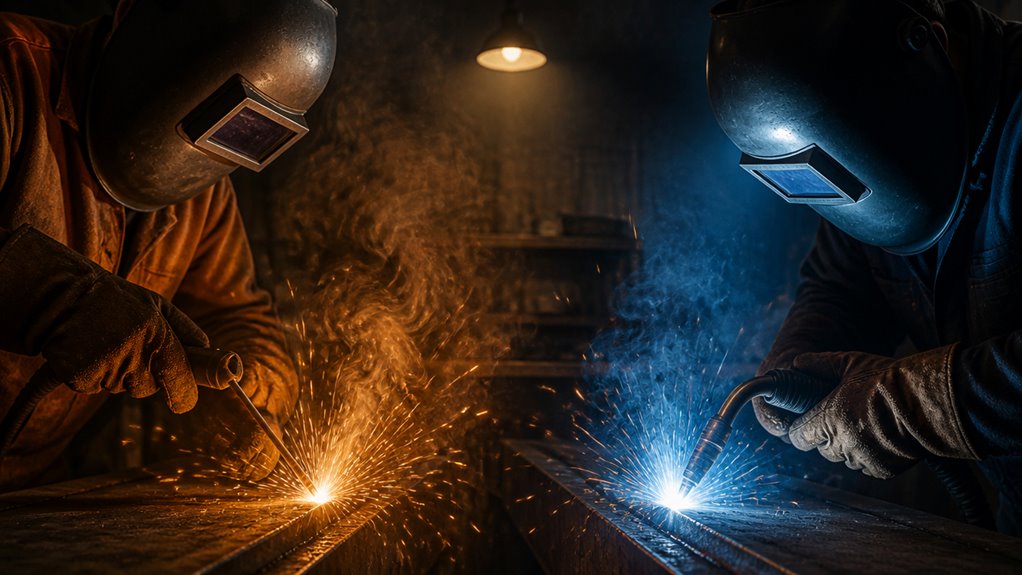
You’ll find stick welders simpler and more portable, great for thick, rusty metals outdoors. However, they produce more slag and require frequent electrode changes.
MIG welders offer cleaner, precise welds on thinner metals with continuous wire feed and shielding gas. This boosts speed and reduces cleanup.
MIG setups are more complex, requiring gas and calibration. Your choice depends on material, workspace, and quality needs. Exploring further reveals nuanced trade-offs in efficiency and cost.

| Feature | Stick Welder (SMAW) | MIG Welder (GMAW) |
|---|---|---|
| How It Works | Uses a consumable flux-coated electrode (stick) | Uses a continuous wire feed with shielding gas |
| Shielding Method | Flux coating creates protective gas and slag | External shielding gas protects the weld |
| Ease of Use for Beginners | Harder learning curve due to manual electrode control | Easier for beginners because of automatic wire feed |
| Weld Quality | Strong penetration but rougher finish | Cleaner, smoother, and more precise welds |
| Cleanup Required | Requires slag chipping and more cleanup | Minimal cleanup with little spatter |
| Best for Metal Thickness | Better for thick metals | Better for thin to medium metals |
| Performance on Dirty/Rusty Metal | Works well on rusty or dirty surfaces | Requires clean metal surfaces |
| Outdoor Use | Excellent for outdoor and windy conditions | Less effective outdoors because wind affects shielding gas |
| Portability | More portable and simple setup | Less portable due to gas cylinder and equipment |
| Welding Speed | Slower because of electrode changes | Faster due to continuous wire feed |
| Efficiency | Lower productivity on large projects | High productivity and faster workflow |
| Equipment Complexity | Simple machine with fewer components | More complex setup with gas and wire system |
| Initial Cost | Lower equipment cost | Higher initial investment |
| Operating Cost | Lower ongoing costs | Additional cost for gas and wire |
| Maintenance | Minimal maintenance | Requires maintenance of wire feed and gas system |
| Best Applications | Outdoor repairs, heavy-duty work, thick steel | Automotive work, fabrication, clean finish projects |
| Finish Appearance | Rougher weld appearance | Smooth and professional-looking finish |
| Tolerance to Weather | Handles wind and moisture better | Shielding gas can be disrupted by wind |
| Skill Requirement | Requires more manual skill and control | Easier to master quickly |
| Main Advantage | Durable, portable, and versatile | Fast, clean, and beginner-friendly |
| Main Drawback | More cleanup and slower process | Less effective outdoors and higher setup cost |
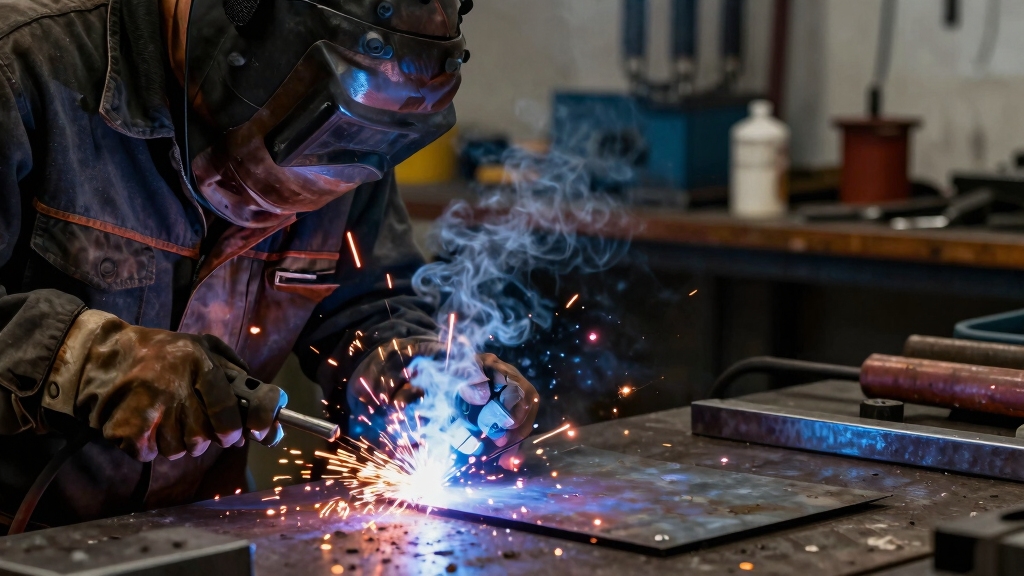
To understand how stick and MIG welders work, you first need to look at their core mechanisms.
Stick welding uses a consumable electrode, the stick, which you manually manipulate. It melts and forms the weld as it’s consumed. This process requires no external shielding gas; the electrode’s flux coating generates protective gas and slag.
In contrast, MIG welding feeds a continuous wire electrode automatically through a spool gun. This wire melts to form the weld pool, while an external shielding gas protects the molten metal from contamination.
You’ll notice that stick welding has a simpler setup with fewer components, making it more portable and suitable for fieldwork. MIG welding, however, demands a gas source and a more complex apparatus. This limits its outdoor portability but offers automation and steady wire feed.
Stick welding’s flux-coated electrodes provide a protective gas and slag shield that makes it ideal for use in windy or damp outdoor conditions.
How does the weld quality of stick and MIG welding compare in practical applications?
MIG welding delivers cleaner, slag-free welds with minimal spatter. This results in superior aesthetics and less post-weld cleanup. It excels on thin metals up to 24-26 gauge, producing precise, uniform beads.
MIG welding offers clean, slag-free welds with minimal spatter, ideal for thin metals and precise, uniform beads.
Conversely, stick welding provides stronger penetration on thicker materials. However, the process creates slag that requires chipping and generates more spatter, especially when using AC current.
While stick welds can be highly durable, their finish demands more labor-intensive cleaning. MIG’s high-quality finish makes it preferable when appearance and minimal finishing are priorities.
Ultimately, if you need a neat, visually appealing weld with less cleanup, MIG outperforms stick. However, for robust, deep-penetration welds on thick metals, stick welding delivers reliable quality despite extra finishing steps.
Typically, MIG welding offers superior speed and efficiency compared to stick welding due to its continuous wire feed system. This eliminates frequent electrode changes.
When you use MIG, you spend more time laying welds and less on interruptions. In contrast, stick welding requires electrode replacement and slag cleaning, consuming significant time.
This results in approximately 25% more actual welding time with MIG, boosting productivity especially for large-scale projects.
Additionally, the use of a shielding gas in MIG welding helps produce cleaner welds with minimal spatter, reducing post-weld cleanup time.
| Feature | MIG Welding | Stick Welding |
|---|---|---|
| Electrode Feed | Continuous wire feed | Manual electrode change |
| Welding Time | Higher (less downtime) | Lower (cleaning needed) |
| Productivity | Better for large jobs | Slower, frequent stops |
Choosing MIG means faster, more efficient welds and improves your work pace substantially.
Although MIG welding offers advanced capabilities, its setup requires more attention to detail than stick welding. You’ll need to connect a shielding gas supply, install the wire spool, and properly feed the wire electrode through the gun.
Ensuring gas flow and wire tension are correct is critical for clean welds, making MIG setup more intricate. In contrast, stick welding uses a consumable electrode that you simply insert into the holder, eliminating the need for external gas or complex feeding mechanisms.
This simplicity makes stick welding more straightforward and portable, especially in field conditions. While MIG demands cleaner surfaces and careful calibration, stick welding tolerates rust and dirt better. This allows you to start welding faster with minimal preparation and fewer components to manage. Additionally, stick welding produces less spatter and slag, resulting in cleaner welds with reduced cleanup time.
Knowing the setup differences helps clarify when each welding method excels and how costs factor into your choice.
You’d opt for a stick welder outdoors or on thick, rusty metals where portability and slag tolerance matter. Its lower equipment cost suits hobbyists or field repairs, though expect more cleanup time.
Conversely, a MIG welder fits indoor or high-volume projects requiring clean, precise welds on thin metals. Despite higher initial costs for gas and wire, MIG’s continuous feed boosts efficiency and reduces post-weld labor.
You should also consider surface conditions. MIG demands cleaner metals, while stick tolerates dirt and corrosion.
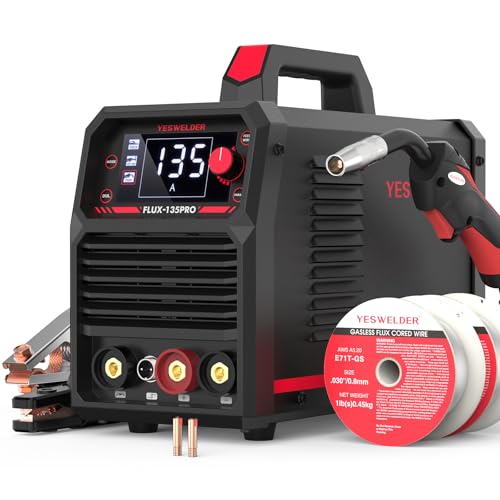
Ultimately, your decision balances environment, material thickness, desired weld quality, and budget constraints. This aligns performance with operational expenses. For outdoor projects requiring portability and tolerance to contamination, flux core welding is an effective alternative combining features of both methods.
No, you can’t do stick welding without electricity.
Stick welding relies on an electric arc created between the electrode and the workpiece to generate the intense heat needed to melt metals.
The power source supplies this current, whether AC or DC.
Without electricity, you can’t maintain the arc, so the welding process won’t initiate or continue.
You need a reliable power source to perform stick welding effectively.
You need a welding helmet with an auto-darkening lens to protect your eyes from intense UV and infrared rays.
Wear flame-resistant gloves and long-sleeve clothing to shield your skin from sparks and heat.
Use ear protection to prevent damage from noise and a respirator if ventilation is poor, as MIG welding produces fumes.
Additionally, sturdy boots and a welding jacket enhance safety, ensuring all-around protection during operation.
Weather wildly weighs on welding work. When wind whips, you won’t worry much with stick welding since it doesn’t rely on external shielding gas.
Rain or rust? Stick welding stands strong, tolerating moisture and rough surfaces better than other methods.
However, extreme cold can cause cracking, and wet electrodes might spark inconsistent arcs.
Yes, you should avoid MIG welding metals with heavy surface contamination or extreme thickness beyond 1/4 inch without proper technique.
MIG welding struggles with dirty, rusty, or oily metals because it requires clean surfaces for quality welds.
Also, very thick metals need multiple passes, reducing efficiency. For those, stick or flux core might be better.
You can use MIG welding for automotive repairs like a scalpel in a surgeon’s hand. It excels on thin metals common in car bodies, producing clean, strong welds with minimal spatter.
However, you’ll need clean, rust-free surfaces and proper shielding gas for peak results. Its speed and finish quality make it ideal for structural repairs and custom fabrication.
You’ll find stick welders excel in rugged, outdoor conditions with simplicity and durability. MIG welders deliver cleaner, faster results in controlled environments.
Stick offers versatility and cost-efficiency for heavy-duty tasks. MIG provides superior finish and ease of use for precision work.
Choosing between them hinges on your project’s demands, whether you prioritize portability and toughness or speed and quality finish. Both have strengths; your application decides which wins.
Last update on 2026-10-15 / Affiliate links / Images from Amazon Product Advertising API
