Phone:
(701)814-6992
Physical address:
6296 Donnelly Plaza
Ratkeville, Bahamas.

Phone:
(701)814-6992
Physical address:
6296 Donnelly Plaza
Ratkeville, Bahamas.

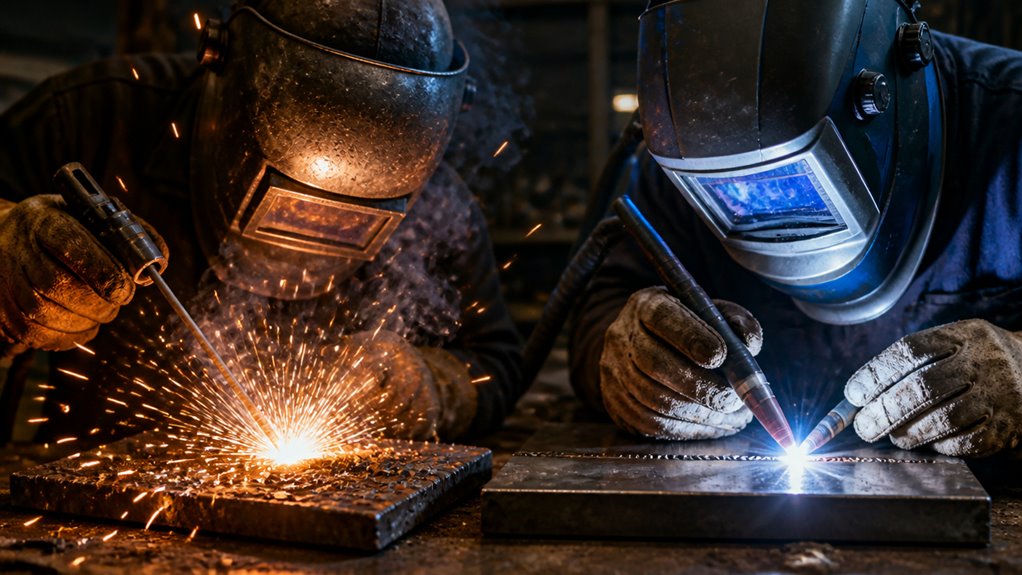
You’ll choose stick welding when working with thick carbon steel or low-alloy metals in rugged, outdoor conditions where surface cleanliness is less critical.
Stick welding delivers deep penetration, mechanical strength, and tolerates contaminants without external gas.
TIG welding suits you better for thinner metals and high-alloy or non-ferrous materials like aluminum and stainless steel.
It offers precise control, superior weld quality, and clean joints but requires meticulous preparation and inert gas shielding.
Understanding these distinctions helps optimize your welding approach.
| Feature | Stick Welding | TIG Welding |
|---|---|---|
| Welding Process | Flux-coated consumable electrode | Non-consumable tungsten electrode with filler rod |
| Shielding Method | Flux-generated shielding | Inert gas (typically argon) |
| Best For | Thick carbon steel and structural work | Thin metals and precision fabrication |
| Material Thickness | 3 mm and thicker | 0.5–8 mm |
| Compatible Metals | Carbon steel, cast iron, low-alloy steel | Stainless steel, aluminum, titanium, copper, magnesium |
| Weld Quality | Strong and durable | Clean, precise, and aesthetically superior |
| Penetration | Deep | Moderate and controlled |
| Welding Speed | Faster | Slower |
| Surface Preparation | Minimal; tolerates rust and dirt | Requires clean, contaminant-free surfaces |
| Outdoor Performance | Excellent | Poor in windy conditions |
| Portability | Highly portable | Less portable due to shielding gas |
| Ease of Learning | Easier for beginners | More difficult to master |
| Equipment Cost | Lower | Higher |
| Maintenance | Low | Moderate |
| Typical Applications | Construction, pipelines, heavy equipment, repairs | Automotive, aerospace, food-grade fabrication, custom projects |
| Main Advantage | Strong welds in harsh environments with minimal preparation | Exceptional precision, appearance, and control |
| Main Drawback | More spatter and slag cleanup | Slower process and requires meticulous preparation |
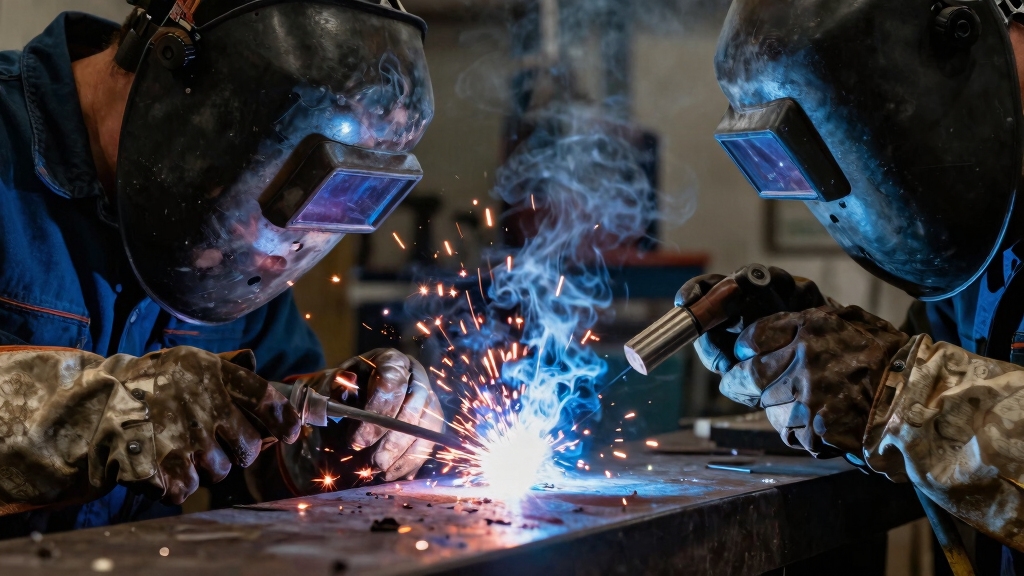
Although both stick and TIG welding join metals through electric arcs, they serve distinct purposes based on material type, thickness, and environmental conditions.
Stick welding excels with thick carbon steel and low-alloy metals, delivering robust penetration and strength even in harsh outdoor environments without external shielding gas.
In contrast, TIG welding uses a non-consumable tungsten electrode and inert gas shielding, making it ideal for thin, non-ferrous metals like aluminum or stainless steel where precision and clean, defect-free welds matter most.
Stick welding tolerates surface contaminants, while TIG requires meticulous surface preparation.
You should choose stick welding for heavy-duty, structural tasks or on-site repairs and TIG welding for applications demanding fine control, aesthetic quality, and thin material work.
Each method optimizes performance by matching metal characteristics and environmental constraints.
Stick welding’s flux-coating protection allows it to perform well in windy or damp outdoor conditions without the need for external gas.
Stick welding is pretty straightforward. You start by striking an arc with a flux-coated electrode. What’s cool about this method is that the electrode decomposes, creating a shield around the weld without needing any external gas. This makes it super handy!
Now, stick welding really shines when you’re working with thick carbon steel and low-alloy materials. Generally, you’ll want to tackle projects that are at least 3 mm thick or more.
And here’s another great thing: the robust arc and effective slag management of stick welding make it perfect for outdoor projects. It’s especially useful in structural applications where the environment can throw a wrench in the works for other welding methods. So, whether you’re on a job site or just tackling a DIY project, stick welding might just be your best bet!
Its ability to tolerate rusty, dirty, or wet surfaces while maintaining strong, reliable welds makes it invaluable for field repairs and construction.
Mastering the stick welding process requires understanding how the flux-coated electrode functions without external shielding gas.
When you initiate the arc, the flux coating decomposes, releasing gases that shield the molten weld pool from atmospheric contamination.
This flux also forms a slag layer that you must chip away after cooling to reveal a clean weld bead.
The process generates a strong, stable arc capable of deep penetration, making it ideal for thick carbon steel sections.
You’ll appreciate its robustness in outdoor conditions since it resists wind and rain interference.
Additionally, the consumable electrode melts to supply filler metal, enabling you to build substantial weld deposits efficiently.
A constant current power supply maintains a stable arc despite manual control of arc length, which requires operator skill for quality welds.
When working with thick carbon steel or low-alloy materials, stick welding delivers exceptional penetration and strength starting from thicknesses around 3 mm and extending well beyond.
You’ll find it ideal for heavy-duty applications requiring deep fusion, as the flux-coated electrodes generate a robust arc that penetrates effectively into dense substrates.
Stick welding accommodates materials like cast iron and low-alloy steels, maintaining joint integrity under mechanical stresses.
Its ability to handle thicker sections surpasses TIG welding, which is better suited for thinner metals.
While stick welding tolerates surface contaminants due to flux protection, it’s optimized for substantial material thicknesses rather than precision on thin gauges.
Electrodes such as 6011 welding rods provide deep penetration and strong fusion even on dirty or rusty surfaces, making stick welding highly versatile in field conditions.
Frequently relied upon in challenging environments, stick welding proves indispensable for outdoor and structural applications.
You benefit from its ability to operate without external shielding gas, making it reliable in windy or rainy conditions where TIG welding would struggle.
The flux-coated electrode generates a protective slag, maintaining weld integrity despite environmental contaminants.
Structurally, stick welding penetrates thick carbon steel and low-alloy materials effectively, delivering superior strength essential for construction, pipelines, and heavy equipment.
Its robust arc ensures deep fusion and resistance to vibration and impact, critical for structural stability.
While you must remove slag post-weld, the process’s portability and simplicity make it ideal for field repairs.
Additionally, stick welding’s high heat input requires careful control to prevent warping, especially on thinner materials.
When you’re doing TIG welding, you use a non-consumable tungsten electrode to create a stable arc. The cool thing about this is that the electrode doesn’t melt during the process. Instead, it stays intact while you work.
To keep everything clean and free from contamination, you rely on inert shielding gas, usually argon. This gas forms a protective layer over the weld pool, helping to ensure that your welds are clean and defect-free.
TIG welding is especially great for thin to medium-thickness metals like aluminum and stainless steel. If precision and weld integrity are important for your project, this process is definitely worth considering. The arc is typically initiated by a high-frequency generator without electrode contact, allowing for controlled heat input and precise bead formation.
Mastering tungsten electrode functionality is essential for achieving the precision TIG welding demands.
You rely on the tungsten electrode because it maintains a stable, non-consumable arc, allowing for precise heat application without contaminating the weld pool.
The electrode’s high melting point guarantees it won’t melt or deform during welding, preserving consistent arc characteristics.
You must select the right tungsten type—pure, thoriated, ceriated, or lanthanated—based on your material and current type, as this affects arc stability and longevity.
Proper electrode sharpening and positioning influence arc focus and penetration, critical for thin metals and detailed welds.
Inspecting and maintaining the tungsten electrode regularly ensures optimal performance and a reliable path for flawless welds, making it truly the heart of the torch.
Although TIG welding relies on a non-consumable tungsten electrode for arc stability, the use of an inert shielding gas is critical to protecting the weld pool from atmospheric contamination.
Without this gas, oxygen and nitrogen could cause oxidation and porosity, compromising weld integrity. You must select and control shielding gas flow carefully to guarantee optimized results.
Key reasons why shielding gas is essential include:
In TIG welding, pure argon is often preferred for its inertness and arc stability.
You’ll find that precise gas management directly affects weld quality and appearance, making it indispensable in TIG processes. Blending argon with helium can increase arc heat and penetration, especially beneficial for thicker materials like aluminum and copper.
Proper shielding gas management directly affects the quality and appearance of TIG welds, but the choice of materials suitable for this process is equally important.
You’ll find TIG welding excels on thin to medium-thickness metals, typically from 0.5 mm up to 8 mm (around 1/8 inch).
It’s ideal for metals like aluminum, copper, magnesium, titanium, and stainless steel, where precision and aesthetic finish matter most.
TIG’s fine heat control guarantees defect-free fusion joints and excellent root penetration without compromising surface integrity.
However, TIG isn’t suited for thick carbon steel or heavy structural applications; that’s where stick welding outperforms it.
When you need clean, precise welds on delicate or non-ferrous metals, TIG welding remains your best choice.
It balances strength with visual quality in critical, thin material applications.
Maintaining consistent argon shielding flow is essential to prevent oxidation and ensure corrosion resistance during TIG welding.
When you need to weld thick materials, stick welding delivers superior strength and deeper penetration. This makes it ideal for heavy-duty applications involving carbon steel, cast iron, or low-alloy steel starting from about 3 mm thickness and above.
TIG welding, by contrast, excels on thin to medium-thickness metals up to about 8 mm. It provides precise heat control and defect-free joints.
Consider these key differences:
Choose your method based on material thickness and strength requirements. For vertical welding positions, selecting the correct electrode type and controlling amperage is essential to achieve quality welds.
Selecting the right welding method involves considering not only material thickness and strength but also environmental conditions and surface preparation.
When you choose stick welding, you benefit from its tolerance to outdoor environments, including wind and moisture. It relies on flux-coated electrodes for shielding, eliminating the need for an external gas supply.
Surface cleanliness can be less stringent, though removing heavy rust or scale improves weld quality.
Conversely, TIG welding demands a controlled environment due to its use of inert gas shielding. You must ensure the base metal is meticulously cleaned—free from oil, dirt, and oxidation—to prevent porosity and inclusions.
Additionally, TIG welding setups require stable airflow conditions, as drafts can disrupt the shielding gas and compromise weld integrity.
Proper surface prep and environmental control are vital for best TIG weld results.
Although both stick and TIG welding have distinct advantages, choosing the right method hinges on evaluating your project’s material type, thickness, environmental conditionsal and desired weld quality.
You must analyze these factors critically:
Assess these criteria to match your project’s technical needs precisely with the welding method.
You need a welding helmet with a proper shade to protect your eyes from intense arcs and UV radiation.
Wear flame-resistant gloves and long-sleeve jackets to shield your skin from sparks and heat.
Use safety boots to protect your feet from hot metal debris.
For both processes, guarantee proper ventilation or respiratory protection against fumes.
Don’t forget ear protection when working in noisy environments.
Safety is non-negotiable for effective welding.
You’ll find stick welding generally costs less upfront and in consumables since it uses flux-coated electrodes and no shielding gas.
TIG welding demands higher initial investment for equipment and continual gas supply, plus more expensive filler rods.
Also, TIG’s slower deposition rates increase labor time, raising overall costs.
So, if budget and speed matter most, stick welding’s more economical.
For precision or thin materials, TIG’s higher expense might be justified.
You can learn stick welding more easily because its process is straightforward and forgiving with dirty surfaces.
TIG welding requires greater hand coordination, managing a non-consumable electrode and filler rod simultaneously, plus clean metal prep, which challenges beginners.
While stick welding suits rapid skill acquisition and outdoor conditions, TIG demands precision and patience but rewards with superior control.
Your learning curve depends on your focus and practice environment.
You’ll want to maintain your welding gear like it’s the last machine on Earth.
For stick welding, clean the electrode holder regularly and remove slag buildup.
Inspect cables for wear since damaged insulation can cause shorts.
TIG welding demands more precision: keep tungsten electrodes sharp and contamination-free.
Check gas lines for leaks and guarantee the torch cup is clean.
Both require routine electrical and safety checks for peak performance and longevity.
You need to store stick welding electrodes in a dry, low-humidity environment to prevent moisture absorption.
This moisture can cause porosity and weld defects.
Often, you’ll use sealed containers or heated ovens for this.
For TIG tungsten electrodes, while moisture is less critical, you should keep them clean and free from contamination.
Store them in protective cases or racks to avoid physical damage and contamination that could degrade arc stability and weld quality.
Choosing between stick and TIG welding boils down to your project’s specific needs: material type, thickness, and environment.
Stick welding offers versatility and speed for thicker metals and outdoor conditions.
TIG provides precision and cleaner welds on thinner materials.
So, why settle for one method? Understanding their strengths can optimize your results.
Assess your requirements carefully, and you’ll make the most efficient, structurally sound welding choice every time.