Phone:
(701)814-6992
Physical address:
6296 Donnelly Plaza
Ratkeville, Bahamas.

Phone:
(701)814-6992
Physical address:
6296 Donnelly Plaza
Ratkeville, Bahamas.

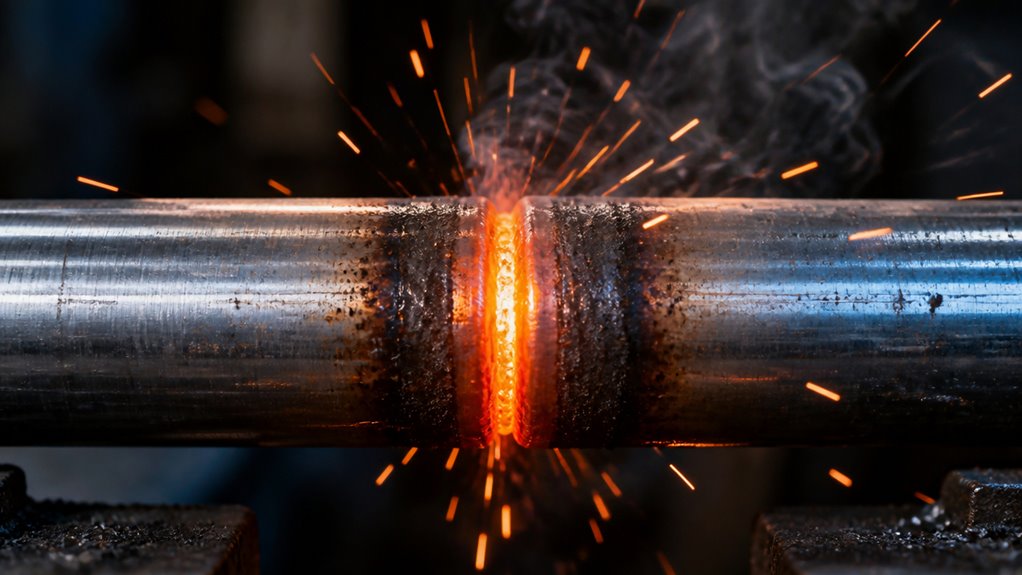
You’ll find friction welding produces joints often stronger than the base metals because it joins metals in a solid state, avoiding melting and related defects like cracking or porosity.
The process uses controlled heat and forge-like pressure to create fine-grained, dense bonds with minimal distortion. This eliminates contaminants through plastic deformation and fosters atomic bonding that improves mechanical properties.
While material and design constraints exist, friction welding reliably delivers high-strength, defect-free joints you can trust. Exploring its specifics reveals why it outperforms conventional fusion methods.
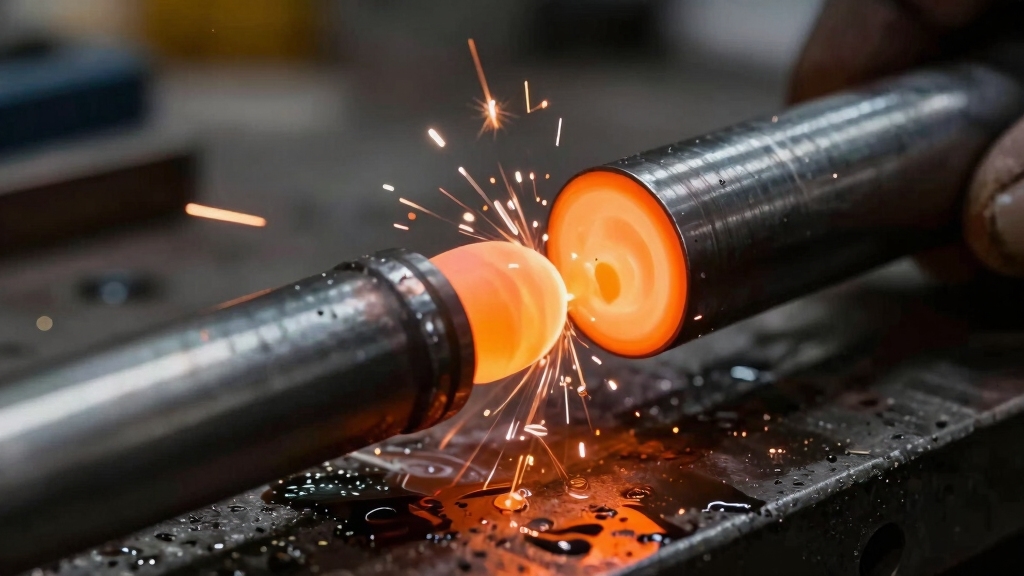
Friction welding joins metals without melting them by generating heat through mechanical friction between the workpieces in motion. You apply a lateral upset force or forging pressure, causing plastic deformation that fuses the materials at their interface.
Friction welding fuses metals through heat from friction and pressure without melting the materials.
This solid-state process avoids melting, which eliminates defects linked to solidification. The friction-generated heat softens the metals, enabling atomic bonding under pressure.
You control parameters like rotation speed, force, and time to guarantee proper heat buildup and material flow. Unlike fusion welding, friction welding produces fine-grained microstructures with minimal distortion.
Because the metals don’t liquefy, the joint forms through mechanical interlocking and plastic flow rather than solidification, resulting in a dense, defect-free bond. This mechanism closely parallels forge welding but uses controlled relative motion to generate consistent heat and pressure.
Controlling parameters such as force and time is critical to managing the heat-affected zone and ensuring joint integrity in solid-state welding processes.
You achieve strong solid-state bonds by combining mechanical friction with precise forging pressure. This process plastically deforms the metals at their interface without melting them.
Heat generated through friction softens the materials, enabling atomic diffusion and mechanical interlocking. The forging pressure consolidates the bond by expelling contaminants and closing voids.
Key factors enabling strong solid-state bonds include:
Unlike fusion welding, friction welding does not create a heat-affected zone, preserving the base metal properties and minimizing distortion.
The strong solid-state bonds created through controlled frictional heat and forging pressure set the stage for welds that often outperform their base metals.
Friction welding avoids melting, eliminating solidification defects like cracking and porosity that weaken fusion welds.
The plastic deformation during the process expels contaminants, ensuring a dense, consolidated bond with minimal discontinuities.
Additionally, the fine-grain microstructure formed under forge-like compression enhances mechanical properties, often surpassing those of the parent metals.
Because the bond forms by intimate atomic contact under pressure without melting, it achieves superior integrity.
Lower thermal distortion and residual stress further preserve strength.
Hence, friction welds can exceed base metal strength by combining defect-free bonding, refined microstructures, and effective forging action, resulting in joints that are both robust and reliable.
Unlike fusion welding processes such as submerged arc welding, friction welding does not rely on a flux blanket to protect the weld zone, which eliminates concerns about shielding and slag removal.
Although friction welding can produce exceptionally strong joints, its effectiveness depends heavily on material compatibility and joint design constraints. You need to make sure the materials are forgeable; otherwise, the process won’t yield a proper bond.
Additionally, joint geometry plays a critical role. Friction welding often requires symmetric or cylindrical parts to maintain consistent pressure and heat generation. Finally, equipment limitations can restrict the complexity of joints you can weld effectively.
Consider these key factors affecting friction weld strength:
Understanding these limits helps you optimize weld quality and strength. However, the need for high-precision equipment and rigid fixtures can increase costs and complicate the welding process.
Explore compelling real-world cases where friction welding demonstrates its exceptional strength, often surpassing the base materials involved.
For example, in aerospace shaft-to-forged ring assemblies, friction welding produces bonds stronger than either parent material, ensuring component integrity under extreme stress.
Automotive driveshafts also benefit; friction-welded joints exhibit superior fatigue resistance compared to traditional fusion welds, reducing failure risk.
In repair applications, friction welding restores worn turbine shafts without compromising mechanical properties, maintaining original strength.
These cases highlight how the solid-state process minimizes defects like porosity and cracking common in fusion welding.
By applying controlled forging pressure and mechanical friction, friction welding achieves fully consolidated, fine-grain microstructures that enhance joint toughness and durability.
When you rely on friction welding, you leverage a joining technique proven to deliver superior strength and reliability in demanding industrial contexts.
Like cad welding, friction welding produces permanent, low-resistance electrical connections through molecular-level bonding, ensuring long-term durability and performance.
You’ll find friction welding most beneficial in aviation and automotive industries, where strong, reliable joints are critical.
It’s perfect for cylindrical parts and forgeable geometries, offering high joint integrity with minimal defects.
You’ll also appreciate its use in repairs and manufacturing, especially when you need solid-state bonds that match or exceed base material strength.
Its precision and low distortion make it ideal for high-reliability applications demanding consistent mechanical performance.
You’ll find friction welding generally costs more upfront than fusion methods because of expensive equipment and slower cycle times.
However, its lower defect rates and reduced post-processing can cut overall expenses.
While you pay more initially, you gain in reliability and strength, which often justifies the investment, especially in high-value or safety-critical components.
Imagine a blacksmith’s forge with a futuristic twist. That’s the essence of friction welding equipment.
You’ll need a powerful motor to spin one or both parts, a robust clamping system to hold them securely, and a precise control unit to regulate speed, pressure, and time.
Additionally, a lathe-like machine bed guarantees alignment. This setup demands high rigidity and accuracy to generate consistent frictional heat and achieve a solid-state bond without melting.
Yes, you can use friction welding to repair damaged components effectively. The process produces strong, solid-state bonds with minimal distortion and defects. This makes it ideal for restoring parts.
It works best on forgeable geometries like cylindrical shapes, where you can achieve high joint integrity. Just ensure material compatibility and precise process control to maximize repair quality. This helps maintain mechanical properties close to the original base metal.
Think of friction stir welding as a sculptor’s gentle hand compared to a blacksmith’s hammer.
Unlike traditional friction welding, which uses rotational friction and axial pressure to join parts by plastic deformation, friction stir welding employs a rotating tool that traverses the joint line.
This stirs the metals without melting them.
This method produces fine-grained, defect-free welds with less distortion, ideal for thin sheets.
In contrast, traditional friction welding suits cylindrical parts and heavier forgings.
So, you’re wondering just how strong friction welding is?
Let’s be clear: it’s not some magic glue but a precise, solid-state process that often outperforms base metals themselves.
If you expect it to fail under normal conditions, you’re probably confusing it with your average backyard welding.
Just remember, while material and design limits exist, friction welding’s strength isn’t a gamble.
It’s a calculated, engineered bond that laughs in the face of conventional joining methods.
[…] you can ensure a smoother welding process and better results. Best results are achieved on forgeable, cylindrical geometries that maintain uniform pressure and heat generation essential for strong […]