Phone:
(701)814-6992
Physical address:
6296 Donnelly Plaza
Ratkeville, Bahamas.

Phone:
(701)814-6992
Physical address:
6296 Donnelly Plaza
Ratkeville, Bahamas.

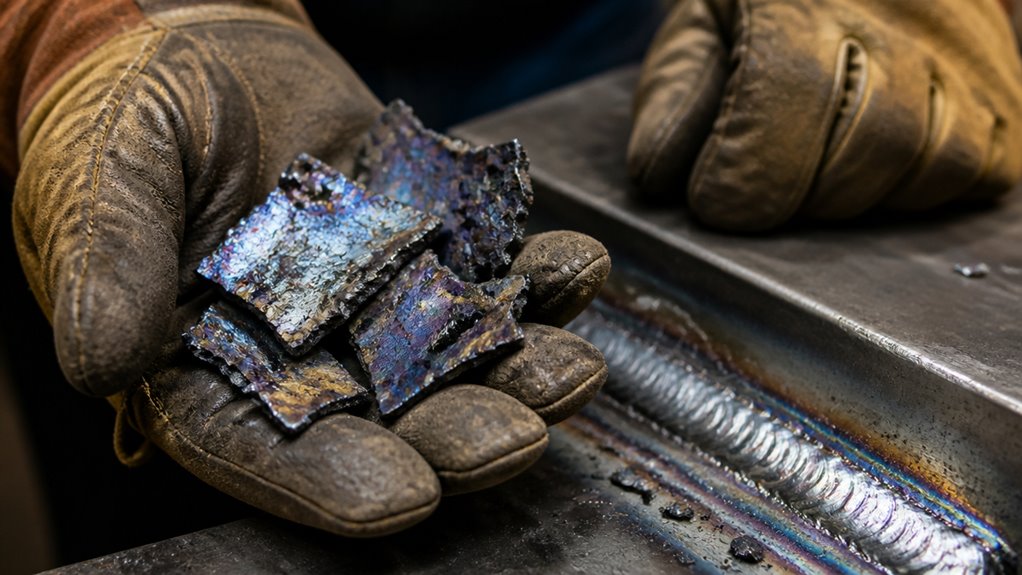
In welding, slag is the nonmetallic layer that forms from molten flux and impurities on top of your weld bead.
It shields the molten metal from oxidation and contamination while controlling cooling, which reduces thermal stresses and promotes strong metallurgical bonds.
This glassy, oxide-rich barrier also slows heat loss for uniform solidification.
Proper slag management is essential to prevent defects and guarantee weld integrity.
Understanding slag’s formation, protection role, and removal will help you optimize your welding outcomes.
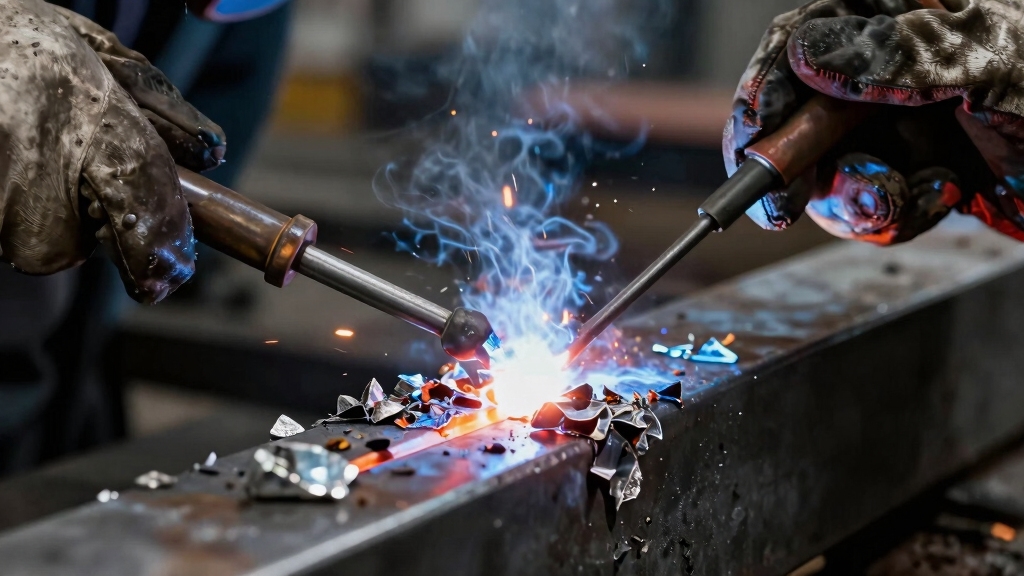
When you weld using processes like shielded metal arc welding or flux-cored arc welding, slag forms as a nonmetallic byproduct that solidifies on top of the weld bead.
Slag arises from molten flux materials and dissolved impurities, which separate from the weld pool due to thermodynamic forces.
As the weld cools, these components solidify into a hardened layer that covers the weld.
This slag primarily consists of oxides such as aluminum, silicon, and calcium, originating from flux constituents like carbonates and silicates.
You’ll notice slag on welds in SMAW, FCAW, and submerged arc welding, where flux plays a crucial role.
Its formation is a natural outcome of flux melting and solidification, serving structural and protective functions during and after welding.
Proper removal of slag is essential to prevent weld defects such as inclusions and porosity that can compromise joint quality.
The formation of slag hinges on the specific properties and composition of the flux materials involved in welding. When flux melts, its chemical makeup, often including carbonates and silicates, reacts with impurities and atmospheric elements. This produces a nonmetallic residue that solidifies as slag.
You’ll find that flux materials containing oxides of aluminum, silicon, and calcium markedly influence slag’s structure and protective qualities.
| Flux Component | Role in Slag Formation |
|---|---|
| Carbonates | Generate gases, aid slag fluidity |
| Silicates | Form glassy slag, trap impurities |
| Metal Oxides (Al, Si, Ca) | Stabilize slag, enhance weld shielding |
Understanding these interactions helps you control slag characteristics for peak weld quality. The flux also plays a critical role in generating shielding gases that protect the weld pool from atmospheric contamination during the welding process.
Almost all arc welding methods that utilize flux generate slag as a byproduct. You’ll most commonly encounter it in shielded metal arc welding (SMAW), flux-cored arc welding (FCAW), and submerged arc welding (SAW).
In SMAW, the flux coating on the electrode melts and forms slag atop the weld bead. FCAW produces slag from flux contained within the tubular wire, which liquefies and solidifies as a surface layer.
SAW uses granular flux that covers the weld zone, generating a substantial slag blanket. Electroslag welding also produces slag through molten flux interaction.
These processes rely on flux materials that melt and react with impurities, resulting in slag formation. Understanding these methods helps you anticipate slag presence, manage its removal, and maintain weld integrity. Additionally, proper eye protection is crucial during slag removal to prevent welder’s flash and other UV-related eye injuries.
Although slag is often seen as a byproduct to be removed, it plays a critical role in protecting the weld pool from atmospheric contamination during welding.
Slag is more than waste; it crucially shields the weld pool from harmful atmospheric contamination.
When you weld, the molten metal is highly reactive with oxygen and nitrogen. Slag forms a protective barrier that prevents oxidation and nitrogen absorption, thereby preserving weld integrity.
Additionally, slag controls the cooling rate by insulating the weld pool. This allows a more uniform solidification that reduces residual stresses and improves fusion.
You’ll find that slag also helps contain the molten metal, especially in vertical or overhead positions, minimizing weld defects.
Understanding how slag contributes to stress concentrators can help in preventing common weld defects.
When you finish welding, removing slag is essential to guarantee a clean, defect-free joint. Slag left on the weld surface can trap impurities, causing slag inclusion defects that compromise structural integrity.
Removing slag improves the weld’s appearance and prepares the surface for additional passes, assuring metallurgical bonding without contamination. Neglecting slag removal can lead to poor fusion, increased porosity, and reduced mechanical properties.
| Importance | Effect on Weld Quality |
|---|---|
| Prevents inclusions | Avoids trapped nonmetallic slag |
| Ensures clean surface | Facilitates inspection and finishing |
| Enables strong fusion | Promotes metallurgical bonding |
| Improves appearance | Produces smooth weld beads |
| Prepares for next pass | Prevents contamination between layers |
Removing slag is a critical step in achieving sound, durable welds.
To effectively remove slag without damaging your weld, you’ll want to grab a few specific tools. Think of a chipping hammer, a wire brush, or even an angle grinder.
Each of these has its own role in the cleanup process.
Now, why is it so important to clean up all that slag? Well, if you don’t, you risk defects like slag inclusion in your next weld pass.
That’s not something anyone wants to deal with! So, let’s dive into how to choose the right tools and use them correctly for the best results in slag removal.
Additionally, following proper safety protocols during slag removal ensures a safer and more efficient cleanup process.
Mastering slag removal is essential to guarantee a clean, defect-free weld surface and to prevent slag inclusion. You’ll rely on specific tools designed for efficiency and effectiveness.
A chipping hammer is indispensable for breaking and dislodging hardened slag from the weld bead. Following this, a wire brush helps remove residual particles and smooth the surface.
For larger or stubborn slag deposits, an angle grinder provides power and precision, quickly clearing the area for subsequent weld passes. Needle scalers are useful for intricate or uneven surfaces, delivering rapid impact to loosen slag without damaging the weld.
Selecting the right tool depends on slag thickness, weld position, and accessibility. Using these tools strategically guarantees you thoroughly remove slag, maintaining weld integrity and preparing the joint for high-quality welding continuation. Proper torch maintenance also plays a crucial role in preventing spatter buildup, which aids in reducing slag formation.
To achieve effective slag removal, focus on employing the appropriate tools combined with precise techniques tailored to the weld’s characteristics.
Start by using a chipping hammer to break the slag layer gently, avoiding damage to the weld bead. Follow with a wire brush or needle scaler to remove residual particles thoroughly.
For large or stubborn slag, an angle grinder offers efficient cleaning but use it carefully to prevent weld surface gouging. Always clean slag between weld passes to prevent inclusion defects and guarantee peak fusion.
Proper use of personal protective equipment is essential during slag removal to protect against flying molten metal spatter and sparks.
| Tool | Application |
|---|---|
| Chipping Hammer | Initial slag detachment |
| Wire Brush | Residual slag cleaning |
| Needle Scaler | Precision slag removal |
| Angle Grinder | Stubborn slag removal |
| Safety Gear | Protect eyes, hands, lungs |
You’ll mostly run into slag inclusion defects when slag isn’t completely removed between weld passes. This can trap nonmetallic material in the weld, which isn’t ideal.
Another thing to keep in mind is that welding too quickly can also lead to these issues. When you rush, it prevents the flux from melting properly and the slag from separating as it should.
Proper slag removal using a chipping hammer and wire brush while the weld is warm but solidified is essential to prevent slag inclusions and ensure proper bonding between layers.
Incomplete slag removal frequently leads to slag inclusion defects, a common and critical issue in welding quality control.
When you fail to completely remove the solidified flux layer between weld passes, slag particles can become trapped within the molten metal during subsequent passes.
This entrapment compromises weld integrity by creating weak points prone to cracking or failure.
Effective slag removal requires using appropriate tools like a chipping hammer or wire brush to make certain no residual slag remains.
Inadequate cleaning often results from insufficient time allowance between passes or improper technique, leaving slag embedded in the weld.
Maintaining strict adherence to slag removal protocols is essential to prevent inclusions, improve fusion, and uphold the structural soundness of the welded joint.
Porosity caused by trapped gases can similarly weaken welds, highlighting the importance of removing contaminants and proper weld preparation.
Beyond improper slag removal, another significant factor that contributes to slag inclusion defects is excessive welding speed.
When you weld too quickly, the molten slag doesn’t have enough time to rise to the surface and separate from the weld pool. This causes slag to become trapped within the solidifying metal, leading to inclusions.
Additionally, excessive speed reduces the weld pool size and heat input, impairing proper fusion between layers. As a result, slag that would normally float out remains embedded inside the joint.
To prevent this, you need to maintain an appropriate travel speed that balances heat input and slag separation.
Controlling welding speed guarantees slag can float off the molten pool, reducing the risk of slag inclusions and improving overall weld quality.
Proper technique and stable arc initiation are also essential to avoid defects caused by uncontrolled electrode contact, such as arc strikes, which can further compromise weld integrity.
Prevent slag inclusion by thoroughly removing all slag between weld passes and maintaining proper welding speed. Slag trapped in the weld weakens the joint and compromises structural integrity.
To prevent defects, you must:
Remove slag completely using a wire brush or chipping hammer before each new pass.
Use electrodes and flux of consistent, high quality to reduce foreign inclusions.
Control welding speed to avoid excessive flux entrapment or incomplete slag burn-off.
Inspect the weld surface carefully for residual slag or irregularities before continuing.
While slag primarily serves as a protective barrier during welding, it also plays a critical role in influencing the cooling rate of the weld metal.
By insulating the molten weld pool, slag slows heat dissipation, allowing the weld to cool more uniformly. This controlled cooling reduces thermal stresses and minimizes the risk of cracks or distortion.
Additionally, slower cooling fosters better metallurgical bonding, improving the weld’s mechanical strength. However, uneven slag coverage or premature slag removal can accelerate cooling, potentially weakening the weld structure.
You must make certain slag remains intact until the weld solidifies adequately to optimize strength. Consequently, slag management directly affects the cooling dynamics and ultimately determines the weld’s structural integrity and performance under load.
Mastering slag management is essential to achieving consistent, high-quality welds. You must understand slag’s formation, functions, and removal to prevent defects like slag inclusion. Proper slag control enhances weld integrity by guaranteeing clean, contamination-free joints and optimal fusion.
To maximize weld quality, focus on:
Removing slag between passes with appropriate tools to avoid entrapment.
Monitoring welding speed and flux quality to minimize slag-related defects.
Utilizing slag’s protective properties during welding to shield against oxidation and control cooling rate.
Maintaining strict technique discipline to ensure slag doesn’t compromise weld bead appearance or strength.
You generally can’t recycle or reuse slag directly in welding because it’s a nonmetallic byproduct contaminated with impurities.
However, some industries recover valuable elements like aluminum, silicon, or calcium oxides from slag for other processes.
In welding, slag’s primary function is protective, so reusing it risks weld defects such as inclusions.
You should remove and discard slag properly to maintain weld integrity rather than attempt to recycle it within welding applications.
Imagine painting a wall but leaving dried tape on it. That’s what slag does to your weld’s appearance.
Slag creates a rough, uneven surface that mars the smoothness of the final weld. If you don’t remove it properly, it can cause discoloration, pitting, or a gritty texture.
This detracts from aesthetics and may signal underlying defects. So you must clean slag thoroughly to guarantee a visually appealing, high-quality weld finish.
Yes, slag can pose health hazards while welding. When it breaks or is removed, slag particles become airborne.
You risk inhaling dust containing metal oxides like aluminum, silicon, and calcium. This can irritate your respiratory system or cause long-term lung issues.
Always wear appropriate respiratory protection and use local ventilation when chipping or grinding slag. This will help minimize exposure and protect your health during welding operations.
Yes, slag formation varies with different welding power sources because each influences heat input and molten pool behavior.
For example, shielded metal arc welding (SMAW) produces slag from flux-coated electrodes, while submerged arc welding (SAW) uses granular flux, creating distinct slag characteristics.
Flux-cored arc welding (FCAW) incorporates flux inside the wire, affecting slag morphology.
Your choice of power source and welding parameters directly impacts slag composition, volume, and removal requirements.
Humidity acts like an invisible hand, subtly altering slag behavior.
When you weld in high humidity, moisture can cause the flux to absorb water, leading to unstable slag formation and increased porosity.
This makes slag harder to chip away cleanly. You’ll need extra care during slag removal, using tools like wire brushes more aggressively to avoid inclusions.
Controlling your environment minimizes these issues and guarantees a cleaner, stronger weld.
To make certain your welds stand the test of time, you’ve got to manage slag with precision. It’s the unsung hero protecting the weld pool but can become a hidden thorn if left unchecked.
Removing slag promptly and preventing inclusion defects keeps your weld strength intact and cooling controlled. Remember, the proof of the pudding is in the eating. Only by mastering slag management can you maximize your weld quality and structural integrity.