Phone:
(701)814-6992
Physical address:
6296 Donnelly Plaza
Ratkeville, Bahamas.

Phone:
(701)814-6992
Physical address:
6296 Donnelly Plaza
Ratkeville, Bahamas.

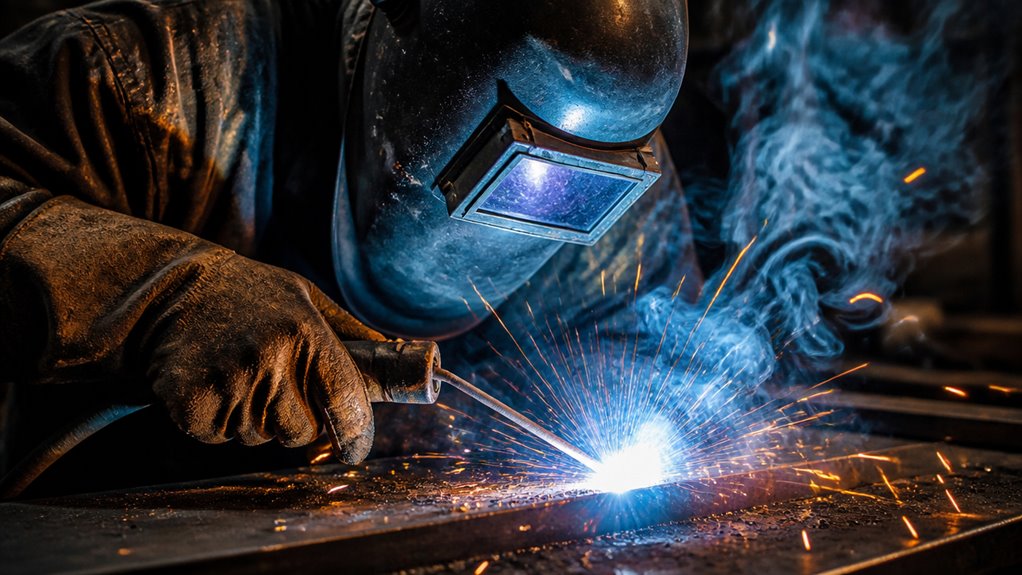
MMA welding lets you join metals by manually striking an electric arc with a flux-coated consumable electrode. This melts the base metal and electrode to form a weld pool.
The flux coating provides shielding gas and slag to protect the weld without needing external gas. You control arc length and current for proper fusion.
This versatile, portable process works well outdoors and in confined spaces. There’s much more to mastering equipment, electrode selection, and common challenges ahead.
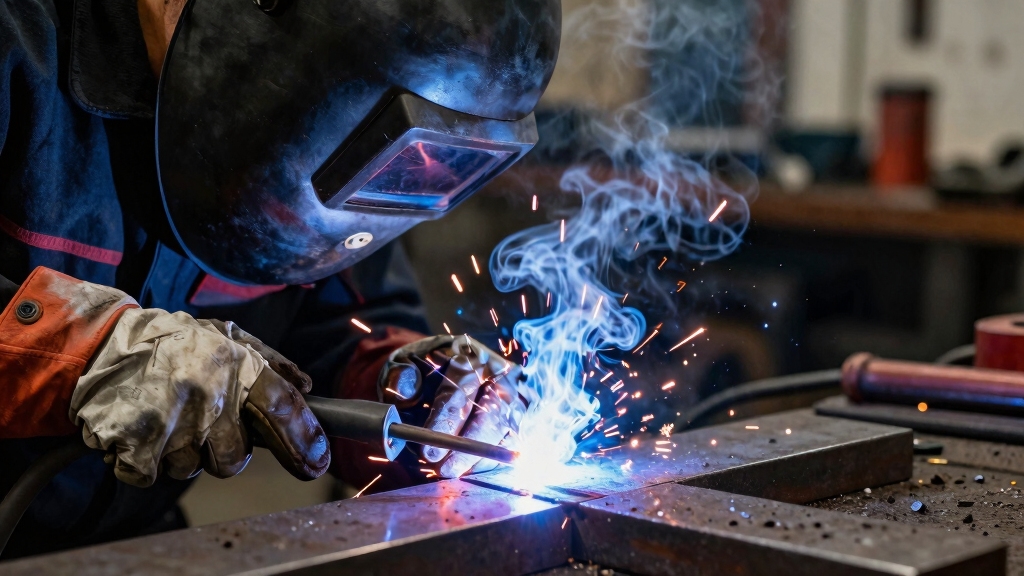
Although MMA welding might seem straightforward, understanding how it works is essential for achieving strong, reliable welds.
You manually strike an electric arc by briefly touching and lifting a flux-coated consumable electrode against the workpiece.
This arc generates intense heat, melting both the electrode tip and base metal to form a molten weld pool.
The electrode’s flux coating decomposes, releasing shielding gas that protects the arc zone and molten metal from atmospheric contamination.
It also forms a slag layer over the cooling weld bead, which you must remove after welding.
You control arc length manually, influencing arc voltage and heat input.
This fusion welding process requires no external shielding gas, relying entirely on the flux coating to maintain weld integrity in various environments.
MMA welding typically uses a constant current power supply to maintain stable arc conditions despite manual control of the arc length.
When you set up for MMA welding, you’ll need several key pieces of equipment that work together to create and maintain the welding arc.
Essential items include a power source providing AC or DC current, an electrode holder for securely gripping the flux-coated electrode, and an earth clamp to guarantee proper grounding.
You’ll also need consumable electrodes with flux coatings that generate shielding gas and slag during welding.
Proper personal protective equipment is critical to protect the welder from burns, radiation, and electric shock hazards during operation.
| Equipment | Purpose | Key Detail |
|---|---|---|
| Power Source | Supplies welding current | AC or DC, adjustable amperage |
| Electrode Holder | Holds and positions electrode | Insulated grip for safety |
| Earth Clamp | Grounds the workpiece | Guarantees stable arc formation |
| Flux-coated Electrode | Consumable filler and shield | Flux creates shielding and slag |
| Protective Gear | Protects welder from hazards | Helmet, gloves, protective clothing |
Selecting the correct electrode and adjusting the welding current precisely are critical steps that directly influence the strength and quality of your MMA welds.
Choose electrodes based on the base metal type, desired mechanical properties, and welding position. For example, E6013 suits general-purpose mild steel welding, while E7018 offers high tensile strength and crack resistance.
Match the current to the electrode diameter, roughly 40 amps per millimeter. Set the current to maintain a stable arc without excessive spatter or electrode sticking.
You’ll need to adjust parameters for AC or DC power sources, considering polarity. DC+ (electrode positive) provides deeper penetration, while DC– (electrode negative) offers faster deposition.
Proper electrode storage and selection prevent moisture absorption, preserving weld integrity and minimizing defects.
Understanding the meaning of numbers on welding rods helps ensure you select electrodes with the right tensile strength, welding position suitability, and flux coating for your specific MMA welding needs.
MMA welding is super popular in the construction industry. Its portability and versatility make it perfect for structural steelwork and assembling skyscrapers. Plus, it’s a lifesaver for maintenance and repair tasks. You can get efficient on-site fixes done without needing a lot of setup time.
And let’s not forget about on-site fabrication! MMA welding really shines in environments where you don’t have access to external shielding gas or controlled conditions. Its adaptability makes it a go-to choice for many projects. It’s just that reliable! Its ability to weld on rusty, dirty, or wet surfaces while maintaining strong, reliable welds makes it indispensable in challenging field conditions with minimal equipment.
Although MMA welding requires skilled manual operation, it remains a cornerstone in construction due to its portability and adaptability.
When you work on-site, you’ll appreciate its minimal equipment needs. No external shielding gas means fewer logistical challenges.
MMA welding excels in joining structural steel, reinforcing bars, and heavy steel plates. This makes it ideal for erecting frameworks and load-bearing elements.
You’ll find it indispensable for welding in confined spaces or outdoor environments where wind could disperse shielding gases.
Its ability to handle various ferrous metals and tolerate surface contaminants like rust or mill scale allows for reliable welds in less-than-ideal conditions.
Additionally, its versatility in welding processes helps reduce the need for multiple specialists on complex projects.
Beyond construction, MMA welding proves highly effective for maintenance and repair tasks across numerous industries.
You’ll find it invaluable for restoring structural integrity in heavy machinery, pipelines, and industrial equipment where portability and reliability matter.
Its flux-coated electrodes allow you to weld in outdoor or confined spaces without needing external shielding gas, vital for on-the-spot fixes.
When you repair worn or cracked components, MMA welding’s versatility across various ferrous metals ensures strong, durable joints.
Remember to clean surfaces from rust or contaminants before welding to maintain weld quality.
The process demands your skill to control arc length and current precisely to ensure proper fusion.
After welding, you’ll remove slag to inspect and possibly re-weld for optimal repair strength.
This makes MMA welding a staple method for timely, cost-efficient maintenance.
Its ability to perform well on rust and scaled surfaces further enhances its suitability for challenging repair environments.
When working on-site, MMA welding offers unmatched adaptability for fabricating metal structures directly in the field. You can rely on its portability and minimal equipment requirements to assemble, modify, or repair components without needing bulky gas cylinders.
This process excels in construction sites, shipyards, and heavy equipment manufacturing, where environmental conditions vary and mobility is essential. Its flux-coated electrode provides self-shielding, eliminating the need for external gas, which simplifies setup in remote or confined locations.
As you weld, the slag protects the molten pool, ensuring sound welds despite wind or dust. You’ll find MMA welding particularly valuable for joining structural steel, pipelines, and frameworks on-site, delivering reliable fusion even on uneven or unprepared surfaces.
This capability saves time and enhances project efficiency. Additionally, MMA welding produces more fumes and slag, necessitating proper ventilation and respiratory protection to maintain a safe working environment.
You’ll really appreciate MMA welding for its incredible portability. It only needs basic equipment and doesn’t require any external gas, making it super easy for fieldwork.
Plus, its versatility is a big win! You can work with various metals and conditions, so it adapts effortlessly to different applications.
And let’s not forget about the cost-effectiveness. It keeps your setup expenses low and reduces material waste, all while delivering reliable welds. What’s not to love?
Its flux-coated electrode provides self-shielding protection, allowing MMA welding to perform well even in windy or damp outdoor conditions.
Offering unmatched portability, MMA welding lets you operate with minimal and compact equipment. This makes it ideal for on-site and remote jobs where bulky gear or external gas supplies are impractical.
You only need a power source, electrode holder, earth clamp, and flux-coated electrodes—all easily transported. Since the flux coating provides shielding gas internally, you avoid carrying heavy gas cylinders, simplifying logistics and setup.
This compactness enables rapid deployment and flexibility in confined or difficult-to-access areas. You can quickly adjust current settings based on electrode diameter, enhancing control without complex machines.
The simplicity of MMA welding gear means less maintenance and fewer failure points, which is essential when working in unpredictable environments. Overall, its portability and convenience reduce downtime and improve operational efficiency in field conditions.
Additionally, MMA welding’s ability to perform robust welds on rusty or dirty surfaces makes it particularly suited for outdoor applications and repair work.
Beyond its portability, MMA welding stands out for its adaptability across a wide range of applications and environments.
You’ll find it ideal for joining various ferrous metals, especially where external shielding gas is impractical. Its flux-coated electrodes protect the weld zone, allowing you to work outdoors or in less controlled settings without compromising quality.
Consider these key applications:
Additionally, MMA welding’s flux composition plays a crucial role in controlling slag formation and protecting the weld pool from contamination.
Many welders choose MMA welding because it provides a cost-effective solution without sacrificing reliability or adaptability.
You’ll appreciate that MMA welding requires minimal equipment: just a power source, electrode holder, earth clamp, and flux-coated electrodes. This eliminates the need for costly external shielding gas cylinders.
Its consumable electrodes, while needing replacement, are relatively inexpensive and widely available. Since the flux coating supplies inherent shielding, you avoid additional consumables and setup complexity.
This makes MMA ideal for on-site and repair work where budget constraints and portability matter. Additionally, its broad electrode range lets you tailor welding parameters to specific materials and thicknesses, optimizing efficiency.
Although MMA welding is a versatile and widely used process, you’ll encounter several common challenges that can affect weld quality and efficiency. To overcome these, focus on:
MMA welding is versatile but presents challenges; addressing them improves weld quality and efficiency.
You can learn MMA welding basics effectively within a few weeks of focused practice, typically 20-40 hours.
Mastery, including controlling arc length, managing slag, and selecting electrodes, usually takes several months of hands-on experience.
Your progress depends on consistent practice, understanding equipment settings, and working on diverse joints and metals.
Skill refinement continues on the job, so expect ongoing learning beyond initial training to achieve high-quality, reliable welds.
You generally won’t use MMA welding on non-ferrous metals because standard flux-coated electrodes are designed for ferrous materials like steel and iron.
Non-ferrous metals like aluminum or copper require specialized processes or electrodes with appropriate flux chemistry.
While you can find electrodes made for some non-ferrous alloys, welding these metals effectively with MMA demands careful electrode selection and technique adjustments.
These adjustments are necessary to address their distinct melting points and thermal conductivities.
You need essential safety gear for MMA welding to protect yourself from intense heat, UV radiation, and sparks.
Wear a welding helmet with a proper shade filter to shield your eyes and face.
Use flame-resistant gloves and a long-sleeve jacket or apron to guard your skin.
Safety boots and ear protection are indispensable too.
Always work in a well-ventilated area to avoid inhaling hazardous fumes and gases generated during welding.
Like a sailor battling stormy seas, you’ll find MMA welding performance challenged by wind and moisture.
Wind can disperse the protective shielding gas from the flux, causing weld defects such as porosity.
Rain and humidity increase the risk of arc instability and contamination, compromising weld integrity.
To maintain quality, you must shield your work area, keep electrodes dry, and choose suitable weather conditions or protective enclosures during welding.
Yes, you can use eco-friendly MMA electrodes designed with low-hydrogen, low-smoke, and reduced-toxic-fume coatings.
These electrodes limit environmental impact by minimizing harmful emissions and slag waste during welding.
Additionally, some manufacturers offer biodegradable or recyclable packaging.
When selecting alternatives, make certain they maintain mechanical properties and weld quality comparable to traditional electrodes.
This way, you won’t compromise performance while reducing your ecological footprint on-site.
So, now that you’ve mastered MMA welding, because who doesn’t want to wrestle with molten metal and flying sparks, you’re ready to tackle any job with precision and grit.
Just remember, choosing the right electrode isn’t a game of roulette, and those pesky slag bits won’t remove themselves.
Embrace the sparks, the challenges, and the occasional singed eyebrow. After all, MMA welding is where skill meets controlled chaos, and you’re the star of this fiery show.