Phone:
(701)814-6992
Physical address:
6296 Donnelly Plaza
Ratkeville, Bahamas.

Phone:
(701)814-6992
Physical address:
6296 Donnelly Plaza
Ratkeville, Bahamas.

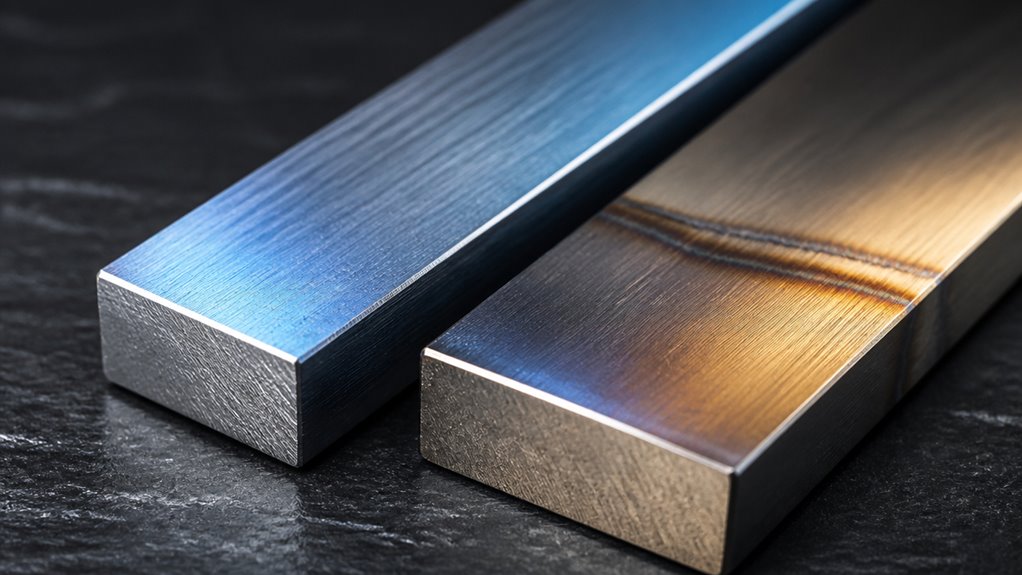
If you need higher strength and hardness, 4140 outperforms 4130, with tensile strengths over 1000 MPa versus 700 MPa in 4130.
However, 4130 offers better weldability and ductility, making it ideal for tubular frames and simpler fabrication.
4140’s higher carbon and manganese boost wear resistance but require careful preheat and post-weld treatment.
Depending on your load and welding demands, choosing between them impacts performance and processing.
Explore their chemical and mechanical trade-offs to optimize your application.
| Feature | 4130 Steel | 4140 Steel |
|---|---|---|
| Steel Type | Chromium-molybdenum alloy steel | Chromium-molybdenum alloy steel |
| Carbon Content | 0.28–0.33% | 0.38–0.43% |
| Manganese Content | 0.40–0.60% | 0.75–1.00% |
| Tensile Strength | Around 700 MPa | Over 1000 MPa |
| Yield Strength | Around 63,000 psi | Around 95,000 psi |
| Hardness (Brinell) | Around 197 HB | Up to 302 HB |
| Ductility | Higher | Lower |
| Weldability | Excellent | Moderate; requires preheat and post-weld heat treatment |
| Machinability | Better (about 70%) | Good (about 65%) |
| Wear Resistance | Good | Excellent |
| Impact Resistance | Better | Good |
| Heat Treatment Response | Good | Excellent |
| Fabrication Ease | Easier | More challenging |
| Typical Applications | Aircraft frames, roll cages, tubular structures | Gears, shafts, axles, heavy machinery |
| Best For | Welded fabrications and lightweight structures | High-load and high-wear components |
| Main Advantage | Superior weldability and ductility | Higher strength, hardness, and wear resistance |
| Main Drawback | Lower strength and hardness | More difficult to weld and machine |
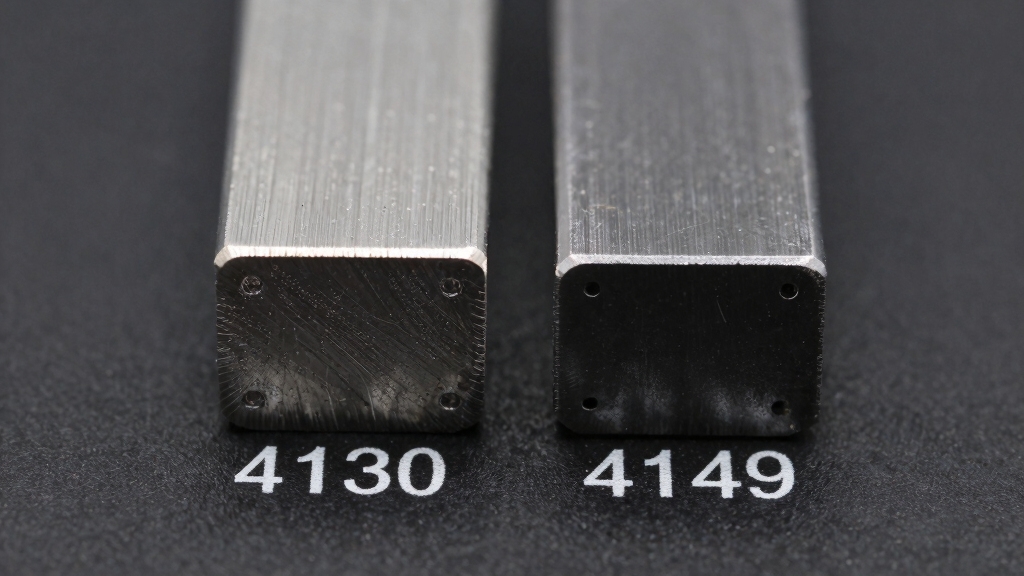
While both 4130 and 4140 steels are chromium-molybdenum alloys, 4140 offers markedly higher strength and hardness due to its increased carbon and manganese content.
Both 4130 and 4140 are chromium-molybdenum steels, but 4140 delivers superior strength and hardness.
You’ll find that heat-treated 4140 achieves tensile strengths exceeding 1000 MPa, compared to 4130’s typical maximum around 700 MPa.
Yield strength further highlights this difference, with 4140 reaching approximately 95,000 psi, while 4130 is near 63,000 psi.
Hardness measurements reinforce these disparities: 4140’s Brinell hardness can reach 302, appreciably higher than 4130’s 197.
This increased carbon and manganese enhance 4140’s microstructure, producing greater resistance to deformation under load.
When selecting materials for high-stress applications, you must consider that 4140’s superior mechanical properties come with trade-offs in weldability and ductility, which you’ll evaluate in subsequent sections.
Due to its higher carbon equivalent, 4140 steel requires careful preheat and heat control during welding to minimize cracking risks and ensure weld quality.
Because the chemical composition directly influences mechanical behavior, understanding the key differences between 4130 and 4140 steels is essential.
You’ll notice 4140 contains higher carbon levels, about 0.38% to 0.43%, compared to 4130’s 0.28% to 0.33%. This increase enhances hardness and tensile strength markedly.
Additionally, 4140 has more manganese, 0.75-1.00% versus 0.40-0.60% in 4130, further improving wear resistance and hardenability.
Both alloys share chromium content, contributing to corrosion resistance, but 4140’s elevated carbon and manganese define its superior mechanical properties.
When selecting between the two, these chemical distinctions clarify why 4140 excels in high-stress and heavy-load applications.
In contrast, 4130 suits projects prioritizing ductility and weldability without sacrificing moderate strength.
It is also important to consider preheating requirements during welding to reduce cracking and residual stresses, especially in higher carbon steels like 4140.
How does weldability influence your choice between 4130 and 4140 steel?
When fabrication demands ease of welding, 4130 stands out with excellent weldability and ductility. This makes it ideal for tubular structures like roll cages.
On the other hand, 4140 requires careful pre-heating (above 300°F) to avoid cracking and brittleness. It also needs post-weld heat treatment to maintain integrity.
Consider these factors:
Thus, for simpler, reliable welding, 4130 outperforms 4140.
Additionally, selecting appropriate preheating temperatures and controlled cooling methods is critical to prevent cracking in higher carbon steels like 4140.
Welding considerations aside, machinability and wear resistance play significant roles in selecting between 4130 and 4140 steels.
You’ll find 4130 offers superior machinability, rated at 70% relative to SAE1212, making it easier to cut and shape with less tool wear.
In contrast, 4140 rates slightly lower at 65%, reflecting its higher carbon and manganese content, which increase hardness but reduce machinability.
When wear resistance is critical, 4140 outperforms 4130 due to its elevated carbon content, providing greater surface hardness and durability under stress.
This makes 4140 your go-to for components like gears and shafts that endure significant friction.
Meanwhile, 4130’s machinability advantage suits applications where ease of fabrication is prioritized over extreme wear resistance.
Your choice hinges on balancing these factors based on operational demands.
However, caution is advised when welding these steels due to the risk of altered microstructure and brittleness under heat, which can compromise mechanical properties.
Selecting between 4130 and 4140 steel depends on your project’s specific performance requirements and environmental conditions.
You’ll choose 4130 when weldability, ductility, and impact resistance are critical, such as in aircraft frames or roll cages. Conversely, 4140 suits applications demanding higher strength and wear resistance, like heavy-duty axles or gears.
Consider these key application factors:
Additionally, controlling heat input during welding is crucial for maintaining joint strength and preventing defects that could compromise performance in critical applications.
You won’t notice a significant density difference between 4130 and 4140 steel since both hover around 7.85 g/cm³. This similarity means their weight per volume is effectively the same.
When choosing between them, density isn’t a deciding factor. Instead, focus on mechanical properties or weldability depending on your application, as those aspects vary more distinctly than their physical mass.
Think of elongation as the steel’s stretch before it snaps.
4130 stretches about 25.5% at 2 inches, giving you more ductility and flexibility under stress.
In contrast, 4140 elongates roughly 17.7%, so it’s less forgiving but stronger.
If you want a material that bends more without breaking, 4130’s your choice.
For higher strength with less stretch, 4140 fits better, especially in high-load applications.
You’ll find 4130 steel offers better impact resistance because it bends before breaking, thanks to its lower carbon content and higher ductility.
This makes it ideal for applications needing toughness under sudden loads.
In contrast, 4140’s increased hardness and strength improve wear resistance but reduce its ability to absorb shocks without fracturing.
You’ll find only slight differences in corrosion resistance between these steels because both contain chromium, which enhances this property.
However, neither 4130 nor 4140 is highly corrosion-resistant without additional surface treatments or coatings.
If corrosion resistance is critical for your application, you’ll need to apply protective finishes or consider stainless steel alternatives.
Both alloys perform similarly under corrosive conditions, with neither providing significant inherent advantage.
When welding 4140 steel, you need to pre-heat it to temperatures above 300°F (about 150°C). This pre-heating reduces thermal gradients and minimizes the risk of cracking and brittleness in the heat-affected zone.
You must control the temperature carefully, ensuring even heating before welding. Follow post-weld heat treatment to relieve stresses. Skipping pre-heat can cause weld defects and compromise structural integrity in high-strength applications.
When choosing between 4130 and 4140 steel, you’ll notice 4140 offers about 15% higher tensile strength, making it ideal for heavy-duty applications.
However, 4130’s superior weldability might suit your fabrication needs better.
Understanding these subtle differences helps you select the right alloy for strength, machinability, and wear resistance.
By aligning your choice with specific requirements, you guarantee peak performance and durability in your projects.