Phone:
(701)814-6992
Physical address:
6296 Donnelly Plaza
Ratkeville, Bahamas.

Phone:
(701)814-6992
Physical address:
6296 Donnelly Plaza
Ratkeville, Bahamas.

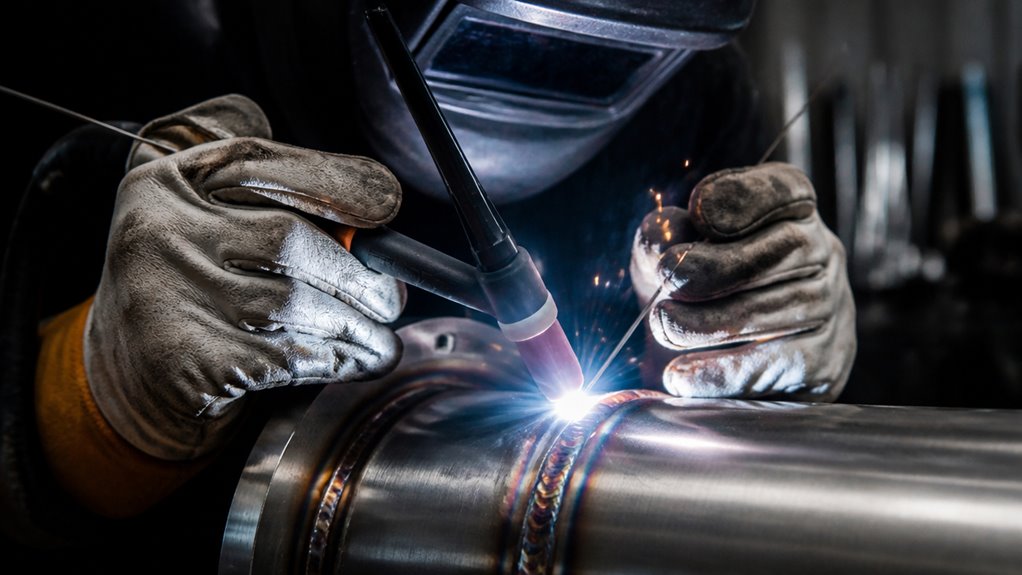
You’d most likely use gas tungsten arc welding (GTAW) when you need highly precise, clean welds on thin or sensitive metals like aluminum, stainless steel, or titanium.
Its tight heat control prevents burn-through and distortion while delivering a flawless visual finish with minimal spatter or slag.
GTAW excels in applications demanding corrosion resistance and metallurgical integrity, such as aerospace or automotive fabrication.
Explore its advantages and limitations to see if it suits your specific welding needs.
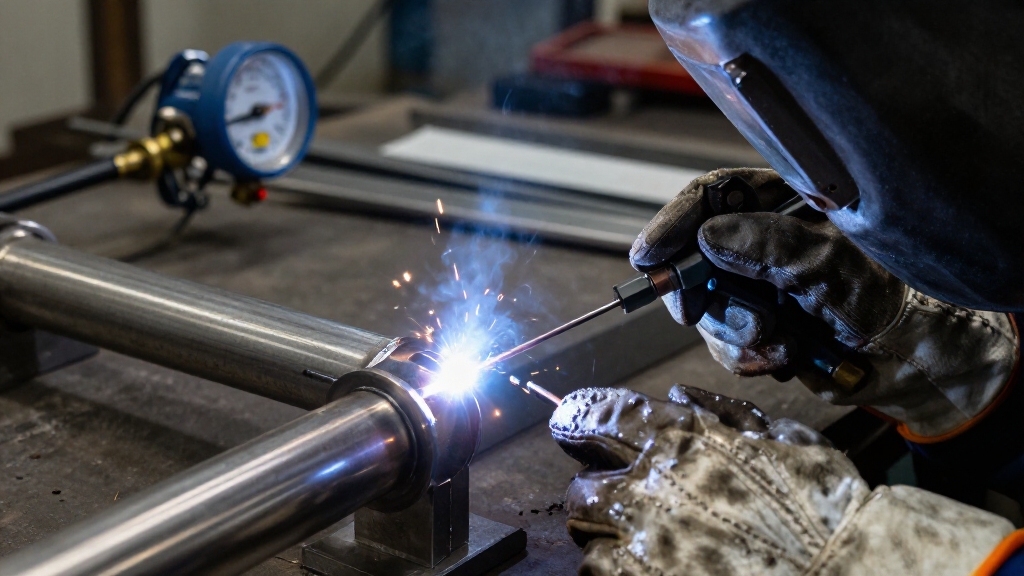
What makes Gas Tungsten Arc Welding (GTAW) distinct is its ability to deliver highly precise, clean welds with exceptional control over heat input.
Gas Tungsten Arc Welding (GTAW) stands out for its precision, cleanliness, and superior heat control.
You’ll find GTAW ideal when working with thin materials that require minimal distortion and a controlled, stable arc.
It’s especially suited for welding non-ferrous metals like aluminum, magnesium, and titanium, as well as stainless steel and copper alloys.
You should use GTAW for root passes on thicker pipe where a flawless initial weld is critical.
Short, precise welds also benefit from this process, as it prioritizes accuracy over speed.
However, GTAW isn’t the most efficient choice for thick materials or long weld runs.
Instead, it excels where weld integrity, minimal heat input, and a clean finish are paramount to your project’s success.
The continuous flow of inert shielding gas protects the weld zone from atmospheric contamination, ensuring a defect-free weld.
When you’re working with thin materials like stainless steel, aluminum, or titanium, having tight heat control is key to avoiding burn-through and warping. That’s where GTAW really shines!
It’s particularly great for thin sheet metal, small-diameter tubing, and those delicate seams where precision is super important.
With GTAW, you can achieve clean and accurate welds, even on metals that require careful handling. It’s all about getting that perfect finish without compromising the material.
Controlling the arc length precisely within 1–1.5 times the electrode diameter helps maintain consistent heat and weld quality on thin metals.
Because controlling heat input is essential when working with thin materials, gas tungsten arc welding (GTAW) offers unmatched precision in this regard. You can apply heat very selectively, minimizing the risk of burn-through or warping.
This tight heat control makes GTAW ideal for delicate welding tasks where dimensional integrity is critical.
When you use GTAW for thin materials, you benefit from:
Focused arc heat that limits thermal distortion.
Short, controlled weld runs that prevent overheating.
Precise adjustment of amperage for delicate sections.
Consistent, stable arc that guarantees uniform heat distribution.
Using pure argon as the shielding gas provides a stable, inert shield that protects the weld pool from contamination, ensuring high-quality welds on thin metals.
Metals like stainless steel, aluminum, magnesium, titanium, and copper alloys respond exceptionally well to gas tungsten arc welding due to their thermal properties and sensitivity to heat.
When you weld these metals, you need precise heat input to prevent distortion, burn-through, or metallurgical damage.
GTAW offers you superior control over heat delivery, allowing you to manage thin sections without compromising structural integrity.
Its inert gas shielding protects the weld pool from contamination, essential for reactive metals like titanium and aluminum.
You’ll find GTAW ideal for non-ferrous alloys and stainless steel because it produces clean, high-quality welds with minimal spatter or slag.
This precision makes GTAW the go-to process when welding metals that require tight tolerances and excellent corrosion resistance, especially in applications demanding metallurgical soundness.
To achieve optimal results, it is important to select the correct tungsten type based on the current type used for the specific metal.
Mastering welds on thin materials demands exceptional heat control. Gas tungsten arc welding (GTAW) excels in this area by delivering precise, localized heat input.
You’ll find GTAW ideal when working with thin sections that require minimal distortion and no burn-through. Its controlled arc allows you to weld delicate seams and thin sheet metals with confidence.
Typical applications include stainless steel, aluminum, and other non-ferrous metals where precision is key. Consider these advantages when choosing GTAW for thin materials:
This makes GTAW the preferred method for precision welding on thin materials. The process uses a non-consumable tungsten electrode and inert gas shielding, ensuring clean, defect-free welds on delicate metals.
When you require welds that must withstand corrosive environments and mechanical stress without failure, gas tungsten arc welding (GTAW) delivers unmatched cleanliness and structural integrity.
You benefit from its precise heat control, which minimizes contamination and prevents defects like porosity or cracking. GTAW’s inert gas shielding guarantees a clean weld pool, essential for corrosion-resistant alloys like stainless steel and titanium.
The process creates smooth, crevice-free joints critical in hygienic and high-purity applications, such as pharmaceutical piping or chemical reactors. Its ability to produce crack-resistant, uniform microstructures enhances longevity under mechanical stress.
Additionally, GTAW is particularly effective for contamination-sensitive metals due to its use of pure argon shielding and stable welding environments.
Aerospace and advanced manufacturing demand welding processes that deliver exceptional precision and reliability. GTAW fits this need precisely.
When you work with aircraft components, fuel systems, or space vehicle parts, you need a process offering tight control and consistent quality. GTAW excels in fabricating nickel-base, cobalt-base, and titanium alloys, where precision isn’t negotiable.
You’ll find it indispensable for applications requiring high dimensional accuracy and minimal distortion, superior weld integrity under extreme conditions, consistent, defect-free joints on complex geometries, and reliable performance with exotic and high-strength materials.
Using GTAW in these sectors guarantees you meet stringent aerospace standards and maintain performance in advanced manufacturing environments where failure isn’t an option.
Its effectiveness relies heavily on meticulous surface preparation and maintaining an inert atmosphere to prevent contamination and ensure weld integrity.
When it comes to automotive and custom fabrication, you really can’t beat GTAW for those projects where precision and appearance are crucial. I mean, if you’re working on something that’s going to be visible, you want it to look flawless, right?
This process shines when you’re dealing with materials like aluminum, stainless steel, and even thin tubing. These materials are often used in exhaust systems, frames, and roll cages.
What sets GTAW apart is its clean finish and the precise control it offers. This makes it the perfect choice for creating tailored, high-quality components. After all, when weld integrity is on the line, you want to ensure that everything is just right. Visual inspection is a vital first step to evaluate surface defects and ensure the weld’s appearance meets quality standards.
Achieving flawless, visible welds demands the precise heat control and clean deposition that GTAW delivers. This makes it the preferred choice in automotive and custom fabrication. You rely on GTAW when appearance and structural integrity must coexist without compromise.
Its ability to produce smooth, uniform welds on thin materials reduces the risk of warping or burn-through, which is critical for high-quality finishes. You’ll appreciate its suitability for complex joints and delicate tubing where other methods can’t match precision.
Key advantages include:
GTAW empowers you to deliver impeccable, durable welds where aesthetics and strength are paramount. Using an AC/DC TIG welder with inverter technology further enhances weld quality by breaking oxide layers and providing precise arc control.
Materials like aluminum, stainless steel, and thin-gauge tubing dominate GTAW applications in automotive and custom fabrication due to their compatibility with the process’s precise heat control and clean welding characteristics.
You’ll find GTAW excels on these metals because it minimizes distortion and burn-through in thin sections, ensuring structural integrity and an aesthetically smooth finish.
The process also handles small-diameter tubing well, which is common in roll cages and exhaust systems. Here, weld accuracy directly impacts performance and safety.
By controlling heat input carefully, you avoid common defects like warping or cracking, which is critical when working with sensitive alloys.
Using GTAW on these materials lets you achieve precise, high-quality welds essential for demanding automotive and custom fabrication projects.
An AC-capable TIG welder is often employed to ensure effective cleaning of oxide layers and stable fusion when welding aluminum components.
The precise heat control and clean welds GTAW provides make it a preferred method for automotive and custom fabrication projects. When you need exact, aesthetically pleasing joints on thin tubing or stainless steel, GTAW excels.
Its ability to minimize distortion and maintain weld integrity suits high-performance applications like motorsports and custom frames.
You’ll find these benefits especially valuable:
While GTAW excels in precision and control, it isn’t always the most efficient choice for every welding project.
When working with thick materials or long production runs, GTAW’s slower deposition rates can hinder productivity compared to faster methods like MIG/GMAW.
If your project involves extensive out-of-position welding, you’ll find GTAW more challenging due to its demanding technique and slower speed.
Large-scale fabrication that prioritizes throughput over weld finesse often benefits from alternative processes.
Additionally, heavy structural welding typically favors other methods unless exceptional quality and integrity justify GTAW’s use.
If your project doesn’t require meticulous appearance, tight tolerances, or sensitive material handling, selecting a faster, more robust welding process will likely be more practical and cost-effective.
Because GTAW offers unmatched precision and control, you should consider it when your project demands tight heat management, high weld integrity, and exceptional surface finish.
This process excels in applications requiring meticulous weld quality over speed or volume. Evaluate your needs against these criteria:
If your work aligns with these factors, GTAW provides superior results. However, for thick materials, out-of-position welding, or high-volume production, alternative methods may be more efficient.
Assess your priorities carefully before choosing GTAW.
You need to wear proper PPE, including a welding helmet with a suitable shade to protect your eyes from intense UV radiation and sparks.
Use flame-resistant gloves and clothing to shield your skin from burns.
Assure adequate ventilation to avoid inhaling harmful fumes and gases.
Keep a fire extinguisher nearby and secure your workspace from flammable materials.
Always follow lockout/tagout procedures when working on energized equipment to prevent electric shock.
You maintain and clean GTAW equipment by regularly inspecting the torch, ensuring the tungsten electrode is sharp and free of contamination.
Replace or dress the electrode as needed.
Clean the collet, collet body, and gas cup to avoid obstruction.
Use a dedicated tungsten grinder for precision shaping.
Check gas flow and hoses for leaks.
Store components in a clean, dry place to prevent oxidation and damage, ensuring consistent weld quality and equipment longevity.
Think of filler materials as the companions joining your welding journey, each chosen to match the terrain of your base metal.
You’ll use tungsten electrodes with pure or alloyed fillers like ER308L for stainless steel, ER4043 for aluminum, and ER70S-2 for mild steel.
These fillers guarantee chemical compatibility and mechanical strength, maintaining joint integrity.
Selecting the right filler controls dilution and weld properties, essential for precision and durability in your GTAW work.
Yes, you can automate GTAW for robotic welding systems. Automation enhances precision by controlling parameters like torch position, travel speed, and current consistently.
However, GTAW’s complexity demands advanced sensors and programming to manage arc stability and filler metal addition. You’ll find robotic GTAW ideal for repetitive, high-quality welds on thin materials and critical components.
Though it requires higher initial investment and expertise compared to simpler automated welding processes.
You’ll find GTAW generally costs more than MIG or stick welding due to slower deposition rates and higher operator skill requirements.
Its precise control and superior weld quality justify the expense in critical applications.
But for high-volume or thick-material jobs, faster methods often cut costs better.
GTAW’s equipment and consumables also tend to be pricier.
You should weigh precision needs against budget constraints when choosing GTAW.
When you need precision, GTAW stands out, offering welds with up to 99% purity. This is essential for aerospace and medical applications.
You’ll appreciate its control on thin materials and the clean, high-integrity joints it produces.
However, remember it’s slower and costlier than other methods. If your project demands flawless, contamination-free welds, GTAW is your best choice.
Understanding these factors helps you optimize quality and efficiency in your welding tasks.