Phone:
(701)814-6992
Physical address:
6296 Donnelly Plaza
Ratkeville, Bahamas.

Phone:
(701)814-6992
Physical address:
6296 Donnelly Plaza
Ratkeville, Bahamas.

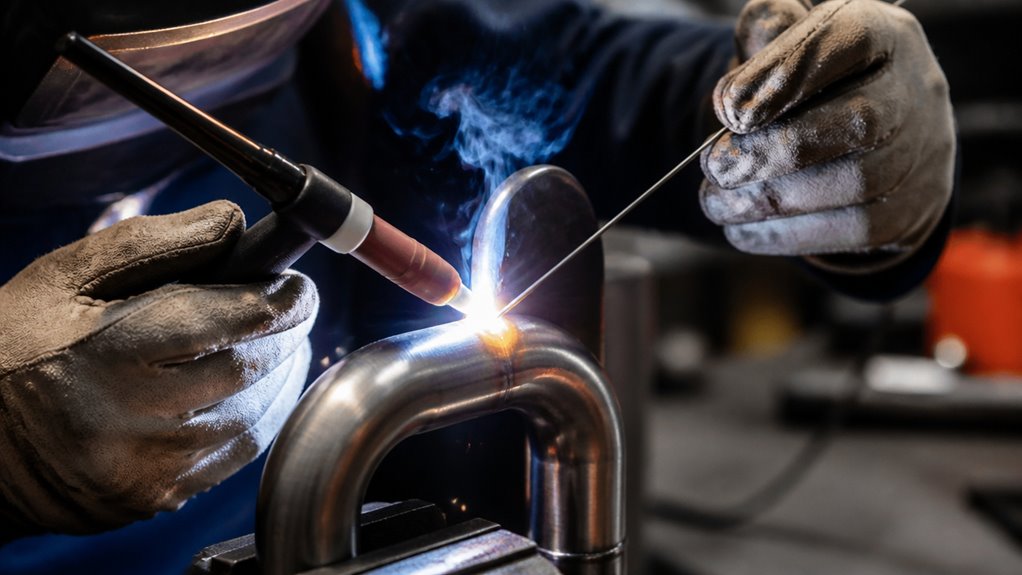
You’ll find TIG welding most effective when you need precise, clean welds on thin or contamination-sensitive metals.
It excels at minimizing burn-through and distortion by controlling heat input precisely, especially for materials like aluminum and stainless steel.
TIG’s stable arc and pure argon shielding guarantee minimal oxidation and high-quality welds.
You’ll also benefit from its fine amperage and torch angle adjustments to achieve peak bead profile and strength.
Explore how specific parameters unleash its full potential.
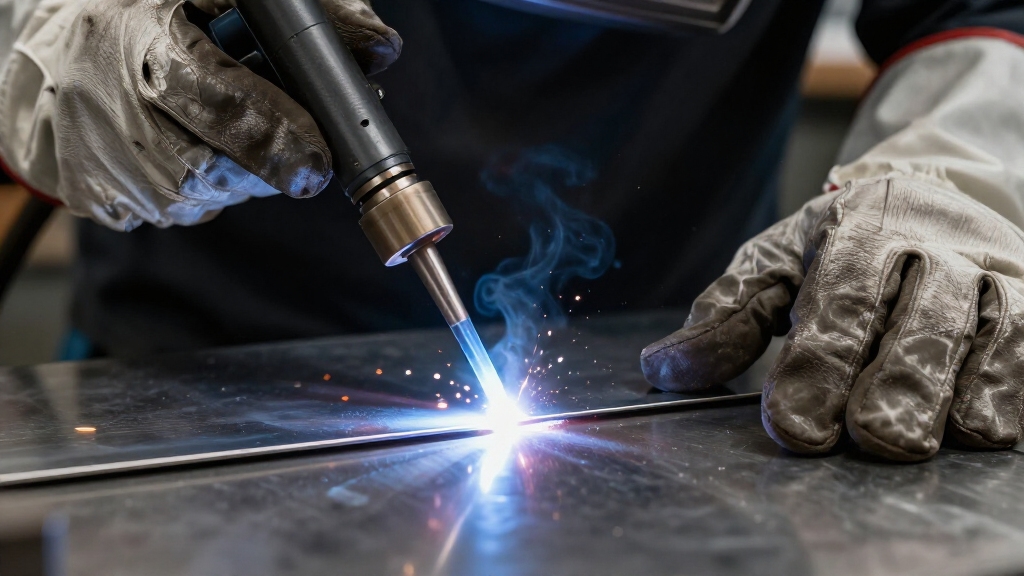
Welding thin materials demands precise heat control. TIG welding excels in this area by minimizing burn-through and distortion.
Precise heat control in TIG welding prevents burn-through and distortion in thin materials.
When working with thin plates around 5–6 mm, TIG allows you to maintain small, controlled weld pools. This is essential for delicate edge fit-up and narrow joints.
You can finely adjust amperage to match heat input exactly to the metal thickness, preventing overmelting. For example, research on 3 mm 5083 aluminum demonstrated optimal joint strength occurs within a narrow heat input range of 296–321 J/mm.
This emphasizes the criticality of parameter control. By keeping the arc stable and the weld pool minimal, you reduce thermal stress and warping.
This precision makes TIG welding the preferred method when handling thin metals that demand exact thermal management for sound, defect-free joints.
Proper tungsten electrode grinding is essential to maintain arc stability and achieve consistent heat control during welding.
Achieving clean, visually consistent weld seams demands the precise control that TIG welding provides. You’ll benefit from TIG’s short arc length and steady torch control, which improve bead consistency and minimize defects.
Maintaining a torch angle around 15–20 degrees optimizes the bead profile. Stable travel speed prevents underfill and excessive buildup.
TIG’s fine amperage adjustment lets you match heat input precisely, avoiding distortion or burn-through, especially on delicate joints. This control is vital when the finished weld remains visible and cosmetic quality is critical.
Unlike faster processes, TIG prioritizes appearance over speed. It enables you to create uniform, smooth welds with minimal spatter.
Proper torch angle and technique are essential to promote deeper penetration and maintain shielding gas coverage for optimal weld quality.
You’ll frequently find TIG welding chosen for projects demanding strict cleanliness and contamination control. You rely on TIG when welds must meet sanitary, radiographic, or pressure-code inspection standards.
Pure argon shielding protects the weld from oxidation. You guarantee base metals are free from rust, paint, oil, and coatings. You maintain draft-free conditions to prevent gas disturbance and porosity.
These factors combine to deliver weld integrity in contamination-sensitive environments. Using a TIG welder with AC balance adjustment allows for superior arc stability and oxide breaking, further enhancing weld quality in these settings.
| Factor | Requirement | Impact on Weld Quality |
|---|---|---|
| Shielding Gas | Pure Argon | Prevents oxidation |
| Base Metal Prep | Rust, oil, coatings removed | Avoids contamination |
| Environment | Draft-free | Guarantees stable shielding |
| Inspection Standards | Sanitary, radiographic | Demands high purity |
| Torch Control | Steady, precise | Minimizes porosity |
Although TIG excels with many metals, it’s particularly effective for aluminum, stainless steel, titanium, and copper alloys due to its precise heat control and shielding capabilities.
You’ll use AC current for aluminum to manage oxide layers effectively, while DC current suits stainless steel by providing stable penetration.
TIG’s inert argon shielding prevents oxidation, vital for reactive metals like titanium and copper alloys. The process allows fine control over heat input, minimizing distortion and preserving base metal properties.
By maintaining clean base metal surfaces and controlling torch angle and travel speed, you guarantee consistent bead quality and fusion.
TIG’s ability to manage filler addition precisely also supports complex alloy welds where mechanical properties and corrosion resistance depend on exact metallurgical conditions.
For optimal results, it is crucial to clean aluminum surfaces immediately before welding to prevent rapid re-oxidation that can compromise weld quality.
Fine-tuning TIG welding parameters like current, travel speed, and root gap directly influences weld strength and integrity.
You need to adjust amperage to match material thickness precisely, avoiding overmelting or insufficient fusion.
Maintaining a stable travel speed is critical; too fast causes underfill, while too slow increases heat input, risking distortion.
Managing the root gap, especially around 1.5 mm for certain alloys, optimizes joint penetration and mechanical properties.
Arc length and torch angle also affect bead consistency and shielding effectiveness, so steady torch control is essential.
Research shows controlled heat input in the 296–321 J/mm range yields superior joint performance for thin aluminum.
By systematically calibrating these parameters, you enhance tensile strength, toughness, and weld appearance.
This ensures stronger, defect-free welds tailored to your application’s demands.
Consistent practice over many hours is vital to develop the necessary muscle memory for precise control and defect-free welds.
Oh sure, just toss a robot in there and expect TIG welding to suddenly churn out flawless art like a factory assembly line!
In reality, automating TIG for high-volume production is challenging due to its precision and slow speed.
You can automate TIG, but it requires sophisticated torch control, precise parameter adjustment, and clean conditions.
It’s feasible for specialized, high-quality parts but rarely matches the speed or cost-efficiency of MIG or stick welding in mass production.
TIG welding generally costs more than MIG welding due to slower deposition rates and higher labor intensity.
You’ll spend more on skilled operators because TIG requires precise control and filler addition.
Equipment costs can also be higher with TIG’s advanced torches and power supplies.
However, TIG’s superior weld quality and precision can reduce rework and defects.
This potential reduction can offset initial expenses in applications demanding high appearance and structural integrity.
You must wear a face shield with proper UV protection since TIG welding emits intense ultraviolet light that can cause eye damage.
Use insulated gloves to prevent electric shock from the high-frequency start.
Make certain good ventilation because the argon gas and fumes can displace oxygen.
Avoid drafts to maintain shielding gas coverage but also prevent gas buildup.
Finally, keep flammable materials away due to the hot tungsten electrode and precise heat input.
TIG welding isn’t ideal for outdoor or windy conditions because even light airflow can disrupt the argon shielding gas, causing porosity and weld defects.
You need draft-free environments to maintain gas coverage and guarantee weld quality. If you must weld outside, consider windbreaks or enclosures to protect the shield gas.
Otherwise, TIG’s sensitivity to contamination and shielding loss makes it unsuitable for windy settings.
Imagine choosing the right key to open a precise, delicate lock. That’s how you select filler materials for TIG welding.
You’ll often use ER70S-2 for mild steel, ER4043 or ER5356 for aluminum, and ER308L for stainless steel. Each filler matches the base metal’s chemistry and heat tolerance, ensuring ideal fusion and mechanical strength.
Your choice must balance compatibility, melting point, and application specifics to achieve clean, defect-free welds.
When you choose TIG welding, you’re tapping into precision, control, and superior finish, especially with thin materials and contamination-sensitive metals like aluminum and stainless steel.
But here’s the catch: without optimizing your parameters, you risk weakening your welds and wasting time.
So, are you ready to master those settings and unleash the full potential of TIG welding?
Your next weld could make all the difference between a good job and a flawless, industry-leading result.
[…] optimal welding results, maintaining precise heat control is essential to minimize distortion and achieve superior weld […]