Phone:
(701)814-6992
Physical address:
6296 Donnelly Plaza
Ratkeville, Bahamas.

Phone:
(701)814-6992
Physical address:
6296 Donnelly Plaza
Ratkeville, Bahamas.

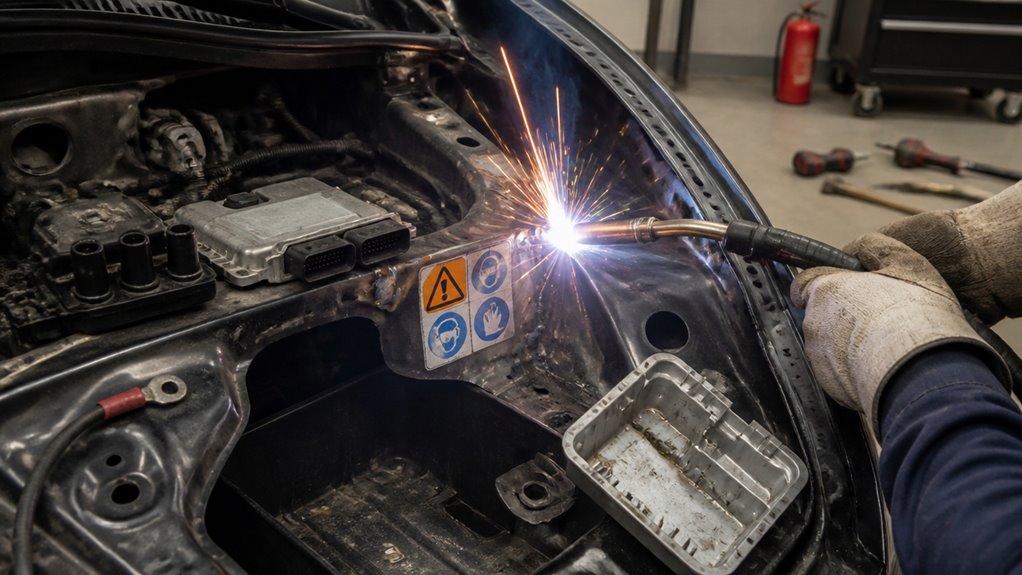
When welding on a vehicle, you should disconnect the negative battery terminal first. Then fully detach the positive terminal and isolate the battery away from the weld area.
Unplug all electronic modules and sensors within 300 mm of the weld zone. Completely isolate or remove the alternator to prevent back-fed current damage.
Safely disconnect fuel lines and ensure proper grounding close to the weld site on clean metal. Following these steps minimizes electrical and fire risks. Keep going to understand how to protect every system effectively.
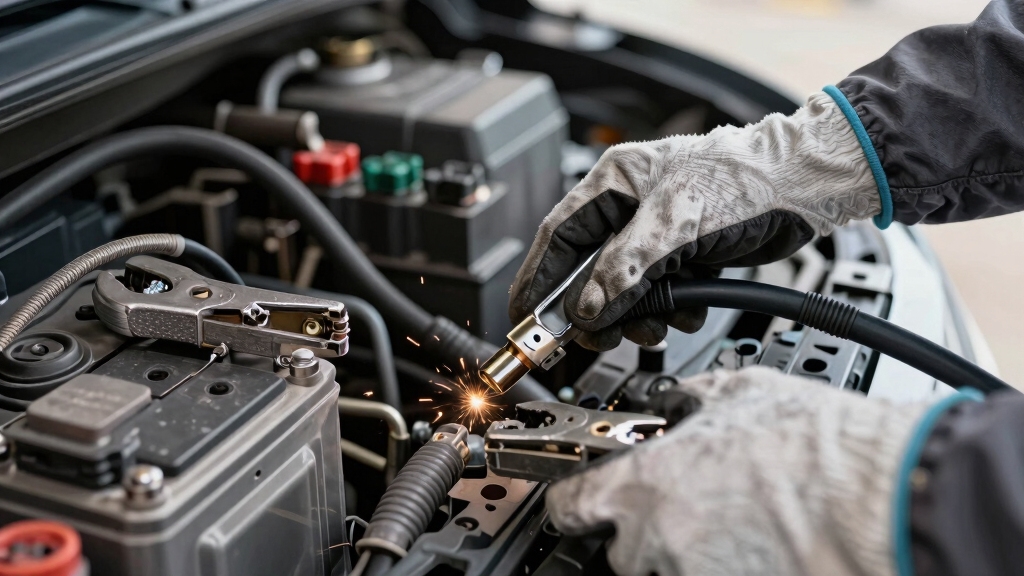
Before you start welding on your vehicle, disconnecting the battery safely is essential to prevent electrical shorts and protect sensitive components.
Begin by loosening and removing the negative battery terminal first to break the main power loop.
Then, detach the positive terminal completely, ensuring both cables are fully removed to create a total circuit break.
Tuck the negative cable away from the battery post to avoid accidental contact during welding.
If possible, remove and store the battery away from the welding area to isolate it from stray currents.
Remember, unhooking the battery doesn’t stop welding discharge but prevents current from flowing through electrical parts.
This reduces the risk of induced damage and electrical shorts that could compromise your vehicle’s systems.
Additionally, wearing insulated gloves and boots while disconnecting the battery further minimizes the risk of electric shock.
Once you’ve disconnected the battery to cut power, you need to protect the vehicle’s electronic modules and sensors from voltage spikes and electrical damage caused by welding currents. Unplug the ECU, ABS controllers, airbag modules, and any sensors within a 300 mm radius of the welding zone.
Label connectors to guarantee proper reassembly. Be especially cautious when welding near the dashboard, firewall, or safety systems.
Using appropriate circuit protection and sizing breakers correctly helps prevent nuisance trips that could lead to unexpected power interruptions affecting sensitive electronics.
| Component | Action | Distance from Welding Area |
|---|---|---|
| Engine Control Unit | Unplug and label | >300 mm |
| ABS/Airbag Modules | Disconnect | >300 mm |
| Sensors/Wiring | Remove or disconnect | >300 mm |
| Infotainment Systems | Unplug if near welding area | >300 mm |
| Seat Belt Sensors | Disconnect for safety | >300 mm |
This approach minimizes the risk of permanent electronic damage.
Isolating the alternator and charging system prevents welding currents from damaging critical components like the diode rectifier. To do this, disconnect the alternator’s positive output cable and ground strap completely.
Relying solely on battery disconnection won’t protect the alternator from back-fed welding current, which can destroy the diode rectifier, causing charging failure and battery drain. If accessible, remove the alternator entirely to guarantee full isolation from stray currents.
Disconnecting only the battery risks damaging the alternator; removing it ensures full protection from welding currents.
Always verify that no cables remain connected between the alternator and battery circuit before welding. This isolation prevents harmful voltage spikes and current flow through the charging system, safeguarding sensitive electronics and avoiding costly repairs.
Prioritize this step to maintain the vehicle’s electrical integrity during welding tasks. Additionally, using proper tools such as insulated spanners and pliers can help safely disconnect components without damaging sensitive electronics.
Protecting the vehicle’s electrical system from welding currents also means paying close attention to fuel lines near your work area.
Before welding, disconnect fuel lines running close to the weld site using line wrenches to avoid damaging connectors.
Always make certain fuel tanks and lines are empty to eliminate ignition risks from residual fumes.
After disconnecting, seal the open fuel lines tightly to prevent leaks and contamination.
If you must weld near the fuel tank, shield it with fire-resistant material to block sparks and heat.
Never weld near NVH foams, sealers, or adhesives around fuel lines, as they may ignite or melt, creating hazards.
These steps are critical to preventing fires and ensuring your welding process stays safe and controlled around fuel systems.
Additionally, ensure proper ventilation and use appropriate respiratory protection to avoid inhaling harmful welding fumes that can pose serious health risks.
When you ground the vehicle for welding, clamp the ground cable within 1 to 2 feet of the weld zone on clean, unpainted metal to guarantee a low-resistance path.
Position the clamp as close as possible to the weld site to minimize stray currents and reduce the risk of electrical damage.
Avoid grounding on painted or rusted surfaces, as they increase resistance and may cause current to flow through sensitive components like bearings or brake lines.
Never attach the ground on one side of a suspension while welding on the other. This prevents current from passing through critical parts.
Make certain the clamp contacts bare metal and secure it firmly to maintain consistent conductivity throughout the welding process. This safeguards vehicle electronics and structural integrity.
Regularly inspect clamps and cables for wear or damage to ensure reliable grounding and prevent welding issues.
Yes, you should remove interior trim and moldings near the welding area. Doing so eliminates fire hazards from combustible materials and prevents damage from sparks or heat.
If removal isn’t possible, cover glass and sensitive surfaces with spark-resistant materials to avoid cracking or melting.
Always clear foams, sealers, and inserts as well, ensuring a safer welding environment and protecting your vehicle’s interior from potential fire or heat damage.
To protect glass near the welding zone from heat damage, cover it with spark-resistant material designed to withstand high temperatures.
Remove surrounding moldings and trim to reduce heat conduction. If removal isn’t possible, use heat shields or fire blankets to shield the glass surface.
Make certain the protective layer fully covers vulnerable areas to prevent cracking or shattering caused by sparks or radiant heat during welding operations.
Yes, welding can severely affect NVH foams and adhesives by causing them to melt, ignite, or release toxic fumes.
You should always remove these materials from the welding area to prevent fire hazards and contamination.
If removal isn’t possible, make sure you shield them with fire-resistant barriers.
Protecting these components preserves vehicle safety and structural integrity while maintaining a clean and controlled welding environment.
You should use fire-proof materials like welding blankets made from fiberglass or ceramic fibers to shield the fuel tank during welding.
These materials resist high temperatures and prevent sparks or molten metal from igniting fuel vapors.
Avoid combustible coverings, as they increase fire risk. Proper shielding minimizes heat transfer and protects the tank’s integrity, ensuring your safety.
Always confirm the shielding fully covers the tank and surrounding areas near the weld zone.
You should attach the welding ground clamp within 1 to 2 feet of the weld site on clean, unpainted metal.
Keeping it close minimizes resistance and stray currents, protecting sensitive components.
Make sure the clamp contacts bare metal to avoid current flowing through bearings or electronics.
Positioning the clamp properly reduces the risk of damage to brake lines, suspension, or wiring, ensuring a safer and more effective welding process.
When welding on your vehicle, disconnecting the battery and protecting electronic modules are absolute musts. You don’t want to fry your expensive sensors.
Always isolate the alternator and charging system to prevent sparks from turning your car into a fireworks show. Handle fuel lines with extreme care, and make certain proper grounding to avoid shocks or damage.
Following these steps precisely isn’t just smart; it’s the difference between a safe repair and a catastrophic disaster. Stay safe and weld wisely!