Phone:
(701)814-6992
Physical address:
6296 Donnelly Plaza
Ratkeville, Bahamas.

Phone:
(701)814-6992
Physical address:
6296 Donnelly Plaza
Ratkeville, Bahamas.

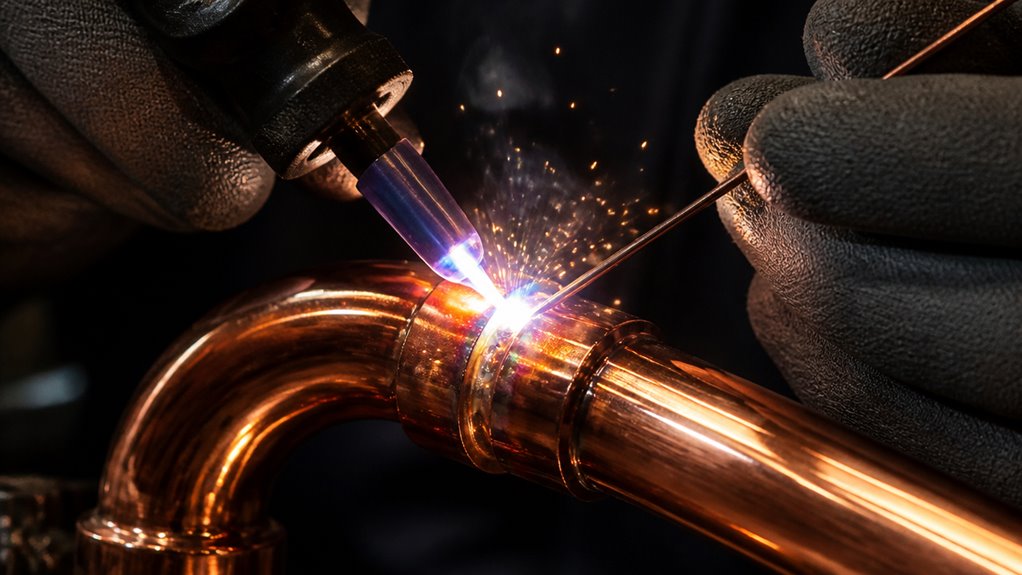
You should use helium or an argon-helium blend for TIG welding copper because copper’s high thermal conductivity quickly dissipates heat. This requires greater input for stable, deep welds.
Helium raises arc temperature and penetration, enabling faster welding speeds and reducing lack-of-fusion defects, especially on thicker sections.
Pure argon suits thin copper, but as thickness increases beyond 2 mm, helium blends and preheating become essential to maintain weld quality and consistency.
Understanding gas selection and preheat strategies will further enhance your results.
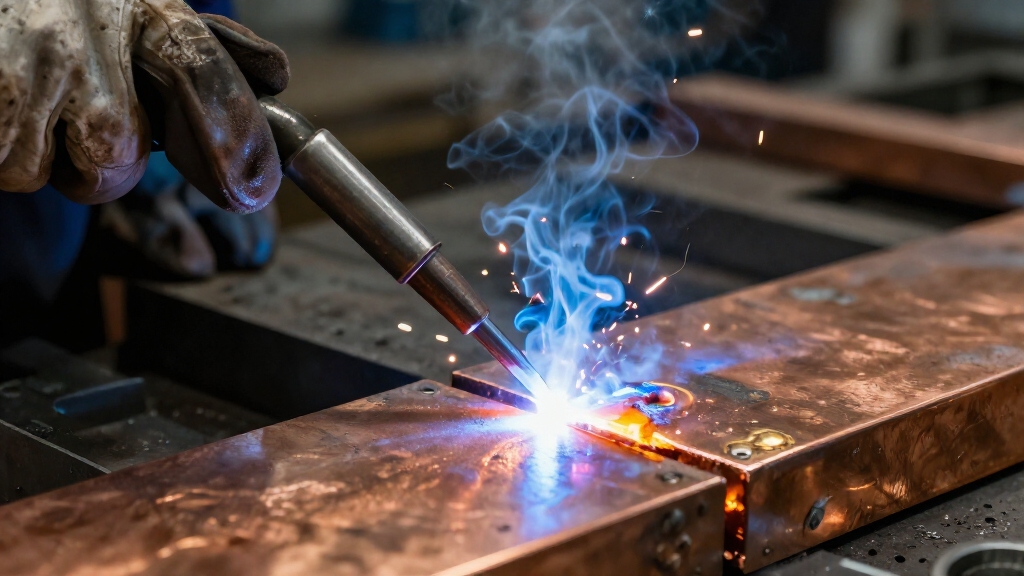
Copper’s high thermal conductivity consistently challenges TIG welding. It rapidly dissipates heat away from the weld zone, forcing you to apply higher heat input compared to many other metals.
Using pure argon as a shielding gas works for thin sections. However, as copper thickness increases, argon’s relatively low arc voltage and heat concentration limit fusion quality.
To compensate, you need shielding gases that deliver higher arc voltage and hotter heat distribution. This maintains weld pool stability and penetration.
Additionally, preheating thicker copper sections becomes essential to reduce thermal gradients and avoid cracking. Understanding this heat flow dynamic is critical because it directly influences your weld parameters, shielding choice, and overall weld integrity when working with copper in TIG applications.
Employing a 75% helium and 25% argon gas mix enhances heat concentration and stabilizes the arc for improved weld quality in copper TIG welding.
When you’re welding copper, you quickly realize that as the material gets thicker, the heat requirements ramp up too. This makes choosing the right shielding gas super important. You know, argon might do the job for thinner pieces, but once you hit around 2 mm, it often doesn’t cut it anymore.
That’s where incorporating helium or argon-helium blends comes into play. These gases help boost the arc temperature and improve penetration, which is crucial for those thicker sections. So, keeping these heat demands in mind can really help you optimize your shielding gas selection, ensuring you get reliable fusion and top-notch weld quality.
Meeting the increasing heat demands of copper welding challenges your choice of shielding gas, especially as thickness grows beyond 2 mm.
Copper’s high thermal conductivity rapidly dissipates heat, forcing you to supply greater arc energy to maintain weld pool stability and achieve full penetration.
Pure argon often falls short here, as its lower arc voltage and heat output can’t compensate for copper’s heat sink effect.
You’ll find helium or argon-helium blends essential because helium’s higher ionization potential and thermal conductivity generate a hotter, more focused arc.
This intensification raises weld pool temperature and depth of fusion, vital for thicker sections where lack of fusion risk escalates.
Additionally, preheating and increased welding current complement helium’s heat contribution, ensuring consistent, defect-free welds on demanding copper joints.
Using 100% argon shielding gas is typically recommended for aluminum but less effective for copper’s heat requirements.
Selecting the right shielding gas critically influences your TIG welding results on copper, especially as thickness increases. For thin copper (under 2 mm), pure argon provides adequate arc stability and heat input.
However, as thickness surpasses 2 mm, argon-helium blends become essential. Helium’s higher thermal conductivity raises arc voltage and heat, improving fusion and penetration on thicker sections.
While pure helium delivers maximum heat, it complicates arc initiation, so blends containing 25% to 75% helium are preferred for balanced performance. Using an argon/75% helium mix with appropriate preheat and increased current optimizes weld quality for copper above 5 mm.
You should avoid defaulting to helium for all copper TIG welding. Instead, tailor shielding gas selection to thickness and heat demand for best outcomes.
Proper shielding gas flow rates must be optimized to prevent contamination and maintain arc stability.
When you’re picking a shielding gas for copper TIG welding, it’s important to consider things like the thickness of the metal and its thermal conductivity.
For thinner copper, pure argon usually does the trick.
But as the thickness increases, you might want to switch to helium or an argon-helium blend. These options offer higher heat input and better fusion.
By understanding these factors, you can really optimize your weld. It helps with penetration, keeps the arc stable, and ultimately improves the overall quality of your weld.
Using argon-helium mixtures also helps counter copper’s rapid heat dissipation and ensures more consistent weld quality.
In copper TIG welding, choosing between helium and argon hinges largely on the material thickness and heat requirements of your project.
Argon suits thin copper up to about 2 mm, offering stable arc initiation and adequate heat.
Beyond this, you’ll benefit from helium or argon-helium blends that increase arc voltage and thermal conductivity, delivering the higher heat input copper demands.
Pure helium raises arc temperature but complicates arc starting, so blends (25–75% helium) strike a practical balance.
Your gas choice directly impacts weld penetration, fusion quality, and travel speed.
Remember, helium enhances heat distribution, improving weld pool size and depth, especially on thicker sections.
Therefore, evaluate your copper thickness and heat needs precisely before selecting argon, helium, or a tailored blend for peak TIG weld performance.
Typical flow rates when using helium blends are higher due to helium’s lighter density, which increases gas consumption and cost.
Although argon works well for thin copper sections, you’ll need helium or argon-helium blends as thickness increases beyond about 2 mm to maintain weld quality.
Copper’s high thermal conductivity demands higher heat input to achieve proper fusion, which pure argon struggles to provide on thicker joints.
Incorporating helium raises arc voltage and thermal conductivity, producing a hotter, broader arc that penetrates deeper.
Argon-helium blends, commonly ranging from 25% to 75% helium, balance arc stability and heat output, making them preferable to pure helium for thicknesses above 2 mm.
As thickness increases, preheating and welding current must also rise to complement shielding gas effects.
Ignoring these parameters risks incomplete fusion and weld defects, so carefully selecting helium concentration based on copper thickness is critical for consistent, high-quality TIG welds.
Preheating copper to around 650°F is recommended for sections thicker than about 1/2 inch to reduce thermal gradients and oxidation, ensuring better weld integrity and reducing the heat-affected zone.
Choosing helium as a shielding gas markedly enhances TIG welding performance on copper by increasing arc heat and improving penetration.
Because copper rapidly dissipates heat, helium’s higher thermal conductivity generates a hotter, broader arc that compensates for copper’s heat loss.
This results in deeper fusion and a more stable weld pool, especially on thicker sections. Helium also enables higher travel speeds and reduces the risk of lack-of-fusion defects.
While pure argon suffices for thin copper, helium or argon-helium blends become essential as thickness increases beyond approximately 2 mm.
Blends balance helium’s heat benefits with argon’s easier arc initiation and stability.
Consequently, using helium strategically improves welding quality and efficiency on copper, particularly for demanding, thick-section joints where conventional argon shielding falls short.
Additionally, helium’s physical properties contribute to effective plasma plume suppression, enhancing laser energy absorption and weld quality.
Harnessing argon-helium blends enhances copper TIG weld quality by balancing arc stability with increased heat input.
When you weld copper thicker than about 2 mm, pure argon struggles to deliver sufficient penetration due to copper’s high thermal conductivity.
By adding helium, typically 25% to 75%, you raise arc voltage and thermal energy, producing a hotter, broader arc.
This improves fusion depth and reduces lack-of-fusion defects.
At the same time, argon maintains easier arc initiation and stability, preventing the erratic behavior that pure helium often causes.
You’ll notice smoother weld pools and faster travel speeds with these blends, especially in thicker sections.
Consequently, argon-helium mixtures enable you to optimize heat input precisely, ensuring consistent weld quality on demanding copper joints without sacrificing control.
For optimal shielding, maintaining a gas purity of 99.99% argon or better is essential to prevent oxidation and weld contamination.
While argon-helium blends provide a balanced approach to welding copper, pure helium alone presents challenges that often make it less practical for TIG applications.
You’ll find pure helium complicates arc initiation, reducing ease and consistency compared to argon-containing mixes. This can affect weld quality and operator control.
Additionally, pure helium’s higher ionization potential demands increased voltage, straining power sources. Consider these factors:
Therefore, while pure helium boosts heat, its operational drawbacks usually steer you toward argon-helium blends for efficient, reliable TIG copper welding. Using argon–helium mixtures can also enhance plasma suppression and improve overall weld quality.
Helium markedly elevates the arc temperature during TIG welding, directly enhancing heat input and weld penetration on copper.
Because helium’s thermal conductivity is roughly ten times that of argon, it produces a hotter, more concentrated arc, which counters copper’s rapid heat dissipation.
This intensified arc heats a broader weld pool, allowing deeper fusion and reducing lack-of-fusion defects. You’ll find that helium also improves the penetration profile, enabling better joint integrity, especially on thicker copper sections.
Additionally, the elevated arc temperature supports higher welding speeds without compromising weld quality, increasing productivity.
Using helium or argon-helium blends optimizes the welding parameters by balancing heat input, penetration depth, and travel speed, vital when welding copper with its high thermal conductivity demands.
Argon’s high ionization energy helps stabilize the arc when blended with helium, ensuring consistent weld quality and smooth arc starts.
Balancing shielding gas selection with appropriate preheat temperatures directly influences the quality and efficiency of TIG welding copper. You’ll need to adjust your approach based on copper thickness to optimize fusion and penetration.
This calibrated gas and preheat strategy improves weld consistency and minimizes defects.
Mastering the interplay between arc stability and heat input is crucial when TIG welding copper due to its exceptional thermal conductivity.
You must select a shielding gas that balances these factors. Pure argon offers stable arc initiation but limited heat, which is adequate for thin copper.
Selecting the right shielding gas is key—pure argon ensures stable arcs but suits only thin copper.
As thickness increases beyond 2 mm, incorporating helium raises arc voltage and heat, enhancing penetration and fusion.
However, pure helium compromises arc stability and starting ease. Therefore, argon-helium blends (25% to 75% helium) provide the best control.
Adjust your welding current and preheat according to thickness to maintain a stable arc while delivering sufficient heat.
This balance minimizes defects like lack of fusion without sacrificing weld quality or process consistency.
It ensures effective fusion in copper’s challenging thermal environment.
Helium itself doesn’t directly affect the color or surface appearance of copper welds.
Instead, it influences arc heat and penetration, which can improve weld bead shape and fusion quality.
However, if you use helium to increase heat, you might see slight oxidation or discoloration from higher temperatures unless you carefully control shielding gas coverage and post-weld cleaning.
Imagine helium as a silent, invisible river flowing through your workspace, harmless in sight but demanding respect.
When you use helium shielding gas, you must guarantee proper ventilation to avoid asphyxiation risks since helium displaces oxygen.
Always check for leaks, use gas detectors, and secure cylinders to prevent tipping.
Wear appropriate PPE and follow storage guidelines rigorously.
These precautions keep your environment safe and maintain welding integrity under high heat.
Using helium in TIG welding raises arc voltage and heat input, which can accelerate wear on tungsten electrodes and consumables.
You’ll notice faster electrode erosion and potentially increased torch component stress due to hotter arcs.
However, proper maintenance, correct electrode selection, and adjusted welding parameters can mitigate these effects.
Like a rare gem, helium costs considerably more than argon. When you choose helium for welding, expect expenses to rise due to its scarcity and production complexity.
Argon is more abundant and cheaper, making it the economical choice for most TIG applications. You’ll find helium priced roughly three to five times higher, impacting your budget especially on large projects.
Weigh the enhanced weld quality against this cost difference carefully.
Yes, you can use helium shielding gases for other copper alloys, especially those with high thermal conductivity like copper-nickel or beryllium copper.
Helium enhances heat input and penetration, which helps weld thicker or demanding copper alloys effectively.
However, you should adjust gas blends and welding parameters based on the specific alloy’s properties.
Some may require more precise control of arc stability and heat distribution to avoid defects or distortion.
When TIG welding copper, helium acts as the torch’s secret weapon, unleashing deeper penetration and faster weld speeds thanks to copper’s high thermal conductivity.
While pure helium isn’t always the go-to, blending it with argon balances arc stability and heat effectively.
By understanding when and how to use helium or argon-helium mixes, you’ll control the weld pool like a conductor, orchestrating precise, strong copper joints every time.