Phone:
(701)814-6992
Physical address:
6296 Donnelly Plaza
Ratkeville, Bahamas.

Phone:
(701)814-6992
Physical address:
6296 Donnelly Plaza
Ratkeville, Bahamas.

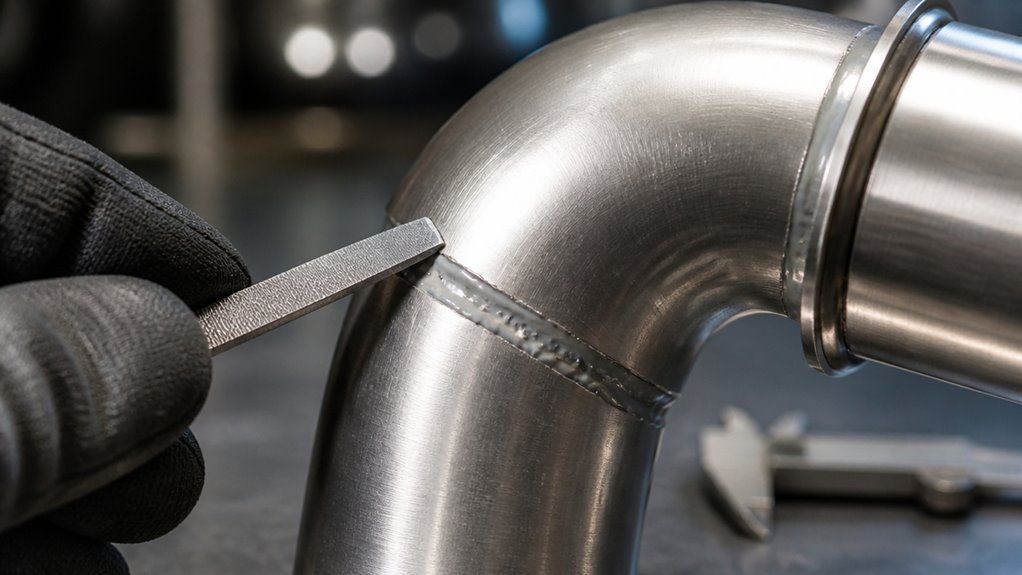
You can use J-B Weld on stainless steel effectively for non-structural repairs like filling cracks or sealing holes. It achieves up to 5,020 PSI tensile strength with proper surface preparation.
It works well when you can clean, abrade, and degrease the metal. Then mix and apply the epoxy evenly without heat.
Avoid using it for high-pressure or high-stress areas requiring welding. Understanding the right conditions and process will enhance your repair’s durability and performance.
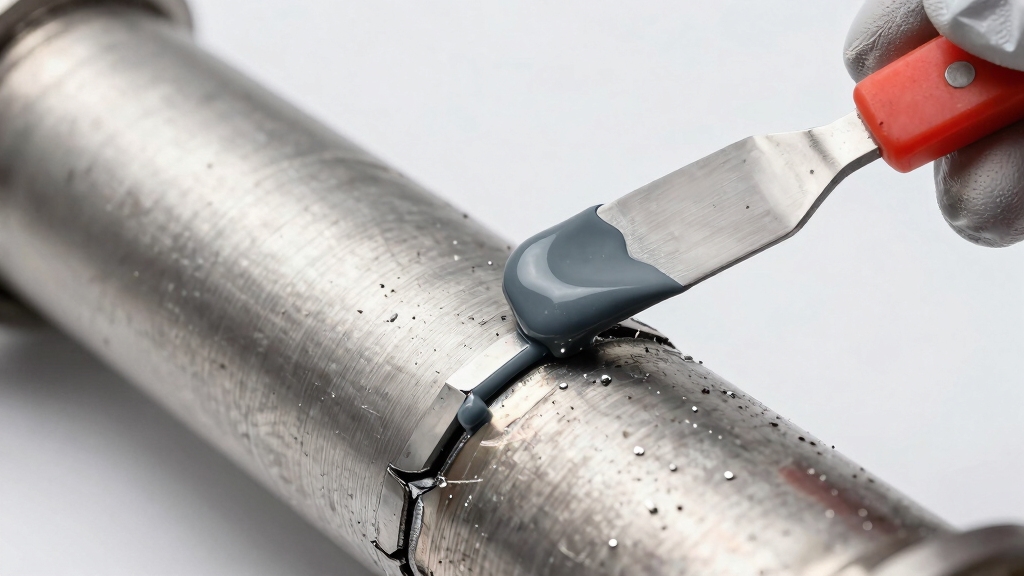
Choosing J-B Weld for stainless steel repairs offers a practical solution when traditional welding isn’t feasible.
Opting for J-B Weld provides an effective fix when conventional welding methods can’t be used.
You rely on its two-part epoxy chemistry to create a strong mechanical bond without melting the metal.
J-B Weld SteelStik, rated for stainless steel, delivers up to 5,020 PSI tensile strength.
This makes it suitable for non-structural repairs like filling cracks or sealing holes.
You must prepare surfaces by removing the passive oxide layer and degreasing for peak adhesion.
Unlike welding, J-B Weld doesn’t require heat, minimizing distortion risks and expanding repair options in confined or sensitive environments.
Its ability to cure at room temperature and withstand moderate temperatures up to 350°F makes it versatile for various industrial and household applications.
This provides an effective alternative when welding is impractical or impossible.
However, proper surface preparation and full curing time are critical to achieving maximum bond strength and durability, especially under thermal stress and mechanical vibration, as inadequate prep can cause adhesion failure.
When should you rely on J-B Weld for stainless steel repairs, and when is it better to avoid it?
Use J-B Weld for moderate mechanical stress repairs like sealing cracks or holes in pipes, tanks, or bonding where welding isn’t feasible.
It’s ideal for non-structural applications with temperature exposure up to 350°F, especially when you can properly prepare the surface by removing the passive oxide layer and degreasing.
Avoid J-B Weld in high-pressure or high-stress environments such as hydraulic or steam lines, where metallurgical fusion from TIG or MIG welding is necessary.
Also, skip it if you can’t guarantee rigorous surface preparation, as contamination or smooth surfaces compromise adhesion.
For best results, ensure you clean and roughen surfaces thoroughly before application to maximize bonding strength and durability.
Making certain a durable bond with J-B Weld on stainless steel starts with meticulous surface preparation.
Ensuring a lasting bond with J-B Weld on stainless steel begins with careful surface preparation.
Begin by mechanically abrading the surface using 80- to 120-grit sandpaper in a cross-hatch pattern to remove the passive oxide layer and create visible scratches.
This increases surface area, enhancing mechanical adhesion. After sanding, thoroughly degrease the area with pure acetone or 99% isopropyl alcohol to eliminate oils that inhibit bonding.
Follow with a secondary cleaning to remove residual metal dust, which could act as a barrier.
Finally, confirm the surface is completely dry before proceeding.
Skipping any step compromises the epoxy’s ability to form a strong mechanical lock with the stainless steel, reducing bond strength and durability.
Proper preparation is critical for peak J-B Weld performance on stainless steel surfaces.
Ensure to apply the mixed epoxy promptly after preparation to prevent premature setting and ensure peak bond strength.
To achieve a reliable bond with J-B Weld on stainless steel, mix equal parts of resin and hardener by volume, ensuring a 1:1 ratio.
Knead or stir the components thoroughly until the mixture is uniform grey with no streaks, typically requiring at least one full minute.
Apply a thin, even layer on both surfaces, filling microscopic scratches created during abrasion to maximize adhesion.
Avoid thick layers to prevent weak spots or incomplete curing.
Follow these steps precisely:
For best results, ensure the stainless steel surface is thoroughly cleaned and mechanically roughened to remove rust and contaminants before application, as this prepares the metal for the strongest adhesion bond strength.
After mixing and applying J-B Weld properly on your stainless steel surfaces, understanding its curing time is critical for achieving maximum bond strength.
The Original J-B Weld formula sets within 4 to 6 hours but requires a full 15 to 24 hours to reach peak tensile strength of 5,020 PSI.
The Original J-B Weld sets in 4 to 6 hours and gains full strength after 15 to 24 hours.
Applying stress before this period compromises the bond’s integrity.
SteelStik cures faster, setting in 5 minutes and allowing light machining after 60 minutes, but full curing benefits from overnight hardening.
Note that curing duration varies with epoxy thickness and environmental factors like temperature and humidity.
To guarantee optimal mechanical adhesion, maintain a controlled environment and avoid disturbing the repair until the recommended curing period elapses.
This ensures a durable, structurally sound bond on stainless steel.
Proper surface preparation and heat curing can significantly improve bond strength and reduce curing time.
Yes, you can paint and finish J-B Weld on stainless steel to match surrounding surfaces.
After full curing, especially with SteelStik, the epoxy can be machined, ground, and filed to achieve a smooth profile.
Use compatible primers and paints designed for metal to guarantee adhesion and color matching.
Proper surface preparation and curing are critical for peak finish quality and durability, preventing peeling or mismatched appearance in your repair.
You might worry about J-B Weld’s safety in food processing, but it’s not FDA-approved for direct food contact.
While it bonds stainless steel effectively, you shouldn’t use it where it touches food or potable water. Its chemical components can leach contaminants if exposed.
Instead, reserve it for external repairs or non-contact areas. For food-safe applications, choose certified food-grade adhesives or welding methods specifically designed for sanitary environments.
You’ll find J-B Weld SteelStik withstands temperatures up to 350°F on stainless steel repairs, making it suitable for moderate heat exposure.
The Original Cold-Weld formula tolerates lower temperatures but offers higher tensile strength.
Avoid exceeding these limits, as extreme heat can degrade the epoxy’s chemical bond and reduce durability.
For your repair, confirm temperature conditions stay within these specifications to maintain structural integrity and long-term performance.
Yes, J-B Weld can withstand outdoor weather conditions on stainless steel if you properly prepare the surface and allow full curing.
Its epoxy bond resists moisture, temperature fluctuations, and UV exposure to a degree, especially SteelStik, which tolerates up to 350°F.
However, prolonged exposure to extreme elements may degrade the adhesive over time.
For best durability outdoors, guarantee thorough surface abrasion, degreasing, and curing before subjecting the repair to weather.
To remove cured J-B Weld from stainless steel, start by carefully applying heat with a heat gun to soften the epoxy without damaging the metal.
Then, use a plastic scraper or putty knife to gently lift and peel off the softened epoxy.
For residual traces, apply a commercial epoxy remover or acetone, ensuring you wipe thoroughly with a clean cloth.
Always work cautiously to avoid scratching or etching your stainless steel surface.
When repairing stainless steel, J-B Weld offers a reliable bond if applied correctly.
Remember, preparation is key to success. Avoid using it on high-stress or heat-exposed areas where welding might be better.
By meticulously cleaning and mixing the epoxy, you guarantee peak adhesion and durability.
With proper curing time, J-B Weld can provide a strong, lasting repair, making it a valuable tool in your stainless steel maintenance toolkit.