Phone:
(701)814-6992
Physical address:
6296 Donnelly Plaza
Ratkeville, Bahamas.

Phone:
(701)814-6992
Physical address:
6296 Donnelly Plaza
Ratkeville, Bahamas.

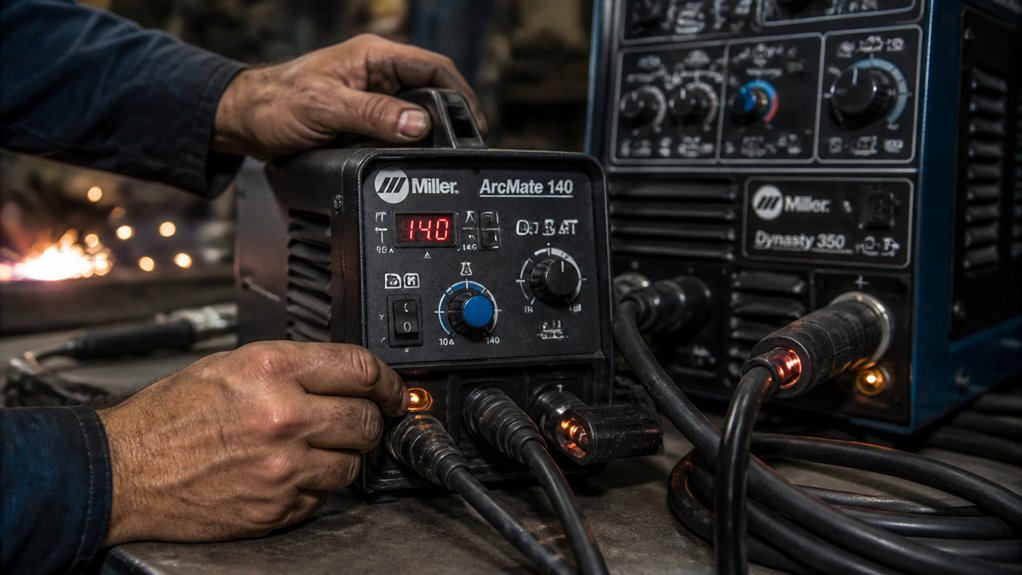
You use secondary power in welding to supply low-voltage, high-amperage current essential for generating and maintaining the welding arc.
This output comes from the transformer’s secondary winding, stepping down voltage while increasing current to optimize heat and arc stability.
Secondary power settings vary by process, balancing voltage and current to control penetration and bead quality safely.
Understanding these fundamentals equips you to tailor power precisely for effective, consistent welds and improved process performance.
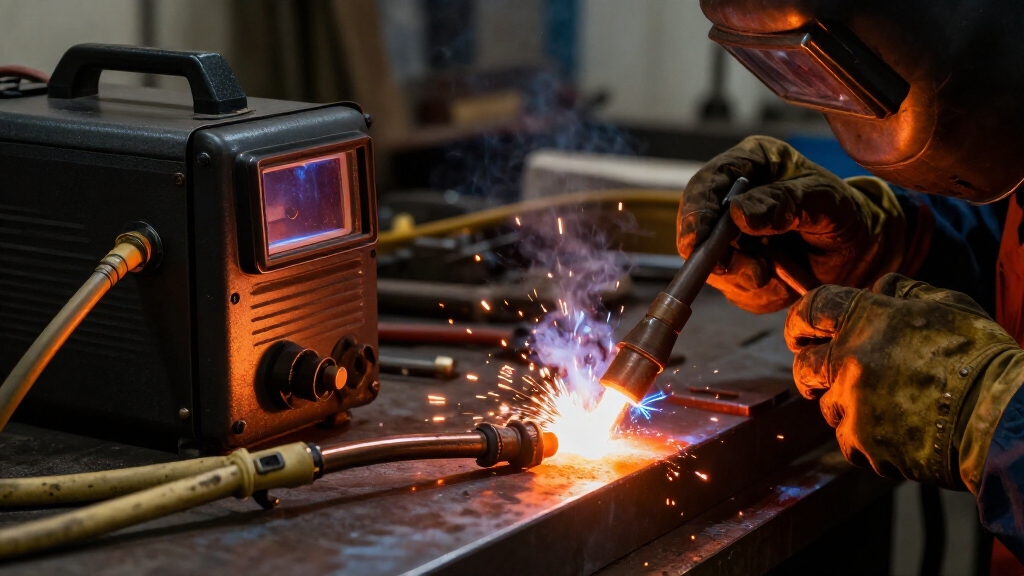
Although you mightn’t see it directly, the secondary power in welding plays a crucial role by delivering the actual energy that forms the weld.
Secondary power in welding quietly delivers the essential energy that creates a strong, lasting weld.
You rely on the secondary circuit, the low-voltage, high-amperage output side of the welding machine, to supply current to the electrode, arc, and workpiece.
This circuit includes the output terminals, leads, electrode, arc, and return path, engineered to handle substantially higher current than the input side.
Unlike primary power from the wall, secondary power operates at reduced voltage but increased amperage, making it the true welding energy source.
Understanding this distinction helps you appreciate that secondary power is the functional output that sustains the welding arc and directly impacts weld quality and performance.
The secondary voltage is stepped down through the turns ratio of the transformer to achieve the necessary low voltage and high current needed for effective welding.
Transformers convert primary electrical power into the secondary power needed for welding by employing electromagnetic induction.
The transformer’s primary winding receives high-voltage input from the power supply, creating a magnetic field in the core.
This magnetic flux induces a voltage in the secondary winding, which is magnetically coupled but electrically isolated from the primary.
The secondary winding has fewer turns than the primary, stepping down voltage while increasing current.
This low-voltage, high-amperage output is essential for sustaining the welding arc.
By adjusting the turns ratio and magnetic coupling, you control the secondary power characteristics.
The secondary circuit, designed for heavy current loads, delivers energy directly to the electrode and workpiece.
This enables efficient heat generation and stable arc performance during welding.
Adjusting transformer taps allows welders to fine-tune the secondary voltage and current to match specific welding needs.
You’ll find that typical secondary voltages usually range from about 15 to 80 volts, but this can vary based on the welding process and equipment you’re using. It’s interesting to note how these voltage levels play a crucial role in the overall performance of the welding process.
When it comes to current capacity, there’s quite a range. For light-duty machines, you might see around 20 amps, while heavy industrial systems can push that number up to 600 amps or even more. This variation really highlights how different applications can demand different setups.
All these voltage and current levels have a direct impact on arc stability, heat input, and ultimately, the quality of the weld. So, understanding these figures is key to achieving the best results in your welding projects. The relationship between amperage and voltage directly affects heat input, which is critical for controlling weld penetration and bead profile.
When you examine the voltage ranges on the secondary side of welding machines, you’ll find they typically span from about 15 to 80 volts, depending on the welding process and specific equipment used.
This low-voltage output is essential for sustaining the welding arc while ensuring operator safety.
Open-circuit voltage, or no-load voltage, often ranges between 50 and 100 volts, influencing arc initiation without current flow.
The voltage level directly affects arc length and stability; too low can cause arc extinction, while too high may lead to excessive spatter.
Transformer design and secondary winding configurations determine these voltage parameters, balancing the need for adequate energy transfer with safety limits.
Understanding these voltage ranges helps you optimize welding performance and equipment settings precisely.
Advanced transformer technology in welding equipment plays a key role in controlling these voltage and current outputs efficiently.
Besides voltage, the current capacity on the secondary side plays a defining role in welding performance. You’ll find that secondary current ranges typically span from 20 amps in light-duty machines to 600 amps or more in heavy industrial welders. This high current output is necessary to generate sufficient heat for effective welding.
The transformer’s design, including winding configuration and magnetic shunt adjustments, directly influences these current levels.
| Typical Secondary Voltage (V) | Typical Secondary Current (A) |
|---|---|
| 15 – 25 | 20 – 100 |
| 25 – 40 | 100 – 300 |
| 40 – 60 | 300 – 600 |
| 60 – 80 | 600 – 1000+ |
Maintaining a proper cable gauge that matches the welder’s current rating is essential to prevent voltage drop and overheating during welding operations.
The secondary power voltage and current directly shape the welding arc’s characteristics, influencing its stability and effectiveness.
You’ll find secondary voltage typically ranges from 15 to 80 volts, while current spans from 20 amps in light-duty setups to over 600 amps in heavy industrial machines.
Voltage primarily controls arc length, affecting bead width and weld pool shape. Maintaining appropriate voltage guarantees consistent arc stability.
Current dictates heat input and penetration depth, enabling you to adjust weld quality precisely.
Keep in mind the secondary circuit behaves as a low-voltage, high-current loop. Its impedance governs the actual current flow, following Ohm’s law.
Understanding these voltage and current levels helps you optimize arc performance and achieve desired weld characteristics efficiently and safely.
Balancing voltage and amperage is essential to maintain proper penetration and stable arc conditions for high-quality welds.
You know, when it comes to starting the welding arc, secondary power voltage plays a crucial role. It helps overcome the circuit’s resistance and ionizes that air gap. It’s like giving the arc a little push to get going.
Once the arc is up and running, the current takes over. This is where things get interesting! The current controls the heat input, which directly impacts penetration and overall weld quality.
Modern inverter welding machines enable rapid current adjustments and microsecond output regulation for precise arc control that improves weld stability and quality.
Initiating the welding arc requires a precise voltage level from the secondary power circuit to overcome the gap between the electrode and workpiece.
This voltage, known as the arc initiation voltage, must be sufficient to ionize the air and create a conductive plasma channel.
Typically, the secondary circuit delivers an open-circuit voltage between 15 and 80 volts, depending on the welding process and equipment.
When you strike the arc, this voltage quickly drops as current flows, sustaining the arc.
If the voltage is too low, you’ll struggle to start the arc; too high, and you risk unstable operation or excessive spatter.
Understanding and controlling arc initiation voltage is critical because it directly influences arc stability and weld quality by ensuring consistent arc ignition every time.
The welding power supply plays a key role in providing and regulating this voltage to maintain arc stability throughout the welding process.
Understand that current in the secondary circuit directly controls the heat generated during welding, profoundly affecting penetration and weld quality.
The welding current determines the rate of energy transfer through the arc, influencing the weld pool’s temperature and size.
Higher secondary current increases heat input, enabling deeper penetration and stronger fusion between materials but risks excessive melting or burn-through if not controlled.
Conversely, lower current reduces heat, producing a narrower, shallower weld bead suitable for thin materials.
Because the secondary circuit operates at low voltage and high amperage, you can precisely adjust current to match the welding task.
This control over heat through current modulation is essential for achieving consistent weld integrity, optimizing bead shape, and preventing defects such as porosity or incomplete fusion.
Proper arc length control complements current adjustment by stabilizing the arc and ensuring consistent heat distribution during welding.
Although the open-circuit voltage (OCV) in welding equipment is lower than the primary supply voltage, it plays a critical role in safety. It represents the voltage present at the output terminals when no welding arc is established.
You need to understand OCV’s safety implications since it remains live even when the arc is off.
Consider these points:
Because electric shock risk increases with factors like wet conditions and damaged cables, operators must always ensure proper grounding and cable integrity to reduce electric shock hazards.
Because secondary power directly controls the electrical conditions at the welding arc, it plays a vital role in determining both weld quality and arc stability.
You rely on the secondary voltage to set the arc length, which impacts bead shape and penetration. The secondary current governs heat input, influencing fusion and weld integrity.
Stable arc conditions depend on consistent secondary output. Fluctuations in voltage or current can cause arc blow, spatter, or inconsistent bead profiles.
The secondary circuit’s low voltage and high current design guarantees sufficient energy delivery while maintaining control over the arc characteristics.
Maintaining stable arc conditions and weld quality requires tailoring secondary power to the specific welding process in use. You need to adjust voltage and current precisely to control heat input, arc length, and penetration.
Consider these key adjustments:
Each process demands specific secondary power tuning to optimize weld integrity and arc stability.
In AC welding machines, secondary power alternates polarity, causing the current and voltage to cycle sinusoidally. This affects arc stability and heat input.
DC welding machines provide constant polarity and steady current. This offers more consistent arc characteristics and deeper penetration.
You’ll find AC secondary power useful for specific applications like aluminum, while DC’s steady output suits most steel welding.
The secondary circuit design adjusts accordingly to handle these electrical differences.
You need to regularly inspect and clean the electrode and work leads to prevent resistance buildup.
Check connections for tightness and corrosion to maintain consistent current flow.
Inspect insulation for wear or damage to avoid shorts or shocks.
Periodically test the secondary circuit’s continuity and measure voltage output to confirm transformer efficiency.
Replace worn cables and damaged terminals promptly, as these directly affect arc stability and weld quality.
Yes, secondary power settings directly affect electrode lifespan.
If you set the current too high, it increases heat input, causing faster electrode wear and potential melting.
Conversely, too low current results in unstable arcs, leading to electrode degradation from erratic melting.
Voltage also influences arc length, impacting electrode consumption.
Ambient temperature affects secondary power efficiency by altering conductor resistance and transformer performance.
When temperatures climb, copper windings and cables increase resistance, causing power losses and voltage drops that degrade arc stability.
Conversely, colder conditions reduce resistance but may stiffen insulation, risking damage.
You should monitor temperature to guarantee optimal heat dissipation and maintain consistent current flow.
Fluctuating ambient conditions directly influence your welding machine’s secondary circuit efficiency and overall welding quality.
Yes, robotic welding demands precise secondary power control for consistent arc stability and heat input.
You’ll need a low-voltage, high-current output that can rapidly adjust amperage and voltage to match dynamic welding conditions.
Automation requires smooth, reliable current delivery to maintain bead quality and minimize defects.
The secondary circuit must support fast response times and often integrates with feedback systems to optimize welding parameters in real time.
Think of secondary power in welding as the precise flow of water needed to turn a turbine. Without the right voltage and current, the welding arc won’t ignite or stay stable, just like a turbine won’t spin without adequate water flow.
By mastering secondary power adjustments, you control the welding process’s energy. This ensures consistent arc stability and superior weld quality, essential for any welding task’s success.