Phone:
(701)814-6992
Physical address:
6296 Donnelly Plaza
Ratkeville, Bahamas.

Phone:
(701)814-6992
Physical address:
6296 Donnelly Plaza
Ratkeville, Bahamas.

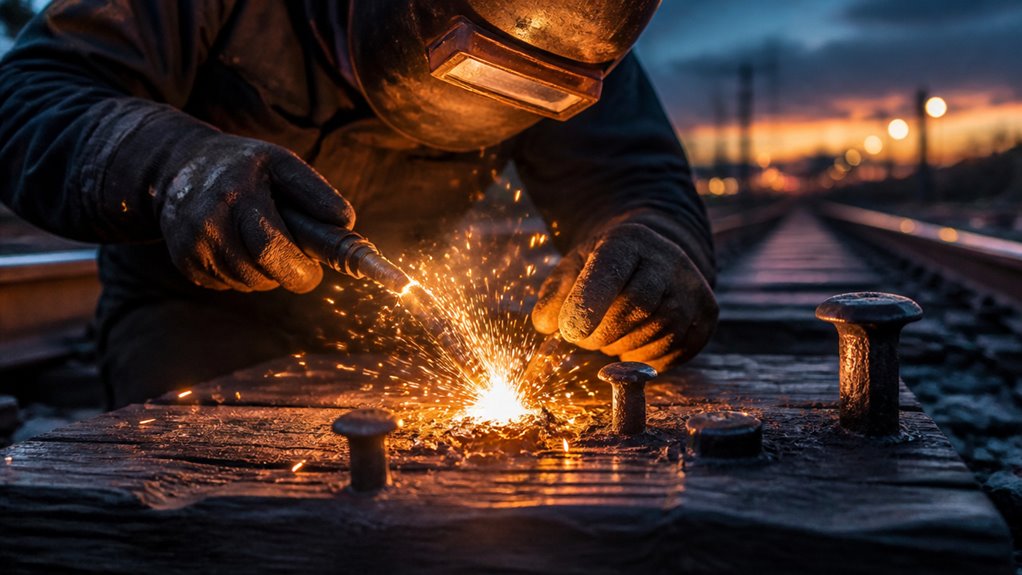
Choose straight, uniform railroad spikes free from deep rust for consistent welds. Clean and prep thoroughly to remove contaminants, ensuring strong, stable arc conditions.
Preheat spikes and use tack or stitch welding to minimize warping and cracking risks. Shape spikes when heated red-hot for malleability, then assemble using multiple tacks to prevent distortion.
Finish weld seams smoothly and protect surfaces to extend durability. Exploring detailed techniques will help you enhance both function and aesthetics in your welded spike projects.
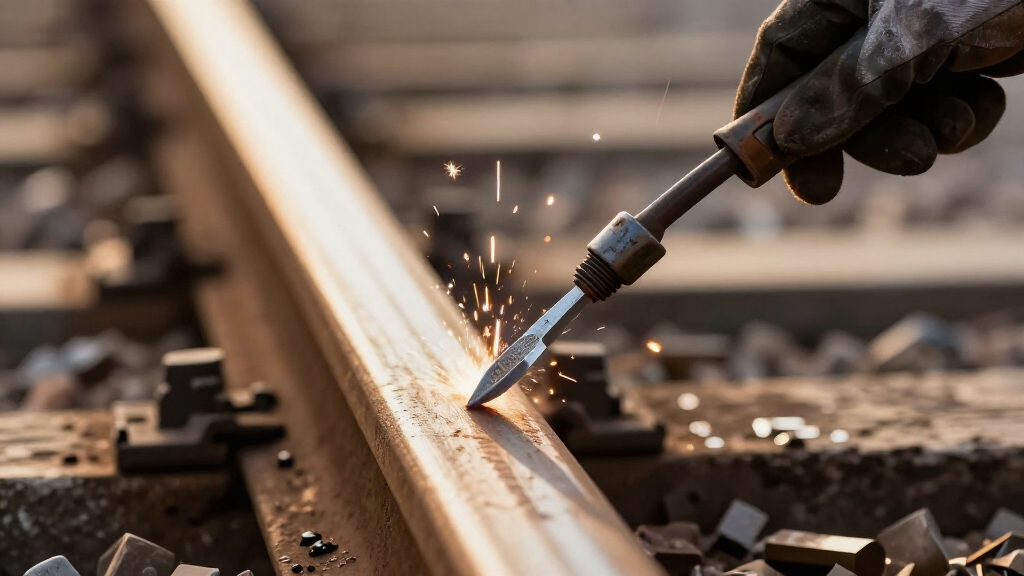
Selecting the right railroad spikes is essential for achieving consistent weld quality and structural integrity in your projects. You should prioritize straight spikes because bent or damaged spikes complicate shaping and reduce uniformity.
Inspect spikes for surface rust; minor rust can be cleaned, but deep pitting compromises strength and weld reliability. Since railroad spikes are primarily carbon steel, they weld compatibly with A36 mild steel, common in shop environments.
Choose spikes of consistent size and condition to ensure uniform fit-up and aesthetics, especially when fabricating racks or multi-spike art. Matching sets reduce variability, aiding precise alignment and reducing stress concentrations in welds.
Preheating spikes before welding can help reduce the risk of hydrogen-induced cracking and improve weld quality, especially when working with higher carbon content spikes.
Once you’ve chosen spikes with suitable straightness and surface condition, the next step is to prepare them thoroughly for welding.
Begin by removing rust, mill scale, and surface contaminants using a wire brush or grinder. This cleaning improves weld penetration and reduces contamination risks.
Focus on assuring clean, bright metal at all contact points, especially where welds will be applied.
After cutting or trimming spikes, grind any burrs or sharp edges to enhance fit-up and safety.
Consistent surface prep across all spikes assures uniform weld quality and structural integrity.
Even if the final project aims for a rustic look, thorough cleaning remains essential to prevent weld defects.
Maintain a systematic approach to surface preparation to optimize weld strength and achieve professional results.
Proper preparation is critical because rust causes unstable arc conditions that increase spatter and reduce weld quality.
Although welding railroad spikes might seem intimidating at first, beginners can easily create functional and decorative projects by focusing on simple assemblies like hooks, racks, and wall art.
Start by selecting straight, minimally pitted spikes for uniformity and weldability. Prepare surfaces meticulously with wire brushing to ensure clean welds. Use tack welding to hold parts securely, minimizing heat distortion.
Consider these beginner-friendly project ideas:
These methods build foundational skills in welding and assembly while producing practical items. Always ensure a well-ventilated workspace to minimize inhalation of hazardous fumes during welding.
Mastering the shaping and assembling of railroad spikes requires precise heat control and strategic hammering to manipulate the steel without compromising its structural integrity.
You’ll heat the spike’s pointed end to a bright cherry red before bending or tapering, ensuring the metal remains malleable.
Use the anvil’s horn for consistent curves like U or J shapes, reheating as needed to maintain workability.
During assembly, tack weld multiple points to stabilize the structure and prevent distortion from heat.
After final welding, hammer joints to blend seams and reinforce connections.
Twisting, flattening, or tapering can refine forms for functional or decorative purposes.
Selecting uniform spikes simplifies alignment and fit-up, improving overall consistency in your design and structural soundness.
Utilizing tack welds and stitch welding techniques helps minimize heat buildup and reduces the risk of warping during the welding process.
After shaping and assembling your railroad spike project, the next step focuses on finishing methods that enhance durability and aesthetics. Proper finishing guarantees your work withstands environmental exposure and maintains structural integrity.
Start by grinding weld seams smooth to remove sharp edges and improve joint appearance. Next, polish surfaces to eliminate oxidation and prepare for sealing. Applying a protective coating, such as clear lacquer or rust-resistant paint, prevents corrosion while preserving the industrial look.
Finally, consider sealing decorative pieces for longevity.
Key finishing steps include:
These steps collectively extend your project’s lifespan and enhance visual appeal. Ensuring arc stability during welding is essential to create strong, clean welds that contribute to the overall durability of your finished work.
Yes, you can safely do railroad spike projects at home if you follow proper safety protocols and use basic welding equipment like a MIG or stick welder.
You’ll need protective gear, including gloves, a helmet, and fire-resistant clothing, as well as a well-ventilated workspace.
Careful surface prep and controlled heat application reduce hazards.
Start with simple tack welding and small assemblies to manage heat distortion.
This approach ensures weld integrity without requiring advanced professional setups.
Think of stubborn rust like stubborn stains on your favorite jeans. You need both patience and the right tools.
To remove it, start with a wire brush or grinder for surface rust. For deeper corrosion, soak spikes in a vinegar bath or use a rust converter.
Electrolysis is a precise method if you want minimal metal loss. Always follow with thorough cleaning to guarantee a solid weld and maintain structural integrity.
You can typically complete a beginner spike welding project within 3 to 6 hours. This timeframe includes surface preparation, tack welding, final welding, and basic finishing.
The exact duration depends on your skill level, the project’s complexity, and available tools. Simpler builds like racks or hooks take less time.
Adding shaping or multiple weld points extends the process. Efficient preparation and steady technique help you stay within this range.
Yes, you can dispose of leftover metal and slag eco-friendly by recycling them at local scrap metal facilities. This minimizes landfill waste and conserves resources.
You should separate ferrous metals from slag and residual flux for proper processing. Additionally, consider repurposing slag as aggregate in construction or landscaping.
Avoid burning or dumping slag, as it may release harmful particulates. Proper sorting and transport guarantee environmental compliance and maximize material reuse.
Yes, you can combine railroad spikes with metals beyond mild steel, but compatibility matters.
Since spikes are carbon steel, welding with metals like stainless steel or aluminum requires specialized techniques and filler materials to prevent cracking or weak joints.
You’ll need to consider differences in melting points, thermal expansion, and metallurgical properties.
Proper surface prep, appropriate welding methods (e.g., TIG), and sometimes intermediate alloys help guarantee sound, durable bonds between dissimilar metals.
Welding with railroad spikes isn’t just a craft; it’s engineering artistry in your hands.
By choosing the right spikes, preparing them meticulously, and applying precise welding techniques, you transform raw metal into functional or decorative masterpieces.
Remember, shaping and finishing aren’t mere steps; they’re your final handshake with durability and design.
So, why settle for ordinary when your sparks can forge extraordinary? Embrace these methods and watch your projects stand the test of time.