Phone:
(701)814-6992
Physical address:
6296 Donnelly Plaza
Ratkeville, Bahamas.

Phone:
(701)814-6992
Physical address:
6296 Donnelly Plaza
Ratkeville, Bahamas.

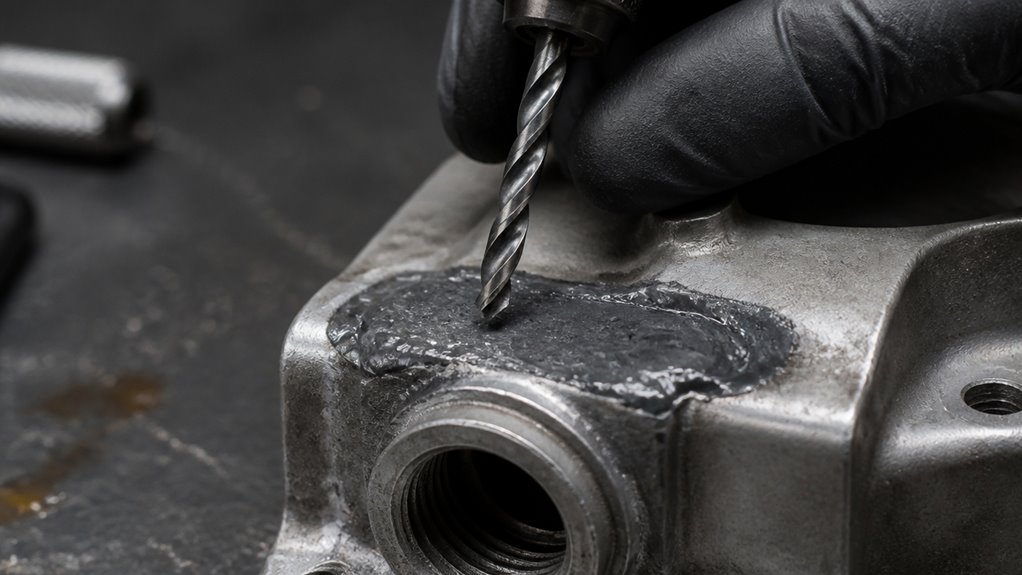
You can drill and tap J-B Weld, but only after it’s fully cured, typically 15 to 24 hours, to guarantee maximum tensile strength around 5,020 PSI.
Drilling too soon or using oversized holes risks cracking and weakens thread retention. Start with a precise pilot hole and drill slowly to avoid chipping.
Then tap carefully, backing out frequently to prevent breakage. Keep in mind that epoxy threads are brittle and better suited for light loads.
Further insights cover ideal techniques and when metal inserts might be advisable.
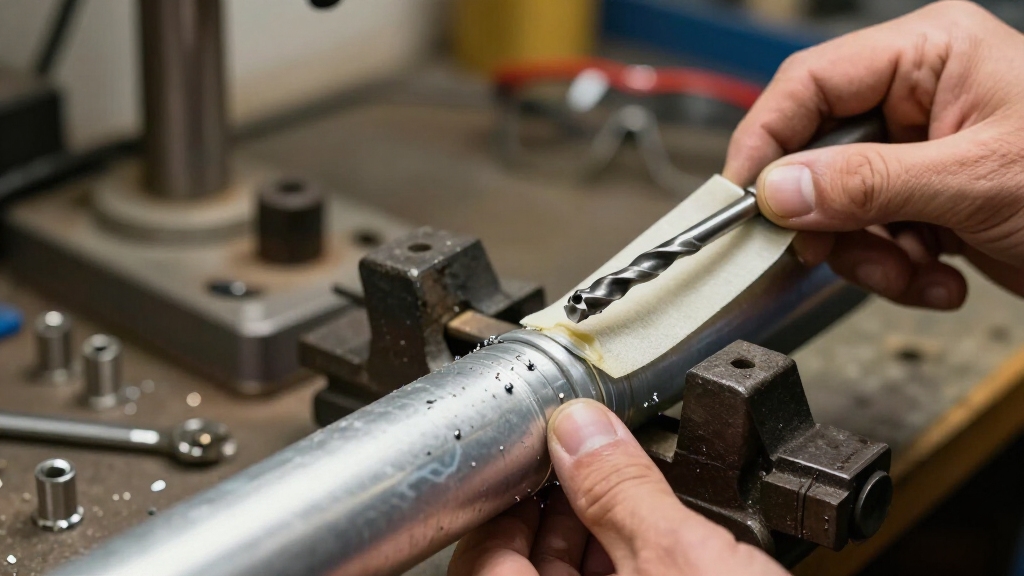
When working with fully cured J-B Weld, you can drill and tap it much like a hard plastic or brittle material, but only after it has completely hardened, typically after 15 to 24 hours.
Start by drilling a pilot hole with a correctly sized drill bit to minimize cracking and guarantee proper thread engagement. Use slow, controlled drilling speed to avoid grabbing or chipping the epoxy edges.
Keep the drilled surface clean to prevent debris from interfering during tapping. Align the tap straight to produce consistent threads and periodically back it out to clear chips, reducing breakage risk.
While cutting oil may ease tapping, it’s not mandatory. Remember, threads in cured J-B Weld hold best under light to moderate loads, so avoid aggressive cuts and oversized holes that compromise strength.
For best results, ensure the J-B Weld has been applied to a clean, prepared surface before curing to maximize adhesion and durability.
Allowing J-B Weld to fully cure before drilling and tapping is critical to guarantee mechanical integrity and reliable thread formation. You should wait at least 15 to 24 hours for the original J-B Weld formula to reach full cure.
Although some variants set within 4 to 6 hours, set time doesn’t equate to full hardness required for machining. Drilling or tapping prematurely risks weakening the repair and producing unreliable threads due to insufficient epoxy strength.
Full curing assures the epoxy reaches its maximum tensile strength, about 5020 PSI, and becomes machinable like a hard plastic. Only after this period can you safely drill pilot holes and tap threads without compromising durability or risking cracking, stripping, or binding during the machining process. Proper surface preparation also plays a key role in achieving optimal bond strength before machining.
Start by confirming that the J-B Weld has fully cured to its maximum hardness before drilling.
Use a slow, steady speed with a sharp drill bit to avoid cracking or damaging the epoxy.
Begin with a pilot hole to guarantee precision and reduce stress.
Clean the drilled surface to remove debris, enhancing thread engagement.
It is important to note that J-B Weld cures to a steel-like hardness rated at 4000 PSI, providing excellent durability for drilled and tapped repairs.
| Step | Recommendation |
|---|---|
| Cure Time | 15–24 hours for full cure |
| Drill Speed | Slow and controlled |
| Drill Bit | Sharp, appropriate size |
| Pilot Hole | Always start with one |
| Surface Cleaning | Remove debris before tapping |
Following these steps guarantees clean, accurate holes without compromising the epoxy’s structural integrity.
Tapping threads in fully cured J-B Weld requires careful preparation and technique to preserve thread integrity and avoid damaging the epoxy.
First, make certain the material is completely cured; partial cure weakens thread strength.
Use a properly sized pilot hole drilled with controlled speed to minimize cracking.
Align your tap precisely to maintain straight, uniform threads and reduce stress concentrations.
Apply light cutting oil if desired to ease tap movement, but it’s not mandatory.
Advance the tap slowly, backing it out frequently to clear debris and prevent chip binding or breakage.
Focus on creating fine, shallow threads rather than aggressive cuts, as epoxy’s brittleness demands delicate handling.
Remember, the resulting threads are suitable for light to moderate loads only.
Always test-fit fasteners to verify thread quality before final use.
For best results, ensure the J-B Weld has undergone its full 15–24 hour cure time to achieve maximum strength and durability before tapping.
When you’re drilling and tapping cured J-B Weld, picking the right drill bit size is super important. You really want to make sure you maintain thread strength and avoid any cracking. It’s all about matching the tap dimensions just right. The pilot hole should be a smidge smaller than the tap’s major diameter to get that ideal thread engagement.
And hey, don’t forget—if you go with oversized holes, it can really cut down on load capacity. So, the size of your hole plays a big role in how durable and reliable your repair will be. Just something to keep in mind!
Also, make sure the J-B Weld is fully cured before drilling and tapping to ensure maximum bond strength and prevent damage during the process.
Selecting the best drill bit size is crucial to guarantee strong thread engagement and prevent cracking or stripping in cured J-B Weld. Choose a drill bit slightly smaller than the fastener’s nominal diameter to ensure the threads have enough material to grip.
Oversized holes reduce bond strength and thread retention. Undersized holes risk cracking during tapping. Use a pilot hole to guide the tap and minimize stress concentrations. When removing or adjusting drilled J-B Weld, combining mechanical removal techniques with controlled methods ensures surface integrity.
| Fastener Size (in) | Recommended Drill Bit Size (in) |
|---|---|
| #6 | 7/64 |
| #8 | 1/8 |
| 1/4 | 7/32 |
| 5/16 | 13/64 |
Achieving ideal thread engagement in cured J-B Weld requires matching the tap size precisely to the pilot hole and fastener dimensions.
You should select taps designed for hard plastics or brittle materials, typically standard-sized taps compatible with the bolt or screw you intend to use.
For instance, if you’re working with a 6-32 screw, use a #36 or #37 drill bit pilot hole and a corresponding 6-32 tap.
Avoid oversized taps that cut aggressively, as they can cause micro-cracking or reduce holding strength.
Use fine-thread taps when possible; they create shallower threads that hold better in epoxy’s brittle matrix.
Maintain strict tap alignment to prevent thread distortion and back the tap out frequently to clear chips.
This approach guarantees durable, reliable threads in fully cured J-B Weld repairs.
It is important to ensure the epoxy has reached full cure before drilling and tapping to achieve maximum strength and avoid damage.
In drilling and tapping cured J-B Weld, hole size critically affects thread strength and durability. You need to select the drill bit size carefully to guarantee peak thread engagement.
Oversized holes reduce epoxy-to-thread contact, weakening the joint and increasing the risk of thread stripping. Conversely, undersized holes can cause excessive stress during tapping, potentially cracking the cured epoxy.
Start with a pilot hole matched to the minor diameter of the intended thread. Then gradually enlarge it to the recommended tap drill size for the fastener you plan to use. This approach minimizes mechanical stress and promotes uniform thread formation.
Since J-B Weld is designed for localized metal repairs with proper curing, following curing instructions carefully is essential to maintain its integrity during drilling and tapping.
When you compare tapped threads in fully cured J-B Weld to metal, you’ll notice that the epoxy’s tensile strength peaks around 5,020 PSI. That’s definitely lower than most metals.
Because of this, its load capacity is somewhat limited, especially when it comes to shear or cyclic stress. Proper curing and full hardness development are crucial to achieving the best bond strength possible with J-B Weld.
Although J-B Weld offers impressive tensile strength once fully cured, around 5020 PSI, its tapped threads don’t match the durability or load capacity of metal threads.
When you tap threads into cured J-B Weld, the epoxy’s brittle nature limits the strength under tension compared to ductile metal threads.
Metal threads distribute loads through plastic deformation, while J-B Weld threads rely on the epoxy’s cured rigidity, which is prone to microcracking under stress.
You’ll find that the tensile strength of tapped J-B Weld threads varies with hole size, thread depth, and proper curing but generally remains lower than equivalent metal threads.
Consequently, while J-B Weld is suitable for light to moderate tensile applications, it won’t deliver the tensile resilience or fatigue resistance metal threads provide in demanding environments.
For maximum performance, proper surface preparation and curing conditions are critical to improving the strength of J-B Weld threaded repairs.
Understanding the load capacity limitations of tapped threads in J-B Weld is essential for ensuring reliable repairs.
While fully cured J-B Weld offers tensile strength near 5,020 PSI, its threaded holes don’t match metal’s ductility or shear strength.
The epoxy’s brittle nature means tapped threads handle light to moderate loads but risk stripping under high torque or impact.
Thread engagement depth, hole size, and load direction critically influence holding strength.
Oversized holes or aggressive tapping reduce thread integrity, increasing failure risk.
Unlike metal, J-B Weld threads can’t absorb stress concentrations as effectively, so you shouldn’t rely on them for critical structural fastening.
For dependable load-bearing repairs, consider metal inserts or hybrid solutions instead of solely relying on epoxy threads.
Because J-B Weld’s cured epoxy forms a rigid but brittle matrix, its tapped threads exhibit markedly lower durability under stress compared to metal threads.
You’ll find that epoxy threads can fail prematurely under load due to inherent brittleness and lower ductility. Here’s what you should consider:
Thus, while tapping cured J-B Weld is feasible, you shouldn’t rely on it for critical or high-stress structural applications.
Selecting the right applications for drilling and tapping J-B Weld hinges on recognizing its material properties and limitations. You should use it primarily for low- to moderate-load repairs where restoring damaged holes or threads is necessary but not critical to structural integrity.
Drilling and tapping cured J-B Weld excels in rebuilding holes filled with epoxy, especially when the material fully surrounds the repair area. It’s ideal for fastening small screws or bolts in non-load-bearing joints, such as cosmetic fixes or light mechanical assemblies.
Avoid using it for high-stress or safety-critical connections, as epoxy threads lack the ductility and load capacity of metal. By restricting application to these conditions, you ensure reliable thread retention while preserving the epoxy’s mechanical performance.
While drilling and tapping cured J-B Weld offers practical solutions for light repairs, common mistakes can compromise the integrity of your work.
Drilling and tapping cured J-B Weld provides effective repairs but requires careful technique to maintain strength and durability.
Avoid these pitfalls to guarantee reliable results:
Addressing these prevents structural failures and preserves the epoxy’s machinability.
This guarantees stronger, longer-lasting threaded repairs.
If your repair must endure heavy loads or frequent fastener removal, metal inserts often provide a more reliable solution than tapping cured J-B Weld. Inserts offer superior mechanical strength and durability, reducing stripping risk under repeated stress. They also maintain thread integrity when exposed to vibration or heat, conditions where epoxy threads degrade faster.
| Factor | Metal Inserts |
|---|---|
| Load Capacity | High, supports structural loads |
| Durability | Excellent under repeated use |
| Vibration Resistance | Superior, minimal thread wear |
| Temperature Tolerance | Higher than cured epoxy |
You should choose metal inserts when safety, longevity, and load-bearing capacity are critical. This ensures a robust, serviceable repair beyond the limitations of epoxy threads.
You shouldn’t drill or tap J-B Weld while it’s still warm or curing. The material isn’t fully hardened then, making it prone to cracking, stripping, or producing unreliable threads.
Wait until it’s completely cured, usually 15 to 24 hours, before machining. Drilling and tapping warm or partially set epoxy weakens the repair and compromises thread integrity.
Always confirm full cure and cooling to maintain structural strength and reliable thread engagement.
You might be surprised, but light cutting oils or specialized tapping lubricants work best when tapping J-B Weld.
These lubricants reduce friction, helping the tap move smoothly through the hardened epoxy without binding or breaking.
Avoid heavy greases; they can gum up the threads.
Even though some say lubricant isn’t strictly necessary, using a thin oil or tapping fluid guarantees cleaner cuts, less heat buildup, and longer tap life, especially during precision machining.
Temperature markedly affects cured J-B Weld’s machinability.
Higher temperatures can soften the epoxy, reducing its hardness and making drilling or tapping easier. However, this also increases the risk of deformation or thread damage.
Conversely, lower temperatures harden the epoxy, improving dimensional stability but increasing brittleness. This brittleness risks cracking or chipping during machining.
You should work within moderate temperatures and guarantee full cure to balance machinability and mechanical integrity for clean, reliable threads.
Tapping J-B Weld itself won’t directly crack surrounding metal, but improper technique can.
If you force the tap or misalign it, stress concentrates near the epoxy-metal interface, risking metal cracks, especially in thin or brittle areas.
You must use slow, controlled tapping with correct alignment and pilot holes to minimize stress.
You’ll find stainless steel and brass screws work best with J-B Weld threads due to their corrosion resistance and lower hardness, reducing stress on the epoxy.
Avoid hardened steel screws, as their rigidity can crack or strip the epoxy threads under load.
Also, use screws with fine, shallow threads to improve engagement and minimize stress concentrations.
Always test-fit to make certain proper thread engagement and avoid over-torquing, which can damage the epoxy repair.
Drilling and tapping fully cured J-B Weld is like carving threads into stone. Precision and patience forge strength.
Waiting for full cure guarantees a solid foundation, while correct drill and tap sizes maintain integrity. Though not as robust as metal, J-B Weld’s threaded bonds serve well in lighter applications.
Recognize when metal inserts outperform and avoid common errors to prevent fracture. Master these techniques, and you’ll turn a simple epoxy patch into a reliable mechanical anchor.