Phone:
(701)814-6992
Physical address:
6296 Donnelly Plaza
Ratkeville, Bahamas.

Phone:
(701)814-6992
Physical address:
6296 Donnelly Plaza
Ratkeville, Bahamas.

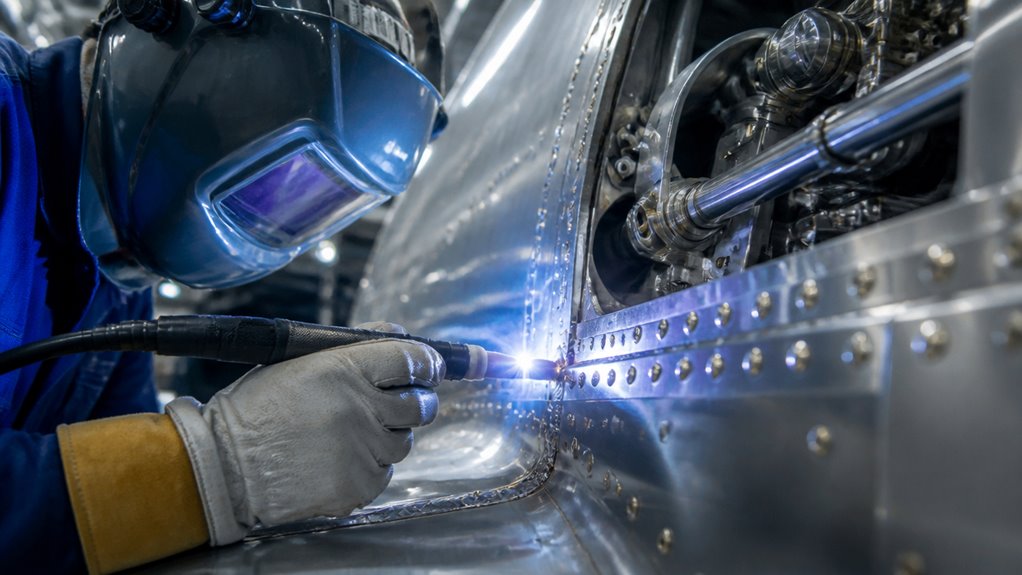
Aerospace welding joins critical lightweight metals like aluminum, titanium, and nickel alloys to create strong, reliable structures for aircraft and spacecraft.
You must precisely control heat input, shielding, and welding parameters to avoid defects such as cracking or porosity that could compromise safety.
This specialized welding uses advanced methods like laser, electron beam, and friction stir welding under strict standards to meet tight tolerances.
Understanding these unique challenges helps you guarantee aerospace components perform flawlessly in demanding environments.
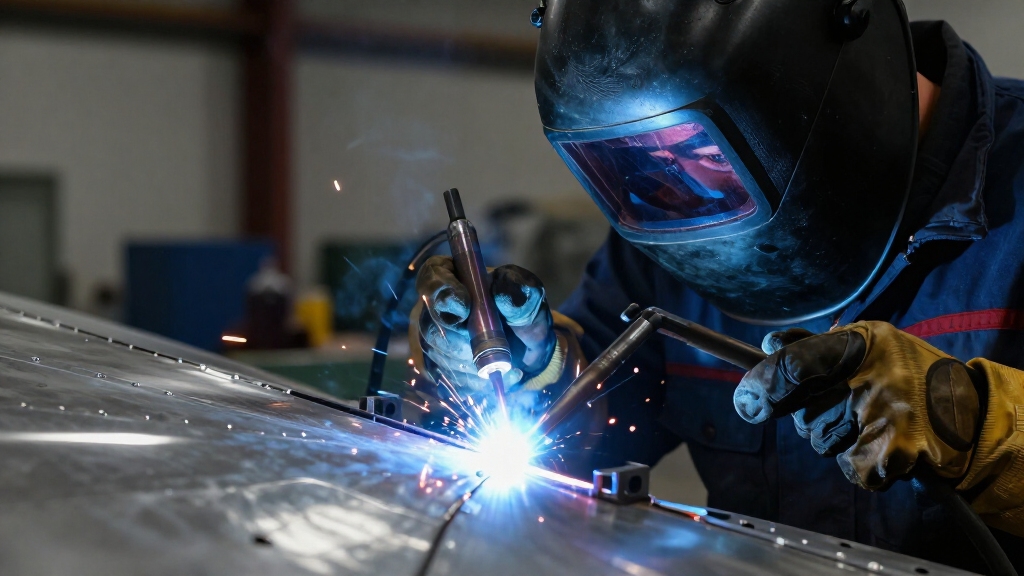
Aerospace welding joins metallic parts critical to aircraft, spacecraft, and related flight hardware. It ensures they withstand extreme conditions like vibration, thermal cycling, pressure, and corrosion.
You rely on this process to create joints that maintain structural integrity under demanding operational stresses. Aerospace welding employs fusion and solid-state joining methods tailored for high-performance alloys such as aluminum, titanium, and nickel-based alloys.
You must control welding parameters precisely to avoid defects that could compromise safety or performance. Aerospace standards require rigorous qualification and inspection protocols, reflecting the critical nature of these welds.
When you understand aerospace welding’s role, you appreciate its necessity for producing strong, lightweight, and reliable components essential for safe, efficient flight and space missions. Maintaining AWS D17.1 certification is essential to ensure weld quality and regulatory compliance in aerospace applications.
Although welding shares fundamental principles across industries, aerospace welding demands far stricter controls and tolerances due to the critical nature of flight hardware.
When you work in aerospace welding, you’ll notice three key distinctions compared to other welding types:
These factors make aerospace welding a highly specialized field where you can’t compromise on accuracy or quality, given the safety and reliability demands of flight hardware. Processes such as Electron Beam Welding and laser welding are often employed to achieve the precise control and minimal distortion required in aerospace applications.
You’ll often come across aluminum alloys in aerospace welding, and it’s no surprise why. Their lightweight nature and resistance to corrosion make them a go-to choice for many applications.
Now, let’s talk about titanium alloys. These materials really shine when it comes to strength-to-weight ratios and heat resistance. That’s why they’re perfect for those critical components that need to stand up to a lot of stress.
And we can’t forget about nickel-based alloys, like Inconel. These are super important when you’re dealing with high temperatures and mechanical stress. They really know how to hold their own in tough conditions!
For welding aluminum alloys effectively, using an AC/DC TIG welder with inverter technology is essential to ensure clean, strong joints and proper oxide layer penetration.
Aluminum alloys frequently serve as the backbone of aerospace structures due to their excellent strength-to-weight ratio and corrosion resistance. When you work with these alloys, you benefit from their ability to maintain structural integrity under cyclic loading and resist environmental degradation.
Key characteristics include:
1. High Strength-to-Weight Ratio
Aluminum alloys optimize aircraft performance by reducing mass while maintaining durability.
2. Corrosion Resistance
Their natural oxide layer minimizes oxidation, vital for long-term exposure to varying atmospheres.
3. Weldability
Certain aluminum alloys, such as 2xxx and 7xxx series, require controlled welding parameters due to susceptibility to cracking and porosity.
Understanding these properties helps you select appropriate alloys and welding methods. This ensures the reliability of aerospace components under demanding operational conditions. Proper welding process selection is essential to achieve strong, defect-free joints in aerospace aluminum alloys.
While aluminum alloys offer a strong balance of lightweight and corrosion resistance, titanium alloys provide distinct advantages where higher strength-to-weight ratios and elevated temperature capabilities are required.
When you work with titanium, you benefit from its exceptional strength retention at temperatures up to 600°C, surpassing aluminum’s thermal limits. Its excellent corrosion resistance in aggressive environments reduces maintenance demands.
Titanium’s low density combined with a high modulus of elasticity enables you to design components that are both lightweight and structurally rigid. However, welding titanium demands stringent atmospheric control to prevent contamination and embrittlement.
You must also account for its reactive nature and potential distortion. Overall, titanium alloys enhance aerospace performance by delivering durability and reliability in high-stress, high-temperature applications where aluminum alloys fall short. Maintaining exceptional shielding and internal purging during welding is critical to preserving these properties.
Nickel-based alloys excel in aerospace applications that demand exceptional strength and corrosion resistance at elevated temperatures. When you work with these alloys, such as Inconel, you benefit from their ability to maintain mechanical integrity under extreme thermal and oxidative stress.
You’ll find them indispensable for components exposed to harsh environments and high loads.
Consider these key uses of nickel-based alloys in aerospace welding:
Proper heat management techniques during welding are essential to preserve the mechanical properties and integrity of these alloys.
In the aerospace industry, you’ll come across various welding methods that are crucial for ensuring the integrity of components. For instance, fusion welding techniques like Gas Tungsten Arc Welding (GTAW) are commonly used.
But that’s not all—advanced solid-state processes, such as friction stir welding, are also making waves in this field.
Now, when we talk about precision and consistency, automated technologies really stand out. Techniques like laser and electron beam welding are game-changers, especially for critical components where every detail matters.
Laser welding offers precise focusing that enables welding of complex parts with minimal post-processing, making it ideal for aerospace applications.
Fusion welding forms the backbone of many aerospace manufacturing processes by creating strong, permanent joints through melting and solidification of base metals.
When you work with aerospace components, you’ll rely on these three common fusion welding methods to achieve peak strength and reliability:
Each method suits specific materials and design requirements, ensuring weld quality meets strict aerospace standards and withstands operational stresses.
You must select the method that aligns with the metallurgical properties and performance demands of your components.
Laser Beam Welding also offers a narrow heat-affected zone, minimizing distortion and preserving base material integrity for superior joint performance.
Exploring solid-state joining techniques reveals essential alternatives to fusion welding for aerospace applications where melting the base metals is undesirable.
These methods rely on pressure, friction, or ultrasonic energy to create strong joints without compromising the base metal’s microstructure.
You’ll find these techniques critical when working with aluminum or titanium alloys, as they minimize distortion and residual stresses while maintaining mechanical properties.
Ultrasonic welding, in particular, uses high-frequency vibrations converted into localized frictional heat to enable efficient fusion without bulk heating the parts.
| Method | Key Feature |
|---|---|
| Friction Stir Welding | Rotating tool generates heat via friction, plasticizing metal |
| Ultrasonic Welding | High-frequency vibrations create localized bonding |
| Diffusion Bonding | Prolonged heat and pressure enable atomic diffusion |
| Roll Bonding | Metal layers are plastically deformed to bond |
| Cold Welding | Pressure bonds clean metals at room temperature |
These solid-state methods guarantee reliability and performance in aerospace structures where fusion welding may induce defects.
Automated welding technologies streamline the production of aerospace components by delivering consistent, high-quality joints with minimal human intervention.
When you implement these systems, you reduce variability and enhance repeatability, vital for aerospace’s strict quality standards.
You’ll encounter three primary automated welding methods:
Additionally, advanced methods like plasma welding provide excellent control over heat input and weld quality for various aerospace materials.
Although aerospace welding demands exceptional precision and reliability, it’s the industry standards that guarantee consistent quality across all processes.
Aerospace welding requires precision, with industry standards ensuring consistent quality in every step.
You must adhere to standards like AWS D17.1 for fusion welding and AWS D17.2 for resistance welding, which specify procedure qualifications, personnel certifications, and acceptance criteria.
NASA standards add stricter requirements for spaceflight hardware, emphasizing traceability and documentation.
Additionally, quality frameworks such as AS9100 and Nadcap enforce rigorous audits and process controls, ensuring compliance with aerospace-specific demands.
These standards define material selection, welding parameters, joint design, and inspection methods to mitigate risks inherent in aerospace environments.
Meeting strict industry standards sets the foundation for aerospace welding quality. Maintaining that quality depends on rigorous control throughout production.
You must implement continuous inspection and verification to detect defects early, preventing costly rework or failure in critical components. Quality control guarantees weld integrity by enforcing adherence to qualified procedures and certified personnel.
Key aspects include:
Because aerospace components endure extreme stresses and environmental conditions, welding designs must prioritize both performance and reliability to guarantee safety and functionality.
You need to select appropriate joint configurations that minimize stress concentration and ensure uniform load distribution. Material compatibility and thermal effects require careful consideration to prevent cracking, distortion, or metallurgical degradation.
You’ll also specify weld geometries and processes that produce consistent penetration and fusion without compromising base metal properties. Incorporating non-destructive evaluation methods in design validation helps detect subsurface flaws before service.
In addition, strict adherence to aerospace welding standards ensures repeatability and traceability, critical for certification and long-term reliability. By integrating these technical factors, your welding designs directly enhance structural integrity, fatigue resistance, and overall aerospace component durability.
When you examine aerospace welding applications, you’ll find it plays a critical role across both aircraft and spacecraft manufacturing.
You rely on welding to create strong, lightweight joints that endure extreme conditions like vibration, thermal cycling, and pressure. Aerospace welding supports structural integrity and functionality in flight hardware, where failure isn’t an option.
Typical aerospace welding applications include:
Each application demands strict adherence to aerospace welding standards and quality controls.
Although aerospace welding offers critical benefits for flight hardware, welders face significant challenges that demand exceptional skill and attention to detail.
You must work with a variety of materials like aluminum, titanium, and nickel-based alloys, each requiring specific techniques to avoid defects such as porosity or cracking.
Tight dimensional tolerances and strict quality standards leave little margin for error, meaning you need precise control of heat input and weld parameters.
Additionally, welding often occurs in confined or complex geometries, making access and consistency difficult.
You must also comply with stringent certification requirements, including procedure and personnel qualifications under AWS D17.1 and Nadcap.
Ultimately, your ability to manage these factors directly impacts the structural integrity and safety of critical aerospace components.
It typically takes you about 6 months to 2 years to become a certified aerospace welder, depending on your prior experience and training program intensity.
You’ll need to complete specialized coursework, hands-on practice, and pass rigorous welding procedure and personnel qualification tests under standards like AWS D17.1.
Continuous skill development and adherence to strict aerospace quality standards are essential to maintain and advance your certification in this demanding field.
You must rigorously control contamination risks, as aerospace welds demand ultra-clean surfaces to prevent defects.
You’ll use specialized ventilation to handle hazardous fumes from exotic alloys like titanium and nickel-based materials.
You’ll strictly follow precise welding parameters to avoid microstructural flaws critical for flight safety.
Additionally, you’ll wear advanced PPE to shield against intense UV radiation and high-temperature spatter unique to aerospace processes, ensuring both personal and product integrity.
Can you imagine welding without gravity pulling molten metal down? Yes, aerospace welding can be performed in zero-gravity environments, but it demands specialized equipment and precise control.
You’ll need adapted welding processes like TIG or laser welding with containment systems to manage molten pools and prevent contamination.
Zero-G welding requires strict procedural adjustments and real-time monitoring to guarantee weld integrity. This is crucial given the unique challenges of fluid behavior and heat transfer in microgravity.
Welding affects aerospace metal recyclability by altering microstructures and introducing alloy segregation or residual stresses. This can complicate remelting and reuse.
You’ll need to control welding parameters precisely to minimize contamination and maintain alloy integrity. Proper post-weld heat treatments help restore metallurgical uniformity, enhancing recyclability.
Additionally, avoiding mixed-metal welds prevents difficulties during sorting and recycling. This ensures that aerospace metals remain recoverable and maintain their high-performance characteristics.
Think of aerospace welding as a launchpad for your career.
You can advance by gaining certifications like AWS D17.1 or Nadcap accreditation, mastering specialized techniques such as electron beam or friction stir welding, and moving into supervisory or quality assurance roles.
Developing expertise in automated welding systems or aerospace materials science also opens doors to engineering or inspection positions.
This allows you to elevate your professional trajectory within this high-precision industry.
As you navigate the intricate world of aerospace welding, remember it’s the invisible thread weaving safety and innovation into every aircraft and spacecraft.
This craft demands precision, strict adherence to standards, and mastery over challenging materials, like a surgeon’s steady hand shaping the future.
By understanding its nuances, you guarantee each weld isn’t just a joint but a lifeline, propelling aerospace technology toward greater heights with unwavering reliability.