Phone:
(701)814-6992
Physical address:
6296 Donnelly Plaza
Ratkeville, Bahamas.

Phone:
(701)814-6992
Physical address:
6296 Donnelly Plaza
Ratkeville, Bahamas.

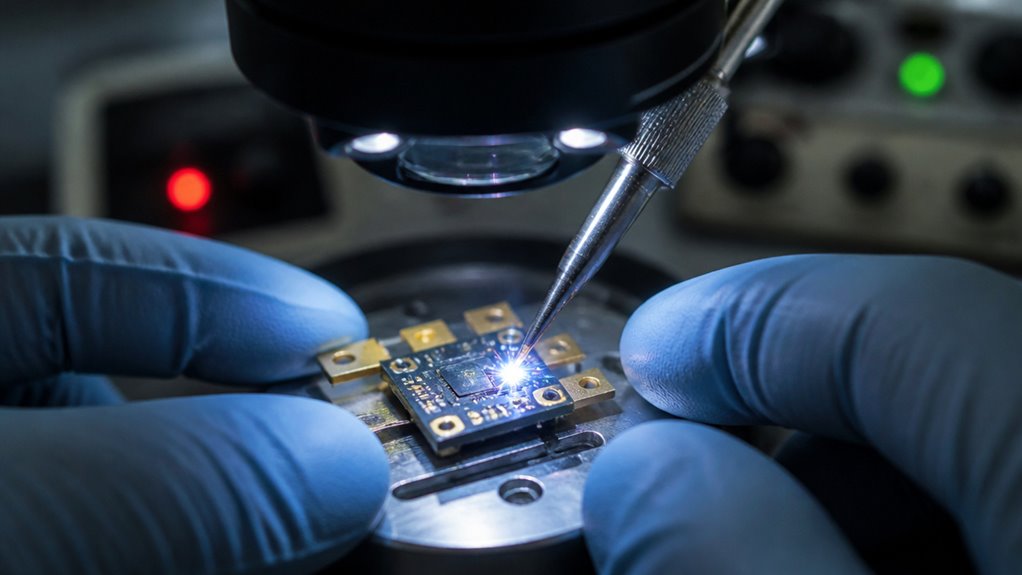
Micro welding lets you join extremely thin materials, typically below 0.5 mm thick, using highly controlled, localized heat to create precise metallurgical fusion bonds.
You’ll work under magnification for exact electrode placement and minimal thermal impact, preserving delicate components and material integrity.
This method uses fine-tuned amperage, stable arcs, and specialized equipment like microscopes and tungsten electrodes to avoid distortion or damage.
If you want to understand the process, materials, and challenges involved, there’s more detailed insight ahead.
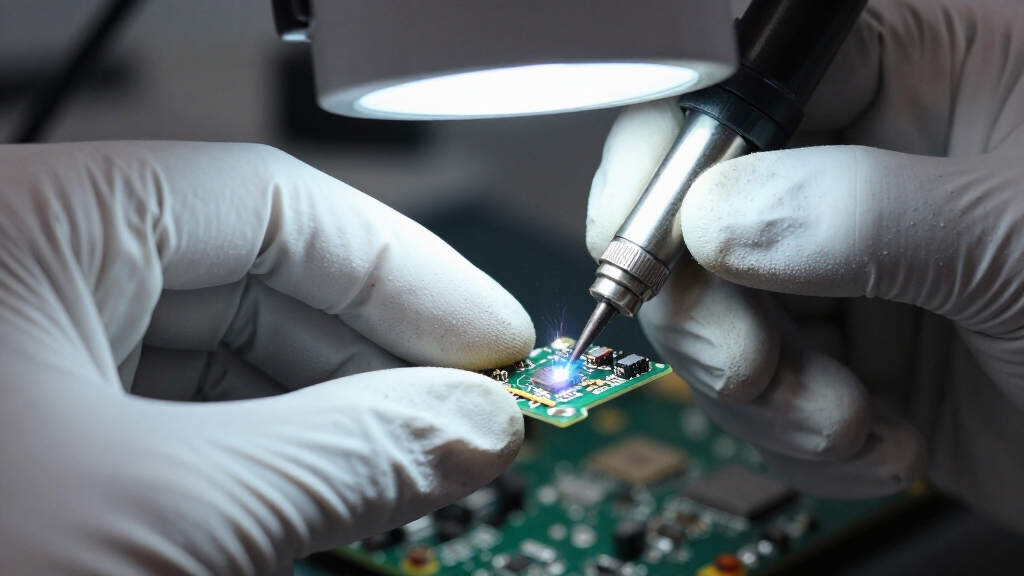
Understanding micro welding means recognizing its role in joining extremely small or thin materials, typically under 0.5 mm thick, with high precision and minimal thermal impact.
You rely on this process when conventional welding introduces excessive heat, distortion, or damage to delicate components.
Micro welding isn’t defined by a single universal standard; instead, it encompasses various techniques designed for fusion zones often smaller than 100 µm.
When you engage in micro welding, you apply highly localized heat to create metallurgical bonds without compromising material integrity.
This precision approach is essential for handling sensitive metals and components where even minor thermal exposure can cause failure.
One such technique uses an electron beam to achieve deep penetration with minimal distortion in microscopic welds.
You control highly localized heat to create metallurgical fusion bonds between materials in the core micro welding process. This precision requires managing heat input far below conventional welding levels to avoid thermal distortion or damage.
Controlling highly localized heat enables precise metallurgical fusion bonds while preventing thermal distortion or damage.
You typically use focused energy sources like laser beams or micro-arc electrodes under microscopic guidance. This ensures that only targeted zones melt and fuse. Often, electrodes apply pressure and current simultaneously to generate the weld.
You regulate amperage, arc size, and shielding gases like argon or helium to maintain a minimal heat-affected zone. The fusion occurs at a microscopic scale, producing joints often under 0.5 mm wide, sometimes as small as 100 µm.
This meticulous control guarantees strong, reliable bonds without compromising the integrity of delicate, thin components. Effective use of shielding gases also prevents oxidation and stabilizes the welding process to reduce defects.
Micro welding excels at joining a wide range of materials, particularly those that are thin, delicate, or sensitive to heat.
You can effectively weld thin ferrous metals like stainless steel and tool steels, as well as nonferrous metals such as copper, aluminum, and titanium.
Precious metals including gold, silver, and platinum are also suitable, especially in electronics and jewelry applications.
The key is that these materials must tolerate localized heat input without distortion or degradation.
You can join dissimilar metals too, provided you control the heat and metallurgical compatibility carefully to avoid brittle intermetallic phases.
Micro welding’s precision lets you work with metals under 0.5 mm thick, including foils, wires, and thin sheets.
This enables strong, reliable bonds in sensitive assemblies where conventional welding would cause damage.
Maintaining shielding gas purity is crucial when welding reactive metals like titanium to prevent contamination and ensure weld integrity.
Precision welding setups rely heavily on specialized equipment to achieve the fine control required for micro welding. You’ll need a high-powered microscope to clearly see small joints and control the weld precisely.
Tungsten electrodes provide stable arc performance, while shielding gases like argon or helium protect the weld pool from contamination. Power supplies with fine amperage control help you maintain minimal heat input, reducing thermal distortion. Additionally, precise manipulators position parts and filler materials accurately.
Correct tungsten electrode grinding is essential for arc stability and weld quality in micro welding.
| Equipment Type | Purpose | Key Feature |
|---|---|---|
| Microscope | Visual magnification | High resolution optics |
| Power Supply | Arc and heat control | Fine amperage adjustments |
| Tungsten Electrodes | Stable welding arc | Durability, precision tip |
| Shielding Gas | Prevent oxidation | Argon or helium |
| Manipulators | Positioning and feeding | Micrometer precision |
When it comes to micro welding, controlling heat application is crucial. You really have to be meticulous about it to prevent any thermal distortion and keep the joint integrity intact. It’s all about getting that balance just right.
Now, let’s talk about equipment. Precision handling is key. You want to ensure consistent electrode positioning and stable arc conditions, especially when you’re working under magnification. That extra focus makes a big difference.
Mastering these techniques isn’t just a nice-to-have; it’s essential. With the right skills, you can achieve reliable, high-quality micro joints that stand the test of time. So, practice makes perfect! Additionally, selecting appropriate preload force ensures intimate contact without deforming parts, which is critical for consistent weld quality.
Mastering controlled heat application is crucial for achieving consistent, high-quality welds at the microscale. You must precisely modulate the heat input to avoid overheating or insufficient fusion, which can compromise joint integrity.
Skilled operators employ several techniques:
These methods guarantee you deliver localized energy only where needed, minimizing heat-affected zones and preserving the microstructure for reliable, precise welds. Careful balancing of amperage with material thickness is essential to control penetration without causing burn-through or warping in micro welding.
Controlling heat is only part of the equation; handling the equipment with exacting skill guarantees the weld’s accuracy at a microscopic scale.
You must maintain steady, deliberate control over the welding apparatus, often under high magnification, to position electrodes or focused energy sources with micron-level precision.
Minute adjustments to amperage, arc length, and electrode pressure demand your constant attention to avoid overheating or material distortion.
You’ll rely on vibration-damped platforms and ergonomic grips to minimize hand tremors.
Additionally, precise alignment of components within the microscope’s field of view secures the weld forms exactly where intended.
Mastering these techniques requires practice and acute hand-eye coordination, as even slight deviations can compromise joint integrity.
Your skillful equipment handling directly influences weld quality, repeatability, and the microstructure of the fusion zone.
Maintaining a consistent arc length and smooth amperage control is essential to prevent defects and ensure weld integrity at such a fine scale.
Micro welding really stands out when it comes to precision and accuracy, especially for those tiny components we often work with.
You know how it is—when you’re dealing with delicate parts, you want to make sure nothing gets damaged. That’s where micro welding shines!
One of the best things about it’s that it significantly reduces heat distortion.
This helps keep the integrity of sensitive materials intact, which is crucial in many applications.
Its ability to localize heat input effectively minimizes the heat-affected zone, preserving material properties and joint strength.
Although standard welding methods suffice for larger components, micro welding offers unmatched precision and accuracy when joining tiny or delicate parts.
You gain control over the weld size, heat input, and placement, guaranteeing minimal impact on surrounding materials.
This precision translates into superior joint quality and repeatability, essential for miniature assemblies.
You benefit from three key technical advantages:
These factors combine to help you create strong, reliable welds on components too small or sensitive for conventional methods. Proper tungsten electrode preparation ensures stable arcs and precise welds critical in micro welding applications.
When working with delicate materials, micro welding minimizes heat distortion by applying markedly lower thermal input than standard welding methods. You can precisely control amperage and arc size, focusing energy only where needed. This keeps the heat-affected zone exceptionally small.
This reduction in thermal input prevents warping, residual stress, and metallurgical changes outside the weld area. Because micro welding uses localized fusion with minimal heat spread, you avoid compromising component integrity or altering mechanical properties in surrounding material.
Compared to conventional welding, which often induces significant distortion due to higher heat and larger fusion zones, micro welding guarantees dimensional stability and preserves the original microstructure. This advantage is critical when accuracy and tight tolerances are required, allowing you to achieve strong, reliable joints without thermal damage or deformation. The minimal heat input also reduces internal stresses and limits embrittlement, enhancing overall weld durability.
Because delicate materials demand minimal thermal impact, micro welding offers distinct advantages over standard methods by delivering precise, low-heat fusion tailored to fragile components.
You’ll find this process essential when working with thin or sensitive substrates that can’t tolerate excessive heat or distortion.
Micro welding’s focused energy input confines the heat-affected zone, preserving the material’s integrity and mechanical properties.
When considering suitability for delicate materials, micro welding excels due to:
Micro welding plays a critical role in industries demanding precise, small-scale joins where conventional welding would cause damage or distortion.
You’ll find micro welding extensively used in electronics for assembling miniature circuitry and components, where heat sensitivity and accuracy are paramount.
In medical device manufacturing, this process guarantees reliable bonds in delicate implants and instruments without compromising material integrity.
Aerospace applications benefit from micro welding’s ability to repair and join thin, complex parts like shafts, couplings, and propeller components, maintaining structural performance with minimal thermal impact.
Additionally, precision manufacturing relies on micro welding for thin ferrous and nonferrous metal parts, where traditional methods risk distortion.
Despite its advantages in precision and control, micro welding presents several challenges that can impact weld quality and process efficiency. You must navigate these limitations to achieve reliable results:
Understanding these challenges guarantees you optimize process parameters and tooling. This helps maintain weld integrity while leveraging micro welding’s precision benefits.
You’ll typically complete a micro weld within seconds to a few minutes, depending on material thickness, joint complexity, and equipment precision.
Because micro welding uses highly controlled, localized heat, the process is quick to minimize thermal damage.
However, prep time and microscopic adjustments can extend the overall duration.
Your skill level and the need for extreme accuracy also influence how long each weld takes, balancing speed with quality and reliability.
You must use magnification tools carefully to maintain clear visibility and avoid eye strain during micro welding.
Since you work with highly concentrated, low-heat energy sources like lasers or micro arcs, always guarantee proper shielding gases and ventilation to prevent hazardous fumes.
Precise hand stability is critical, so ergonomic support and steady positioning reduce operator fatigue.
Additionally, you should wear protective gloves and eyewear specifically rated for micro welding wavelengths and intensities.
Can you imagine relying solely on manual skill for every tiny weld? Micro welding can indeed be automated, especially with laser or arc-based systems under microscopes, enabling precise control of heat and positioning.
However, due to the extreme delicacy and precision required, many tasks still demand manual operation. You’ll find automation excels in repetitive, consistent applications, but for complex or variable repairs, your steady hand and expertise remain essential.
Micro welding preserves electrical conductivity by minimizing heat-affected zones and avoiding excessive thermal distortion.
You’ll achieve strong metallurgical fusion without degrading the base material’s conductive properties.
Because the welds are extremely small and precisely controlled, you won’t face significant increases in resistance or loss of signal integrity.
However, improper technique or contamination during welding can introduce defects that negatively impact conductivity.
Maintaining strict process control is critical.
Like threading a needle in a haystack, micro welding demands specialized training.
You should pursue certifications such as the American Welding Society’s (AWS) Certified Welding Inspector (CWI) or specific micro welding courses focused on precision techniques, microscopy, and equipment handling.
Hands-on experience under expert supervision is vital.
Mastery of amperage control, electrode manipulation, and heat management guarantees you deliver reliable, defect-free miniature welds consistently.
You rely on micro welding to join tiny components, guarantee precision, and maintain material integrity.
You choose specialized equipment, apply skilled techniques, and overcome unique challenges.
You benefit from its advantages: enhanced accuracy, minimal distortion, and versatility.
You use micro welding in electronics, medical devices, and aerospace.
Understanding its core processes, materials, and limitations empowers you to make informed decisions and achieve superior results in demanding, high-precision applications.