Phone:
(701)814-6992
Physical address:
6296 Donnelly Plaza
Ratkeville, Bahamas.

Phone:
(701)814-6992
Physical address:
6296 Donnelly Plaza
Ratkeville, Bahamas.

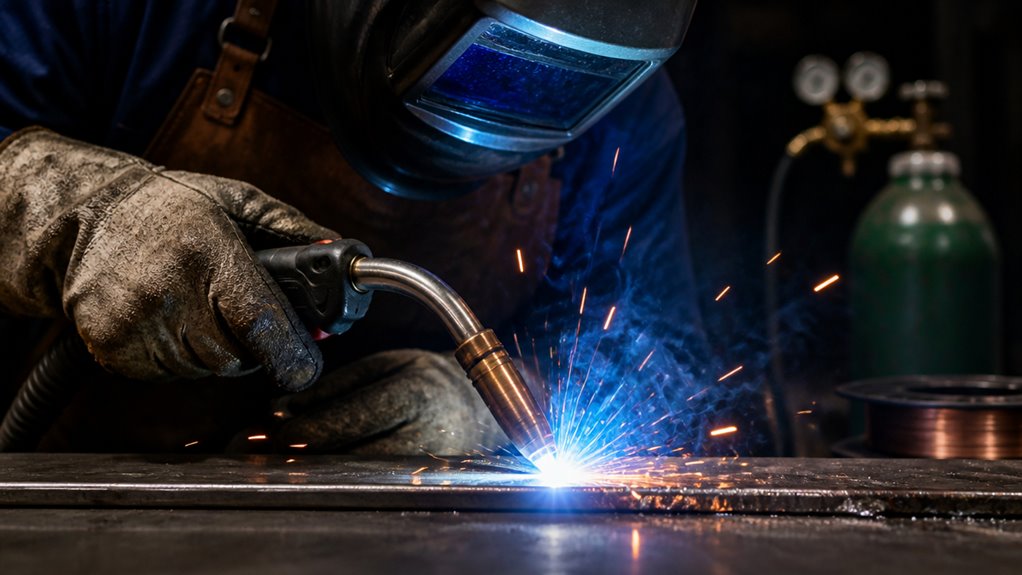
Yes, you need shielding gas when MIG welding with solid wire to protect the molten weld puddle from atmospheric contamination by oxygen, nitrogen, and hydrogen.
Without gas, you’ll get unstable arcs, porosity, increased spatter, and weak welds unsuitable for structural work.
Gas guarantees arc stability, proper metal fusion, and consistent bead quality.
Different metals require specific gas mixes and flow rates for peak results.
Understanding these details can enhance your welding performance and minimize defects.
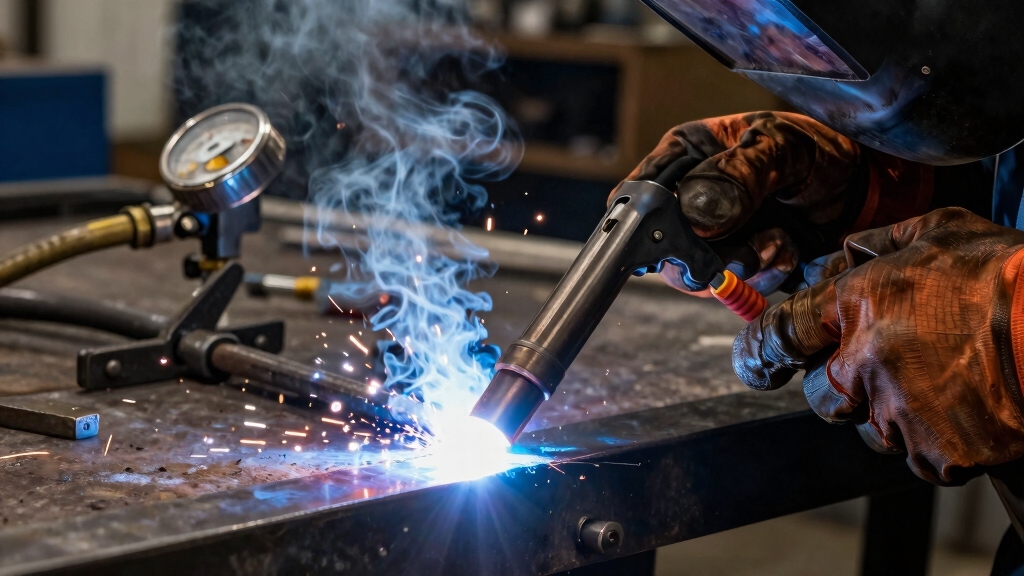
Because MIG welding relies on a molten weld puddle, it requires a shielding gas to protect this vulnerable area from atmospheric contamination.
MIG welding depends on shielding gas to safeguard the molten weld puddle from air contaminants.
The weld puddle is highly reactive and exposed to oxygen, nitrogen, and hydrogen in the air. Without shielding, these gases cause defects like porosity, oxidation, and weak weld fusion.
Shielding gas forms a protective barrier around the arc and weld pool, preventing these atmospheric gases from interfering with the metal’s solidification.
When you use solid MIG wire, it lacks internal protection, so an external gas supply is essential. Commonly, argon-based mixtures provide both arc stability and contamination prevention.
Ensuring proper shielding gas coverage directly impacts weld quality, consistency, and mechanical properties, making gas indispensable for standard MIG welding. Different gas mixtures can be selected to optimize penetration, reduce spatter, and improve arc stability depending on the metal type and thickness.
When you weld solid wire without using shielding gas, you’re basically leaving the molten weld puddle unprotected. This means it’s exposed to atmospheric gases like oxygen and hydrogen. Not a great situation, right?
This exposure can lead to some serious issues, such as porosity and weak fusion in the weld. These defects really compromise the integrity of the joint.
Plus, without the gas, the stability of the arc goes downhill. This can result in inconsistent weld quality, which isn’t what you want when you’re aiming for a strong, reliable weld.
In the end, skipping the shielding gas can lead to potential failures in your welds, and nobody wants that!
MIG welding requires an external shielding gas to protect the weld pool from contamination and ensure proper arc stability.
When you weld solid MIG wire without shielding gas, atmospheric gases like oxygen and hydrogen contaminate the molten weld puddle, causing significant defects.
Without the protective gas layer, oxygen oxidizes the weld metal, leading to excessive spatter and weak, brittle joints.
Hydrogen absorption promotes porosity, creating trapped gas pockets that compromise weld integrity.
These defects reduce mechanical strength and increase susceptibility to cracking and corrosion.
Additionally, the absence of shielding gas results in erratic arc stability, producing inconsistent bead profiles and poor fusion.
You’ll notice rough surface textures and reduced penetration depth, further degrading weld quality.
Since solid wire lacks internal flux, you can’t rely on self-shielding, making external gas essential for defect-free welds.
Welding without gas ultimately yields structurally unsound joints unsuitable for critical applications.
Using the proper shielding gas helps maintain a stable arc and prevents atmospheric contamination critical to weld quality.
Although MIG welding with solid wire offers strong joints under proper conditions, omitting shielding gas exposes the molten weld puddle to atmospheric contamination. This severely degrades weld quality.
Without the protective gas layer, oxygen, nitrogen, and hydrogen from the air react with the molten metal. This causes oxidation, porosity, and brittleness.
These contaminants introduce microscopic voids and inclusions, reducing mechanical strength and increasing susceptibility to cracking. You’ll observe spatter and inconsistent arc stability, further compromising the weld’s integrity.
Additionally, the absence of gas disrupts the arc’s shielding effect, leading to unstable arc characteristics and poor bead appearance. To maintain weld strength, ductility, and corrosion resistance, you must use an appropriate shielding gas like a 75% argon-25% CO2 mix.
Skipping gas results in compromised welds unsuitable for structural or critical applications. Proper surface preparation before welding is essential to improve strength and durability.
When you’re welding mild steel with a MIG welder, the go-to gas mixture is usually 75% argon and 25% CO2.
This combo really shines when it comes to achieving peak arc stability and top-notch weld quality.
Now, if you’re looking to save a bit of cash, pure CO2 can be a good alternative, especially for short circuit transfer.
Just keep in mind that while it’s budget-friendly, it might lead to more spatter and not-so-great bead appearance.
To keep everything running smoothly, aim for a flow rate between 15 to 20 cubic feet per hour.
This will help ensure consistent shielding and keep porosity out of your welds.
Small additions of CO2 improve arc stability and penetration, making a big difference in weld quality.
Happy welding!
Many welders prefer a 75% argon and 25% CO2 mixture, commonly known as C25, as the ideal gas blend for MIG welding mild steel. This blend optimizes arc stability, penetration, and weld bead appearance.
Argon provides a smooth, stable arc, while CO2 enhances penetration and reduces spatter. Using pure CO2 can lead to a harsher arc and increased spatter, but C25 balances these effects.
When you set your flow rate between 15 and 20 cubic feet per hour (CFH), you achieve sufficient shielding to prevent atmospheric contamination, such as oxygen or hydrogen, which cause porosity.
C25 remains the industry standard for general-purpose mild steel MIG welding, offering a reliable compromise between weld quality, cost efficiency, and ease of use in both shop and home environments.
However, for applications requiring deeper weld fusion, pure CO2 is often preferred due to its maximum penetration capabilities despite increased spatter.
While the 75% argon and 25% CO2 mix (C25) remains the preferred choice for most mild steel MIG welding, pure CO2 offers a specific set of advantages worth considering.
You’ll find pure CO2 provides deeper weld penetration and higher heat input, beneficial for thicker mild steel sections. It’s also more cost-effective compared to argon-based blends.
However, pure CO2 generates a less stable arc and increased spatter, requiring precise control of welding parameters to maintain quality. This gas is mainly suited for short circuit transfer modes and applications where penetration outweighs aesthetics.
When using pure CO2, you must anticipate a more oxidizing environment, which can affect weld bead appearance and necessitate diligent post-weld cleanup.
Ultimately, pure CO2 serves well where budget and penetration are prioritized over arc smoothness and spatter reduction. Choosing the correct polarity and wire type alongside shielding gas is essential to optimize weld quality when using pure CO2.
Although selecting the right gas mixture is vital for MIG welding mild steel, optimizing the gas flow rate guarantees consistent shielding and weld quality. For indoor welding without drafts, set your flow rate between 10 and 15 cubic feet per hour (CFH) to maintain adequate coverage without excessive gas consumption.
Generally, 15 to 20 CFH is recommended for mild steel to prevent atmospheric contamination and porosity. If you weld outdoors or in drafty conditions, increase the flow rate to 30–35 CFH to compensate for gas displacement.
Avoid exceeding necessary flow rates, as this wastes gas and can introduce turbulence, reducing weld integrity. Use a regulator with a flow gauge to monitor and adjust flow precisely, ensuring stable arc performance and crucial weld bead consistency.
Choosing the appropriate argon+CO2 blends can help reduce spatter and improve weld appearance while maintaining good penetration on mild steel.
Choosing 100% argon for aluminum MIG welding guarantees peak shielding by preventing contamination from reactive gases like oxygen and CO2.
Selecting pure argon ensures optimal shielding by blocking reactive gases during aluminum MIG welding.
Aluminum’s oxide layer is highly reactive. Exposure to oxygen or CO2 during welding causes porosity, weak welds, and poor bead appearance.
Argon’s inert properties ensure a stable arc and consistent heat transfer. This promotes smooth weld puddles without oxidation.
You must maintain a flow rate of 20–35 CFH to sustain this protective atmosphere. Aluminum’s high thermal conductivity demands sufficient shielding coverage.
Using any argon mixture containing CO2 or oxygen risks creating defects and compromising joint integrity.
Hence, strict adherence to pure argon shielding is critical to achieve structurally sound, high-quality aluminum welds with minimal post-weld cleanup.
Additionally, argon’s exceptional arc stability helps maintain consistent metal transfer and clean bead formation throughout the welding process.
Aluminum welding demands pure argon to prevent contamination, but stainless steel requires a different gas approach due to its unique alloy composition.
For ideal MIG welding on stainless steel, you’ll typically use a blend of argon with small amounts of CO2 and sometimes helium.
A common and effective mixture is 98% argon with 2% CO2, which provides adequate arc stability and penetration while minimizing oxidation.
Adding helium can enhance heat input and improve weld bead profile, especially on thicker sections, but it increases cost.
Avoid pure CO2 or high oxygen content gases, as they can cause excessive spatter and degrade corrosion resistance.
Selecting the right gas mixture for stainless steel balances arc characteristics and metallurgical integrity, ensuring a clean, defect-free weld.
Maintain gas flow at 20–30 CFH with 0.5–3 seconds post-flow to preserve the chromium oxide layer and prevent oxidation.
When you set up your MIG welder, maintaining the correct gas flow rate is critical to guarantee consistent shielding and prevent weld defects.
For mild steel indoors, aim for 10–15 cubic feet per hour (CFH). Increase to 30–35 CFH if you’re welding outdoors or in drafty environments.
Aluminum demands higher flow rates; keep a minimum of 20 CFH, with 25–35 CFH providing optimal coverage due to its reactive nature.
Stainless steel welding typically requires 20–30 CFH to ensure effective shielding, usually with argon-CO2 mixes.
Using a flow gauge regulator helps precisely set these values, avoiding under- or over-shielding, which can cause porosity or gas waste.
Adjust rates based on environmental conditions and material to uphold weld integrity without excessive gas consumption.
Frequently, welders wonder if they can skip using shielding gas during MIG welding. The answer depends on the wire type.
When you use flux-cored wire (FCAW), you can often weld without external gas because the flux inside the wire generates its own protective gas.
Here’s when skipping gas is possible:
However, remember that traditional solid wire MIG welding always requires external gas for shielding. Skipping gas only applies with flux-cored wire explicitly made for this purpose.
This ensures proper weld quality and minimizes defects.
Effectively managing MIG welding gas costs and setup maintenance requires careful attention to gas selection, flow rates, and equipment calibration.
You need to choose the best gas mixture, such as the common 75% argon/25% CO2 blend, to balance cost and weld quality.
Monitor flow rates closely. Exceeding 20–25 CFH generally wastes gas without improving results, while insufficient flow causes porosity.
Calibrate your regulator and flow gauge regularly to ensure accuracy. Inspect your gas lines and connections for leaks that can increase consumption and degrade weld integrity.
By maintaining proper setup and avoiding excessive flow, you’ll minimize gas expenses while preserving weld quality.
Regular preventative maintenance on your regulator and hoses prevents costly failures and downtime.
This keeps your MIG welding process efficient and cost-effective.
You can’t effectively do MIG welding outdoors without shielding gas because wind disperses the gas, leaving the weld exposed to contamination.
If you try, you’ll get porosity and weak joints.
To weld outdoors without external gas, you’d need flux-cored wire, which creates its own shielding gas internally.
Otherwise, you must use a higher gas flow rate or windbreaks to maintain proper shielding when using solid wire MIG welding outside.
Gas purity directly impacts your MIG weld quality by ensuring a stable arc and clean weld bead.
Impurities like oxygen or moisture introduce porosity and weaken the weld joint.
Using high-purity gases prevents atmospheric contamination, reduces defects, and improves penetration and bead appearance.
If your gas isn’t pure, you’ll see increased spatter, inconsistent arc, and weaker weld strength.
Always use certified high-purity shielding gases to achieve the best results.
Imagine the hiss of gas flowing steadily as sparks fly. Stay sharp. Always store cylinders upright and secure to prevent tipping.
Ventilate your workspace well; gas buildup can suffocate you silently. Check regulators and hoses for leaks using soapy water. Never smell the gas directly.
Use proper PPE, including gloves and eye protection, to guard against burns and UV exposure. Follow these steps precisely to guarantee safe, efficient MIG welding gas handling.
Yes, you’ll find environmental impacts vary with MIG shielding gases.
Argon and helium are inert, posing minimal environmental harm, but producing them consumes significant energy.
CO2, while used as shielding gas, is a greenhouse gas contributing to climate change.
Using 75% argon/25% CO2 blends balances weld quality and environmental footprint.
You should monitor and minimize gas consumption to reduce emissions and energy use associated with gas production and transport.
Yes, you can customize gas mixtures for unusual metals in MIG welding.
Different metals demand specific shielding gases to optimize weld quality and prevent defects.
You’ll often blend argon, CO2, helium, or oxygen in precise ratios depending on metal reactivity and thickness.
For example, aluminum needs pure argon, while stainless steel benefits from tri-mix blends.
Tailoring gas composition improves arc stability, penetration, and reduces contamination risks effectively.
You need shielding gas in MIG welding to protect the weld pool, guarantee arc stability, and achieve clean, strong welds.
Using solid wire without gas leads to contamination, spatter, and weak joints. You must choose the right gas mixture: argon for aluminum, argon-CO2 blends for mild steel, and tailored gases for stainless steel.
While flux-cored wire can sometimes skip gas, you risk quality and consistency. Manage gas flow and costs precisely for best results.