Phone:
(701)814-6992
Physical address:
6296 Donnelly Plaza
Ratkeville, Bahamas.

Phone:
(701)814-6992
Physical address:
6296 Donnelly Plaza
Ratkeville, Bahamas.

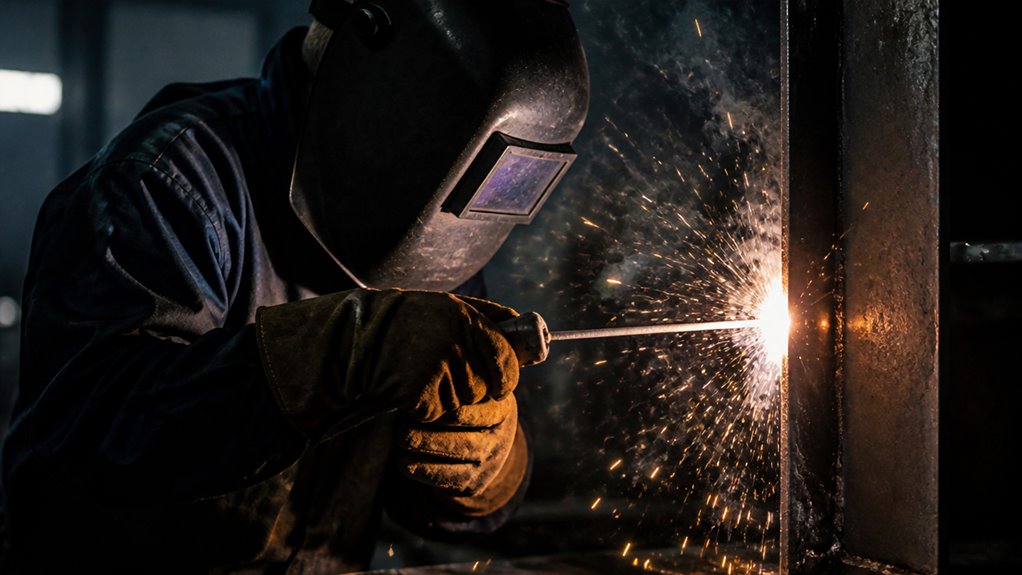
You might hear that AC is preferred for vertical and overhead welding, but it’s usually not the best choice.
AC’s alternating polarity causes arc instability, increased spatter, and inconsistent heat input. This makes weld control harder against gravity’s effects.
DC offers superior arc stability, precise heat control, and minimized molten metal sag. This optimizes weld quality in these positions.
While AC suits specific electrodes or magnetized metals, DC generally outperforms it for vertical and overhead welding. Exploring the nuances reveals why.
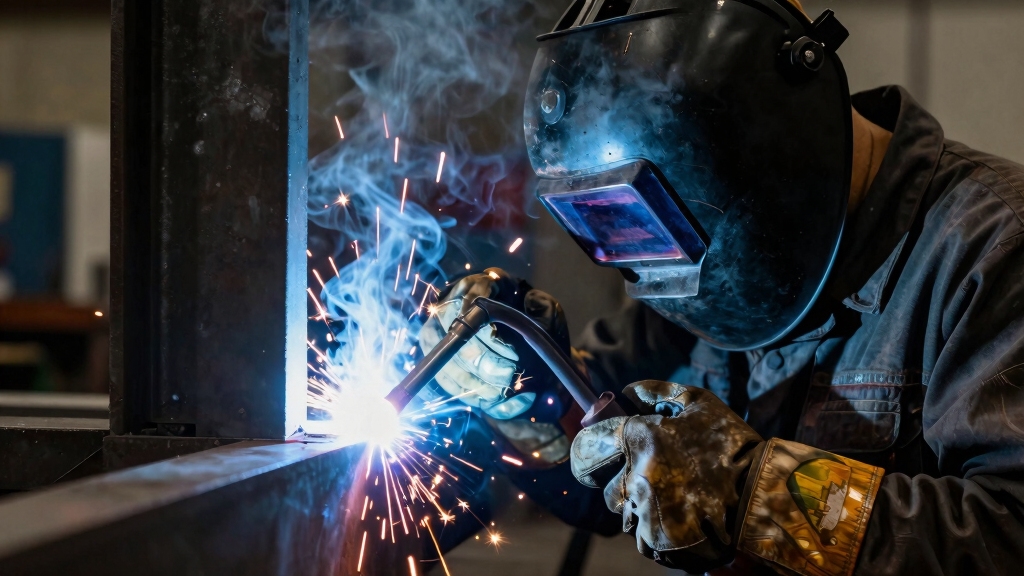
Although some welders might consider AC for vertical and overhead welding, you’ll find that DC consistently offers superior arc stability and control critical for these positions.
DC’s single-direction current guarantees a steady arc, minimizing molten metal sagging caused by gravity. This stability reduces spatter and prevents weld defects that are common when using AC, which suffers from arc fluctuations.
You’ll also benefit from DC’s precise heat input control, essential to avoid blow-through or excessive penetration in vertical or overhead seams. Additionally, DC allows you to select polarity to optimize penetration and melting rates, a capability unavailable with AC.
Its constant current characteristic ensures steady amperage despite arc length changes, making DC ideal for manual welding in challenging positions like vertical and overhead.
When you trace the roots of the AC preference myth in vertical and overhead welding, it largely stems from early welding practices and electrode design.
The AC preference myth in vertical and overhead welding originates from early practices and electrode design.
Initially, AC was favored due to its compatibility with electrodes like E6011, which minimized arc blow on magnetized materials.
This compatibility led some to generalize AC as the go-to current for all out-of-position welding.
However, this oversimplification ignored AC’s inherent arc instability and excessive spatter production, critical drawbacks for vertical and overhead work.
Additionally, early welding equipment limitations and a lack of polarity control in AC contributed to misconceptions about its effectiveness.
These historical factors combined to create a persistent myth, despite modern welding standards and technical evidence overwhelmingly endorsing DC for superior arc stability, heat control, and reduced spatter in vertical and overhead positions.
Proper polarity selection optimizes arc stability and weld quality, which is essential for challenging welding positions like vertical and overhead.
Understanding how AC welding operates in vertical and overhead positions requires examining its electrical characteristics and practical effects on the weld pool.
AC alternates current direction typically 60 times per second, causing the arc to fluctuate between electrode positive and negative. This cyclical polarity shift destabilizes the arc, leading to inconsistent heat input and molten metal flow.
As a result, you’ll notice increased spatter and less control over the weld pool’s behavior in these positions. Gravity exacerbates this challenge by pulling molten metal downward.
AC’s inherent arc instability makes containing the weld pool difficult. Moreover, the lack of polarity control restricts your ability to adjust penetration and bead shape precisely, which is critical in vertical and overhead welding.
These factors collectively limit AC’s effectiveness in such positions. In contrast, inverter welding machines provide precise arc control and rapid current adjustments that improve stability and weld quality in challenging positions.
You might come across claims that AC welding offers benefits in out-of-position welding despite its known limitations.
One perceived advantage is AC’s ability to mitigate arc blow when welding magnetized materials. This can improve arc control in certain scenarios.
Additionally, AC can deliver moderate penetration suitable for some electrode types like E6011. These are designed to operate on AC and facilitate slag removal.
Some welders also note that AC’s alternating current reduces the risk of electrode sticking in challenging positions.
Moreover, AC equipment tends to be simpler and less costly, making it accessible for fieldwork.
However, these factors don’t outweigh the technical drawbacks in vertical and overhead welding. Arc stability and spatter control are essential for quality and safety, and AC underperforms in these areas.
In contrast, electrodes like 6010 rely on DC electrode positive polarity to achieve deep penetration and arc stability critical for out-of-position welding.
You might’ve noticed that AC welding can have some challenges, especially when it comes to arc stability. The alternating current flow can create fluctuations, which can really compromise the consistency of your welds. This can be frustrating, right?
On top of that, this instability tends to lead to increased spatter. That means more cleanup work for you after welding, which isn’t exactly ideal. It can really diminish the overall quality of your project.
Although AC welding offers some advantages in specific scenarios, its inherent arc instability presents significant challenges, especially in vertical and overhead positions.
The alternating current causes the arc to fluctuate, leading to inconsistent penetration and weld defects. This instability increases the difficulty of maintaining a steady arc length, which is vital for controlling molten metal flow against gravity.
| Challenge | Impact on Welding |
|---|---|
| Arc fluctuation | Uneven heat distribution, weak fusion |
| Molten metal sag | Increased risk of weld defects |
| Control difficulty | Requires lower amperage, reduces efficiency |
This instability complicates out-of-position welding, forcing you to rely on DC for more consistent, defect-free welds in vertical and overhead applications. Understanding the role of arc stability and how voltage adjustments influence it can help optimize welding parameters despite these challenges.
The arc instability inherent in AC welding not only disrupts heat distribution but also contributes materially to excessive spatter generation.
Because the current alternates direction, the arc fluctuates in intensity, causing inconsistent metal transfer and droplet detachment.
This instability results in erratic molten metal ejection, increasing spatter volume.
Excessive spatter complicates vertical and overhead welding by contaminating the work area and requiring extensive post-weld cleanup, reducing efficiency.
Unlike DC, which maintains a stable arc and controlled metal transfer, AC’s inherent oscillations prevent you from achieving smooth weld pools in these positions.
Consequently, you face higher defect risk from spatter-induced inclusions or porosity.
Managing these issues demands lower amperage settings and electrode type restrictions, limiting AC’s practical use in out-of-position welding where precise control and cleanliness are paramount.
Furthermore, the need for consistent arc length is critical to reduce spatter and maintain weld quality in semiautomatic processes.
When welding overhead with E6011 electrodes on AC, you must reduce the amperage by about 15% compared to flat position settings to control the molten metal flow effectively.
This amperage adjustment compensates for the increased gravitational pull on the molten weld pool, minimizing sagging and drip. E6011’s cellulosic coating provides deep penetration and arc stability on AC.
However, the alternating current’s inherent fluctuations require careful parameter tuning. You should also fine-tune the AC balance control, if available, to optimize arc force and minimize spatter.
Maintaining a tight arc length and steady travel speed further aids molten metal control. Despite these adjustments, AC’s arc instability limits overall overhead weld quality compared to DC.
These settings are critical to mitigate AC’s drawbacks when using E6011 electrodes overhead.
Additionally, the fast-freezing slag characteristic of E6011 rods helps reduce slag sagging and dripping during vertical and overhead welding, improving weld quality under challenging conditions.
Since aluminum requires higher temperatures to weld effectively, you’ll find AC indispensable for aluminum applications due to its ability to clean the oxide layer and maintain stable arc conditions.
AC’s alternating polarity continuously breaks up aluminum oxide, exposing fresh metal and ensuring proper fusion. This cleaning action is critical, as aluminum oxide’s high melting point impedes weld quality.
Additionally, AC balances penetration and cleaning, optimizing weld bead formation on aluminum. For magnetized materials, AC is preferred because it neutralizes arc blow, a magnetic deflection problem common with DC welding.
Modern inverter-based AC TIG welders also enhance this process by offering precise arc control and reducing distortion for superior weld quality.
Mastering vertical and overhead welding demands precise control over arc stability and heat input. Here, DC clearly outperforms AC.
DC’s single-direction current guarantees a stable arc, minimizing arc fluctuations that cause spatter and weld defects common with AC’s alternating flow.
This stability allows you to control heat input precisely, preventing molten metal sagging or blow-through in gravity-challenged positions.
Additionally, DC’s reduced spatter production means cleaner welds and less post-weld cleanup, essential when working overhead or vertically.
You can also select polarity with DC to optimize penetration and deposition rates, a control AC lacks.
While AC fluctuates and destabilizes the arc, DC delivers consistent performance, making it the superior choice for maintaining weld quality and structural integrity in these demanding positions.
Although both AC and DC currents have their applications, you’ll find DC is generally the preferred choice for vertical welding due to its superior arc stability and control.
When deciding, consider spatter, arc stability, and electrode compatibility. AC may suit magnetized metals or specific electrodes like E6011 but requires amperage adjustment and yields more spatter.
DC offers precise heat control and reduced defects, essential for vertical weld integrity.
Soldering tools, unlike welding equipment, cannot provide the necessary temperatures above 1000°C required for true metal fusion in welding.
| Factor | AC Current | DC Current |
|---|---|---|
| Arc Stability | Fluctuates, less control | Consistent, superior control |
| Spatter | High, complicates finishing | Low, cleaner welds |
| Electrode Use | Limited (e.g., E6011) | Broad compatibility |
| Heat Input Control | Less precise, risk of sagging | Precise, prevents blow-through |
| Application Range | Specialized cases | Standard for vertical welding |
Yes, you can convert AC welding equipment for DC use in vertical welding, but it often requires adding a rectifier to change AC to DC.
This modification improves arc stability and control, essential for vertical positions. However, be aware that not all AC machines are designed for easy conversion, and costs might outweigh benefits.
Make sure your equipment supports DC output and polarity control to optimize weld quality in vertical applications.
Safety first, as the old adage goes. When welding overhead with AC versus DC, your core protective gear—helmet, gloves, jacket—remains the same.
However, AC’s higher spatter and arc instability mean you’ll want enhanced flame-resistant clothing and a full face shield to guard against flying debris.
DC’s stable arc reduces spatter, letting you focus more on heat control and less on splash protection.
Always maintain rigorous PPE standards for both.
You’ll find welding speed generally slower with AC in vertical applications due to arc instability and increased spatter. This forces you to slow down for control and cleanup.
With DC, you can weld faster because the arc is stable and produces less spatter. This allows smoother metal flow against gravity.
This stability lets you maintain consistent bead placement and penetration, improving overall efficiency and weld quality in vertical positions.
Yes, you’ll find cost differences between electrodes for AC and DC welding.
Electrodes designed for DC, like low-hydrogen types, tend to be pricier due to their enhanced performance and stability in vertical welding.
AC electrodes, such as E6011, are generally less expensive but require amperage adjustments and produce more spatter, increasing cleanup costs.
You’ll notice AC welding creates more spatter and an unstable arc in overhead jobs, which directly worsens weld appearance.
This instability often results in uneven bead profiles and increased surface roughness, making cleanup tougher.
In contrast, DC welding delivers a stable arc and reduced spatter, producing cleaner, smoother welds.
When welding vertical or overhead, you should know that 70% of professionals prefer DC for its superior arc stability and reduced spatter.
While AC has been traditionally favored, especially with E6011 electrodes, its limitations often compromise weld quality and efficiency.
Understanding these technical nuances helps you optimize settings and electrode choice.
By prioritizing DC, you’ll achieve cleaner, stronger welds with fewer defects, enhancing both productivity and structural integrity in challenging positions.