Phone:
(701)814-6992
Physical address:
6296 Donnelly Plaza
Ratkeville, Bahamas.

Phone:
(701)814-6992
Physical address:
6296 Donnelly Plaza
Ratkeville, Bahamas.

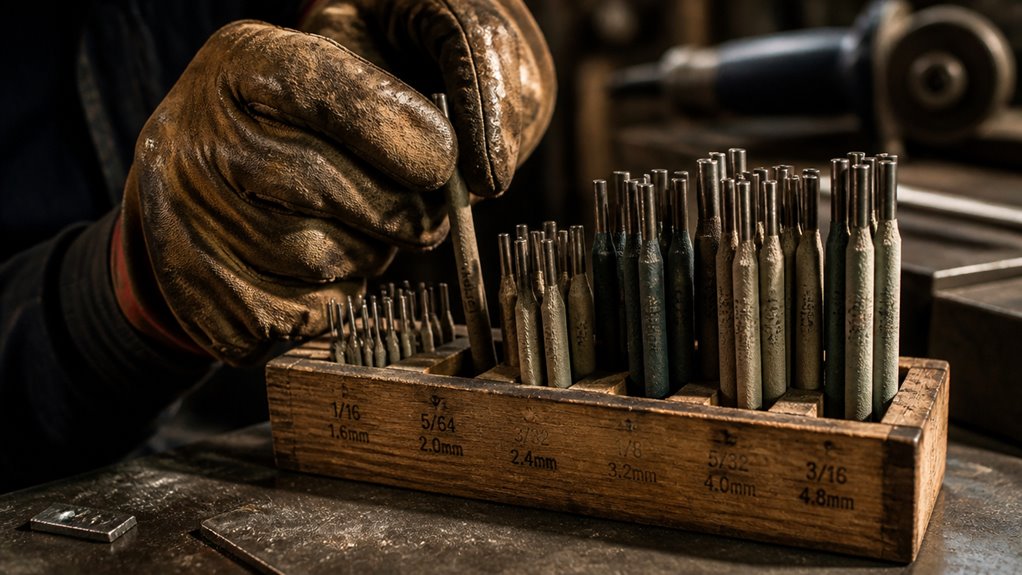
To select the right welding electrode, first identify your base metal type using magnetism and spark tests.
Then assess its tensile strength and thickness.
Match the electrode’s tensile rating and alloy composition to your metal, ensuring compatibility with your power source and welding position.
Choose electrode coatings tailored to penetration and service conditions, adjusting size and amperage accordingly.
Avoid weak or incompatible electrodes to secure durable, crack-resistant welds.
Understanding these fundamentals will enhance your weld quality and performance.
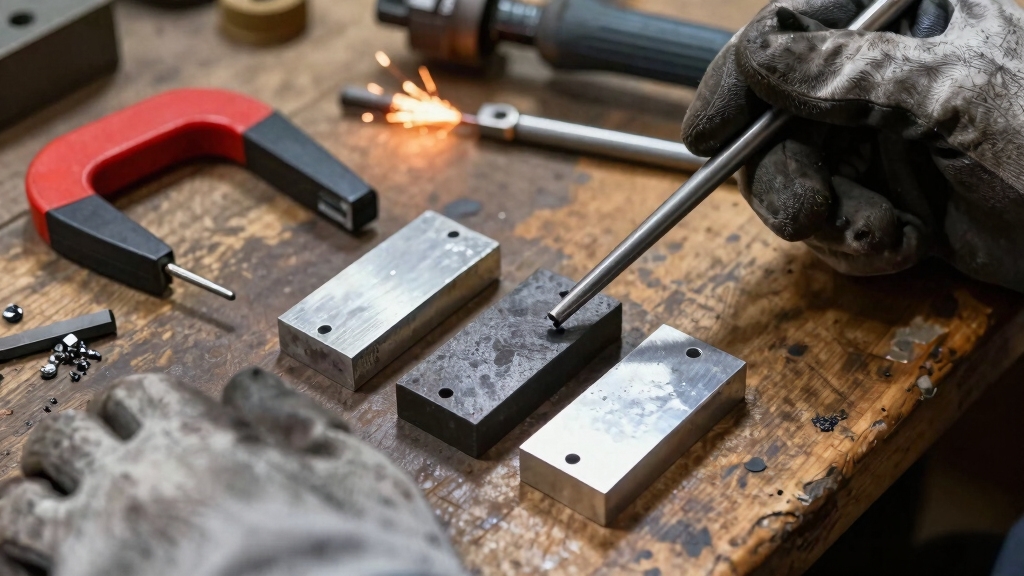
Start by applying simple physical tests to accurately identify base metal types before selecting welding electrodes.
You can quickly distinguish carbon steel from non-ferrous alloys using magnetism. Carbon steel is magnetic, while aluminum and stainless steel generally are not.
Examine the metal’s surface for visual clues. Color and texture variations often indicate alloy composition.
Conduct a spark test by grinding a small area and observing the spark pattern. Steel alloys produce distinct spark characteristics compared to aluminum or copper.
These tests provide initial confirmation of the base metal category, essential for matching electrode composition.
Avoid relying solely on appearance. Combining magnetism and spark tests enhances accuracy in identifying base metals, ensuring you choose an electrode compatible with the metal’s chemical and mechanical properties.
For critical applications, such as pinning and welding a flash hider, selecting an electrode compatible with the barrel material is crucial for weld integrity and safety.
To choose the right electrode, you first need to take a close look at the tensile strength and thickness of the base metal. This step is crucial because the electrode you select should ideally match or even exceed the mechanical properties of the base metal. By doing this, you’ll help prevent issues like weld cracking and failure down the line.
Now, let’s talk about thickness. If you’re working with thicker metals, you’ll want to opt for larger diameter electrodes. This is important because larger electrodes are better equipped to achieve the necessary penetration and fusion for a strong weld. So, keep these factors in mind as you make your electrode selection! Proper electrode selection is guided by electrode classification codes that indicate tensile strength, welding position suitability, and coating type.
Evaluate the base metal’s tensile and yield strengths carefully to guarantee the selected electrode meets or exceeds these values, preventing weld cracking and structural failure. You must verify the base metal’s mechanical properties through documentation or testing to establish accurate strength parameters.
Match the electrode’s tensile strength rating, indicated by the AWS classification, with or above the base metal’s tensile strength to secure compatibility and durability. Consider yield strength to anticipate elastic deformation limits during service. Overlooking strength mismatches risks weak welds or brittle fractures.
Additionally, account for the base metal’s alloy composition, as certain alloys require electrodes with specific mechanical properties or chemical compatibilities to maintain integrity. By rigorously evaluating these factors, you make certain the electrode selection supports reliable, high-performance welds under operational stresses.
Selecting electrodes with proper low-hydrogen characteristics can enhance toughness and reduce cracking in thick structural steels.
Consider the base metal’s thickness as a critical parameter when selecting electrode diameter and welding settings. You should choose an electrode core wire diameter that corresponds to the material thickness, generally at least three-quarters of the base metal thickness or a minimum of 3/16 inch for thinner metals.
Thicker metals require larger diameter electrodes to maintain proper penetration and fusion without excessive heat input. Additionally, adjust amperage settings to match the electrode size. Larger diameters demand higher amperage, while smaller electrodes suit thin materials to prevent burn-through.
Precise matching prevents weld defects like cracking or incomplete fusion. By evaluating thickness alongside base metal strength, you guarantee peak electrode selection that balances weld quality, efficiency, and structural integrity.
It is also important to consider the amperage-by-thickness rules to ensure the amperage setting delivers adequate penetration without causing burn-through or spatter.
When selecting a welding electrode, matching its composition to the base metal is critical to guarantee weld integrity and compatibility.
You need to confirm the base metal type—steel, stainless steel, or aluminum—and choose an electrode with a corresponding alloy composition to avoid metallurgical incompatibilities.
Analyze the base metal’s chemical properties, especially carbon content and alloying elements, since these affect weldability and potential cracking.
Also, assess mechanical properties like tensile and yield strength to guarantee the electrode’s filler metal can provide adequate strength.
Use physical tests, such as magnetism, to distinguish carbon steel from non-ferrous metals.
Additionally, selecting an electrode with the appropriate core metal ensures metallurgical compatibility and optimal weld performance.
Alright, let’s dive into decoding those AWS electrode codes! So, the first two digits? They tell you the tensile strength ratings, which are super important for matching the base metal you’re working with.
Once you’ve got that figured out, the next step is to check if the electrode’s minimum tensile strength meets or even exceeds that of the base metal. Why is this important? Well, it’s all about ensuring your weld’s integrity. You definitely want to avoid any potential issues down the line!
Now, don’t forget about that fourth digit! It’s crucial for confirming compatibility with your welding current type. This little detail can really help optimize your arc stability and overall performance in your welding project. So, keep an eye on that!
Also, the third digit indicates the welding positions supported by the electrode, which is key to matching your welding technique and joint orientation.
How do the digits in an AWS electrode code inform your welding choices? The first two digits specify the minimum tensile strength in ksi. This guides you to select an electrode that meets or exceeds your base metal’s strength requirements.
This guarantees weld integrity and prevents cracking. The third digit indicates the welding position suitability, whether you can weld flat, vertical, or overhead.
The fourth digit identifies the compatible current type: AC, DC+, or DC–. This is critical for matching your power source to maintain arc stability.
By analyzing these code digits precisely, you avoid mismatches that compromise weld quality. Understanding AWS code digits lets you systematically align electrode properties with mechanical requirements and power sources.
This optimizes weld performance and structural reliability without guesswork. Ensuring that the electrode selection aligns with a qualified Welding Procedure Specification is essential for maintaining consistent weld quality and code compliance.
Although selecting an electrode may seem straightforward, decoding the AWS electrode code is essential to match tensile strength ratings accurately.
You need to interpret the first two digits of the AWS classification, which define the minimum tensile strength in ksi (thousand pounds per square inch) of the deposited weld metal. This guarantees the electrode’s strength meets or exceeds the base metal, preventing weld failure.
For example, AWS 6010 indicates 60 ksi tensile strength. Use the table below to visualize common strength ratings:
| AWS Code | Tensile Strength (ksi) | Application Example |
|---|---|---|
| 6010 | 60 | Carbon steel welding |
| 7018 | 70 | Structural steel |
| 8010 | 80 | High-strength alloys |
Always verify tensile strength compatibility before final electrode selection. The final digit in the AWS code also indicates important features such as the low-hydrogen flux coating in 7018 electrodes, which improves weld quality and reduces cracking risk.
After confirming the tensile strength requirements through the AWS classification, the next step involves identifying the compatible current types for your electrode.
Focus on the fourth digit of the AWS code, which specifies the suitable welding current: AC, DC positive (DCEP), DC negative (DCEN), or both.
Selecting an electrode compatible with your power source guarantees optimal arc stability and weld quality.
For example, a “1” in the fourth digit often indicates AC and DC capability, while a “2” or “4” specifies DC positive or negative, respectively.
You must also verify that your amperage settings align with the electrode’s core wire diameter and current type.
Incorrect matching can cause poor penetration, excessive spatter, or arc instability, compromising weld integrity.
Power source selection shapes welding process like a conductor orchestrating heat and control for optimal results.
Electrode coatings play a critical role in determining weld quality, arc stability, and slag formation. Selecting the right coating type is essential for your specific welding application. Different coatings affect arc characteristics, weld penetration, and slag removal efficiency, directly impacting the mechanical properties of the weld.
Consider these key coating types:
Choose coatings aligned with your base metal, welding position, and desired weld attributes to optimize performance. Cellulosic coatings, in particular, create a forceful spray-type arc that enhances penetration and cleaning action, making them ideal for pipeline and structural welding applications.
Coating selection influences how well your electrode performs under various welding positions and joint configurations. You need electrodes designed for flat, horizontal, vertical, or overhead welding to maintain arc stability and control.
Additionally, consider joint types. V joints demand more filler metal and penetration than butt joints, requiring electrodes that deliver sufficient deposition rates. Proper electrode choice prevents weld discontinuities and assures mechanical integrity.
| Welding Position | Recommended Electrode Type |
|---|---|
| Flat | High deposition, fast-freeze coating |
| Horizontal | Cellulosic or rutile for arc control |
| Vertical | Low spatter, fast freeze coatings |
| Overhead | Low slag, stable arc coatings |
| Joint Type | Electrode adjusted for filler volume |
Match electrode capabilities precisely to position and joint demands for peak weld quality.
When selecting welding electrodes, you must guarantee they match your power source’s output type, whether AC, DC, or both, to maintain stable arc performance and weld quality. Mismatched electrodes can cause arc instability, excessive spatter, or poor penetration.
Check the electrode’s AWS classification, focusing on the fourth digit, which indicates compatible current types. Also, verify that your power source can supply sufficient amperage for the electrode size to avoid underperformance or damage.
Consider these factors for compatibility:
This precision guarantees peak arc stability and weld integrity.
When you’re choosing an electrode core wire diameter, aim for one that’s at least three-quarters the thickness of your material. This helps ensure you get the proper penetration.
Now, let’s talk about amperage settings. You’ll want to adjust these based on the size of your electrode. If you’re using a larger diameter, increase the current to keep that arc stable. This little tweak can really make a difference!
Efficiency in welding depends markedly on choosing the correct core wire diameter for the electrode, especially relative to the material thickness. Selecting an appropriate diameter guarantees peak penetration and weld quality while preventing defects like burn-through or inadequate fusion.
Thicker materials demand larger core wires to sustain higher amperage and deeper weld pools. Thinner metals require smaller diameters to avoid excessive heat input.
Consider these factors when selecting core wire diameter:
Selecting the correct amperage setting goes hand in hand with choosing the appropriate electrode size for the material thickness. You need to increase amperage as the electrode diameter grows to ensure proper melting and fusion without causing defects.
Using too high amperage on thin materials risks burn-through. Too low amperage on thick materials leads to poor penetration.
| Electrode Diameter (in) | Recommended Amperage Range (A) |
|---|---|
| 1/16 | 30 – 70 |
| 3/32 | 70 – 130 |
| 1/8 | 130 – 200 |
Adjust amperage within the range based on electrode type and welding position for optimal arc stability and weld quality.
When working with varying material thicknesses, adjusting electrode size and amperage is essential to achieve proper weld penetration and avoid defects. Thicker materials require larger electrode diameters and higher amperage to guarantee full fusion. Thinner materials demand smaller electrodes and lower amperage to prevent burn-through. You must precisely match these parameters to the material thickness to maintain weld integrity and mechanical performance.
Select an electrode core wire diameter at least three-quarters of the material thickness. Increase amperage proportionally with electrode size to maintain stable melting. Use smaller electrodes and reduced amperage for thin materials to avoid holes. Make sure amperage aligns with electrode type specifications for peak arc stability.
This analytical approach safeguards against under-penetration and excessive heat input.
Because service conditions directly impact weld performance and longevity, you need to carefully evaluate the operating environment before choosing an electrode.
Assess factors like corrosion exposure, temperature extremes, and mechanical stresses the weld will endure.
Select electrodes with chemical compositions and coatings designed to resist anticipated corrosive agents.
For high-temperature applications, choose electrodes formulated to maintain strength and ductility under thermal cycling.
Consider cyclic loading and fatigue stresses by opting for electrodes that provide the necessary flexibility and toughness to prevent crack propagation.
Match electrode mechanical properties, such as tensile strength, yield strength, and ductility, to those required by the service conditions.
This analytical approach guarantees durability and minimizes weld failure risks.
It enables you to deliver reliable, long-lasting welds tailored to specific environmental challenges.
Although electrode selection may seem straightforward, overlooking critical factors can lead to poor weld quality and costly rework. You must avoid common mistakes by carefully analyzing base metal properties, welding position, and power source compatibility.
Misjudging these elements risks weld defects, insufficient penetration, or cracking.
Key mistakes to avoid include:
Using electrodes with tensile strength below the base metal’s minimum, causing weak joints.
Selecting incompatible electrodes for the welding current type, reducing arc stability.
Ignoring joint configuration and choosing electrodes unable to deliver required penetration.
Overlooking service environment conditions, leading to premature corrosion or fatigue failure.
You need to store electrodes in a dry, controlled environment. Moisture absorption degrades coating integrity, leading to weld defects like porosity and cracking.
Humidity and temperature fluctuations accelerate deterioration, reducing shelf life and performance. Keep electrodes sealed in airtight containers and use heated storage ovens if necessary.
Proper storage maintains coating chemistry and guarantees consistent arc stability, penetration, and mechanical properties. This is essential for reliable weld quality.
You should always wear proper PPE, including gloves, safety goggles, and flame-resistant clothing, to protect against sparks and UV radiation.
Handle electrodes with dry hands to avoid contamination and maintain coating integrity.
Store electrodes in a dry, controlled environment to prevent moisture absorption, which can cause weld defects.
Assure proper ventilation to avoid inhaling fumes.
Finally, keep electrodes away from flammable materials and verify power is off before changing electrodes to prevent electric shock.
Just like a classic typewriter demands fresh ribbons, welding electrodes typically can’t be reused once consumed.
You can’t reliably recondition them because their coating deteriorates and core wire oxidizes after exposure to heat and air.
Reusing electrodes risks poor arc stability and compromised weld integrity.
Instead, discard spent electrodes and select new ones that match your base metal and welding conditions to guarantee consistent performance and structural soundness.
Electrode moisture content critically affects weld quality by causing hydrogen-induced cracking and porosity.
When electrodes absorb moisture, water vapor decomposes during welding, releasing hydrogen that compromises weld integrity.
You’ll see increased spatter, arc instability, and weld defects.
To maintain quality, store electrodes in dry conditions and bake them according to manufacturer recommendations before use.
Controlling moisture prevents weld brittleness and guarantees consistent mechanical properties in the finished joint.
You must dispose of used welding electrodes as hazardous waste due to potential heavy metal and chemical contamination.
Follow local environmental regulations strictly. Never discard electrodes in regular trash or drains.
Store them in labeled, sealed containers to prevent leaching. For flux-coated electrodes, avoid airborne dust during handling.
Consult Material Safety Data Sheets (MSDS) for specific disposal instructions.
Coordinate with certified waste management services to ensure compliant, safe electrode disposal.
If you don’t nail electrode selection, your weld might just crumble like a house of cards in a hurricane.
You’ve got to match metal types, decode AWS codes, and dial in amperage with surgical precision.
Overlooking coating or power compatibility? That’s a recipe for disaster.
Get it right, and your welds will stand tougher than steel giants.
So, don’t guess; analyze, select, and conquer every weld with absolute confidence every single time.