Phone:
(701)814-6992
Physical address:
6296 Donnelly Plaza
Ratkeville, Bahamas.

Phone:
(701)814-6992
Physical address:
6296 Donnelly Plaza
Ratkeville, Bahamas.

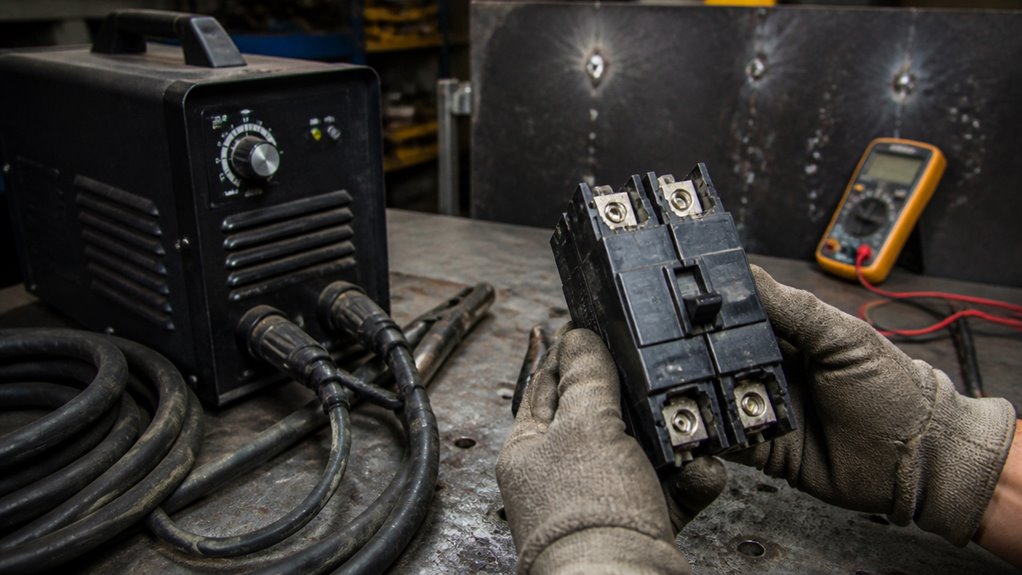
For a 220V welder, size your breaker at 125% of the welder’s maximum current draw to handle inrush surges safely and prevent nuisance trips.
Typically, you’ll use a 50-amp breaker paired with 6 AWG copper wire, but adjust this if your welder’s duty cycle is low or high, applying corresponding multipliers.
Make certain your wiring gauge matches the breaker to avoid overheating and comply with NEC codes. Understanding these factors helps you optimize safety and performance.
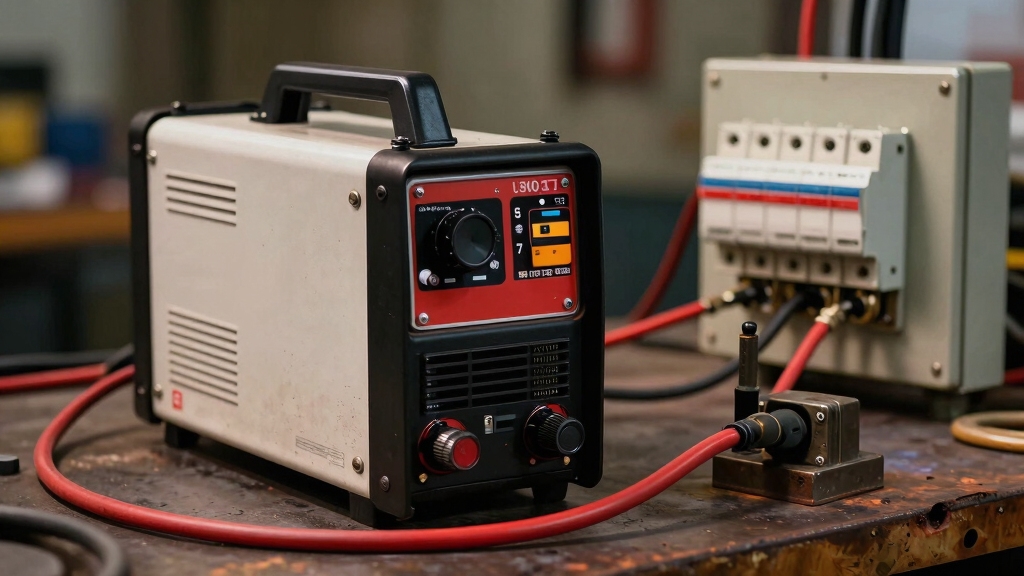
When calculating the breaker size for your 220V welder, start with the welder’s maximum current draw.
Apply a safety multiplier of 125%. For example, if your welder’s max current is 40 amps, multiply 40 by 1.25 to get 50 amps.
Use a 125% safety multiplier on your welder’s max current to determine the appropriate breaker size.
This means you should use a 50-amp breaker to guarantee safe operation. Most 220V welders require breakers between 30 and 40 amps, but larger units may need 40 or 50 amps.
Dual-voltage welders using 220V input typically require a 50-amp breaker rated for 240V.
Always verify the amp requirements in your welder’s manual before selecting a breaker. Choosing the correct breaker size protects your equipment and wiring from overload or damage.
Matching the breaker size to the appropriate wire ampacity ensures safe operation and prevents overheating or fire hazards.
Selecting a breaker size at 125% of your welder’s maximum current guarantees the circuit can handle temporary surges without tripping unnecessarily.
Welders often draw momentary inrush currents during startup, which are higher than their steady operating current.
If your breaker matches the max amps exactly, it risks nuisance trips during these spikes.
By sizing the breaker at 125% of the max amps, you ensure it tolerates these brief surges while still protecting the wiring and equipment from sustained overloads.
This multiplier aligns with electrical codes and manufacturer guidelines, balancing safety and operational reliability.
Ignoring the 125% rule can lead to frequent breaker trips or, worse, overheating and fire hazards due to undersized protection.
Always verify your welder’s max current and adhere strictly to this sizing principle.
Additionally, following the NEC 200% rule helps accommodate surge currents while ensuring the breaker size does not exceed receptacle ratings.
When it comes to using your 220V welder, matching the wiring gauge to the breaker size is super important for safety and efficiency.
So, what does that look like? Well, typically, you’d want to use 10-gauge wire with a 30-amp breaker.
If you’re stepping it up to a 40-amp breaker, then 8-gauge wire is the way to go.
And for those using a 50-amp breaker, you’ll need to grab some 6-gauge wire.
Using the right gauge is crucial, as it helps prevent overheating and keeps you in line with electrical codes.
It’s all about keeping your welder—and yourself—safe while you work!
Always ensure to maintain a 25–30% safety margin to prevent voltage drops and overheating during extended operations.
Although breaker size is critical for safety, matching the correct wiring gauge is equally important to prevent overheating and guarantee reliable operation.
Using an undersized wire can cause excessive heat buildup, risking fire and equipment failure. Here’s how to match wiring gauges to breaker sizes for 220V welders:
Always adhere to NEC guidelines, which limit 10 AWG copper wire to 30 amps maximum.
Correct wire sizing guarantees compliance, prevents voltage drops, and maintains welder performance under load. When selecting wiring and breakers, consider the welder’s duty cycle and output capacity to ensure the electrical system supports continuous or heavy use safely.
Matching the correct wiring gauge to your breaker size guarantees safe and efficient operation of 220V welders. You must select wiring that supports the breaker’s amperage to prevent overheating and assure compliance with electrical codes.
For example, a 30-amp breaker pairs with 10-gauge wire, while a 50-amp breaker requires 6-gauge wire. Always confirm the welder’s current draw and select a breaker rated at 125% of that value.
| Breaker Size (Amps) | Wire Gauge (Copper) | Voltage |
|---|---|---|
| 30 | 10 | 220V |
| 40 | 8 | 220V |
| 50 | 6 | 220V/240V |
This compatibility assures safe operation and protects your equipment from electrical faults. Properly matching your electrical setup also supports maintaining stable arc stability and consistent welding performance.
When selecting a breaker size for your welding machine, duty cycle plays a critical role in determining the appropriate amperage rating.
The duty cycle reflects how long your welder can operate within a 10-minute period without overheating. A higher duty cycle demands a larger breaker to handle continuous current.
Consider these duty cycle categories:
Adjusting breaker size based on duty cycle guarantees safe operation and protects your equipment from overload or nuisance trips. Proper breaker sizing also ensures compatibility with the welder’s thermal protection features to maintain reliable performance.
Understanding the duty cycle helps you determine the appropriate breaker size, but selecting the correct breaker also depends on the type of 220V welder you use.
MIG welders typically require 30-amp to 40-amp breakers, suitable for most standard applications.
Stick welders often demand higher capacity, with common models needing 40-amp to 50-amp breakers depending on their power draw.
Portable 110V welders generally use 20-amp breakers, but for 220V stick welders, a 50-amp breaker is common due to higher current demands. Always make certain your breaker size doesn’t exceed 125% of the welder’s maximum current rating.
Matching the breaker with proper wiring gauge—10 AWG for 30 amps, 8 AWG for 40 amps, and 6 AWG for 50 amps—is vital for safety and performance.
Keep in mind that machine derating on 120V means 220V welders can often deliver higher amperage safely without overheating, influencing breaker size choices.
When you’re using dual-voltage welders, it’s important to choose the right breaker size to ensure everything runs smoothly. Typically, you’ll be looking at around 50 amps for 220V or 240V input.
Now, don’t forget about the 125% safety multiplier! It’s a smart move to apply this to your welder’s maximum current. This helps you avoid those annoying nuisance trips and keeps everything operating safely.
Also, make sure your wiring gauge is up to par. For a 50-amp breaker, you’ll need 6 AWG wire. This is crucial for complying with electrical standards and preventing any overheating issues.
Remember to account for startup power surges by adding 30–50% extra capacity to your breaker size to handle inrush currents safely.
Although dual-voltage welders can operate on different input voltages, you need to select a breaker size based on the higher voltage requirement to assure safe and reliable performance.
This approach prevents undersized protection and potential hazards.
For dual-voltage welders using 220V or 240V, breakers must accommodate the maximum current at these voltages, often requiring a 50-amp breaker rated for 240V.
Consider these points when sizing breakers for dual-voltage welders:
It is also important to account for the CC and CV welding power supply characteristics, as their current and voltage behaviors can influence the electrical load and protection requirements.
Since dual-voltage welders often experience varying duty cycles and inrush currents, you need to apply safety multipliers to select an appropriate breaker size.
Start by identifying the welder’s maximum current draw and multiply by 1.25 to comply with standard safety margins.
If your welder operates with a low duty cycle, use a multiplier of 1.3 times its KVA rating.
Medium duty cycles require 1.6, and high-duty cycles call for 2.0.
These adjustments guarantee the breaker can handle startup surges and continuous loads without nuisance tripping.
When sizing breakers for dual-voltage machines, always choose the next breaker size above the calculated rating if the result isn’t standard.
This is especially important for 220/240V welders that commonly need 50-amp breakers to accommodate their inrush currents safely.
Including a 25–30% safety margin on running watts helps prevent voltage drops and tripped breakers during welding startup surges.
Choosing the correct wiring gauge is critical to safely supporting the breaker size for dual-voltage welders. If you opt for a larger breaker, your wiring must handle the increased current without overheating or voltage drop.
Here’s when you should choose a larger breaker and adjust wiring accordingly:
Always match wiring gauge to breaker size to maintain safety and performance under dual-voltage conditions.
You shouldn’t use a standard household breaker for a 220V welder because those breakers typically handle 15-20 amps, which is insufficient.
Welders usually require 30-50 amp breakers depending on the model’s amperage draw.
Using an undersized breaker risks frequent trips or wiring damage.
Always match the breaker size to your welder’s current rating and follow NEC guidelines.
This ensures proper wire gauge and breaker capacity for safe, reliable operation.
Breaker trip curves dictate how quickly a breaker trips under different overcurrent conditions.
For your welder, a breaker with a suitable trip curve prevents nuisance tripping during startup surges but still protects against real faults.
Slow-trip curves handle inrush currents better, maintaining stable welding performance.
Using a breaker with an incompatible curve can cause frequent interruptions or insufficient protection, impacting weld quality and safety.
Always match trip characteristics to your welder’s electrical demands.
Imagine you’re welding outdoors in a damp environment.
Using a GFCI breaker protects you from electrical shock by quickly cutting power if it detects ground faults.
While not always mandatory for 220V welders, GFCI breakers are highly recommended in wet or outdoor settings.
They enhance safety, especially with portable welders.
Check local codes, but adding GFCI protection is a smart, proactive safety measure for your 220V welder setup.
You should regularly inspect breaker panels for signs of wear, corrosion, or overheating, especially near welder connections.
Tighten all terminal screws to prevent arcing. Clean dust and debris to maintain airflow and prevent shorts.
Test breakers periodically to verify they trip correctly under load. Monitor for unusual noises or heat during welding.
Follow manufacturer guidelines and consult an electrician if you notice irregularities or after any welding equipment upgrades.
Imagine your welding arc flickering like a candle in the wind. That’s what an improperly sized breaker can cause.
Yes, breaker size directly affects arc stability. If the breaker is too small, it trips frequentlys interrupting current flow.
Too large, and it risks overheating circuits. You need a breaker rated at 125% of your welder’s max current to guarantee smooth, consistent amperage.
This maintains a stable, reliable arc during welding.
When you match your 220V welder’s breaker size to 125% of its max amps, you assure safety and efficiency. The correct wire gauge perfectly supports the breaker’s load.
Understanding duty cycles helps you avoid overloads. Choosing the right breaker size prevents nuisance trips.
By following these guidelines, you’ll keep your welder running smoothly, avoiding downtime and damage. This ensures your welding projects are consistently reliable and safe.