Phone:
(701)814-6992
Physical address:
6296 Donnelly Plaza
Ratkeville, Bahamas.

Phone:
(701)814-6992
Physical address:
6296 Donnelly Plaza
Ratkeville, Bahamas.

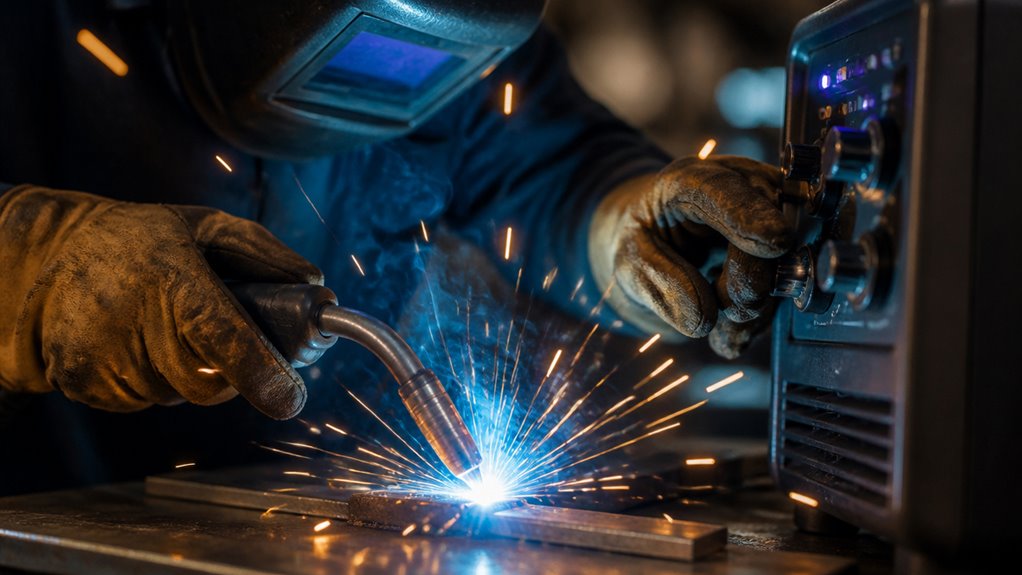
You control weld quality by balancing amperage and voltage precisely.
Amperage governs heat input, penetration depth, and electrode melt rate, vital for fusion and strength.
Voltage sets arc length and shapes the bead profile, affecting bead width and stability.
Too high amperage risks burn-through; too low causes weak fusion.
Excessive voltage widens and flattens the bead, while low voltage narrows it but increases penetration.
Mastering this balance guarantees defect-free, strong welds and peak arc behavior.
Exploring these details reveals key welding adjustments.
| Feature | Amperage (Current) | Voltage |
|---|---|---|
| Primary Function | Controls heat input and penetration | Controls arc length and bead profile |
| Measured In | Amps (A) | Volts (V) |
| Direct Effect | Determines electrode melt rate and weld penetration | Determines arc stability and weld bead width |
| Higher Setting Results | Deeper penetration, more heat | Longer arc, wider and flatter bead |
| Lower Setting Results | Shallower penetration, weaker fusion | Shorter arc, narrower and deeper bead |
| Impact on Weld Strength | Strongly affects fusion and structural integrity | Indirectly affects strength through bead shape |
| Too High Can Cause | Burn-through, excessive penetration | Undercut, excessive bead flattening |
| Too Low Can Cause | Incomplete fusion, weak welds | Arc instability, poor fusion |
| Controls | Current flow through the circuit | Electrical pressure maintaining the arc |
| Most Important For | Material thickness and penetration depth | Arc behavior and weld appearance |
| Relationship with Wire Feed Speed | Increases as wire feed speed increases (MIG) | Generally set independently |
| Effect on Weld Bead | Influences depth of penetration | Influences width and shape of bead |
| Ideal Adjustment Goal | Match material thickness | Maintain stable arc and proper bead profile |
| Common Rule of Thumb | 1 amp per 0.001″ of steel thickness | Adjust based on desired arc length |
| Role in Weld Quality | Ensures proper fusion and strength | Ensures smooth, stable weld appearance |
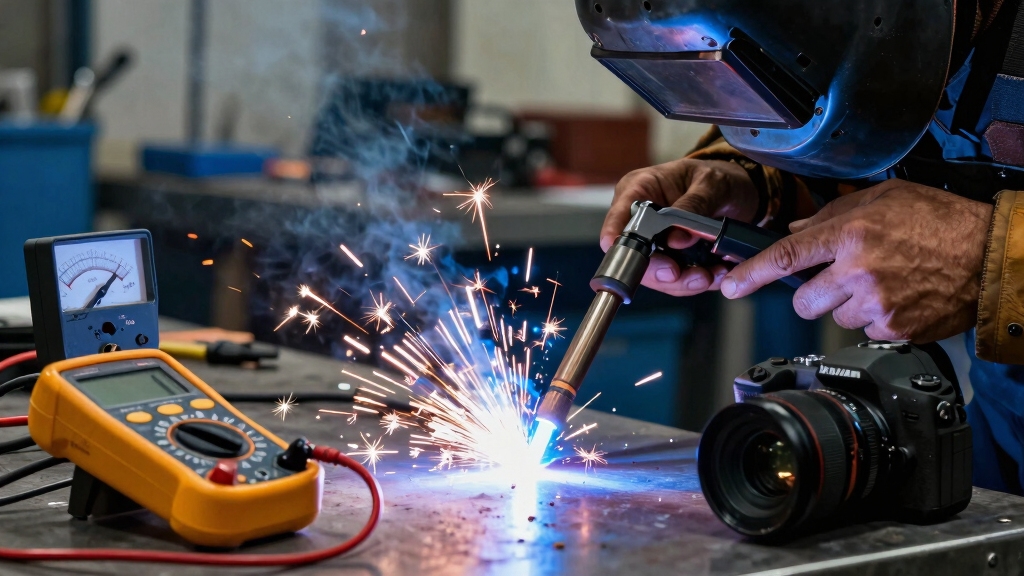
Understanding amperage in welding is essential because it directly controls the current flow through the circuit, determining the heat generated at the arc.
When you increase amperage, you raise the electron flow rate, which boosts the electrode melt-off rate and penetration depth into the base material.
This current intensity is the primary driver for weld metal deposition. Unlike voltage, which influences arc length and stability, amperage dictates the thermal energy input, affecting weld quality and strength.
If you set amperage too low, you risk weak penetration and incomplete fusion. If set too high, you might cause excessive penetration or burn-through.
Consequently, controlling amperage precisely allows you to optimize heat input, ensuring consistent weld integrity and efficiency in your welding process.
Matching amperage to material thickness is critical to achieve proper penetration without causing defects such as burn-through or porosity.
When it comes to choosing the right amperage for your welding projects, it’s all about matching it to the thickness of the material. You want to ensure that you get proper penetration and strong welds, right?
So, here’s the deal: as you increase the amperage, you also ramp up the heat input and penetration depth. That sounds great, but be careful! If you push it too high, you risk burning through thinner sections. Nobody wants that!
The key is to control your amperage precisely. This way, you can achieve optimal fusion without sacrificing the quality of your bead or the structural integrity of your weld. It’s all about finding that sweet spot! For example, a good rule of thumb is to use approximately 1 amp per 0.001” of steel thickness to guide your settings effectively.
Selecting the correct amperage is critical when welding materials of varying thicknesses. It directly controls penetration depth and weld strength.
You need to adjust amperage proportionally with material thickness: thinner metals require lower amperage to prevent burn-through. Thicker metals demand higher amperage to guarantee adequate fusion.
A practical guideline is about 1 amp per 0.001 inch of thickness. However, factors like welding process and joint design also influence this.
Insufficient amperage results in weak penetration and poor fusion, compromising weld integrity. Excessive amperage causes excessive heat input, risking warping or burn-through. Using pulse MIG or short-circuit transfer modes can help deliver intermittent heat and allow cooling intervals, reducing the risk of burn-through when welding thin metals.
Balancing amperage with material thickness sets the foundation for controlling penetration during welding. You’ll want to select an amperage that matches your material’s thickness to guarantee proper fusion without burn-through.
As a rule of thumb, use approximately 1 amp per 0.001 inch of thickness, adjusting for weld position and joint design. Higher amperage increases heat input, deepening penetration but risks excessive melt-through on thinner metals.
Conversely, insufficient amperage leads to weak penetration and incomplete fusion, compromising weld integrity. You can fine-tune penetration by adjusting wire feed speed in MIG welding, which directly impacts amperage.
Always consider heat input, volts times amps over travel speed, to maintain consistent weld quality. By precisely controlling amperage, you guarantee peak fusion and mechanical strength tailored to your material’s demands. Maintaining a steady wire feed speed is essential to ensure consistent amperage and penetration throughout the weld.
You know, wire feed speed really plays a crucial role in controlling amperage when it comes to wire-fed welding processes.
When you increase the feed speed, it actually pushes more electrode wire into the arc. This, in turn, raises the amperage, which boosts current flow and increases heat input.
So, it’s all about managing that relationship just right. If you can get it dialed in, you can optimize both penetration and deposition.
But, of course, you want to be careful—you don’t want to risk burn-through or end up with weak fusion. Balancing those factors is key!
Matching wire diameter with proper amperage settings is essential for ensuring arc stability and optimal welding performance.
Controlling wire feed speed directly influences amperage in wire-fed welding processes, making it a critical parameter for managing heat input and penetration.
When you adjust wire feed speed, you’re effectively controlling the current output. Higher speeds push more wire into the arc, increasing amperage, while slower speeds reduce it. This relationship enables precise control over the weld bead’s characteristics and the melting rate.
Consider these impacts as you fine-tune wire feed speed:
Increasing feed speed raises amperage, deepening penetration but risking burn-through on thin materials. Lowering feed speed decreases amperage, reducing heat input and possibly causing weak fusion. Optimal feed speed balances melt-off rate and weld pool stability for consistent bead formation.
Mastering wire feed speed lets you optimize weld quality by directly managing amperage and heat input. Additionally, the continuous wire electrode feed is essential for maintaining a stable arc and consistent welding performance.
Several key factors make wire feed speed a critical variable in managing amperage during welding.
As you increase wire feed speed, the amperage rises proportionally because more filler metal demands greater current to melt.
This relationship is essential in constant voltage systems like MIG welding, where voltage remains stable and amperage dynamically adjusts with feed rate.
Controlling wire feed speed lets you fine-tune heat input, directly influencing penetration depth and deposition rate.
However, pushing wire feed speed too high risks excessive amperage, causing burn-through on thinner materials.
Conversely, reducing wire feed speed lowers amperage, potentially leading to insufficient fusion.
Proper heat input control during welding is necessary to prevent weak joints and ensure strong fusion.
Although amperage largely governs heat input and penetration, voltage plays a critical role in shaping the arc behavior and weld bead profile.
When you increase voltage, you lengthen the arc, which widens the bead and raises its width-to-depth ratio. This causes the bead to flatten, improving puddle wetting but risking undercut if voltage runs too high.
Conversely, low voltage shortens the arc, resulting in a narrower, rougher bead and potential lack of fusion.
Consider these effects when setting voltage:
Higher voltage creates a flat, broad bead with increased toe wetting.
Excessive voltage may cause concavity and undercut along bead edges.
Low voltage results in a tight, irregular bead prone to fusion defects.
Understanding voltage’s impact helps you optimize weld quality and arc stability.
The arc length directly influences these voltage effects and must be carefully controlled for optimal welding results.
When you adjust voltage during welding, you directly influence the arc length. This, in turn, modifies the weld bead’s shape and stability.
Increasing voltage extends the arc, flattening the bead and raising the width-to-depth ratio by spreading heat over a broader area. This results in a wider, shallower weld profile, enhancing bead wetting but risking undercut if voltage is excessive.
Higher voltage lengthens the arc, creating a wider, flatter bead but may cause undercut if overused.
Conversely, lowering voltage shortens the arc, producing a narrower, deeper bead with a higher penetration profile. However, this can potentially cause a rougher bead and lack of fusion.
Proper voltage adjustment stabilizes the arc, ensuring consistent metal transfer and bead appearance. You must calibrate voltage carefully to control arc behavior, balancing bead geometry without compromising weld integrity or causing defects linked to arc instability or improper heat distribution.
Adjusting voltage in combination with inductance settings can further optimize arc stability and metal transfer characteristics for improved weld quality.
To achieve a sound weld, you must precisely balance voltage and amperage. Improper settings can lead to defects like weak fusion, excessive spatter, or burn-through.
Amperage controls penetration and melt-off rate, while voltage stabilizes the arc and shapes the bead. If amperage is too low, you risk incomplete fusion; too high, and you might burn through the base material.
Excessive voltage flattens the bead and causes undercut, whereas too little voltage creates an unstable arc.
Keep these in mind:
Low amperage with high voltage often results in poor penetration and spatter. High amperage combined with low voltage can cause burn-through and narrow beads.
Balanced settings produce a stable arc, proper bead shape, and consistent penetration.
Mastering this balance guarantees defect-free, structurally sound welds. Using a constant current power supply helps maintain steady amperage, which is crucial for manual welding processes to reduce arc length fluctuations.
Your welding process type dictates how you adjust voltage and amperage. For stick and TIG, which use constant current power sources, you set amperage primarily. Voltage varies with arc length.
In MIG welding, a constant voltage system, you control voltage while amperage changes automatically with wire feed speed. Understanding this helps you optimize heat input, arc stability, and penetration based on process characteristics and material thickness for consistent weld quality.
Worried about handling high amperage welding safely? You should always wear insulated gloves and protective clothing to prevent severe electric shocks and burns.
Make certain your work area is dry, and use properly rated cables and connectors to handle the current.
Never touch live parts and keep a safe distance from the arc.
Adequate ventilation is essential to avoid toxic fumes generated by intense heat and high current.
Stay alert and follow all safety protocols strictly.
Yes, both voltage and amperage settings impact electrode lifespan.
Higher amperage increases electrode melt-off rate, shortening electrode life due to faster consumption.
Excessive voltage can destabilize the arc, causing irregular melting and uneven electrode wear.
If you keep amperage too low, it may cause arc instability and poor fusion, indirectly affecting electrode condition.
You need to balance settings precisely to optimize electrode longevity and maintain weld quality.
You’ll need to adjust voltage and amperage based on environmental factors like temperature, humidity, and wind.
Cold or damp conditions often require higher amperage to maintain proper penetration and arc stability.
Wind can disrupt the arc, so increasing voltage helps stabilize arc length and prevent spatter.
In dusty or contaminated environments, fine-tuning amperage avoids poor fusion.
Always monitor conditions closely and tweak settings to maintain consistent weld quality.
Like fixing a stubborn engine, start by checking your ground clamp. Ensure it’s clean and tight.
Inspect your electrode or wire for contamination or damage. Clean your workpiece to remove rust, oil, or paint that disrupts arc stability.
Verify shielding gas flow isn’t blocked or leaking, as inconsistent coverage destabilizes the arc.
Finally, examine the torch and cable connections for wear or loose contacts.
These steps often restore a steady arc.
You can’t underestimate how vital balancing voltage and amperage is in welding. It’s the difference between a flawless weld and a disaster waiting to happen.
By precisely adjusting amperage for material thickness and wire feed speed, and fine-tuning voltage to control arc length and bead shape, you gain full command over your weld quality.
Master this dynamic duo, and your welds will perform like a well-oiled machine. They will deliver strength and precision every single time.