Phone:
(701)814-6992
Physical address:
6296 Donnelly Plaza
Ratkeville, Bahamas.

Phone:
(701)814-6992
Physical address:
6296 Donnelly Plaza
Ratkeville, Bahamas.

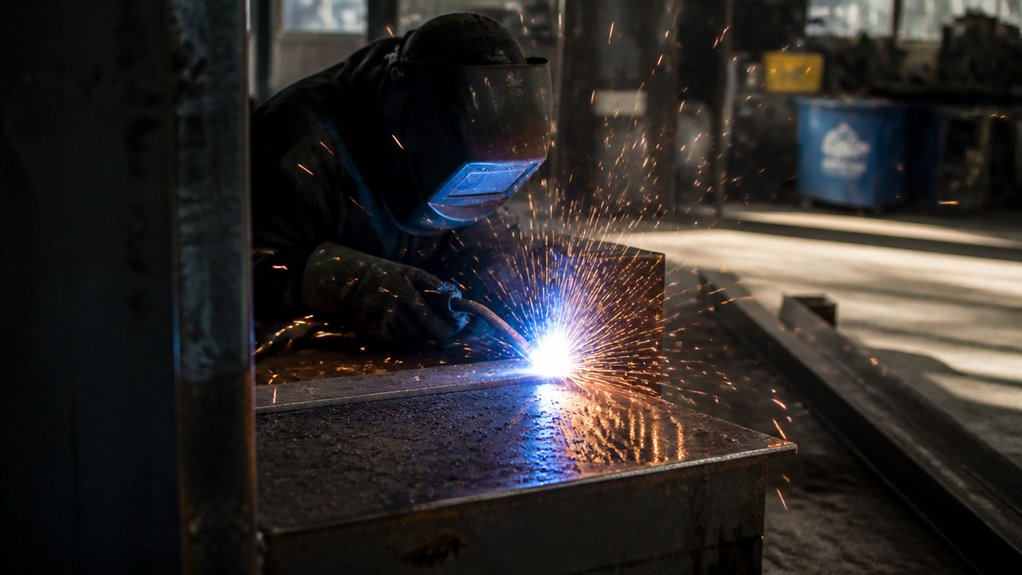
You can look at welding safely from about two meters away. However, harmful UV, visible, and infrared radiation still reach beyond the direct arc area due to reflections off metal surfaces and walls.
These reflected rays can cause eye damage like photokeratitis and retinal fatigue despite your distance. Protective screens and proper shielding help reduce these risks, but exposure levels vary with welding type and environment.
Understanding these factors guarantees safer observation and controls for bystanders and adjacent workers.
When watching welding from a distance, you should maintain at least 200 centimeters (approximately 6.5 feet) away to minimize exposure to hazardous radiation.
This distance represents a practical threshold for adjacent workers not directly involved in welding, balancing radiation intensity and exposure duration.
The safe distance varies with welding processes like MMA, MAG, or FCAW. Factors such as current, environment, and exposure time materially influence risk.
Although some US Army trials suggest 3 to 20 meters for 10-minute exposure to remain below daily UV thresholds, no universally defined safe limit exists.
Reflective surfaces can increase exposure, so you should consider environmental variables. For unequipped personnel, physical barriers or screens provide additional protection.
Radiation intensity and angle affect the effective safe distance.
Consistent use of certified welding helmets and UV-blocking gear is essential even at a distance to prevent eye injuries.
Maintaining a safe distance from welding operations reduces your exposure to harmful radiation.
Understanding why ultraviolet (UV) radiation from welding poses a serious risk to your eyes is fundamental to effective protection.
Welding arcs emit intense UV radiation (200-400 nm), which penetrates the cornea and conjunctiva. This causes cellular damage similar to a burn.
Even a few seconds’ exposure can trigger photokeratitis, or arc eye, characterized by delayed pain, tearing, redness, and blurred vision.
The intensity varies with welding process, current, and proximity, making a universally safe distance undefined.
UV radiation also reflects off metal surfaces, increasing exposure risk.
Because this radiation can cause acute eye injury and contributes to cumulative harm, you must use appropriate eye protection.
Maintain recommended distances to mitigate these effects effectively.
Using welding masks with the correct shade number ensures optimal protection against harmful UV and IR radiation based on the welding process and amperage.
Welding can be tough on your eyes, and it’s not just about the bright light. When you’re exposed to the intense visible light from welding arcs, your eyes can get really tired, and fast! This happens because the bright light can overwhelm your iris, making it hard for your eyes to adjust and regulate how much light they take in.
But that’s not all. There’s also infrared radiation, which you can’t see but can definitely feel. This type of radiation generates heat, and if you’re exposed to it for too long, it can lead to serious damage to your eye tissues over time. Chronic exposure to ultraviolet radiation from welding significantly increases the risk of ocular melanoma and long-term vision impairment.
Frequently, welders and nearby workers experience eye fatigue caused by the intense visible light emitted from welding arcs. This light, spanning 400-700 nm, overwhelms your retina and forces your iris to constrict continuously. This reduces its response speed and leads to discomfort and temporary visual impairment.
Even at distances up to 2 meters, reflected visible light can induce significant retinal stress, impairing focus and reaction time. Unlike UV radiation, which causes delayed symptoms, visible light fatigue manifests immediately through glare and ocular strain.
You must recognize that no safe exposure threshold exists for visible light fatigue due to variables like intensity, exposure angle, and duration. Mitigation requires proper eye protection and adequate screening of welding zones to prevent continuous retinal overstimulation and maintain visual performance during and after welding operations. Using an auto darkening welding helmet is essential for instant protection against intense visible light and minimizing eye fatigue.
While visible light from welding arcs causes immediate retinal fatigue, the infrared (IR) radiation component poses a different set of risks centered on thermal effects.
Unlike UV or visible light, IR radiation penetrates ocular tissues, generating heat within the cornea and lens. Prolonged or intense IR exposure can induce thermal keratitis and accelerate cataract formation by denaturing proteins in these structures.
You mightn’t perceive IR radiation directly, but its cumulative impact stresses ocular tissues, especially during extended welding sessions.
The risk escalates with reduced eye protection or closer proximity to the arc. Consequently, even if visible discomfort seems minimal, inadequate shielding permits IR-induced thermal injury.
To mitigate this, use filters that absorb IR wavelengths and maintain recommended distances.
IR radiation intensity correlates with exposure duration and proximity, emphasizing the need for all-encompassing protective strategies.
Certified face shields with filter lenses block harmful UV and IR rays and provide full facial coverage beyond the eyes.
When you’re welding, it’s really important to be aware of the hazards around you. For instance, sparks can cause direct injuries, which is something you definitely want to avoid. On the other hand, fumes and particles present their own set of challenges, mainly through inhalation.
Did you know that exposure to ultrafine particles—those tiny bits smaller than 50 nanometers—can be particularly concerning? They tend to accumulate in the welder’s breathing zone, which can significantly increase respiratory risks. Using fume extraction systems close to the welding area helps reduce exposure to these harmful particles.
Sparks generated during welding arcs can pose significant impact hazards in addition to radiation and fume exposure.
These molten metal droplets can fly at high velocities, risking injury to unprotected skin and eyes. You need to understand key factors affecting spark impact risks:
Contaminants such as oil, rust, and grease on base metals increase spatter and spark generation by disturbing the molten metal flow, leading to more hazardous welding spatter dynamics.
Measuring fume and particle concentrations at both 30 cm and 200 cm from the welding arc reveals critical exposure differences between welders and adjacent workers.
You’ll find that particle number and mass distributions during active welding are similar at these distances.
However, the welder faces markedly higher exposure to ultrafine particles under 50 nm and spatter sized 0.5–4 µm.
Over minutes post-welding, particle morphology and concentration evolve spatially and temporally, altering inhalation risks.
Gas metal arc welding on mild steel exemplifies these dynamic changes.
To mitigate health hazards, you must recognize that even at 200 cm, adjacent workers still encounter measurable fume concentrations.
Hence, controlling exposure requires effective ventilation, adequate respiratory protection, and maintaining recommended separation distances to reduce inhalation of hazardous welding aerosols.
Porosity can also contribute to compromised weld quality by trapping gas pockets, which highlights the importance of controlling shielding gas coverage during welding.
Although maintaining a safe distance reduces direct exposure to welding radiation, reflections from metal surfaces, walls, and ceilings can markedly increase eye risks even when you stand back.
These reflected UV, visible, and IR radiations can cause unexpected eye damage, including arc eye and retinal fatigue. You should consider these factors:
Therefore, even at a distance, you must account for reflected radiation in risk assessments. Employ appropriate eye protection and area screening to mitigate these hidden hazards effectively. Regularly inspect and maintain eye protection equipment to ensure optimal defense against these risks.
Reflected radiation can markedly extend the reach of hazardous welding emissions beyond the immediate arc zone, making proximity a key factor in exposure risk.
Reflected radiation significantly increases the danger radius of welding emissions beyond the immediate arc area.
You should maintain at least 200 cm distance because this threshold reduces exposure to ultraviolet (UV), visible, and infrared (IR) radiation levels below harmful intensities for non-welders.
At 200 cm, radiation intensity diminishes considerably due to inverse square law effects and scattering from surfaces. This distance also accounts for indirect exposures from reflective metal, walls, and ceilings, which can otherwise amplify UV and visible light hazards.
Additionally, particle concentrations remain similar between 30 cm and 200 cm, but radiation is the dominant risk beyond the welder’s breathing zone.
Therefore, 200 cm is the minimal safe distance to protect your eyes and skin from acute and chronic welding emissions when unprotected.
Maintaining this distance is also crucial to minimize exposure to electromagnetic interference, which can disrupt pacemaker function and increase health risks.
Welders face notably higher levels of fine particle exposure, especially those under 50 nm, when compared to bystanders who are just 200 cm away.
It’s interesting to note that while the particle number and mass distributions look similar during active welding, the closeness to the source really changes things.
For welders, being right there means they’re encountering much more spatter and nanoscale particulates.
This close proximity can significantly impact their health. So, understanding these spatial differences is really important.
It helps in evaluating health risks and figuring out the best protective measures we can take.
Welding generates a complex mixture of airborne particles that differ markedly in concentration and composition between the welder’s immediate breathing zone and adjacent bystanders.
When you’re close to the arc, particle exposure intensifies, especially with ultrafine particles under 50 nm and spatter particles ranging 0.5–4 μm.
Those standing just a couple of meters away face lower concentrations but still encounter some airborne particulates.
Key differences include:
Understanding these distinctions helps you manage protective strategies effectively.
The variation in particle concentration and composition between the welder’s breathing zone and adjacent areas markedly influences exposure risks.
At 30 cm, where you weld, you encounter higher concentrations of ultrafine particles (<50 nm) and spatter (0.5–4 μm), increasing inhalation hazards.
By contrast, at 200 cm, particle mass and count approach similar levels during active welding, but the particle size distribution shifts, reducing ultrafine exposure.
Temporal changes post-welding further alter particle morphology and concentration.
For bystanders, exposure intensity diminishes with distance, yet reflections and environmental factors complicate risk assessment.
You must also consider that no clear safe exposure threshold exists, necessitating engineered controls like screens and protective equipment.
Maintaining separation and understanding spatial-temporal particle dynamics are essential to managing health risks effectively.
Eye protection plays a critical role in preventing acute and chronic damage caused by the intense ultraviolet (UV), visible, and infrared (IR) radiation emitted from welding arcs.
Effective eye protection is essential to prevent damage from the intense UV, visible, and IR radiation of welding arcs.
To shield your eyes effectively, focus on these key elements:
Protecting your vision with proper eye gear is only part of managing radiation hazards during welding.
Welding screens serve as critical barriers that block ultraviolet (UV), visible, and infrared (IR) radiation emitted by the arc.
These screens use materials with specific optical densities that absorb or reflect harmful wavelengths, preventing radiation from reaching bystanders.
Their placement around the welding zone creates a controlled environment, reducing exposure for adjacent workers and the public.
Screens also mitigate radiation reflections from nearby surfaces, which can otherwise extend the hazard area.
By completely enclosing or partially shielding the arc, welding screens maintain radiation intensities below harmful thresholds at typical safe distances, usually beyond 2 meters.
You should always make certain screens meet regulatory standards and are correctly positioned to maximize radiation attenuation.
Whenever you face uncertainties about welding safety, whether related to radiation exposure, fume dispersion, or appropriate protective measures, seeking expert advice guarantees that risk evaluations and control strategies are accurate and compliant with current standards.
When uncertain about welding safety, expert advice ensures accurate risk assessments and compliance with standards.
You should consult experts especially when:
Experts, such as those at TWI ([email protected]), provide process-specific guidance grounded in the latest research and regulations. This proactive approach minimizes eye and skin hazards, addresses fume risks, and ensures your safety measures reflect proven technical standards.
Don’t rely on assumptions. Get precise, analytical advice to safeguard everyone involved.
Oh sure, if you enjoy the idea of turning your skin into a crispy, UV-burned mess, welding’s got you covered.
Beyond eye damage, you’ll face ultraviolet radiation that can scorch unprotected skin, much like a nasty sunburn.
Prolonged exposure ups your risk of skin cancer, as classified by IARC.
You face long-term health risks from welding fumes, including chronic respiratory diseases like bronchitis and decreased lung function.
Prolonged exposure to metal particles and gases can cause occupational asthma and pneumoconiosis, and increase your risk of lung cancer.
Certain metals in fumes, such as hexavalent chromium and manganese, pose neurotoxic and carcinogenic hazards.
To protect yourself, make sure proper ventilation, use respiratory protection, and minimize your exposure duration consistently.
If you wear contact lenses during welding, you risk eye irritation from UV radiation, fumes, and particles trapped beneath the lenses.
UV exposure can cause arc eye symptoms intensified by lens use, while fumes and debris may adhere to lenses, increasing discomfort and infection risk.
You must use proper welding goggles with UV protection and avoid wearing contacts unprotected.
Consider consulting eye care and safety professionals for tailored advice.
Yes, you can choose welding methods that emit less harmful radiation.
Processes like TIG welding generally produce lower UV and IR radiation levels compared to MMA or FCAW. This reduces eye and skin hazards.
However, no method is completely safe without proper protection. You still must wear adequate eye gear and use screens, as all arcs emit intense UV and visible radiation.
Always assess the specific welding process and exposure conditions carefully.
Yes, welding noise can cause hearing loss if you’re exposed to high decibel levels over time. The noise from welding processes, like grinding, cutting, and arc striking, often exceeds safe limits for prolonged exposure.
You should use appropriate hearing protection, such as earplugs or earmuffs, especially in enclosed or noisy environments. Consistent exposure without protection increases your risk of permanent auditory damage.
Monitor noise levels and apply controls accordingly.
You might think stepping back like a knight retreating from a dragon’s fiery breath keeps you safe, but welding’s UV and infrared radiation penetrate much farther than you expect.
Even from a distance, reflections and invisible rays can harm your eyes. Always wear appropriate protection and use welding screens to block dangerous radiation.
Don’t rely solely on distance; get expert safety advice to guarantee you’re fully shielded from all arc hazards.