Phone:
(701)814-6992
Physical address:
6296 Donnelly Plaza
Ratkeville, Bahamas.

Phone:
(701)814-6992
Physical address:
6296 Donnelly Plaza
Ratkeville, Bahamas.

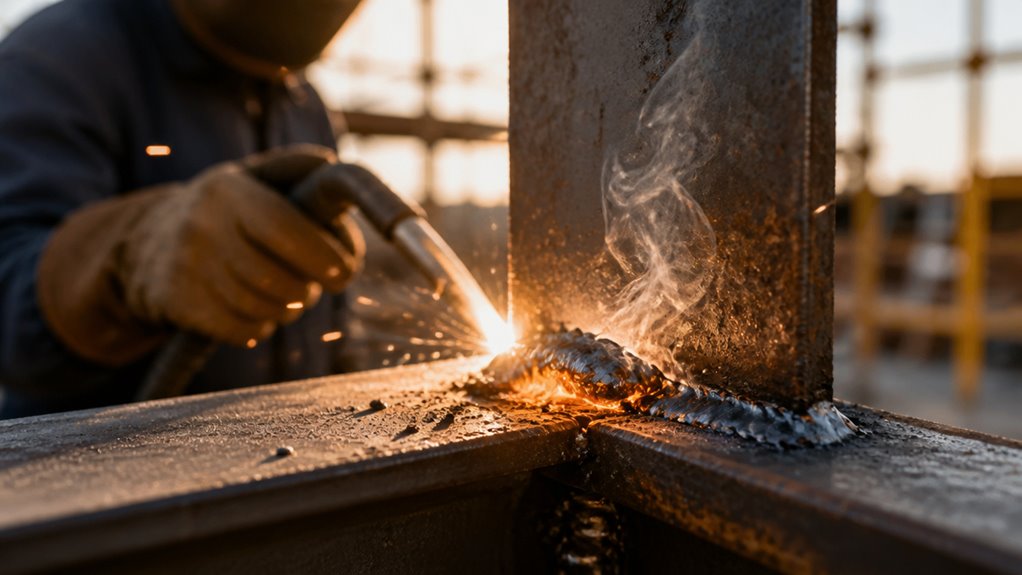
A field weld is a weld you make directly at the final installation site, rather than in a fabrication shop.
You use it when components are too large or impractical to fully assemble before transport. This allows precise fit-up and on-site adjustments.
This method is common in piping and structural work, identified by a field weld symbol on drawings.
While field welding faces unique challenges like weather and inspection demands, it’s essential for projects needing on-site assembly or repair.
More details explain when and how to apply these welds effectively.
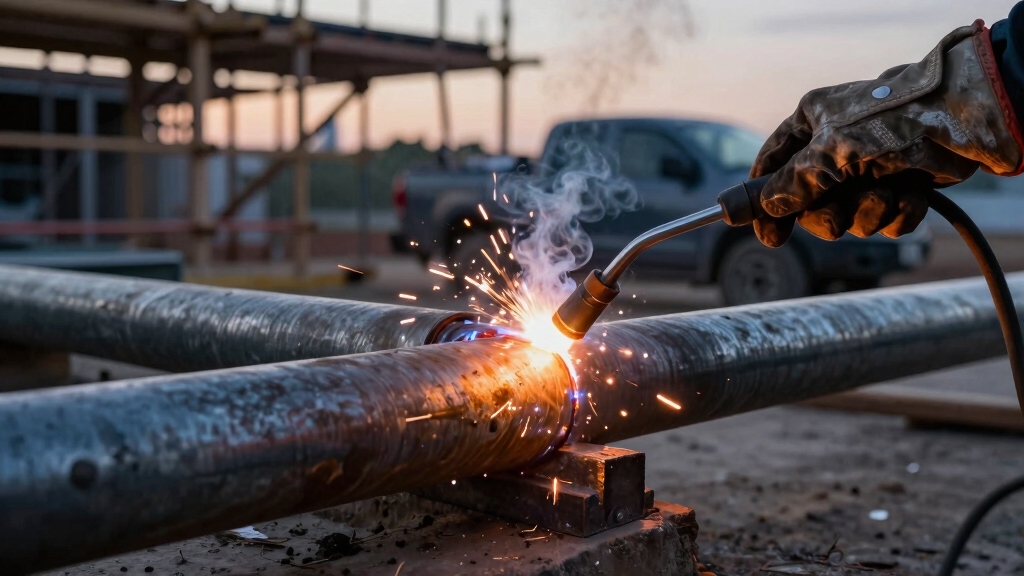
Understanding what a field weld is and when to use it’s essential for anyone involved in construction, fabrication, or maintenance.
Knowing when and what a field weld is crucial for construction, fabrication, and maintenance professionals.
A field weld is a weld made at the final installation site rather than in a fabrication shop. You’ll encounter field welds when components are too large, impractical, or uneconomical to fully assemble before transport.
In piping and structural work, you use field welds to join spools, pipe sections, flanges, or structural members on site. These welds are typically identified on drawings with a field weld symbol or flag.
Field welding accommodates final assembly in place, enabling you to manage large structures or equipment that can’t be moved fully assembled. This ensures precise fit-up and onsite adjustments during installation.
Because field welding often involves variable conditions, controlling heat input and welding parameters is critical to ensure weld quality and manage the heat-affected zone.
When deciding between field welds and shop welds, consider factors like project logistics, environmental conditions, and quality control requirements.
Choose field welds when components are too large or cumbersome to transport fully assembled, or when final installation dimensions require on-site adjustments.
Field welds suit projects with limited shop access or when assembly must occur directly at the installation site.
Conversely, shop welds offer superior environmental control, higher productivity, and consistent quality due to controlled conditions.
If your project demands stringent quality standards with minimal environmental risks, shop welding is preferable.
However, when transport constraints, site-specific assembly, or repair needs dominate, field welding becomes the practical option despite its increased logistical challenges and inspection demands.
Using a welding rig can help overcome some logistical challenges by providing a mobile workstation with essential welding equipment directly on-site.
Field-fit welds help you accommodate on-site dimensional variations by providing extra material length. This allows precise trimming and adjustment during installation.
This added allowance, typically around 150 mm, ensures that when final measurements differ from design specifications, you can modify lengths without compromising fit or alignment.
By trimming and beveling the extra section on site, you achieve proper joint preparation for welding under actual field conditions.
This flexibility is critical when tolerances are tight or when unpredictable factors like foundation settling or thermal expansion affect final dimensions.
Field-fit welds reduce the need for costly rework and enable seamless integration of components assembled from transportable spools or sections.
Ultimately, they improve installation efficiency and structural accuracy by allowing you to adapt precisely to real-world site conditions.
Proper welding preparation and positioning are essential in field welds to avoid misalignment and ensure reliable, leak-proof joints under varying site conditions.
Although field-fit welds offer flexibility in accommodating site variations, the process of welding on location introduces several challenges and expenses you need to anticipate.
Weather conditions, limited workspace, and access difficulties increase labor intensity and safety risks. Additionally, setting up scaffolding or tarpaulins and ensuring proper preheat and interpass temperatures add to costs. Equipment transport and protection also impact your budget.
| Challenge | Expense Impact |
|---|---|
| Variable weather | Delays, protective gear costs |
| Restricted access | Scaffolding, hoisting expenses |
| Environmental controls | Tarpaulins, heating equipment |
Understanding these factors helps you plan for the complexities and costs intrinsic to field welding. This ensures smoother project execution. Properly sizing electrical components, such as breakers, by applying the NEC 200% rule can prevent costly downtime and equipment damage during field welding operations.
Inspecting field welds for quality always requires thorough attention to detail and adherence to established standards.
Field weld inspection demands meticulous attention and strict compliance with industry standards.
You begin by verifying proper pre-weld preparation, including surface cleanliness and fit-up accuracy.
After welding, perform visual inspection to identify surface defects such as cracks, porosity, or undercut.
Depending on project specifications, apply non-destructive testing (NDT) methods like radiographic (RT) or ultrasonic testing (UT) to detect internal flaws.
You must confirm compliance with welding procedure specifications (WPS), checking parameters like electrode type, preheat, and interpass temperature.
Document inspection results meticulously for traceability.
Always consider environmental conditions during inspection, as field welds may face variable weather affecting quality.
Proper inspection guarantees structural integrity, safety, and longevity of the welded assembly on site.
Additionally, understanding and applying welding standards and safety protocols during inspection is essential to ensure compliance and prevent defects.
For steel field welds, you’ll often use stick welding (SMAW) or flux-cored arc welding (FCAW) because they handle outdoor conditions well.
For stainless steel or aluminum, TIG welding (GTAW) offers better control but requires cleaner environments.
MIG welding (GMAW) suits thicker materials and faster work but needs shielding gas protection.
Always match the process to the material, joint type, and environmental factors to guarantee strength and quality in your field welds.
Weather impacts your field welding quality by influencing cooling rates and contamination risks.
Cold temperatures can cause rapid cooling, leading to brittle welds and cracking.
Rain or humidity introduces moisture, increasing hydrogen content and porosity.
Wind can blow shielding gas away, causing weld defects like oxidation.
You must control environmental factors with shelters, heaters, and proper procedures to maintain weld integrity and avoid rework or failures on-site.
You should know that over 60% of welding-related injuries occur on-site, highlighting the need for strict safety measures in field welding.
Unique precautions include securing scaffolding, weatherproofing work areas, and managing confined space hazards.
You must also control fumes with ventilation, guarantee proper grounding to avoid electric shock, and maintain clear communication amid noisy environments.
Using personal protective equipment suited for variable conditions is critical to prevent accidents and guarantee quality.
You’ll find field weld symbols standardized through the AWS A2.4 welding symbols system, widely adopted across industries.
This system uses a flag at the arrow-reference line junction to indicate on-site welding.
While some older drawings may differ, most follow this convention to guarantee clarity.
You must interpret these symbols correctly to avoid installation errors, as they precisely communicate welding location and type.
This consistency maintains quality in fabrication and construction projects.
Like mastering a complex symphony, you need specialized training to excel at field welding.
You should complete certified welding courses focusing on on-site conditions, including safety protocols, environmental challenges, and equipment handling.
Familiarize yourself with applicable codes like AWS D1.1 or API standards and gain hands-on experience in variable weather and confined spaces.
Master inspection techniques and NDT methods to guarantee weld integrity.
This preparation helps you deliver quality welds despite field challenges.
When you face the maze of construction, a field weld is your flexible bridge, connecting pieces right where they stand. Choosing between field and shop welds is like picking the right tool; each has its place.
Field-fit welds streamline installation, but watch for challenges that can inflate costs. Inspecting these welds is your quality compass, ensuring strength and safety. Mastering field welds keeps your project solid, precise, and ready to withstand the test of time.