Phone:
(701)814-6992
Physical address:
6296 Donnelly Plaza
Ratkeville, Bahamas.

Phone:
(701)814-6992
Physical address:
6296 Donnelly Plaza
Ratkeville, Bahamas.

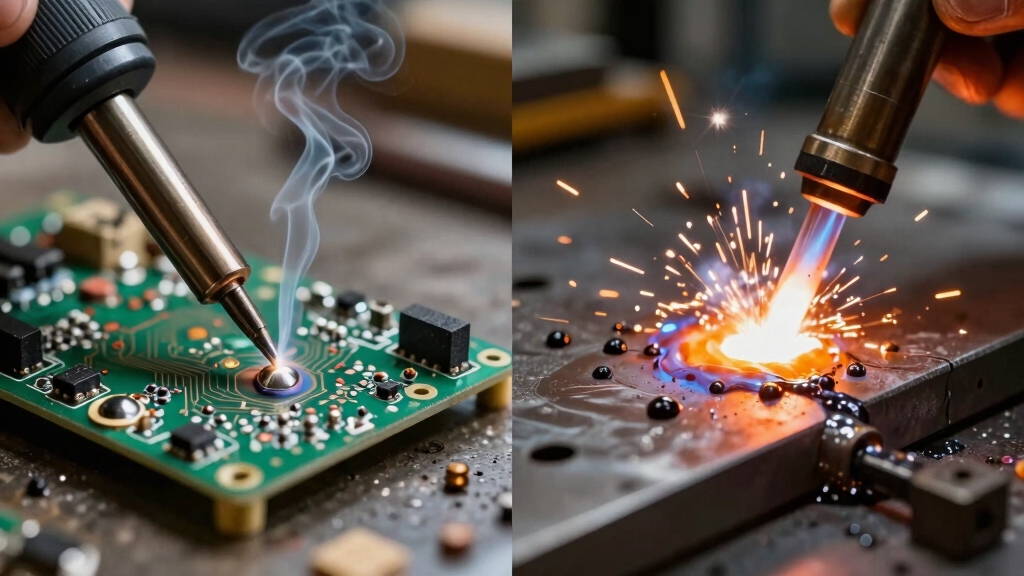
You use soldering to join metals with low-melting filler below 840°F (450°C) without melting base metals. This technique is ideal for delicate or heat-sensitive work.
Welding melts base metals and filler at much higher temps, around 6,500°F or more. This creates stronger, fused joints for structural needs.
Soldering preserves metal properties but has lower strength, while welding changes metallurgy for durability. Choosing between them depends on heat limits and mechanical demands.
Explore their processes and applications further to understand which fits your project best.
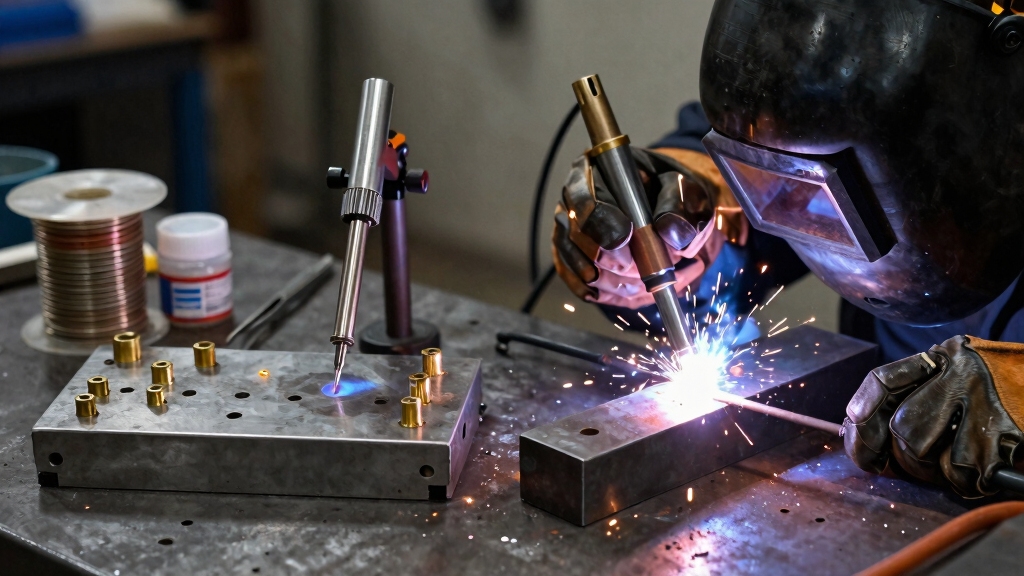
Although both soldering and welding join metals, you should choose soldering when working with delicate components or dissimilar metals that can’t withstand high heat.
Soldering operates below 840°F, keeping base metals solid and avoiding thermal distortion. It uses low-melting filler metals like tin-copper alloys, relying on capillary action for bonding.
Soldering bonds metals below 840°F using low-melting filler metals and capillary action without melting the base metals.
Welding, by contrast, melts base metals at temperatures up to 10,000°F, creating fusion joints with superior mechanical strength suitable for load-bearing applications.
You’ll find welding requires specialized equipment and often certification, while soldering demands less heat and simpler tools.
When precision, minimal thermal impact, and compatibility with different metals matter, soldering is your solution. For structural integrity and high-stress conditions, welding remains essential.
Your choice depends on the metals involved, joint strength requirements, and heat tolerance.
Alternatively, ultrasonic welding offers solid-state bonds without melting base materials, providing a fast, clean joining method for certain metals and thermoplastics.
When you solder, you start by heating the joint to just below 840°F. It’s important to keep the base metals solid during this process. Instead, you’re melting a low-temperature filler metal.
As the solder melts, it flows into the joint thanks to capillary action. This means it moves into the space between the surfaces, bonding them together without actually melting the workpieces.
Once everything cools down, the solder solidifies, creating a strong joint. This bond relies on a liquid-solid phase connection that forms between the base metals. Pretty neat, right?
Soldering typically occurs at temperatures below 400°C, which is far lower than the heat required for welding base metals.
The soldering process operates at temperatures below 840°F (450°C), ensuring the base metals remain solid throughout. This low-temperature range allows you to join components without altering their metallurgical properties or causing distortion.
Unlike welding, where temperatures soar between 6,500°F to 10,000°F to melt the base metals, soldering relies on melting only the filler metal.
Consider these key points about soldering’s temperature range:
It prevents base metal melting, maintaining structural integrity.
Heat sources include soldering irons, guns, or low-temperature torches.
The process typically requires less warm-up time than welding.
It enables joining dissimilar metals without damaging components.
It falls within liquid-solid phase bonding, where only the solder liquefies.
This precision temperature control is vital for delicate electronics and plumbing applications.
To ensure safety and preserve coating integrity, soldering galvanized steel requires careful temperature control to avoid exceeding 380°C and prevent zinc vaporization.
Understand that soldering relies on a filler metal, typically a low-melting alloy like tin-copper. This metal melts and flows into the joint without melting the base metals.
The filler metal wets and bonds surfaces via capillary action, ensuring a secure but non-fusion joint. Unlike welding, where filler rods fuse with molten base metals, soldering’s filler metal remains distinct. This preserves the base metal’s integrity.
| Aspect | Soldering Filler Metal | Welding Filler Metal |
|---|---|---|
| Composition | Low-melting alloys (e.g., tin-copper) | High-temperature rods, often flux-coated |
| Melting Behavior | Melts below 450°C, no base melting | Melts with base metals, forms fusion |
| Function | Bonds via wetting and capillary action | Adds material to molten pool for fusion |
This approach limits thermal stress and material distortion. In contrast, welding wires, such as solid or flux-cored types, act as filler material that fuses separate pieces into a unified structure and forms a metallurgical bond.
Soldering forms joints by heating the filler metal until it liquefies and flows into the narrow gap between base metals through capillary action.
You don’t melt the base metals; instead, the solder wets their surfaces and solidifies, creating a liquid-solid phase bond.
This technique depends on precise temperature control below 840°F (450°C) to preserve the base metal’s integrity.
As you work, the molten solder penetrates microscopic surface irregularities, ensuring mechanical interlock and electrical continuity.
Key points to understand:
This mechanism distinguishes soldering from welding’s fusion process. Proper surface preparation, like cleaning and mechanical abrasion, is essential for achieving a durable soldered joint.
When you weld, you apply intense heat, often between 6,500°F and 10,000°F, to melt the base metals along with a filler material. This creates a fusion that bonds the workpieces at a molecular level.
This melting process generates a molten pool where the base metals coalesce, allowing atoms to intermingle and form a continuous solid upon cooling. You typically use a welding torch or arc to supply this energy.
You also control the temperature and shield gas to prevent contamination. The filler rod, introduced into the molten pool, supplements the metal volume, ensuring joint integrity and strength.
As the weld solidifies, it alters the microstructure locally, enhancing mechanical properties. This fusion process produces joints stronger than the original metals, suitable for load-bearing and structural applications.
Controlling heat input, travel speed, and electrode angle is critical to achieve proper fusion and penetration for a high-quality weld with minimal defects, a principle known as heat input control.
When it comes to soldering and welding, temperature plays a huge role. Soldering usually happens at temperatures below 840°F. This means the base metals stay solid, which is pretty neat!
On the flip side, welding cranks up the heat, reaching temperatures of up to 10,000°F. That’s hot enough to melt the metals together, creating a strong bond.
Now, let’s talk about how we generate that heat. For soldering, we typically use tools like soldering irons or heat guns. They’re pretty handy and get the job done without melting the base materials.
In contrast, welding employs high-energy methods like MIG or TIG torches, which are designed to handle those extreme temperatures. Among welding techniques, TIG welding offers precise heat control for clean, high-quality welds.
In comparing temperature ranges, it’s essential to understand how heat affects the metals involved.
Soldering operates below 840°F (450°C), ensuring the base metals stay solid while only the solder melts.
Welding, in contrast, reaches temperatures between 6,500°F to 10,000°F, melting the base metals and filler material for fusion.
This significant difference in heat input defines the fundamental nature of each process.
Brazing melts a filler metal above 840°F but below the base metal melting points, relying on capillary action to create strong joints while preserving the base metals.
The key distinction between soldering and welding lies in how they affect the base metals’ state.
In soldering, you avoid melting the base metals altogether; instead, you heat them just enough to melt the filler metal. This bonds the surfaces through a liquid-solid phase interaction.
This means the base metals remain solid, preserving their original microstructure and mechanical properties.
Conversely, welding requires you to melt the base metals themselves, creating a molten pool that fuses the workpieces together upon solidification.
This fusion results in a metallurgical bond stronger than the original metals.
Understanding this difference is essential: soldering provides a joint without altering the base metal’s phase, while welding fundamentally transforms the base metals by melting and re-solidifying them to form a robust structural connection.
For welding, selecting between constant current or constant voltage power supplies is crucial depending on the process and desired arc control.
Although both soldering and welding rely on heat to join metals, they employ vastly different heat sources and temperature ranges that directly influence their processes and outcomes.
Soldering uses lower heat, typically under 840°F (450°C), with a soldering iron or heat gun. Welding requires much higher temperatures, often between 6,500°F and 10,000°F, produced by electric arcs, MIG, TIG, or oxyacetylene torches.
This difference determines whether the base metals melt (welding) or remain solid (soldering).
Soldering heats only the filler metal, avoiding base metal melting.
Welding melts both base metals and filler for fusion.
Soldering equipment includes irons and heat guns.
Welding demands high-energy sources like electric arcs or gas flames.
Temperature disparity affects joint strength and material compatibility.
The maximum flame temperature of oxy-acetylene torches can reach around 6,330°F (3,500°C), contributing to the high heat required for welding.
When you compare soldering and welding in terms of strength and durability, welding clearly outperforms soldering by producing joints stronger than the base metals themselves.
Welding achieves this by melting and fusing the base metals and filler material, creating a homogeneous joint with mechanical properties equal to or exceeding the original metals.
In contrast, soldering relies on a low-melting filler that bonds without melting the base metals.
This results in joints limited by the solder’s mechanical strength.
Consequently, soldered joints exhibit lower load-bearing capacity and are more prone to failure under stress or fatigue.
Welding’s fusion process also alters the microstructure at the joint, enhancing durability.
Soldering remains a liquid-solid phase bond, suitable only for electrical or non-structural applications requiring less mechanical strength.
Equip yourself with the right tools to guarantee effective soldering or welding results.
Soldering requires precision instruments that provide controlled heat below 840°F, ensuring the base metals don’t melt.
Welding demands equipment capable of generating extreme temperatures, often above 6,500°F, to fuse metals.
Key tools include:
Understanding these tools’ functions helps you select the precise equipment needed for your project.
This optimizes joint quality and process efficiency.
Since soldering and welding serve fundamentally different purposes, choosing the right method depends on your project’s material compatibility, load requirements, and operating environment.
Use soldering when joining dissimilar metals, like copper to steel, especially in electronics or plumbing where heat sensitivity and weaker mechanical strength suffice.
Welding, however, demands similar metals and excels in high-stress, load-bearing applications requiring robust, fusion-formed joints.
If your project involves structural integrity or certification standards, welding is your choice.
Conversely, for delicate assemblies or electrical connections, soldering offers precise, lower-temperature bonding without altering base metals.
Evaluate thermal constraints, mechanical load, and metal types carefully to select the appropriate technique.
This ensures joint reliability while optimizing efficiency and material performance.
You generally shouldn’t rely on soldering for outdoor repairs in wet conditions. Moisture can prevent proper solder adhesion and cooling, leading to weak joints.
Soldering requires clean, dry surfaces for effective capillary action and bonding. If you must solder outdoors, make sure the area is dry and protected from humidity.
For reliable, durable repairs in wet environments, welding or specialized waterproof techniques are more appropriate.
You must wear a welding helmet with proper shade for eye protection during welding. Soldering only needs safety glasses.
Welding demands flame-resistant clothing and gloves due to extreme heat and sparks. Soldering gloves suffice for minor burns.
Ventilation is critical for both, but welding produces more hazardous fumes. This requires fume extractors or respirators.
You also need stricter fire safety and workspace clearance for welding to prevent ignition of nearby materials.
Oxidation can reduce solder joint strength by up to 50% if not controlled. In soldering, oxidation mainly affects the solder’s wetting ability.
You use flux to prevent oxide buildup and guarantee proper bonding. In welding, oxidation forms scale on molten metal surfaces, weakening fusion and causing defects.
You must shield the weld pool with inert gases or flux to minimize oxidation and maintain joint integrity during welding.
You’ll find that welding has more significant environmental impacts due to high energy consumption and emissions from flux and shielding gases.
Soldering, while lower in energy use, can release harmful fumes from flux and lead-based solders if not properly ventilated.
Both processes require careful handling of waste materials to avoid contamination.
You should implement fume extraction and material recycling to minimize environmental harm in either method.
You can definitely automate both soldering and welding in manufacturing.
Automated soldering often uses robotic arms with precise temperature control for consistent joints in electronics or PCB assembly.
Welding automation involves advanced robotic systems, like MIG or TIG robots, delivering high heat and filler material for strong, repeatable structural joints.
Automation improves speed, quality, and safety, especially in high-volume or hazardous environments, making it indispensable in modern production lines.
When deciding between soldering and welding, think of them as two different keys releasing metal bonding.
Soldering, with its lower temperatures and filler metals, suits delicate tasks needing precision without altering base metals.
Welding, on the other hand, demands higher heat to fuse metals directly, ensuring unmatched strength and durability.
Choose based on your project’s thermal tolerance, strength requirements, and material type. Ensure you apply the right technique for peak, lasting results.