Phone:
(701)814-6992
Physical address:
6296 Donnelly Plaza
Ratkeville, Bahamas.

Phone:
(701)814-6992
Physical address:
6296 Donnelly Plaza
Ratkeville, Bahamas.

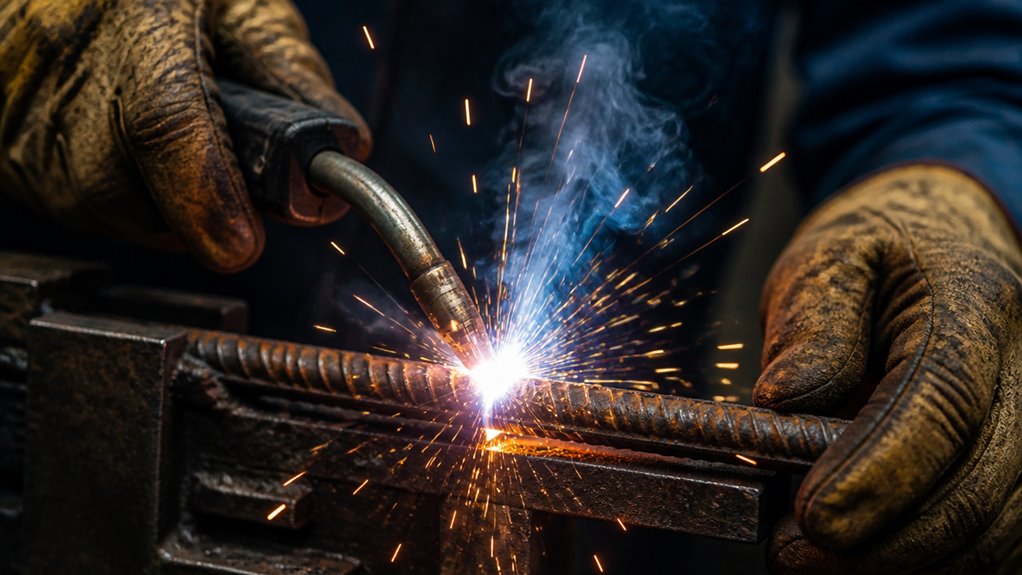
You can weld rebar safely, but only if you use the right steel grade. ASTM A706 is preferred and you must follow strict codes like AWS D1.4.
Welding requires controlled heat input, proper filler metals, and qualified welders to avoid cracking, embrittlement, or weakening in the heat-affected zones.
While tack welds may hold bars temporarily, they don’t replace tie wire structurally.
Understanding approved methods, risks, and inspection protocols guarantees weld integrity and reinforcement reliability for your project.
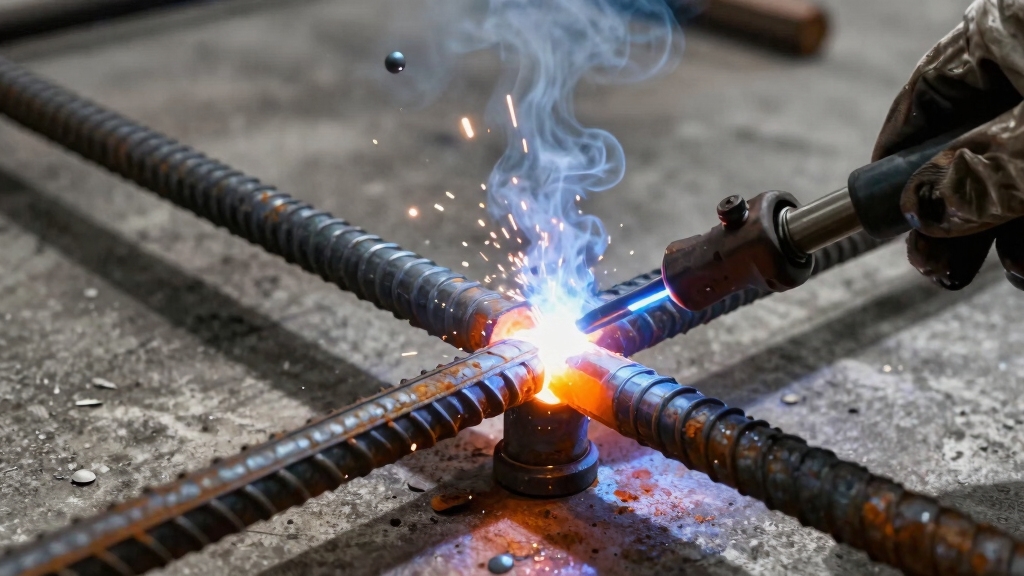
Welding rebar means joining reinforcing steel bars by melting their surfaces to create a fused joint, rather than tying them together with wire.
When you weld rebar, you alter the steel’s microstructure in the heat-affected zone, which can impact tensile strength and ductility.
Welding rebar changes its microstructure, affecting key properties like tensile strength and ductility.
While a simple tack weld can replace tie wire for positioning, it doesn’t provide structural integrity.
Controlled welding occurs mostly in factory settings where parameters like heat input, filler metal selection, and cooling rates are carefully managed to maintain mechanical properties.
Field welding demands strict adherence to procedures and quality control to prevent weakening the reinforcement.
Understanding that welding modifies rebar behavior helps you evaluate when fusion is technically appropriate versus when traditional tying remains the safer, more reliable choice.
Proper heat input control and post-weld treatments are critical to minimize adverse effects on the heat-affected zone and ensure weld durability.
Not all rebar grades respond the same when subjected to welding, so knowing which types you can weld safely is key to maintaining structural integrity.
ASTM A706 rebar is specifically designed for welding, featuring controlled chemistry and mechanical properties that tolerate heat input without compromising strength or ductility.
Conversely, ASTM A615 rebar generally isn’t suited for welding unless its carbon equivalency (CE) is low, typically 0.55% or less for bars up to #6.
For larger bars (#7 and above), weldability demands become stricter, requiring CE below 0.45% and often preheat to prevent cracking.
You must evaluate the specific grade’s chemical composition and relevant standards like AWS D1.4 to determine weld suitability.
Ensure welding procedures and filler metals align with the rebar’s grade for safe, reliable results.
Additionally, controlling heat input and using proper techniques can minimize issues like porosity and weld defects that compromise weld quality.
Although rebar welding can enhance construction efficiency, you must strictly follow applicable codes and project specifications to guarantee safety and structural integrity.
Rebar welding boosts efficiency but demands strict adherence to codes and project guidelines for safety.
Codes like AWS D1.4/D1.4M set specific weldability criteria, emphasizing material grade, carbon equivalency limits, preheat, and welding procedures.
For instance, ASTM A706 rebar is typically approved for welding, while ASTM A615 often requires stringent carbon equivalency thresholds and preheating to avoid brittle failures.
Project specs may further restrict welding to prefabricated cages or shop conditions, limiting field welds to non-structural tack welds.
You’ll also need to make certain qualified welders, proper filler metals, and inspection protocols align with these standards.
Ignoring these requirements risks weakening reinforcement, leading to structural compromise and code violations.
Always consult relevant standards and project documents before welding rebar.
It is essential to use a properly qualified Welding Procedure Specification to ensure consistent weld quality and compliance with codes.
Welding rebar can be a bit tricky because it involves some serious changes to the material. When you apply heat, the area around the weld, known as the heat-affected zone (HAZ), experiences microstructural changes. These changes can impact the rebar’s mechanical properties in significant ways.
For instance, you might find that the tensile strength and ductility get reduced. This can potentially weaken the reinforcement if things aren’t managed correctly. So, it’s really important to have a good grasp of how welding parameters affect the HAZ. By doing so, you can help ensure that the rebar maintains its performance and doesn’t compromise the overall integrity of your project. Using proper welding techniques and controlled cooling can help minimize these negative effects on rebar strength.
Because welding introduces intense localized heat, it creates a heat-affected zone (HAZ) in the rebar that substantially influences its mechanical properties. This zone experiences microstructural changes that can affect performance and durability. You must comprehend how HAZ size and thermal cycles impact the steel to guarantee weld quality and structural integrity.
| Factor | Effect on HAZ | Consideration |
|---|---|---|
| Heat Input | Larger HAZ, more microstructural change | Control heat to limit damage |
| Cooling Rate | Faster cooling can induce brittleness | Preheat or post-heat may be needed |
| Rebar Grade | Some grades tolerate HAZ better | Use weldable grades (e.g., A706) |
| Welding Process | Different processes alter HAZ size | Choose appropriate method |
| Joint Design | Influences heat concentration | Optimize to reduce HAZ |
Managing the HAZ is critical to preserving rebar performance after welding. Employing multi-pass welding techniques with controlled heat input can help minimize thermal stresses and reduce the risk of cracking in thicker sections.
The heat-affected zone (HAZ) directly influences the mechanical properties of welded rebar by altering its microstructure. When you weld rebar, the intense heat can cause grain growth, phase transformations, and residual stresses within the HAZ.
These changes may reduce tensile strength and ductility if not properly controlled. You must consider the rebar grade and carbon equivalency because higher carbon contents increase hardness and susceptibility to cracking in the HAZ.
Preheating and controlled heat input help mitigate these effects by minimizing thermal gradients and preventing embrittlement. Additionally, improper welding can produce microcracks or weaken the bond between steel and concrete.
Consequently, to preserve mechanical performance, you should follow established welding procedures and use appropriate filler metals tailored to the rebar’s chemistry and size. Maintaining interpass temperature during welding is also critical to reduce cold cracking risk and ensure weld integrity.
Selecting the best welding method for rebar hinges on controlling heat input and ensuring weld quality to maintain reinforcement integrity.
Choosing the right welding method is key to controlling heat and preserving rebar strength.
You’ll typically choose shielded metal arc welding (SMAW) or gas metal arc welding (GMAW) for field applications due to their precise heat control and adaptability.
SMAW offers strong welds with low equipment complexity, while GMAW delivers higher deposition rates and consistent weld profiles.
For factory settings, resistance welding excels by providing rapid, repeatable welds without excessive heat.
Regardless of method, you must use filler metals compatible with the rebar grade, usually low-hydrogen electrodes for A706 steel.
Additionally, adhering to AWS D1.4 standards guarantees weld procedure qualification and inspection criteria are met, reducing risks of cracking or embrittlement.
Your method choice should balance equipment capability, bar size, and site conditions for optimum results.
GMAW’s advantage of high deposition rates and fast welding speeds can significantly improve productivity in suitable rebar welding applications.
Controlling heat during rebar welding directly influences the steel’s structural integrity and performance.
If you apply excessive heat, you risk altering the microstructure in the heat-affected zone. This can reduce tensile strength and increase brittleness.
You need to carefully manage heat input to prevent cracking and distortion, which compromise reinforcement effectiveness.
Preheating may be necessary depending on the bar’s size and chemistry to ensure proper fusion without thermal shock.
Additionally, precise heat control helps maintain the mechanical properties specified by ASTM and AWS standards. This avoids embrittlement and preserves ductility.
Maintaining a controlled cooling rate is essential to prevent hydrogen-induced cold cracking and preserve weld quality.
When you’re welding rebar in a factory, you’ve got the advantage of a controlled environment. This means consistent heat input and strict quality assurance—both of which are key for making sure your welds are top-notch.
But when it comes to field welding, things get a bit trickier. You have to deal with variable conditions and often limited access to the right equipment. These factors can really impact the integrity of your welds. Using a mobile welding rig on-site can help overcome many of these challenges by providing stable power and organized tools directly at the job location.
Welding rebar in a factory setting offers distinct advantages over field welding due to the controlled environment. This guarantees consistent temperature, humidity, and cleanliness.
This controlled setting helps you maintain optimum welding parameters, reducing risks of thermal distortion, cracking, and contamination. In contrast, field welding exposes you to variable weather, dust, and inconsistent heat management, which can compromise weld integrity.
Additionally, maintaining precise heat input and stable conditions is crucial for achieving proper base metal fusion in welding.
| Aspect | Factory Welding |
|---|---|
| Temperature | Stable, regulated |
| Humidity | Controlled, low moisture |
| Cleanliness | Dust-free, debris minimized |
| Equipment Setup | Calibrated, consistent |
| Welding Conditions | Repeatable, monitored |
Although factory and field welding both aim to produce structurally sound rebar joints, the quality assurance processes they require differ markedly due to environmental variability and process control.
In factories, you benefit from consistent conditions, calibrated equipment, and standardized procedures. This enables rigorous non-destructive testing and certification.
You can enforce strict adherence to welding parameters, welding procedure specifications (WPS), and welder qualifications, ensuring repeatable quality.
In contrast, field welding exposes you to variable weather, limited accessibility, and less controlled environments. This complicates inspection and testing.
You must rely heavily on visual inspection and portable testing methods while maintaining compliance with AWS D1.4 standards.
Consequently, your quality assurance in the field demands increased vigilance to prevent defects like cracks or incomplete fusion that compromise structural integrity.
Quality assurance measures highlight the stark contrast between factory and field welding environments, which directly influence practical challenges encountered on-site.
In factories, you benefit from controlled conditions: stable temperature, clean surfaces, and calibrated equipment, ensuring consistent weld quality.
On-site, however, you face variable weather, limited space, and less precise environmental control. This increases risks of contamination, inconsistent heat input, and improper preheating.
You must also contend with accessibility issues that complicate joint preparation and inspection.
Additionally, field welding demands strict adherence to codes like AWS D1.4/D1.4M and thorough material verification, which can be difficult under time constraints.
These factors elevate the risk of heat-affected zone degradation and mechanical property alteration.
This necessitates meticulous procedural controls to maintain structural integrity when welding rebar in the field.
While welding rebar can hold reinforcement bars in place during assembly, it doesn’t fully replace tie wire in most applications.
Tie wire remains the standard because it avoids altering the rebar’s mechanical properties through heat.
Welding demands strict adherence to codes like AWS D1.4 and careful material selection, usually favoring ASTM A706.
You can use tack welds as a temporary substitute for tie wire to improve rigidity during transport or placement.
However, these welds lack structural capacity and require quality control.
Additionally, field welding can introduce risks such as heat-affected zone weakening if not properly managed.
If you rely on welding to hold rebar instead of tie wire, you must recognize the risks of poorly executed welds. Improper welding can cause heat-affected zones that reduce tensile strength, induce cracking, and cause embrittlement. This weakens the reinforcement, compromising structural integrity and safety.
| Risk | Effect |
|---|---|
| Heat-affected zone damage | Reduced mechanical properties |
| Cracking | Potential failure under load |
| Embrittlement | Loss of ductility |
| Misalignment | Improper load distribution |
You must control welding parameters and select appropriate materials. Otherwise, the reinforcement may fail prematurely, jeopardizing the entire structure. Poor welds are hidden defects that evade visual inspection, increasing risk during service life.
Because welding rebar involves altering the steel’s microstructure, you must strictly follow established procedures and standards to guarantee weld integrity.
Start by verifying rebar grade; ASTM A706 is preferred due to its weldability, while A615 demands careful carbon equivalency assessment.
Control heat input meticulously to avoid detrimental effects like cracking or embrittlement.
Apply preheat when required based on bar size and chemistry, following AWS D1.4/D1.4M guidelines.
Select filler metals that match mechanical properties to maintain joint strength.
Conduct welder qualification and procedure validation to confirm consistency.
Implement rigorous inspection protocols, including visual and nondestructive testing, to detect flaws early.
Remember, improper welding can compromise structural performance and safety.
Adhere to project specifications and codes without exception to uphold reinforcement reliability throughout the service life.
You’ll want a portable welding machine that offers precise control, like a stick (SMAW) or flux-cored arc welding (FCAW) unit, for tack welding rebar in the field.
These processes handle dirty or rusty surfaces well and provide good penetration without complex setup.
Make sure you use low-hydrogen electrodes or appropriate flux-cored wires to minimize cracking.
Also, having a reliable power source, proper protective gear, and a clamp to secure the bars improves weld quality and safety.
Welding rebar can speed up your project like a well-oiled machine, especially when fabricating cages in controlled settings.
However, in the field, it demands strict procedures and quality checks, which can slow progress if mishandled.
You’ll need extra time for preheat, inspection, and avoiding heat damage.
While welding improves rigidity and placement accuracy, improper execution risks costly rework, potentially offsetting initial time gains on your construction timeline.
Yes, welding rebar can reduce labor costs compared to tying wire by speeding up assembly and improving rigidity during handling.
However, you must factor in skilled labor, specialized equipment, and quality control to avoid weakening the reinforcement.
For small or complex jobs, tying wire remains more cost-effective.
Welding benefits manifest primarily in controlled fabrication settings with weldable grades like ASTM A706, where efficiency and structural consistency outweigh added procedural demands.
You’ll need specialized training focused on welding reinforcing steel per AWS D1.4/D1.4M standards.
This includes understanding rebar grades, proper heat input, preheating requirements, and carbon equivalency limits.
You must learn to select appropriate filler metals, control weld quality, and avoid heat-affected zone damage.
Certification specific to reinforcing steel welding is essential, along with practical experience in field and shop conditions to guarantee compliance with project specifications and structural integrity.
You can’t ignore the elephant in the room. Welding rebar on-site does pose environmental concerns.
You’ll face fumes generated by burning coatings and metals, which require proper ventilation or respiratory protection.
Sparks may ignite nearby combustible materials, so controlling the workspace is critical.
Noise pollution also impacts surrounding areas.
Managing waste like slag and used consumables is essential to prevent soil or water contamination.
Always follow safety and environmental regulations strictly.
Welding rebar isn’t a simple yes or no. It hinges on grade, code compliance, and method.
If you overlook these details, you risk compromised strength and structural failure. But when done correctly, welding can enhance performance and even replace tie wire.
So, before you grab the welder, ask yourself: are you prepared to meet the strict standards and avoid costly mistakes? The integrity of your project depends on it.